Showing posts with label Acre. Show all posts

24 March 2026

The Siege of Acre, Part 3

So King of Jerusalem Guy of Lusignan was camped at Acre, ready to besiege the city and take control of it as a base for future conflict against Saladin, who was trying to consolidate the Middle East under his caliphate and re-take lands held by Christians after the First and Second Crusades.

With Guy were others: French and Flemish soldiers, Germans under the Landgrave of Thuringia Louis III, Italians under the Archbishop of Ravenna, and Armenian troops under Leo II of Cilicia. Although Conrad of Montferrat was against the attack and stayed in Tyre, he was convinced by Louis III (his mother's cousin) to attend and bring troops. (William II of Sicily died around this time, and his ships left.)

Saladin learned about the army massing at Acre and marched to counter them, with an initial unsuccessful attack on 15 September 1189.

Saladin attacked again on 4 October, from east of the city. He was dealing with a Crusader army of 30,000 infantry and 2,000 knights. The Christians also had 100 ships blockading Acre from the sea to prevent reinforcements. In the first fighting, Crusader crossbowmen "softened" the enemy up. Templars attacking Saladin's east flank (see illustration) were so effective that the Muslims drew men from other parts of the field. Crusaders followed the Muslims, attacking relentlessly. Much of Saladin's army started to retreat.

The Crusaders, however, decided that plunder was more important than pursuit. They started collecting weapons and items from the bodies on the field. When Saladin saw this, he brought his men together and had his cavalry pursue the Crusaders who were retreating to camp, laden with booty. Crusaders were being killed until the soldiers still in camp in front of Acre, guarding against troops coming from Acre to help Saladin, left camp and countered Saladin's cavalry.

The garrison at Acre saw that they were no longer contained, and surged out the gates to attack the Crusaders from behind. Many Templars were killed, including Grandmaster Gerard de Ridefort. Conrad became surrounded and was rescued by the efforts of Guy. The Crusaders lost up to half their men, but Saladin was stopped.

That autumn, more Crusaders arrived, with men and supplies. We'll continue tomorrow.

23 March 2026

The Siege of Acre, Part 2

A couple weeks ago I mentioned the events that led to Saladin coming to power in Egypt. From there he had two choices: stay in Egypt and try to bring the entire country under his control, or try to surpass all the other Muslim rulers in the Eastern Mediterranean. Ten years later he was making good on the second goal, one milestone being the Battle of Hattin, in which he defeated the largest army the Kingdom of Jerusalem had ever put together under the command of King of Jerusalem Guy of Lusignan. Guy was captured during Hattin.

Jerusalem after a five-day siege fell to Saladin. Pope Urban III died on 19 October 1187, supposedly of sadness that Jerusalem was lost. Pope Gregory VIII proposed a new venture that would become the Third Crusade.

Saladin was unable to conquer Tyre, which was held by Conrad of Montferrat. Saladin tried to negotiate rather than fight when he saw that reinforcements from Europe were arriving to aid Conrad. As part of negotiation, Saladin released Guy, but Conrad would not allow Guy to enter Tyre;:everyone blamed Guy for mismanaging the defeat at Hattin. (Also, Conrad was the closest male relative to Baldwin V of Jerusalem and saw himself as the man who should be King of Jerusalem instead.)

Saladin left Tyre and turned his attention to Acre.

Acre was an important port city, and would be a natural target for Christians. Muslim records tell that they debated destroying the city to make it unusable versus reinforcing the defenses.

News of the loss of Jerusalem galvanized Christian leaders. In early 1188, reinforcements from Europe started arriving. William II of Sicily sent ships with 200 knights. The Archbishop of Pisa arrived with 52 ships. They contacted the King of Jerusalem, still camped outside of Tyre, and pledged to support him. Conrad still would not let Guy into Tyre.

Guy needed a city for a base, and Hattin had destroyed most of the fighting men from Jerusalem, but now Guy had allies from the Mediterranean—between 7000 and 9000 infantry and between 400 and 700 knights—so he decided to go to Acre (30 miles away in the south) to use it as his base against Saladin.

Saladin had left thousands of men in Acre, so this attack would not be easy. West and south of Acre was a sea wall; east was the only approach. Guy tried an attack on the walls that failed thanks to Saladin reinforcing it. Guy set up camp east of the city and waited for reinforcements from Europe.

A few days after setting up camp, reinforcements started to arrive. Things were looking up for Guy...or were they? We'll continue tomorrow.

22 March 2026

The Siege of Acre, Part 1

The Siege of Acre was two years long and a major event in the history of the Crusades. Although started independently by Guy of Lusignan in his role as King of Jerusalem against Saladin, it became a part of the Third Crusade (once that venture overcame some difficulties in getting started).

Let's start with a discussion about Acre itself. Sitting at a natural harbor on the coast in the Northern District of Israel, the first settlement there was established in the Early Bronze Age (c.3000BCE). Although that settlement was abandoned and another started in the Middle Bronze Age, it is considered one of the oldest continuously inhabited settlements on Earth.

It has been called many things over the centuries. The earliest mention of it in writing is in Egyptian hieroglyphs with the name 'ky around 1800 BCE. Mid-14th century BCE sees it being called Akka. The Hebrew Bible calls it 'Akkō. It has also been called Ptolemaïs and Antioch, but those names were also used for other cities and caused some confusion.

The Crusades called it Saint Jean d'Acre. The Apostle Paul stayed there with a local Christian community on his way back from Macedonia. A bishop from Acre attended the First Council of Nicaea in 325.

Over time, Acre was held by Phoenicians, Persians, Greeks, Alexander the Great, the Romans, the Byzantines, and came under the Rashidun Caliphate in 638CE. It was the main port of Palestine during the following Umayyad and Abbasid Caliphates.

During the Fist Crusade, Acre was captured by the Christians led by King Baldwin I of Jerusalem (father of Baldwin II and grandfather of Melisende, the first Queen of Jerusalem). By the time of the Siege of Acre, the population was about 25,000 Christians, Jews, and Muslims. It was roughly the same size as Jerusalem.

Then Saladin decided it was a prize he had to have, and his reputation for war was so impressive that in 1187 the city gave in to him without a fight.

This is where Guy comes in. He brought a force to Acre that was too small, and wound up starting a long siege in front of Acre that was itself besieged by Saladin's forces behind Guy's. See you next time with the details.

10 November 2022

The End of Barbarossa

You are Frederick I, offspring of two of Germany's most powerful families. As a young man, you went on Crusade and distinguished yourself in battle. You become King of Germany and King of Italy. As Holy Roman Emperor, you attempt to re-establish the extent of the Roman Empire. Your help is requested for a Third Crusade, "the most meticulously planned and organized" of any Crusade up until then. The approach of your army so unnerves Saladin that he divides his forces, currently trying to lift the Siege of Acre imposed by Richard Lionheart of England.

Meanwhile, your forces proceed through the Armenian Kingdom of Cilicia, reaching the Saleph River (now called the Göksu in Turkey on a plateau in the Taurus Mountains). The army is sent along a mountain path, while you decide on a shortcut advised by the locals: simply cross the river on your horse.

Holy Roman Emperor Frederick I, called Barbarossa, drowned in the Saleph on 10 June 1190.

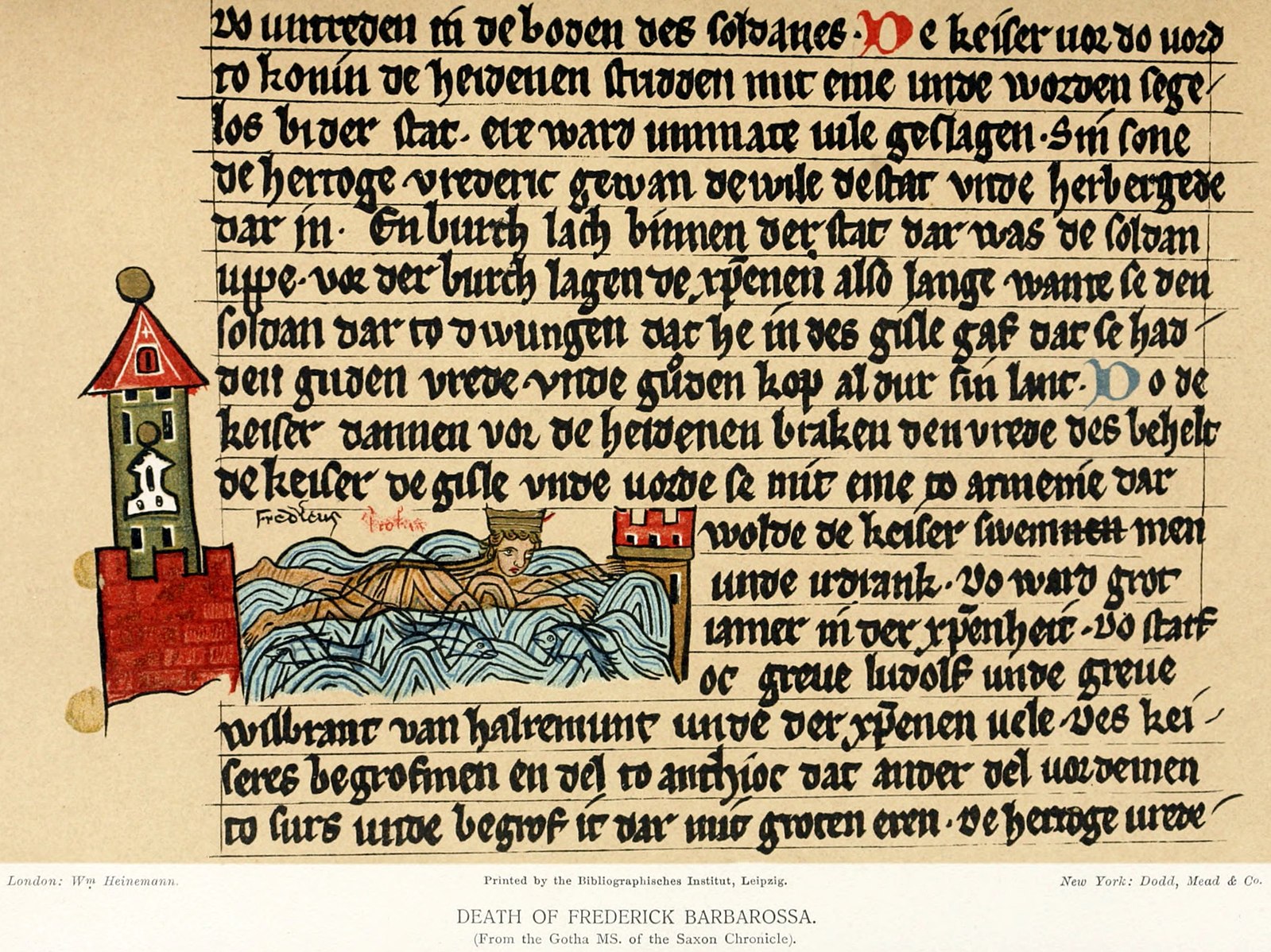
Accounts vary. A biography written within a few years of Frederick's death says he chose to swim the river—possible, but he was 68 years old at the time—and was swept away. A churchman who was with the Crusade says it was a simple swim to refresh himself, but the old man encountered an unexpected current (illustrated in a manuscript of the Saxon Chronicle above). Another says he was thrown from his horse and weighed down by his armor. A contemporary chronicler claims God saved them from an evil man by drowning him in shallow water while the emperor was washing himself.

Whatever the case, the body was subjected to mos Teutonicus, thousands of German soldiers abandoned the Crusade and went home, and Philip of France took the rest to the Holy land where he shared command of the Crusade with Richard I of England, with whom he was not on friendly terms.

Frederick's reputation was such that he is one of those characters who passed into legend, specifically that he is not dead but lies sleeping (like Arthur, with attendants) until such time as his country needs him, either in the Kyffhäuser Mountains in Thuringia or Untersberg. The signal for his revival will be the disappearance of ravens flying around the mountain. His red beard continues to grow, his eyes are only half-shut, and occasionally his hand raises, signaling a boy to go outside and see if the ravens are still flying.

Germany never lost its interest in Barbarossa. The Kyffhäuser Monument (also called Barbarossa Monument) was erected on the anniversary of Frederick's coronation in 1896 to commemorate him and Kaiser Wilhelm I, who was declared the reincarnation of Barbarossa. Hitler named his invasion of the Soviet Union "Operation Barbarossa," although originally called "Operation Otto" after Otto the Great.

These recent posts have, of course, told barely one percent of the extensive accomplishments of Barbarossa. Tomorrow I want to dip into one of his other actions: the revival of the Roman Justinian Code.

20 August 2021

Muslim Massacre

I have written about Muslim-Christian relations before (here and here). Conflict between the forces of Western European culture and the Arab world has been going on for centuries, with atrocities on both sides. One of the earliest atrocities was committed by King Richard I, called Lionheart.

Ayyadieh
After the fall of Acre during the Third Crusade, there was an agreement between Richard and his opponent, Saladin, to exchange prisoners.  Richard was willing to give up about 2700 hostages (men including soldiers, women, children) taken in Acre for 1600 Christian hostages held by Saladin. Richard also demanded 100,000 gold pieces and the True Cross.

Richard was an impatient man at best, and he wanted Saladin to release the Christian hostages first. Saladin, a powerful and proud man in his own right, of course demanded in turn that Richard release the citizens of Acre. Negotiations broke down. Richard decided to teach Saladin a lesson in delaying the fulfillment of Richard's demands.

On either August 16th or 20th, 1191, Richard had his captives to a hill called Ayyadieh, where they were in sight of Saladin's army. He had them all put to death. This enraged the watching army, who charged the Crusaders. Richard, however, had plenty of forces there, and they were able to retreat safely into the city.

An eyewitness Kurdish chronicler in Saladin's army, Baha ad-Din ibn Shaddad, claimed in his chronicle that many Crusaders did not approve of this particularly callous treatment of prisoners. Christian chroniclers do not mention that there were women and children, leading the reader to assume that only soldiers were massacred.

Saladin, outraged, and also know for harsh treatment of his hostages, had his Christian prisoners executed. The True Cross was sent to "Damascus, where it was said to be buried under the portals of the chief mosque." (The Dream and the Tomb: A History of the Crusades, by Robert Payne, p.239)

01 August 2012

Muslim-Christian Relations, Part 1 (of 2)

The Second Crusade (1145-49) had put a great deal of the Holy Land under European rule, but Saladin (Salah ad-Din Yusuf ibn Ayyub, 1138-1193) had re-conquered much of that territory, prompting several kings of Europe to agree to another crusade. The Third Crusade (1189-92) was unsuccessful in putting the Holy Land under Western European control. It did, however, open up a dialogue between the east and west in unforeseen ways.

The death of Henry II put the English troops under the command of Richard the Lionhearted. Richard loved military campaigns. His first stop was at Cyprus to conquer that island, after which he joined King Philip of France and Leopold V of Austria, who were embroiled in the two-year-long Siege of Acre. Richard's siege machines started destroying the walls. The residents of Acre sent appeals to Saladin to help them, but he could not defeat the Europeans. Acre had no choice but to surrender. Five weeks after Richard's arrival, the Europeans took the city, and banners were raised over the city representing the Kingdoms of Jerusalem, France, England, and the Duchy of Austria.

Richard may have been a great commander, but he was a terrible co-commander. The three lords fought over the disbursement of the spoils of war. Richard argued against the other two over whom should be left as King of Jerusalem; Richard prevailed. Richard also refused to accord Leopold the same respect as a king, and took down Austria's banner. In August, Philip and Leopold had had enough: they went back home, leaving 10,000 French troops with Richard's army.

Richard alone was left to deal with Saladin and establish a treaty after Acre. Payments of money and the transfer of Muslim and Christian prisoners were arranged. Richard did not like the slowness of the payments, and the fact that he wanted more Christians handed over faster. He had 2700 Muslim men, women and children of Acre killed outside the walls. Saladin, not to be outdone, killed all the Christians in his possession.

But the relationship between these two commanders was going to take an odd turn.

[to be continued]