Showing posts with label Adam Marsh. Show all posts

12 May 2026

Eleanor the Queen

A queen can have several duties, one of which is to produce heirs that can either succeed their parents or be used to make politically advantageous marriages. Eleanor of Provence was one of four sisters each of whom became a queen. Eleanor was married to King Henry III of England, and exercised a great deal of influence in England, even if she was disliked by the citizens of London.

Her relationship with Henry was very strong, and he did his best to care for his young wife (they were married when she was not yet a teenager and he was 28). He embarked on a campaign of updating and decorating royal apartments. They had their own rooms, but he made sure they were next to each other. If the queen's apartments were in a separate building or other part of the palace, he made sure the distance between them had covered walkways so she could visit his apartments in comfort.

The two often appeared in public in matching outfits, and Henry made sure her residences had furniture and trappings equal to his. For the wedding of their daughter, Margaret, to King Alexander III of Scotland, they wore matching cloth of gold.

Eleanor also matched her husband in religious devotion. Henry had a special love of King Edward the Confessor, and instilled in Eleanor the same religious fervor. In 1250 she and Henry vowed to go on Crusade, and she vowed that after his death she would enter a nunnery.

She had close relationships with some of the greatest English minds of that era: Adam Marsh, Robert Grosseteste of London (the bishop, not the Oxford scholar), and royal physician and Bishop of Durham Nicholas Farnham.

Part of that religious devotion expressed itself in an act of anti-semitism shortly after Henry died. Henry had created in 1232 the Domus Conversorum ("House of Converts") in the west of London, a place where Jews who converted to Christianity would be housed, fed, given a stipend, and instructed in their new faith and made to pray for the king, his ancestors, and his descendants. Henry died in 1272, succeeded by his eldest son, Edward. In 1275 Eleanor sought, and received, permission from King Edward I to expel Jews from the lands given to her, in Marlborough, Gloucester (told to go to Bristol, but choosing Hereford since Bristol was known to have plenty of anti-semitism), Worcester (told to go to Hereford), and Cambridge (told to flee to Norwich).

Edward was raised by his mother to be hostile to Jews, and used the crime of coin-clipping as an excuse to punish them. This was a prelude to 1290, when Edward expelled all Jews from England.

Eleanor retired after Henry's death to Amesbury Priory, where two of her granddaughters were already nuns. She died in June 1291 and was buried at the Priory in a location that is now unknown—the only English queen whose grave is unmarked (except for her heart, which was buried at the Franciscan priory Greyfriars in London).

Of her children, Edward became king, Margaret became queen of Scotland, Beatrice became Duchess of Brittany, and Edmund became Earl of Leicester and Lancaster. Edmund had a nickname, "Crouchback," which sounds like something worth discussing. See you tomorrow.

20 February 2022

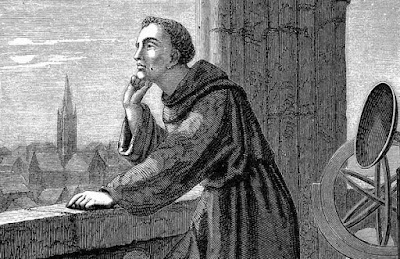
Roger Bacon's "Opus Majus"

Roger Bacon was born about 1219 into a wealthy family in England. He attended classes at Oxford University, where he learned a love of science from masters such as Robert Grosseteste and Adam Marsh. About 1240 he joined the Franciscans, which might have stifled his interests. There was a prohibition on the order against publishing without special permission from the superiors. This was in place because of a work published previously that was considered heretical.

Bacon looked for support and patronage from the papal legate to England, telling him that educational reform was needed. This was one Gui Foucois, although in England he was known as Cardinal Guy de Foulques. The cardinal was not interested in providing financial aid, but was interested in his work and ideas. Unfortunately, without money, Bacon could not afford the writing materials and scientific equipment to produce what he wanted to send.

Then, in 1265, the situation changed. Guy de Foulques was elected Pope Clement IV. Another request to the new pope returned the same result: Clement wanted the information, but would not send money. Bacon could only assemble a shorter work than he wanted to. The result was the Opus Majus or Opus Maius (Latin: "Greater Work"). Its seven sections (which included some of his earlier writings along with new materials) are:

•The Four General Causes of Human Ignorance (believing in an unreliable source,  sticking to custom, ignorance shared by others, pretending to knowledge)
•The Affinity of Philosophy with Theology (concludes that Holy Scripture is the foundation of all sciences)
•On the Usefulness of Grammar (a study of Latin, Greek, Hebrew, Arabic)
•The Usefulness of Mathematics in Physics (in this section he proposes changes to fix the Julian calendar)
•On the Science of Perspective (the anatomy of the eye and brain; light, vision, reflection and refraction, etc.)
•On Experimental Knowledge (a review of alchemy, gunpowder, and hypothesizes microscopes, telescopes, eyeglasses, machines that fly, and ships driven be steam)
•A Philosophy of Morality (philosophy and ethics)

It was sent to Clement in late 1267 or early 1268; however, Clement died in 1268. We do not know if he even had opportunity to read what he had requested.

"The Science of Perspective" was about optics. In that section, he discussed the anatomy of the eye, and how light is affected by distance, reflection and refraction. He also goes into mirrors and lenses. Most of this knowledge of optics came from Alhazen's Book of Optics, previously discussed here, and Robert Grosseteste's work on optics based on Al-Kindi, of whom I have never written before; I think there's my next topic.

For more on Bacon, use the search feature in the blog.