Showing posts with label London. Show all posts

30 July 2026

Criminal Northampton

After the populist mayor of London John Northampton was defeated in the election of 1383 by Nicholas Brembre, Brembre worked to overturn all of Northampton's efforts to help the common people. When Northampton led a large group to protest the return to the status quo, he was arrested and imprisoned in Brembre's house.

The charge was sedition, for speaking against the established order. Northampton and two confederates, John More and Richard Norbury, were tried and found guilty. One of Northampton's servants during his term as mayor, Thomas Usk, turned informant on Northampton.

Northampton appealed to John of Gaunt, but received no support. A death sentence for the three men was commuted to 10 years in prison. To prevent any kind of collusion between them, they were sent to separate facilities, all at least 100 leagues (1 league = 3 miles) outside of London. Northampton wound up at Tintagel.

Northampton only served a couple years: he was pardoned by Richard II (Richard had supported Northampton when running for his first term as mayor, but did not support him against Brembre), but not allowed to return to London.

Then came the Merciless Parliament in 1388, which (among other things) led to the execution of Brembre and Thomas Usk. In 1395 Northampton's London citizenship was restored. The end of his life was comfortable: at his death he left property worth £5000. He was a benefactor of the Charterhouse monastery, a Carthusian establishment. He died in 1398 and was buried in the church of the Hospital of St Mary de Elsyngspital in London.

Who was Thomas Usk, the man who informed on Northampton? He was a minor civil servant, but also a poet, writing a work that was once assumed to have been by Chaucer. I'll tell you more about this minor poet tomorrow.

29 July 2026

Nicholas Brembre

Proving that "what goes around comes around"—although we should probably just allude to the medieval concept of the Wheel of Fortune—one-time Nicholas Brembre, who had persecuted former mayor John Northampton, would himself be persecuted by the Merciless Parliament, mentioned here.

Brembre started as a member of the Grocers' Company, one of the Great Twelve Liveries in London, and made a lot of money in the wool trade. Like many other important and active male citizens, he was an alderman, a sheriff, and became mayor (for four terms). 

His origins are unknown, but he married the daughter of a wealthy vintner, and became the guardian of his father-in-law's youngest daughter upon the elder man's death. Brembre owned property in London, including "two large houses and several blocks of shops, four cellars, eleven chambers, two stables, a wharf, and a crane" [source] His many connections to other important guild members and his dominance in the wool trade made him very wealthy and very important to the city. The Comptroller of Customs at the time was Geoffrey Chaucer, who would have overseen Brembre's accounts.

His first term as mayor was in 1377. John of Gaunt had proposed a bill that the mayor of London be replaced with someone appointed by the king. This caused great unrest in London, and riots. The mayor, Adam Staple, was deposed, and the city put Brembre forward as a candidate that Gaunt might approve. That turned into Brembre's first term as mayor. He was succeeded by William Walworth in 1381, but Walworth was succeeded by Northampton.

Brembre defeated John Northampton for mayor in 1383.

Northampton had challenged the established order and made helping the common people his goal. At a time when the merchant guilds were some of the most powerful political as well as economic influences, Northampton broke up their monopolies, which made the guild leaders (like Brembre) his enemies.

Brembre's return to the office meant overturning Northampton's reforms and restoring monopolies. Northampton led a large protest against the changes brought about by Brembre, an assembly of about 500 people marching through the city. Brembre and his people confronted them, and Northampton was told to accompany Brembre. Northampton refused, and was arrested for sedition and imprisoned in Brembre's house.

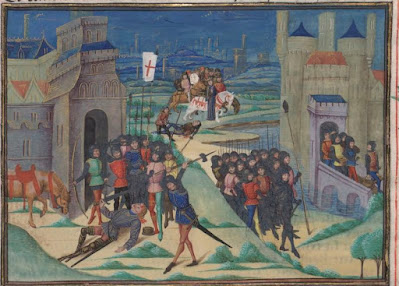
Northampton's friend John Constantine organized a general strike: several shops closed in protest of Brembre's policies. Brembre had Constantine executed for insurrection. (The illustration is Brembre's petition to the Crown in April 1384 to have his decision about Constantine's fate ratified.)

As for Northampton, we'll follow up on his fate next time with a third installment on the man who tried to help his fellow man against the power of the wealthy.

28 July 2026

Mayor Northampton

Despite his past as a troublemaker being involved in public brawls, even being imprisoned in the Tower for a time because of one in 1371, John Northampton became an Alderman for the Cordwainer Ward in 1375 to 1377, and was a member of Common in 1376 during the Good Parliament, helping to impeach Richard Lyons. In 1376 he also became one of the two annually elected sheriffs of London.

Then he became Mayor of London in 1381 for two years. He was a populist at a time when the common people felt they were being neglected and taken advantage of by the ruling class and the wealthy. John's term was distinguished by attempts to help the citizens. He opposed monopolies in the selling of fish, bread, ale, wine, and poultry, allowing tradesmen from outside the city to compete with London merchants.

He also made a decision directly affecting currency. He had £80 minted as 76,000 farthings. A farthing was a quarter of a penny (discontinued in 1961). He insisted that bread be sold in measures that allowed a person to buy an amount of bread for a single farthing. This was a huge boon to those at the bottom rung of the economic ladder. Tradesmen were ordered to accept farthings as payment.

He also made ordinances against fraud and deceit in business; see recent posts here and here for examples of his administration punishing fraud and unfair business practices. He also made laws against prostitution.

Unfortunately, populist policies are difficult to maintain in a monarchy, even after the enormous movement in 1381 that we call the Peasants' Revolt. In the mayoral election of 1383, John Northampton was replaced by Nicholas Brembre, who was an ally of King Richard II, the boy king who had survived and suppressed the Peasants' Revolt.

Brembre had Northampton arrested for sedition, that is, speaking out against the established order of things. Northampton was accused of provoking an insurrection.

Before we go on and see Northampton's fate, I want to talk about Brembre, who was a very influential figure in London. See you next time.

(In lieu of any available pictures of John Northampton, the illustration is of one of the most famous mayors of London, Dick Whittington.)

24 July 2026

Criminal Cases, Part 2

Sometimes the "punishment" was more of a restriction. Take the case of Thomas Welford, who sold salted herring. He had a ship docked at Queenshithe filled with salted herring. He was a wholesaler, and sold to retailers called "hucksters"; in this case he sold them 5 herrings for a penny.

The hucksters would then sell 4 herrings for a penny, but this did not give them very much profit. They complained to the mayor and aldermen that Welford's price was too high. Welford claimed that he could not afford to sell at a lower price.

It turned out, however, that he had sold 600 herrings at the rate of 10 to a penny. The buyer, William Botild, was brought forward and admitted that he had paid that price. Welford was forced to sell 9 for a penny, so that the hucksters could then sell 5 for a penny and receive a decent profit. This was applied to all herring sales in the city of London at the time (1382).

Speaking of fishmongers, five days after the previous case, the mayor and aldermen decided to make a more sweeping statement on the selling of fish. lamenting that many people ignore the ordinances of the City of London "as to the buying and selling of fish."

A citizen by the name of Adam Carlelle had gone to where the fishmongers all ply their trade and had,

...in a haughty and spiteful manner, cursed the said strangers, saying aloud, in the hearing of all, that he did not care who heard it or knew of it, but that it was a great mockery and badly ordained, that such ribalds as those should be selling their fish within the City.

It was deemed that his behavior was an insult not only to the fishmongers but to the City Ordinances themselves. Adam was henceforth forbidden to hold any office in the City, or "wear any vestment of a suit belonging to any office." Violation of this would mean "losing his freedom of the same city, and of forfeiting all things which unto the city aforesaid in future he might lose or forfeit."

Regarding clothing, harlots were forbidden to wear hoods of fur or anything fancy, ordered by the mayor and aldermen.

Tomorrow we'll look at a few more decisions of the aldermen.

11 May 2026

Eleanor versus London

The citizens of London may have welcomed their new queen when she and Henry III rode to Westminster for the coronation after the wedding (1236) at Canterbury, but while they got to know her they found plenty of reasons to resent her presence.

For one thing (and this may not have been her fault exactly), she was accompanied by several retainers from the continent (called Savoyards from her mother's background, Beatrice of Savoy). Some of these became influential in Henry's administration. But Eleanor made deliberate moves that angered Londoners.

One was claiming the queen-gold. The Queen of England was allowed one-tenth of all the fines paid to the Crown. That wasn't enough for Eleanor, however: she started levying fines on Londoners for perceived infractions. This was one more straw on the camel's back for the barons to rebel in the Second Barons' War.

Eleanor and Henry seemed devoted, but there were troubles between them. He had gardens planted for her. He had her rooms in the palace painted with flowers. In 1252, however, they quarreled over a dispute between her followers from Savoy and Henry's Lusignan relatives from Poitou. Henry banished her from Court, took control of her properties in England, and stopped her collecting the queen-gold. The disagreement lasted only a fortnight, however, and Henry afterward trusted her even more than before, making her co-Regent (with his brother, Richard of Cornwall) when he traveled out of England.

During the recently discussed Second Barons' War, when the forces of Simon de Montfort invaded and occupied London (aided by the citizens), Eleanor and Henry were trapped in the Tower of London. Eleanor escaped, sailing down the Thames on a barge. The Londoners attacked her with stones and mud and rotten produce.

The Mayor of London, Thomas Fitzthomas, rescued her and took her to the home of the bishop of London, Richard of Gravesend. She eventually made it to France and raised a fleet to go back, but the fleet was wrecked off Flanders in a storm.

Despite her reciprocated antipathy with London, she was successful at the other functions of a queen. We'll talk about the duties of a medieval queen through Eleanor's example next time.

23 February 2023

The Mayor's Cat

Dick Whittington (c.1354 - 1423) passed into popular literature because of a story about him and his cat. It was actually about 150 years after he was around that his name started to be used for a rags-to-riches story. As the story grew and was embellished, different versions were created, but the popular elements were as follows:

A poor orphan, Dick Whittington (the real Whittington was the son. of a Gloucestershire knight), seeks his fortune in London. Falling asleep on a stoop of a wealthy family, he is given a place to sleep and work as a scullion, cleaning the kitchen. He lives in a rat-infested garret, which is made safe because he has a cat (which he bought for a penny that he earned from shining shoes). Eventually, glad of a room but resentful that he is not paid money for his work, he leaves the house. During his journey, he hears the "London Bells" ringing, and they seem to be telling him to "Turn again, Whittington" and tell him he will become mayor. He returns to the house. At the spot where he heard the bells, the foot of Highgate Hill, is a monument to his cat (see illustration).

Skipping over a bit (a great deal, actually), there is a situation overrun by rats and mice. Dick's cat turns out to be exemplary at dealing with the rodent problem, and he is subsequently offered a great deal of money for the cat. Whittington becomes rich, marries his master's daughter (Alice Fitzwarren, which was the name of the real Whittington's wife), joins his new father-in-law in business, and is later elected mayor of London three times. (He was actually mayor four times, but once was when the king appointed him.)

The folk tale of a man with a useful cat is not unique to England. Two Italian versions are known. A German version is known from the 13th century. A 14th century Persian chronicle tells the same story of a widow's son who made his fortune because of his cat's hunting ability. Although the motif is found much earlier than the English version, the Aarne-Thompson classification system calls it the "Whittington's cat" motif.

Just as today, cats are everywhere, and had both good and bad reputations, which we will study next time.

20 February 2023

The Great Twelve

Of all the livery companies in medieval London, 12 were considered the most important and influential. They were collectively referred to as the Great Twelve Livery Companies of the City of London. Which were considered the most important?

1. The Mercers: the word is related to "merchandise" and was a collection of all the shopkeepers of non-edible goods, a wide-ranging group!

2. The Grocers: they started early as the Guild of Pepperers, responsible for dealing in spices, but changed over time to represent more edibles. They were also charged with maintaining the official standards of weights and measures.

3. The Drapers: they regulated wool (and other) cloth in the City. The wool trade was enormously important to England's finances.

4. The Fishmongers: got their first royal charter from Edward I in 1272. Thanks to the Thames, fish was a popular staple.

5. The Goldsmiths: regulated the quality of gold and silver, crucial for coinage and trade. Gold and silver goods needed to be brought to their hall (currently on Foster Lane) for assay and approval, and marked legitimate; hence the term "hallmark." They were also responsible for checking quality of the output of the Royal Mint.

6 & 7. The Merchant Taylors & the Skinners:

8. The Haberdashers: besides hats, they sold caps, gloves, pins, and ribbons. They did not get a royal charter until 1448.

9. The Salters: salt could make a man rich. Not only used in cooking, it was part of the process for cleaning, bleaching, and degreasing leather. Salt was used for dying fabric. This group was expert in salting meat and fish.

10. The Ironmongers: they regulated the quality of iron which was necessary for use in wheels and other items.

11. The Vintners: they controlled the import of wine, which accounted for one-third of all imports in the 14th century! Today they still retain the right to sell wine besides (as with most other livery companies) doing charitable work.

12. The Clothworkers: in 1528, the Fullers (who prepared cloth by removing impurities like grease nd dirt) and the Shearmen (finishers who made sure the surface of the cloth was smooth) merged to become the Clothworker's Company.

But what was the deal with positions 6 and 7? Was it a tie for most important? Not quite: they agreed to take turns about who had precedence over the other. For those details, you'll have to come back for the next post.

01 March 2022

The Inns of Court

To my surprise, I have used "law" or "laws" (should really get around to combining them) as keywords in 43 posts (out of nearly 800), but have never mentioned the Inns of Court, where civil law was learned.

In the early Middle Ages, law was taught by the clergy, but Pope Honorius III in 1218 forbade the clergy to practice civil law. Then, in 1234, Henry III forbade law schools within the London city limits. Laymen interested in teaching law moved outside London and looked for buildings or collections of buildings to buy or rent, and the guilds in which they worked evolved into the Inns of Court. Four Inns exist: The Honorable Societies of Lincoln's Inn, the Inner Temple, the Middle Temple, and Gray's Inn. They truly were inns, because students lived as well as learned there. They are all near each other.

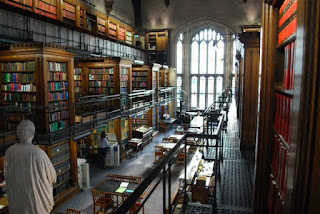
Although Lincoln's Inn claims the earliest records going back to 1422 (incidentally, the picture above is the Lincoln's Inn library) we know that lawyers lived in the Temple as early as 1320, though not as teachers. In 1337 the place was divided into the Inner Temple, and the Middle Temple (as distinct from an Outer Temple that existed). By 1388 they were two distinct groups. In 1620, a meeting of senior judges decreed that all four were considered equal in order of precedence, regardless of when they may have been founded.

Like the seven subjects of the University curriculum, law students were expected to spend seven years learning the law, mostly by attending court and asking questions afterward. Their experience included dining communally with practicing barristers for networking and additional knowledge. It wasn't until the mid-18th century that common law became. subject for study in universities.

The Inns of Court recognized three levels: student (learning law), barrister (practicing law), and master of the bench (called "bencher"). Benchers were senior members of the Inns, and could be appointed by existing benchers when still a barrister. An appointed High Court Judge was automatically a bencher. Benchers were the governing body of their respective Inn. Their duties were to admit students, "graduate" students, and appoint other benchers. One bencher was appointed Treasurer for a term on one year.

But I know the question nagging at you is "Why were they called the Inner and Middle Temple?" You either know why, and are wondering if I'll address the subject, or don't know why, and are hoping I'll answer your question. Good news for both: I'll answer the question tomorrow.

If you are curious what the seven subjects were, you can find a list in this post, or you can learn more about them (and much more) here.

07 February 2022

The Peasants Are Revolting!

The Peasant's Revolt of 1381 was the result of several factors , first enumerated and named in A Short History of the English People (John Richard Green, 1874), and analyzed endlessly since. (You can find several posts I've made on this here.) Distrust of government, belief in corruption of royal officials, anxiety over the French raiding southern England, and a poll tax of 12 pence per adult—the third in four years—made the average rural citizen say "Enough!"

The first signs of rebellion came when collectors of the poll tax were attacked in spring. This was followed by more resistance by attacking justices in Essex in May, and then a June uprising in Essex promised to rebel against all the king's laws. People started burning property, and an escheator (official in charge of claiming property for the Crown when, for instance, the previous owner died intestate) was beheaded and his records burned. Elsewhere, houses of officials and official records were being destroyed.

A leader appeared in the records, one Wat Tyler, who led the rioters into Canterbury, executing officials and freeing prisoners, after which they approached London. The group was joined by a radical priest, John Ball, southeast of London. Meanwhile London was experiencing a sympathetic uprising of citizens who burned the grandest house in London, the Savoy Palace, and the main building of the Hospitallers.

The rebels outside London entered, invading the Tower of London. They captured and beheaded the Archbishop of Canterbury, Simon Sudbury, and others.

See my other posts for more detail, but let me say that most of the rebels were given pardons once the destruction stopped, except for the individuals who were responsible for more grievous destruction and murder. A list of "principle leaders and traitors" includes Walter Tyler (who had been killed earlier by the Mayor of London), Alan Threader, William Hawk, and John Stakpull. We know very little about John, but what we know leads to an interesting conjecture. I'll tell you about that next time.

15 April 2019

Dick Whittington and His Cat

Dick Whittington buying his cat
A popular figure from English folk tales is Dick Whittington. He is based on Lord Mayor of London Richard Whittington (c.1354-1423), who started as a wealthy mercer, became a money-lender who helped the King, was elected to several positions, and donated a great deal of money to good causes.

More than 150 years after his time, his name started getting used for ballads, a play, and numerous stories of the "rags to riches" variety. There are different versions of his story, but we can present the main elements:

A poor orphan, Dick Whittington, seeks his fortune in London. Falling asleep on a stoop of a wealthy family, he is given a place to sleep and work as a scullion, cleaning the kitchen. He lives in a rat-infested garret, which is made safe because he has a cat (which he bought for a penny that he earned from shining shoes). Eventually, glad of a room but resentful that he is not paid money for his work, he leaves the house. During his journey, he hears the "London Bells" ringing, and they seem to be telling him to "Turn again, Whittington" and tell him he will become mayor. He returns to the house.

Skipping over a bit (a great deal, actually), there is a situation overrun by rats and mice. Dick's cat turns out to be exemplary at dealing with the rodent problem, and he is subsequently offered a great deal of money for the cat. Whittington becomes rich, marries his master's daughter (Alice Fitzwarren, which was the name of the real Whittington's wife), joins his new father-in-law in business, and is later elected mayor of London three times. (He was actually mayor four times, but once was when the king appointed him.)

The folk tale of a man with a useful cat is not unique to England. Two Italian versions are known. A German version is known from the 13th century. A 14th century Persian chronicle tells the same story of a widow's son who made his fortune because of his cat's hunting ability. Although the motif is found much earlier than the English version, the Aarne-Thompson classification system calls it the "Whittington's cat" motif.

12 April 2019

Mayor Richard Whittington

One of the most prominent mayors of the City of London in the Middle Ages (and perhaps of all other eras) was Richard Whittington. He was born sometime in the 1350s into a well-to-do family, but as a younger son would not have expected to inherit anything substantial; he was therefore sent to London to learn to be a mercer (a merchant who deals in cloth). Fortunately, he was good at the trade, and by 1388 he was selling to the royal court. He used his growing wealth to become a moneylender, rather than buy property. This ingratiated him to many prominent people; King Richard II was borrowing from him in 1397.

By that time he had been a councilman, an alderman, and a sheriff as well as a powerful member of the Mercers' Company. In 1397, Mayor Adam Bamme died. London and the King were in the middle of a serious dispute: asserting mismanagement, King Richard had appropriated London's real estate. Richard forced London to accept Whittington as mayor. Richard owed Whittington money, and could simply default on the loan. If Whittington wanted his money, he would work with Richard to resolve the dispute. Within days, they struck a deal by which London would receive back all its real estate and right to self-government in exchange for £10,000. That was in June; in October, the citizens elected Whittington mayor in his own right.

In all, he was elected mayor 4 times (though not consecutively). When Richard II was deposed in 1399, Whittington's situation did not suffer: he also had business dealings with Bolingbroke, now King Henry IV, and so he remained on good terms with the (new) King. He also loaned large sums to Henry V, and continued to be successful, as a member of parliament representing London, and even as a judge in usury trials in 1421! Henry V also appointed him supervisor of the funds for rebuilding Westminster Abbey.

He was a magnanimous figure. Money from him helped to rebuild the Guildhall (used as town hall for centuries). He financed drainage systems for parts of London, a ward for unmarried mothers at a hospital, the rebuilding of his ward's church, and "Whittington's Longhouse," a public toilet that seated 128 and was situated so that high tide in the River Thames would flush it out. His will left £7000 to rebuild Newgate Prison, repair St. Bartholomew's Hospital, install public drinking fountains, and more.

Historians know him well, but schoolchildren in England know the name for things he never did, and we will look at that next.

11 April 2019

John Carpenter's White Book

The Liber Albus or White Book was the first compilation of the laws of the City of London. It was assembled in 1419 by one John Carpenter, the Town Clerk of London, with whom it is so closely identified that a statue of Carpenter in the City of London School for Boys shows him holding the book!

The earliest firm date for Carpenter is 18 December 1378 when he was baptized in Hereford Cathedral. Later information says he was 45 in 1417, when he became Town Clerk of London, which would mean he was born about 1372. Records frequently list him as John Carpenter the younger, to distinguish him from two other men of that name who were active at that time. Oddly (to modern sensibilities), one of the other John Carpenters was his older brother, to whom he left much property when John the younger died in 1442.

The White Book was completed in 1419, the first time all of English Common Law (at least, as it pertained to the City of London) was compiled in a single document. A large part of it is given over to the regulation of the food trade and civic order. One scholar discusses how the document was put together with a specific agenda; Carpenter and the mayor who ordered the work were aiming to establish the City of London as the recipient of "ancient and sacrosanct privilege" not enjoyed by the rest of England. (This may have been partially because the King seized London's real estate in 1392, claiming that the City had been mismanaged.)

The mayor who ordered the work was Richard Whittington, one of the more prominent mayors of that century. If the name sounds vaguely familiar, you may be recalling the English folk tale Dick Whittington and His Cat. Yes, this is that Dick Whittington! And he—if you did not suspect already—deserves his own entry next.

10 April 2019

Local Government, Part 2

A modern Aleconner [link]
We know that, in medieval London, an alderman held an assembly called a Wardmote every other year, at which attendance by every male in the ward over a certain age (with some exceptions) was required. The purpose of these meetings was manifold.

One major occurrence was to administer the "Oath of Frankpledge"; this was an oath that imposed upon each attendee an obligation to civic duty. (Knights and some others were exempt, since they owed allegiance to different authority.) The oath:

You shall swear, that you shall be good and true unto the King of England and to his heirs, Kings, and the King's peace shall you keep; and to the officers of the City you shall be obedient, and at all times that should be needful, you shall be ready to help the officers in arresting misdoers, and those disobedient to the King's peace, as well denizens as strangers.  And you shall be ready, at the warnings of the Constables and Beadles, to make the watches and other charges for the safeguard of the peace, and all the points in this Wardmote shown, according to your power, you shall well and lawfully keep. And if you know any evil coven within the Ward of the City, you shall withstand the same or unto your Alderman make it known. So God you help, and the Saints.
Regarding the line "as well denizens as strangers": A "citizen" was a native; a "denizen" was a foreigner residing locally; a "stranger" was someone present without a fixed local address. The potentially disruptive behavior of strangers (who of course had no oath of obligation to the municipality) was a constant concern. Since visitors had to stay somewhere, innkeepers were made responsible for the actions of their temporary tenants. In 1384, in London, innkeepers were required to answer for the customers' actions if the customers stayed longer than a single day and night. A guest whose behavior required the attention of the authorities could cost the innkeeper a fine of £100.

After the oath came the elections. Various positions needed to be filled by the male citizens. The Beadle [Old English bydel: "a person who makes a proclamation] was responsible for disseminating information orally in a society without Twitter or newspapers. He was the first "social medium." Also elected for a two-year term were aleconners, whose enviable job was to test bread, ale, and beer for quality. Scavengers had the less enviable task of finding and removing trash from public spaces.

These practices helped to maintain order in a large city such as London, by dividing it up into Wards of a more manageable size and putting responsibility into the hands of people who were neighbors of those they policed and served. Although written laws and contracts were used at this time, the verbal contract of the frankpledge served to bind the men to their obligations. The frankpledge quoted above comes from the Liber Albus, the White Book. We should talk about that next.

09 April 2019

Local Government, Part 1

A village meeting.
What was the level of communication between the typical medieval citizen and the authorities? What role did the citizenry play in legislation?

Municipalities in the Middle Ages were much smaller than what we usually have now. Considering that 95% of the population was agrarian and needed land for sustainability, there might be only a few dozen families in a couple square miles, looking to each other for trade and the mutual benefit that comes from knowing all your neighbors. Everyone, or representatives of families, could easily spread the word to gather at the village square to discuss matters that applied to the entire community.

What happens in a town the size of London, however? Estimates for the middle of the 14th century (post-Plague) put London at 25,000 to no more than 50,000. How do you keep that large a population involved by "scaling up" the village model of meeting in the square?

Well, you break it down into villages, or rather, "wards."

London was divided into 24 wards, 12 on each side of the Walbrook. (The Walbrook is/was a river that flowed north to south and emptied into the Thames. It is one of the "lost rivers" of London. Yeah, I'll explain that some day.) A 25th was added in 1394 due to post-Plague growing population.

Each ward had an elected official, the alderman. Every other year, the alderman was required to hold a "ward mote" (from the Anglo-Saxon moot = assembly) of the residents of the ward. Well, not all residents. Everyone over the age of 15 was required to attend, including servants. Unless you were a woman (your husband or father would represent you), or a knight (your allegiance was to the king, not the ward), or his squire (you do what your knight tells you), or a clerk (university students were not yet trusted to be useful members of society), or an apprentice (the master you were apprenticed to would handle it, thanks).

For convenience, meetings were held in the principal church in the ward. A beadle would call the roll—two rolls, actually, to separate freemen from servants—to make sure everyone was there who was required. Those absent were fined four pence.

What was on the agenda? We will look at that next.

08 April 2019

Population Density

In the Middle Ages, how many people lived in how much space? An economist who writes about cotton, migration and other topics (and has written a piece on why Westeros has gone millennia without an Industrial Revolution) has compiled data on what we know about populations in medieval countries and tried to produce estimates of population density.

The first point he makes is that sustainable population in 800CE is not the same as that of 1000 or 1300. Conditions change all the time in a society that does not have control over disease or natural disaster. He cites a widespread previous figure of 30-120 people per square mile and rejects it. Taking the total area of a country and our best knowledge of that country's population, the math works out to far fewer people.

Therefore, he offers figures such as France with about 68/square mile in 1300, Italy with between 60 and 95 folk per square mile, England and Wales with 11-30, Scotland with somewhere between 4 and 8, and Sweden and Norway with 1-4. This, of course, neglects wide swaths of a country that might be uninhabitable.

Also, what about the tendency of people to cluster together for mutual benefit? Well, in the many villages that dot the land, populations of a few hundred dominate. In fact, it looks like self-sufficiency in a typical medieval village averages about 300 people. (Incidentally, this is the same figure a 2010 government study determined the average person has in the "personal network": the number of people you know well enough to say you "know" them. link) Also, a country that is 95% agrarian needs space for crops and livestock, and so population density is still fairly low.

But what about urbanization? Let's look at London.

Best estimates for London in 1000 CE are 5000-10,000; three centuries later it is ten times that number. That changes radically because of the Plague, however, and in 1350 the population has dropped by half, say 25,000-50,000. This presents enormous challenges for governance. How do legislative decisions get made and disseminated when you cannot get the whole village in one place?

We will look at that next time.

17 November 2015

The Myth of Bad Water

One of the things that "everyone knows" about the Middle Ages is that there was no clean water to be had, and so they drank beer and wine all the time.

Of course, many people preferred ale or wine or some other drink (like cider). One of the reasons modern people might think that the Middle Ages did not drink water is because it is rarely mentioned in literature. Instead, references to wine and ale are frequently found. But who bothers mentioning drinking water, when it is so plentiful and common. In a pre-industrial age, sources of clean fresh water were numerous: they drank it, cooked with it, washed things with it. Medical advice included when to drink water, and that cool water was better, although some doctors warned about drinking too much, too fast. One source believed that drinking water during a meal retards digestion.

Still, the clear benefits of drinking water were known. Lupus Servatus was a 9th century Benedictine monk and a prolific writer. One of his bits of advice was:
Let us make use of a healthy, natural drink which will sometimes be of benefit to both body and soul – if it is drawn not from a muddy cistern but from a clear well or the current of a transparent brook.
Servatus' line shows that they understood how to choose good drinking water. The abbot Ælfric of Eynsham stated his drink preferences: "Ale if I have any, or water, if I have no ale."

The need for fresh water was so well understood that cities made it a point to secure sources. Thirteenth-century London established a system called The Conduit that brought fresh water to the center of London. They expanded this as the city grew. Messing with water could be illegal: an 8th century Bavarian law made fouling a public source of water punishable by a fine and being made to clean it up thoroughly.

Clean water was plentiful and much appreciated in the Middle Ages.

10 September 2014

Two Men and a Car

Redvers Coat of Arms
William de Redvers, 5th Earl of Devon, died 10 September 1217; he was born sometime before 1146, (the year his mother died). His coat of arms was a lion rampant (facing left). At Richard Lionheart's coronation, four earls supported the canopy under which he walked in the procession. William was one of the canopy bearers. Prior to Richard's accession, William was loyal to King John.

Falkes de Breauté, with no particular aristocratic standing (he is rumored to have been illegitimate), died in 1226. His coat of arms was a griffin. He, too, had been loyal to King John. Falkes rose to prominence during the First Barons War when John faced a revolt from his barons. Falkes was prominent in many military engagements on behalf of John.

With their loyalty to King John (at a time when he needed men faithful to him), these two men probably crossed paths more than once. At least one of those times, however, was not in a good way.

William had a son, Baldwin, who would become the 6th Earl of Devon after William's death. Baldwin married Margaret Fitzgerald, the daughter of King John's chamberlain. Baldwin and Margaret had a son, also named Baldwin. Sadly, the elder Baldwin died on 1 September 1216.

Evolution of Vauxhall griffin
Falkes, with no title or fortune to his name, took it upon himself to improve his standing by kidnapping the widowed Margaret and forcing a marriage. William objected, but John approved, choosing to reward Falkes for exemplary service. Falkes received not only Margaret's dowry from her father, but also, when William died in 1217, the estates connected to the Devon title, since he was now regent for the younger Baldwin, who became the 6th Earl of Devon.

Part of Margaret's dowry was an area in London dominated by a manor which, because of her new husband, became known as Falkes' Hall. The name morphed through the years once the original reason for the name faded into history, first becoming "Foxhall" and later "Vauxhall." In 1857, a Scottish engineer founded a company in Vauxhall which later became the Vauxhall Iron Works and then, in 1907, the Vauxhall Motor Company. This company used, as its logo, the griffin of Falkes de Breauté.

So...if Falkes had not kidnapped William's daughter-in-law, the area in London known as Vauxhall would not have been given that name; moreover, whatever name it did get, the logo of an automobile company coated there might have been a lion rampant, which might have caused problems for the French Peugeot line of automobiles.

10 November 2012

The Anarchy, Part 2 (of 3)

In 1135, upon the death of Henry I of England, his nephew Stephen of Blois (c.1192-1154) assumed the throne. All well and good, except that Stephen (and the top men of the country) had sworn an oath years earlier to uphold Henry's choice of his daughter Matilda as heir. Stephen's argument was that his oaths were not as important as a quick and successful transition. His opportunity came because Matilda was across the Channel and Stephen was able to travel faster than she—also, he was supported by many of the barons and Stephen's powerful younger brother, Bishop of Winchester Henry of Blois.

Stephen was crowned on 26 December. Shortly after, he had to go north to deal with Scotland. David I of Scotland (1084-1153) was laying claim to lands in the north of England, and Stephen dealt with this quickly and decisively. His court at Easter was lavish and well attended by the nobles of England. Stephen's position had been confirmed by Pope Innocent II. Later conflicts with Wales turned to victories for Stephen. All looked well.

Meanwhile, on the continent, Matilda and her husband, Geoffrey of Anjou, were taking control of the lands that had been joined to England since William the Conqueror—the mutual grandfather to many of the players in this drama. By 1144, Geoffrey and Matilda were styling themselves Duke and Duchess of Normandy. By 1139, she had gathered sufficient armed forces in France to be able to cross the English Channel and begin the conquest of southwest England. In February 1141, Stephen's forces besieged Matilda in Lincoln Castle; unfortunately, Matilda's illegitimate half-brother, Robert, 1st Earl of Gloucester, brought up his forces behind the king. Robert was aided by the Stephen-hating Welsh. Many of Stephen's forces deserted him, and the king was captured and imprisoned in Bristol, a city currently in the hands of Matilda's forces.

Matilda escaping Oxford
Matilda made a procession to London, sending word ahead that the "Lady of the English" (so she was calling herself) was coming to be made Queen, as was her right. Once she took up residence, emissaries from the city suggested what was probably her surest way to gain their hearts: cut their taxes in half. When she refused to do so, the citizens waited until she had left the city, and then shut the gates of London against her.

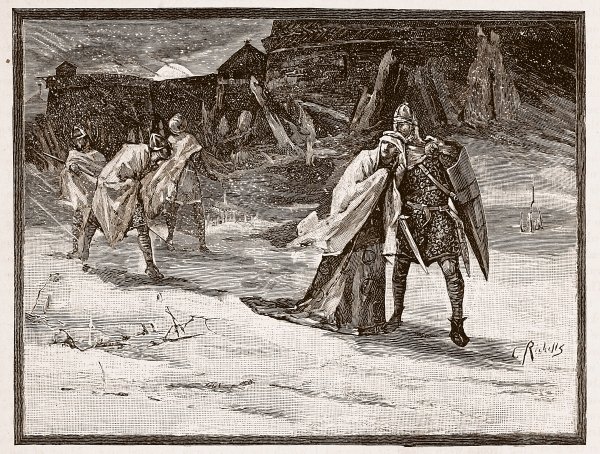
Meanwhile, the imprisoned Stephen's wife, also named Matilda, succeeded in capturing Robert of Gloucester, and used him to arrange an exchange of prisoners. With the release of both Stephen of Blois and Robert, hostilities resumed. The following winter, Queen Matilda was almost captured at Oxford, but she fled across the frozen Thames, camouflaged against the snow in a white cloak. The future of England's throne was looking more uncertain than ever.

[to be continued]

22 September 2012

Jews in London

One street is all that remains of the Jewry
Jews had followed William the Conqueror to England* and established a significant presence in London in an area still called Old Jewry. Their business and money-lending practices were efficient, such that their homes were made of sturdy stone more often than their Gentile neighbors' houses. William II (1087-1100) seems to have been tolerant of the Jews; Henry II (fl.1154-1189) as well. Life in London was considered amenable enough to Jews that the well-known Rabbi Abraham ibn Ezra visited London, where in 1158 he wrote his Iggeret ha-Shabbat (Epistle on the Sabbath), which can still be found in print today.
Of course, life was never "good" for the Jews in medieval Europe. In England, for instance, there were laws designed to harass the Jews, like that which required every Jew who died in England to be buried at a special cemetery set up at Cripplegate in London—which forced every Jewish family to pay a fee for the burial.

King Henry III of England was first mentioned here in my second-ever blog post. In 1232 he established the Domus Conversorum (House of Converts), meant for Jews who converted to Christianity, giving up their possessions in exchange for a home and a daily stipend for food and necessities.

Henry was devout, certainly, but not always charitable. In the words of one scholar:
If Henry III, despite being constantly broke, managed to find enough money to keep work at [Westminster] Abbey in progress, that was partly because he was at least a devout enough Catholic to be able to rob the Jews with a good conscience. [A History of London, Robert Gray]
Henry, always in need of money, was fond of borrowing from the Jews and simply not paying them back. Jews were seen as being a tool for the King's pleasure, and the Barons and others resented the Crown's control over them. For the Coronation of Richard I Lionheart in Westminster Abbey, a Jewish group tried to crowd in the Abbey to show support and bring gifts for the new king. Their presence touched off riots. Londoners rushed to the Jewry and set fire to houses, killing those who tried to escape.

Thirty were reported killed. The conviction rate afterward: three. Two of those had accidentally torched a Christian home, and one had robbed a Christian home in the confusion.

*No evidence exists of a Jewish presence in England prior to 1066.

26 August 2012

The Tun

Current robes, Mayor of London.
Henry le Waleis (?-c.1302) was a prominent citizen of London who served as alderman in two different wards, was elected sheriff in 1270, and became mayor in 1273. Law enforcement seems to have been a serious consideration of his during his time in public office: in 1270 as sheriff he erected a new pillory for bakers who tried to cheat customers by selling underweight loaves of bread.

Waleis had several butcher and fishmonger stalls removed to make a better passageway for the king when he traveled in and out of London. These merchants were upset, and challenged the change with the former mayor, Walter Hervey, on their side. But when Hervey had strong words with Waleis, Waleis had Hervey arrested and imprisoned; he was tried and demoted from his position as alderman. To be fair, Waleis did have new buildings constructed in 1282 in a different part of London for the butchers and fishmongers.

In 1283, in the Cornhill area of London, he built a prison for the temporary incarceration of "night-walkers." Night-walkers were people found wandering the city after curfew. Night-watchmen would patrol the city, checking to make sure you had legitimate reasons for being outside at night. A servant who carried a message from his employer giving a reason for travel, and who carried a light (to prove he was not hiding his actions), would be allowed to go on his way. Someone with no light could be deemed "suspicious." Transgressors were held for the night and turned over to the mayor and aldermen in the morning. It was called "The Tun" because it resembled a tun or cask used for wine, stood on end and crenelated at the top..

Strangers and suspicious characters were an important issue for the mayor. Waleis made sure that the city gates had sergeants who were "fluent of speech" in order to question strangers to the city. He also arranged that parish churches would coordinate so that their bells rang curfew at the same time, whereupon gates and taverns were all to close.

An Ordinance of the city directed that bakers and millers found cheating their customers would be drawn (dragged) to the Tun. Waleis provided a wooden hurdle to which the malefactor would be strapped and then drawn through the streets for a touch of public humiliation before his incarceration. Also, if a priest were found with a woman, he would be drawn to the Tun with minstrels playing in order to draw even more attention to his misbehavior. (This practice was eventually eliminated. The Church convinced the King that the laity should not authority over the clergy.)