Showing posts with label Assassins. Show all posts

12 March 2026

Amalric and the Assassins

In 1173 King of Jerusalem Amalric I tried to make an alliance with the Order of Assassins. They were a sect of Shi'ite Islam whose goals were political as well as religious: they went after the Abbasid Caliphate as well as Christians. They had been subdued by the Templars and were forced into an annual tribute.

Amalric made them a deal: convert to Christianity, and you won't have to pay tribute to the Templars anymore. An envoy from the Order of Assassins to Amalric's court agreed to this. (Yes, hard to believe that this was a serious agreement on the part of the Order, since their entire identity was being faithful to their Shi'ite leader, the "Old Man of the Mountain" Rashid al-Din Sinan.)

Anyway, the envoy was returning from the negotiations when he was discovered by a patrol of Templars led by Walter of Mesnil. Despite being granted safe conduct by Amalric, the Templars killed him. William of Tyre and Walter Map both wrote about the incident, claiming it was a great loss of the chance to convert more Muslims to Christianity. (Walter Map suggested that the Templars did not want the Assassins to convert because it would make the Templars superfluous, but this imagines (quite wrongly) that there weren't plenty of non-Christians for the Templars to guard against and take tribute from.

Amalric was furious and demanded from the Templar master, Odo of Saint Armand, that Walter be turned over to him for punishment. Odo refused, saying that he had already given Walter penance to do and that Walter was being sent to the pope.

Amalric would have none of it. He went to where Walter was staying before heading to the pope and captured him, imprisoning him in Tyre.

On 15 May in 1174, Amalric's rival Nur ad-Din died. Amalric felt this was the best chance to (again) try to conquer Egypt. His first attack on a city there failed, but he accepted money to retreat. Heading back to Jerusalem, he fell ill. By the time he got to Jerusalem, it seemed clear that he had contracted dysentery. No treatment helped, and he died on 11 July. He left behind two daughters and a son, Baldwin, a sickly boy of 13 years. The illustration shows Amalric dying and the boy being crowned.

There were concerns about the young Baldwin IV. He did not seem to feel pain, which meant he was likely suffering from leprosy. In fact, I've talked about him as The Leper King, and that he was the only viable candidate, but he was fairly soon replaced by Baldwin V, his nephew through Sibylla of Jerusalem.

Since all that has been covered before, I want to turn to the mother of Baldwin V and sister of Baldwin IV, Sibylla of Jerusalem.

09 March 2022

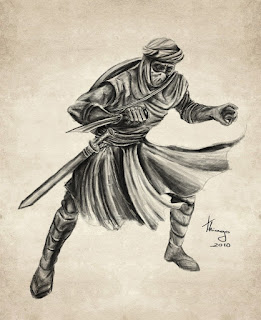
The Order of Assassins

We cannot talk about the Order of Assassins without talking about the word "assassin" and its origin, and you may be surprised to learn that 1) the origin is not what you've been told, and 2) I've already gone over this. In fact, the founder of the Order referred to his members as Asāsiyyūn (or أساسِيّون), "people who are faithful to the foundation [of the faith]." The hashish derivation was added later by Europeans who did not know the whole story.

With that out of the way, we can discuss their origin more calmly. They were originally called the Nizari Isma'ili State, founded by Hassan i-Sabbah. Sabbah (c.1050 - 12 June 1124) was a Twelver Shia, called thus (in English, anyway) because they believed in twelve divinely ordained imams who are the spiritual successors to Muhammad.

Sabbah was strongly Twelver, but later in life embraced the Isma'ili doctrine. The followers of Isma'ilis believed that Isma'il ibn Jafar was the proper spiritual successor to Imam Ja'far al-Sadiq; other Twelver Shia believed Isma'il's younger brother, Musa al-Kadhim, was the true Imam. Sabbah further made "different choices" in Cairo when he gave his support to Nizar, the son of Isma'ili Imam-Caliph al-Mustanṣir, as the next Imam. Sabbah was jailed by the chief of the army, but the collapse of one of the jail's minarets was taken as a sign to get rid of him: he was therefore deported. He wound up in Isfahan in 1081.

Sabbah decided he needed a stronghold where he could found the Nizar Isma'ili State, maintain his own safety, instruct others in his beliefs, and from which he could conduct his mission to spread the word of his specific beliefs. In 1090 he and his followers captured Alamut Castle, the first and greatest of the Nizari Isma'ili fortresses. From here he used his Order of Assassins to covertly eliminate leaders—first Muslim, later Christian as well—who stood in the way of spreading his version of Islam.

The way he conquered Alamut Castle, and the castle itself, deserve more than a passing glance. I'll tell you about it tomorrow.