Showing posts with label HREmperor Henry V. Show all posts

13 February 2026

Pope Honorius II

After his atypical election in December 1124, Pope Honorius II got to work clashing with Holy Roman Emperor Henry V over Henry's claim to territory in Italy. Henry said that Matilda of Tuscany had left her lands to him. Henry began appointing his own vicars throughout the area in opposition to what the papacy and the towns wanted, completely ignoring the terms of the Concordat of Worms that left investing clerics to the Church rather than secular authority.

Fortunately for the papacy, Henry V died on 23 May 1125, but a new conflict arose. Henry left no heir and nominated his nephew, Duke of Swabia Frederick Hohenstaufen as the next emperor. The papacy did not want an expansion of Hohenstaufen power, however.

The clerics chose another, Lothair of Supplinburg, Duke of Saxony, as the next Holy Roman Emperor. Lothair wrote to Honorius requesting the pope's confirmation, an act of obedience to papal authority that pleased Honorius. One of Lothair's advisors was Norbert of Xanten, founder of the Premonstratensian Order (also called Norbertines).

Honorius also had to deal with barons in southern Italy who were harassing farmers and travelers. The papal armies had to take over several towns to suppress and arrest barons, laying siege to their castles, etc. 

The illustration shows him formally accepting the new order called the Templars, in 1128. There were other religious groups and figures whom he felt needed correction, however, so he turned his attention from dealing with secular authorities to various religious figures and groups. I'll tell you about them tomorrow.

12 February 2026

The Election of Pope Honorius II

Lamberto Scannabecchi was born on 9 February 1060 in a rural community. He entered the priesthood and became the archdeacon of Bologna. He gained the attention of Pope Urban II who named him a cardinal in 1099. Urban's successor, Pope Paschal II, made Lamberto cardinal bishop of Ostia in 1117. (Cardinal bishops are senior members of the Church who advise the pope.)

When Pope Gelasius II was driven from Rome in 1118 by Holy Roman Emperor Henry V, Lamberto accompanied him and was even with Gelasius at his deathbed. Lamberto was part of the group that elected Pope Calixtus II, becoming his close advisor.

Lamberto was sent to Henry V as papal legate to argue against the emperor's right to the Investiture of prelates. The Concordat of Worms (see illustration) in 1122—the agreement between the Catholic Church and the Holy Roman Empire that bishops and abbots would be appointed by the Church and not the secular authority—owes its result to the efforts of Cardinal Lamberto.

Urban and Paschal had expanded the number of Italian cardinals. Calixtus (originally Guy of Burgundy) had also named several cardinals, mostly French and Burgundian. The two groups did not trust each other. Each group turned to Roman noble families for support.

The Italian cardinals found it with the Pierleoni family who had gained a reputation as protectors of the popes. Urban II had died in a Pierleoni manor. The northern group found support from the Frangipani family. Upon Calixtus' death (13 December 1124), the two families agreed that an election should happen in three days, which was canon law. The Frangipani wanted Lamberto as their candidate, but the local people wanted Theobaldo Boccapecci, the Cardinal-Priest of Sant'Anastasia.

The election took place, and the majority vote went to Theobaldo. He chose the name Celestine II, but just as he was donning the papal red mantle and Te deum was being sung to start his investiture, Frangipani supporters burst into the chamber, attacked and wounded Theobaldo, and declared Lamberto as Pope Honorius II.

Theobaldo was willing to resign, but the Pierleoni clan would not accept Lamberto as pope. Days of debate, fighting, and attempts to bribe supporters followed. Eventually the supporters of Celestine accepted his willingness to resign, leaving Lamberto as the only claimant.

Honorius, in what may have been a planned bit of theater to smooth things over with the city, resigned the position because of the inappropriate manner in which he became pope. He was immediately elected unanimously by the assembled cardinals and invested on 21 December 1124.

What kind of pope was he? We'll find out tomorrow.

10 October 2022

Empress Matilda

The previous post discussed how Stephen of Blois seized the throne of England in 1135 upon the death of King Henry I, despite having sworn an oath of loyalty to Henry's daughter, Matilda. Coincidentally, usurpation was how Henry gained the throne, too.

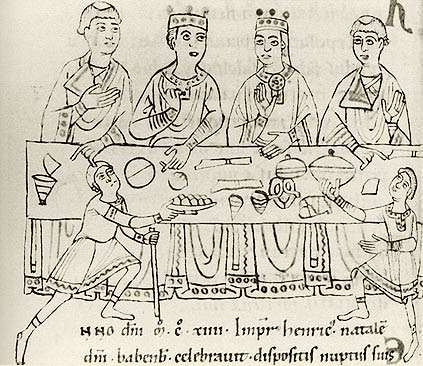
Matilda did not take well to Stephen's usurpation. She was not, after all, an idle daughter waiting for her moment to shine: by this time, she was Empress Matilda by virtue of marriage to Holy Roman Emperor Henry V (shown above in a 12th century chronicle). (And who would believe it? Henry V tried to usurp the throne from his father, Henry IV.)

Henry V had died 10 years prior to the current crisis, but Matilda retained the title Empress. Her father recalled her to Normandy and arranged marriage to Geoffrey of Anjou to protect his southern border. (Blois was also on the southern border of Normandy; perhaps if he had arranged a different marriage...?) From here she could make plans to assume the English throne, kicking off a period called The Anarchy.

Stephen's reign was not without trouble. Not everyone approved of him personally, or of his seizing of the throne after pledging loyalty to Henry's daughter. In 1139 she left Geoffrey to conquer Normandy while she crossed the English Channel to take the throne from Stephen. She and her half-brother Robert of Gloucester visited her step-mother Adeliza, which caused Stephen to react. Afterward, she and Robert, with support from her uncle, King David I of Scotland, raised an army and captured Stephen at the Battle of Lincoln in 1141.

The next step was to be crowned at Westminster, but the people of London were against her and prevented it. She was never considered a Queen, not even for a moment. Her title in royal listings is Domina Anglorum, "Lady of the English." Stephen's supporters captured Robert, and Matilda agreed to exchange him for Stephen.

Although she had control over much of south-west England, Matilda returned to Normandy in 1148 (now under her husband's control), leaving her eldest son to continue the war. Other factors were at play: she was living in a castle that she took from the bishop of Salisbury; Pope Eugene III threatened her with excommunication if she did not return it.

The war became a stalemate, and the stalemate become the 1153 Treaty of Wallingford (or Westminster, or Winchester: all three are used), formally ending The Anarchy and agreeing that Matilda's son would become king upon Stephen's death, which obligingly happened a year later. Henry became King Henry II of England, starting the Angevin Empire.

I'd like to talk about the impact of the Angevin Empire next, but if you want more detail on The Anarchy you can check out posts from 10 years ago: Parts One, Two, and Three, along with this.)

12 August 2014

The Investiture Controversy

The Concordat of Worms that
ended the Investiture Controversy
There was a recent mention that Holy Roman Emperor Henry IV was best known for the Investiture Controversy. Investiture was the act of conferring on someone honors or titles. In this case, the controversy was over who had authority to name clergy, the king of the country in which the bishop would preside, or the pope?

Obviously, kings would like to choose the people who would manage ecclesiastical courts, and stock the positions with those loyal to the throne. The pope (and other clergy) would much rather have the Church decide on these positions and not owe any particular loyalty to secular governments.

The concern of the secular authority was based on the fact that a bishopric carried with it a grant of land, and the secular lords wanted to make sure those lands were still under some kind of control. A bishop named by the pope would not necessarily be loyal to the local lord.

Pope Gregory tried to reform some church practices, including bringing the power of investiture completely under the papacy. For a long time, Germany was in the position of ratifying popes, but when Henry IV first became king of the Germans in 1056, he was only six years old, and so the Gregorian reformers acted fast to wrest the power of the papacy away from German control. The Church created the College of Cardinals as the body authorized to elect a new pope.

In 1075, Gregory declared that the sole universal power in the world was the pope's; secular power only applied to local concerns. He also declared that the pope alone had power to appoint or depose clergy, and the pope had power to depose an emperor.

Henry opposed this, and continued to appoint clergy, but the pope excommunicated him. If his nobles had stayed loyal, the outcome might have been different, but much of the aristocracy turned on him, forcing him to make the Walk to Canossa. Even the resolution at Canossa did not stop the battle between popes and emperors.

In 1122, a "final" resolution was made with an agreement between Henry V and Pope Calixtus II. Called "The Concordat of Worms" (because the meeting took place near Worms), it gave the German kings the power to grant or withhold secular power (lands, titles) to clergy, but not to make them clergy.

This controversy did not exactly begin (or end) with Henry IV and Pope Gregory VII. The debate between papal and secular authority to confer titles was confused on Christmas Day 800 when Pope Leo III placed the crown of the Holy Roman Emperors on his head during Mass. This raised the question whether the pope had the authority to pick an emperor or king. And the Concordat did not exactly resolve the issue everywhere: just between Germany and the pope. England and the papacy also butted heads over this, which we will look at tomorrow.

07 August 2014

Fathers & Sons in the HRE

Henry IV (center), with his sons Henry V & Conrad
Holy Roman Emperor Henry IV is best known for the Investiture Controversy and the Walk to Canossa, when he did penance so that Pope Gregory VII would lift an excommunication.

Henry was excommunicated again in 1084; however, this time he wasn't so penitent. He marched into Rome, deposed Gregory, and appointed his own pope, Clement III. The College of Cardinals had another idea, however, declared Clement III an "anti-pope," and appointed their own pope, Pope Urban II. Urban supported Gregory VII's ideas and opposed Henry, as did Pope Paschal II who followed him in 1099.

Henry was prepared to oppose the popes, but a further betrayal created worse trouble for him. His son, Henry (1086 - 1125; later Holy Roman Emperor Henry V). Sons in line for the throne often make designs on that throne before their predecessor departs by his own choice, and young Henry decided that his father's excommunication was good grounds for staging a rebellion.

In 1104, young Henry decided it was time to stand up and depose Henry IV. The Church was willing (naturally) to support the son against the father who had proven to be no friend to the papacy. Henry IV had been trying to maintain order in the Empire, and did not want a war. He agreed to a meeting to try to achieve a peaceful resolution; the meeting, however, was a ruse, and he was captured by his son's forces. Imprisoned in Böckelheim Castle in southwestern Germany, he was forced to renounce his creation of Pope Clement and to admit that he was unjustly hostile to Pope Gregory.

Henry IV was German, however, and Germany itself was not keen on having their king deposed and imprisoned by a teenager who then declared himself Holy Roman Emperor Henry V. In 1106, forces loyal to Henry IV opposed his son and the pope and freed Henry IV from his prison. Henry Senior started making alliances with other nations for support. Early in 1106, he defeated his son's forces, but he succumbed to an illness of several days and died on 7 August.

Because he was still excommunicated, his body was placed by order of the papal legate into an unconsecrated chapel until the excommunication was lifted in summer of 1111.

Henry V did become Holy Roman Emperor in his own right from 1111 until 1125

09 November 2012

The Anarchy, Part 1 (of 3)

When the White Ship sank in 1120, drowning King Henry I's son and heir, William Adelin, England was in crisis. Henry decided that his daughter, Empress Matilda (1102-1167), should inherit the throne. She was called "Empress" because she had been betrothed as a child to the Holy Roman Emperor, Henry V; they were married in 1114. She had actually spent some years as Henry's regent in Italy, gaining some political and administrative experience.

That came later, however. Her father, King Henry I, had about 20 illegitimate children, but none of them would have been acceptable as king, so he tried to gain himself a legitimate heir to replace William by marrying again in 1121 (to Adeliza of Louvain), but no male heir was forthcoming. Henry V died in 1125, and Henry I summoned his daughter from Germany—awkward for her, since she had essentially become a German, having grown up there since childhood, learned the language, and ruled its people. Still, she had not produced an heir for Henry V, and so that dynasty ended and the throne went to someone who had no use for the widow of his predecessor. Matilda spent a year in Normandy, becoming re-acquainted with her father, and in 1126 went to England.

Even though Henry had his Court swear oaths to accept her status, however, not everyone was pleased with the choice. King Louis VI of France suggested William Clito, Henry's eldest illegitimate son, in order to create conflict in the English court. Through a sudden and advantageous marriage, Louis managed to make Clito's status more important and potentially more disruptive to Henry's plans.

Then, in 1135, Henry I died. Matilda was in Anjou with her new husband, Geoffrey of Anjou—too far from England to take control of the situation. Her cousin, Stephen of Blois, rushed to seize the Crown, breaking—along with a majority of barons—the oath he had sworn years earlier. His action started a period of civil war that lasted for almost 20 years.

[to be continued]