Showing posts with label India. Show all posts

30 September 2026

Games of Diplomacy

A 7th-century Sanskrit biography of the Indian emperor Harshavardhana written by his court poet Banabhatta contains the first literary mention (we believe) of the game of chess. In it we read that the Indian emperor sent a gift to the Sassanian King Khosrow I. The gift was a game that contained pieces that have been translated in different ways: "royal figures of sculptors" or "fighting terracotta-warriors" or even "When this king reigns, the fight among kings is confined to terracotta statuettes."

The strong assertion is that this was a chess game. (More detail available here; just search for "chess.")

The biography explains that the king of India sent it to Khosrow with a challenge, or taunt:

As your name is the King of Kings, all your emperorship over us connotes that your wise men should be wiser than ours. Either you send us an explanation of this game of chess or send revenue and tribute to us.

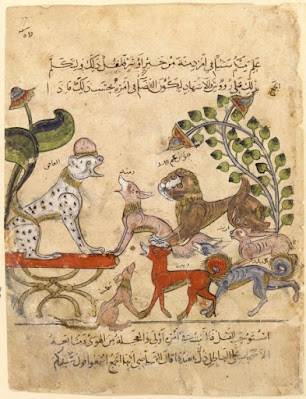
Khosrow tossed the challenge to his vizier, Bozorgmehr, who had been an advisor and military commander under Khosrow's father. It took three days, but Bozorgmehr figured out the arrangement and rules of the game of chess. (The illustration shows Bozorgmehr challenging the Indian envoy to a game.)

Khosrow decided that turnabout was fair play, so he had Bozorgmehr design a board game to send to India. The game was called Nard, and was designed to represent Zoroastrian philosophy:

  • 30 Checkers: Represent the 30 days of a month.
  • 24 Points (Squares): Represent the 24 hours of a day.
  • 4 Sections of the Board: Represent the 4 seasons of the year.
  • Two Colors (Black and White): Symbolize night and day.
  • The Dice: Represent the stars of fate, fortune, and life's unpredictability
Khosrow sent it to the Indian emperor with the same challenge. They failed to decipher the playing of the game, and therefore were obliged to pay tribute to Persia.

And that (we are told) is how these two wildly popular games came to be. Tomorrow we will return to more serious matters, perhaps fables.

26 February 2022

A Book of Fables

King Alfonso X's son, Fernando de la Cerda, requested that the Toledo School of Translators produce a Castilian version of a Book of Fables, Kalīla wa-Dimna. The book is a series of stories with animals as the main characters; each story has a lesson to be learned, similar to the fables of Aesop.

The title refers to two of its characters who are jackals, the steady Kalīla and the ambitious Dimna. They are door wardens for the king, who is a lion. Oddly enough, Kalīla and Dimna only appear in the first of the 15 stories contained in the collection.

Several of the stories include a king, and their subject matter is usually about the relationship and duty of a king toward his subjects. The introduction to the book claims that it was written for the king of India. It was then called the Panchatantra. When the king of Persia, Khosrow I, heard of the book, he sent his physician to India to make a copy in Pahlavi (Middle Persian).

Copying was not allowed by the king of India, but the physician, Borzuya, was allowed to read it. He read a story each day, and then at night wrote in a journal what he remembered. In this way he brought the fables westward. The Arabic author and translator Ibn al-Muqaffa (died c.756) translated it into Arabic as Kalīla wa-Dimna. It became the first Arabic literary classic. Its popularity led to the publication of a German version by Gutenberg. Today copies can be found in over 100 languages.

The frequent theme of a king's relationship with his subjects places this collection not only into the genre of fables but also into the genre of "Mirrors for Princes," guides to teach proper conduct when one has authority and responsibility.

One more foray into the realm of cultural and linguistic melting pots: next time, we look at Mozarabic culture.