Showing posts with label Battle of Hattin. Show all posts

23 March 2026

The Siege of Acre, Part 2

A couple weeks ago I mentioned the events that led to Saladin coming to power in Egypt. From there he had two choices: stay in Egypt and try to bring the entire country under his control, or try to surpass all the other Muslim rulers in the Eastern Mediterranean. Ten years later he was making good on the second goal, one milestone being the Battle of Hattin, in which he defeated the largest army the Kingdom of Jerusalem had ever put together under the command of King of Jerusalem Guy of Lusignan. Guy was captured during Hattin.

Jerusalem after a five-day siege fell to Saladin. Pope Urban III died on 19 October 1187, supposedly of sadness that Jerusalem was lost. Pope Gregory VIII proposed a new venture that would become the Third Crusade.

Saladin was unable to conquer Tyre, which was held by Conrad of Montferrat. Saladin tried to negotiate rather than fight when he saw that reinforcements from Europe were arriving to aid Conrad. As part of negotiation, Saladin released Guy, but Conrad would not allow Guy to enter Tyre;:everyone blamed Guy for mismanaging the defeat at Hattin. (Also, Conrad was the closest male relative to Baldwin V of Jerusalem and saw himself as the man who should be King of Jerusalem instead.)

Saladin left Tyre and turned his attention to Acre.

Acre was an important port city, and would be a natural target for Christians. Muslim records tell that they debated destroying the city to make it unusable versus reinforcing the defenses.

News of the loss of Jerusalem galvanized Christian leaders. In early 1188, reinforcements from Europe started arriving. William II of Sicily sent ships with 200 knights. The Archbishop of Pisa arrived with 52 ships. They contacted the King of Jerusalem, still camped outside of Tyre, and pledged to support him. Conrad still would not let Guy into Tyre.

Guy needed a city for a base, and Hattin had destroyed most of the fighting men from Jerusalem, but now Guy had allies from the Mediterranean—between 7000 and 9000 infantry and between 400 and 700 knights—so he decided to go to Acre (30 miles away in the south) to use it as his base against Saladin.

Saladin had left thousands of men in Acre, so this attack would not be easy. West and south of Acre was a sea wall; east was the only approach. Guy tried an attack on the walls that failed thanks to Saladin reinforcing it. Guy set up camp east of the city and waited for reinforcements from Europe.

A few days after setting up camp, reinforcements started to arrive. Things were looking up for Guy...or were they? We'll continue tomorrow.

21 March 2026

Gerard de Ridefort

Gerard de Ridefort (that's his coat of arms to the left) is another of the many characters who has no known background recorded anywhere—we don't know his family, birthdate, education, whence he came—until he rose to prominence in some group. In this case, he barely appears in records in the service of King Baldwin IV of Jerusalem, and then is suddenly Marshal of the kingdom in October 1179.

It seems from the Chronicle of Ernoul that he was supposed to marry an heiress, Cécile Dorel, the niece of Raymond III of Tripoli. I told the story (in "The Power of Gold") of how he lost her because of 10,000 bezants. After that incident, Gerard fell ill for awhile, then swore off women and joined the Templars.

When Baldwin IV died and there was disagreement in the kingdom over the proper husband for the successor, Queen Sibylla, Raymond of Tripoli (and many others) felt her husband, Guy of Lusignan, was unsuitable, and a search in Europe was conducted to find someone else. Gerard, holding a grudge against Raymond, chose to support Guy as king.

After 1187, when the trip to Europe resulted in a donation from King Henry II of England to support the Christian kingdoms in the Holy Land, Gerard took the money designated for the Templars and hired mercenaries to attack Saladin's son, al-Afdal, in the poorly planned Battle of Cresson. They were hopelessly outnumbered and Gerard was wounded. He was also one of the few that even survived.

That was in May. In July he led the Templars into the Battle of Hattin. Hattin was a disaster for the Christians. Saladin had taken the city of Tiberias. Gerard and others wanted to besiege it and take it back. Raymond's advice was to wait and let Saladin leave the strong-walled city to continue spreading his territory. Gerard wouldn't listen to Raymond and wound up on an undefended plain where they were surrounded and captured. Gerard was one of many prominent men taken hostage. Lower ranked Templars were executed.

Gerard was offered a deal by Saladin. If Gerard would convince a particular Templar fortress to simply surrender without fighting, Saladin would let Gerard go. Gerard agreed, then did the opposite: he went to Tortosa, a major port on the Syrian coast, and set up its defense. He seized more of the money that Henry II had donated to the Crusader cause (but not specifically given to the Templars). Conrad of Montferrat wrote a letter in September 1188 complaining about this.

Gerard used the money for more mercenaries. He and Guy went to the Siege of Acre, where Gerard was again taken hostage by Saladin. Saladin had little patience with someone who had broken his promise once already, and beheaded Gerard.

The Siege of Acre became a significant event in the history of the Crusades, and though mentioned has never been discussed in detail. We'll take a close look at it starting tomorrow.

20 March 2025

Guy of Lusignan

Guy of Lusignan (c. 1150 – 18 July 1194), who married Sibylla of Jerusalem (twice!) in yesterday's post,  has been mentioned before in his role as King of Jerusalem. To be put in the position to become king, he must have had some significance prior to that point, so let's look at his earlier life.

He was originally from a noble family in Poitou. Poitou was part of Henry II's possessions on the continent, overseen by his son, Richard I "Lionheart." Guy and his brothers in 1168 attempted to capture Eleanor of Aquitaine for ransom. They failed, but managed to capture William Marshal (then only in his 20s and not yet risen to prominence). Eleanor ransomed William, but Richard banished the brothers.

The brothers wound up in the Holy Land. Aimery went there first, settling in the Kingdom of Jerusalem and marrying Eschiva of Ibelin, whose father attempted to become King of Jerusalem as Baldwin IV was failing (seen in yesterday's post). Guy came to Jerusalem sometime between 1173 and 1180, joining his brother in Jerusalem.

King Baldwin IV and his mother, Agnes of Courtenay, welcomed and supported Guy. He was made Agnes's constable in Jaffa, and then appointed by Baldwin to be constable of the kingdom. There were rumors that he was having an affair with Agnes, who was 14 years older than Guy, but they were likely designed by others to discredit him because of his growing influence.

His hasty marriage to Baldwin's sister, Sibylla, was designed to stave off the attempt of Raymond III of Tripoli to take over the Kingdom of Jerusalem and marry her off to Raymond's chosen candidate, Baldwin of Ibelin, Guy's brother's father-in-law. The marriage was likely a happy one (see below), and produced two daughters, Alix and Maria. Sibylla's son by her earlier marriage to William of Montferrat died young, so Sibylla and Guy ruled as Queen and King of Jerusalem.

Before they were crowned, however, there were members of the court that disapproved of Guy. They convinced Sibylla to annul the marriage if she wished to be crowned. She agreed, on the condition that she be allowed to choose her next husband. The court agreed, the annulment took place, the coronation took place, and then Sibylla chose her next husband: Guy of Lusignan. She had outfoxed the court for an arrangement that obviously pleased her.

As a war leader, Guy was a failure. In an attempt to prevent the growing encroachment of Saladin on the Kingdom of Jerusalem, Guy marched with the army to the disastrous Battle of Hattin, in which the army was destroyed completely. Saladin's men killed almost everyone, sparing Guy and a few others. The few were taken to Saladin's tent where, well, good and bad things happened. I'll share the gory details tomorrow.

14 January 2022

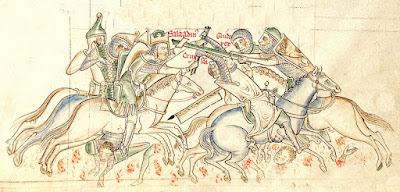
The Battle of Hattin

 The Horns of Hattin is an extinct volcano whose twin peaks overlook Hattin in the Lower Galilee. In 1187, a battle took place between the forces of Saladin and Crusaders that was devastating for the Crusaders.

At the time, there were many Western European forces in the Middle East, due to the Second Crusade, and Jerusalem was in Christian hands, with Guy of Lusignan currently the King of Jerusalem. Still, the desire was to have the entirety of the Holy land under Christian control, which meant further conflict. Likewise, Muslim forces wanted the Christians to withdraw.

Saladin controlled much of the territory surrounding the Crusader forces and promised his people that he would drive the Christians from Jerusalem. Saladin had made a private treaty with the Franks in 1185 to give them Jerusalem if the Crusaders would stop waging further battles. There was peace until 1187 when a Muslim caravan was raided by Raynald of Châtillon. Saladin swore he would kill Raynald and sent a force to raid an area held by the Franks. The Templars lost about 150 knights and 300 foot soldiers in this battle (the Battle of Cresson), which was a severe blow to Frankish morale.

Guy was advised to move against Saladin, and on 3 July 1187, his forces started marching towards the Sea of Galilee (known at the time as Lake Tiberias). They were harried constantly nay Muslim archers, and along the way found little fresh water to replenish their supplies. The Muslim forces prevented them from reaching Lake Tiberias and fresh water, and set fires to the dry grass to annoy the Franks further with smoke and heat.

Three times the Frankish forces charged Saladin's, and three times they were beaten back, the third time being definitive. Many European nobles were taken captive that day. Guy of Lusignan and Raynauld of Châtillon were taken to Saladin. Saladin offered water to Guy, a sign that Guy would be treated well; Guy offered the water to Raynauld, but Saladin slapped it from his hand, charging Raynauld with breaking the truce. Raynauld was executed.

Guy of Lusignan was taken to Damascus as a prisoner (released in 1188). Two-hundred Templars and Hospitallers were beheaded, as were many others. A piece of the True Cross was taken from the Crusaders and sent to Damascus, about which I will have more to say next time.