Showing posts with label earthquake. Show all posts

22 December 2025

Earthquake!

I told of a specific earthquake that was particularly destructive 11 years ago (and could happen again, eventually), but there were many recorded in history, of course.

One of the worst in England took place in 1185 in the East Midlands (see illustration), as recorded by the Abbey of St. Werburg in Chester:

Prima quoque die post ramis Palmarum id est, feria secunda hoc est xvij kal. Aprilis, magnus terre motus plerisque locis Anglie et ut aiunt quidam omni particulariter orbis climate hora diei sexta contigit.

"On the first day after Palm Sunday, that is on Monday, April 15, there was a great earthquake in very many places in England, and as some say particularly, in every region of the earth; it happened at the sixth hour of the day."

Difficult to know where the epicenter was, but the villages of Raleigh and Danethorpe in Nottinghamshire were completely destroyed. Houses made of masonry were less resilient than wood and fell down. Parts of Lincoln Cathedral fell, creating a question: was the damage because the earthquake was very intense, or because construction was less than stellar.

The British Isles had another major earthquake 90 years later, recorded in the Annals of Oseney and the annals of Waverley Abbey in Surrey. On 11 September 1275 between the first and third hour of the day it was felt in Canterbury, London, Wales, and Winchester. Osney recorded that homes and churches were downed and people were killed.

This earthquake caused the 11th-century timber church dedicated to St. Michael on top of Glastonbury Tor. I think Glastonbury Tor is where we'll go next.

21 December 2025

The Earthquake Synod

The Earthquake Synod was held on 21 May 1382 in London, England. It was called by Archbishop of Canterbury William Courtenay to address 24 of the theses put in writing in recent years by John Wycliffe.

During the meetings, an earthquake in the Dover Straits happened at 3:00pm with an estimated intensity of VII to VIII on the Modified Mercalli intensity scale, which runs from I (so mild it is felt by no one, perhaps only detectable by instruments) to XIII (which represents total destruction).

The earthquake destroyed the bell tower of Canterbury Cathedral. A manor house and church in Kent were damaged. In London, some miles away, Westminster Abbey and St. Paul's Cathedral also sustained damage.

At the Synod in London, the monastery where it was being held felt the shaking which alarmed many of the participants. The archbishop cleverly used the earthquake as a sign of favor, declaring:

This earthquake portends the purging of the kingdom from heresies. For as there are shut up in the bowels of the earth many noxious spirits, which are expelled in an earthquake, and so the earth is cleansed, but not without great violence: so there are many heresies shut up in the hearts of reprobate men, but by the condemnation of them the kingdom is to be cleansed, but not without irksomeness and great commotion.

Of the 24 theses, 10 (such as his rejection of transubstantiation) were considered heretical. The rest (for example, criticizing Church hierarchy and matters of wealth vs. poverty) were considered simply erroneous and should be ignored.

The synod decreed that those who professed any of the heretical 10 ideas should be prosecuted. For this to happen, though, needed the cooperation of secular authority, but the House of Commons rejected the bill that would have made it into law. In November he was summoned to stand before a synod at Oxford, where many of his colleagues were sympathetic to his views. Again, the secular powers would not condemn him and he kept his freedom and his views.

He was summoned to Rome in 1383, but he had a stroke and could not travel; he died in the following year. The Church did not succeed in getting him declared outright as a heretic until years after his death, in 1415 at the Council of Constance (probably called because Wycliffe's ideas were being spread by Jan Hus). In order to deal with things definitively, the order was given to burn Wycliffe's books along with his body. His corpse was exhumed (but, burials being what they were, there is a theory that the body dug up was a man who had been buried next door), burned, and the ashes scattered in the river. (The illustration shows his burning from a 16th century book on martyrs.)

For a change, let's talk about earthquakes in the Middle Ages next time. See you then.

17 October 2014

The Destruction of Basel

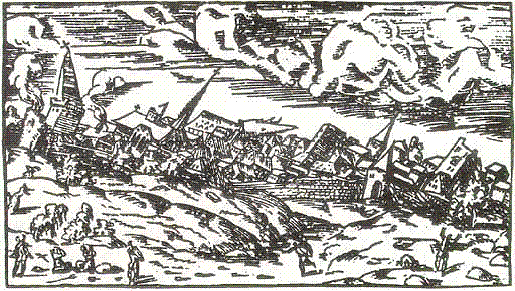
Late medieval woodcut representing destruction in Basel
Earthquakes have been in the news lately, but one of the biggest earthquakes known happened in the Middle Ages. It is called the Great Basel Earthquake, and sometimes the Earthquake of Saint Luke, because it fell in his feast day.

On the evening of 18 October 1386, an earthquake took place whose force is estimated at 6.0-7.1.* It was one of the largest of the approximately 10,000 earthquakes detected in Switzerland in the last 800 years. Based on the accounts, a rumble occurred about 8:00pm, with the major quake striking at 10:00pm.

Although it is impossible to determine now what the epicenter was, Basel suffered the greatest destruction (possible by virtue of being the largest set of structures affected by the earthquake). Basel was completely destroyed, as were any churches, castles, and towers within a 30-kilometer radius. Further damage was done to town buildings due to the fire caused by torches and candles being knocked over. Tremors were felt as far away as Zurich and the Île-de-France (272 miles away!). No building in Basel survived, according to reports.

Considering the size of the earthquake, and the timing, you would expect casualties in the thousands. While estimates vary, an estimate by a modern risk management firm is 300 deaths in Basel.

*On the Moment Scale, which has replaced the Richter Scale.