Showing posts with label Knights Hospitaller. Show all posts

11 March 2026

The 1170 Syrian Earthquake

On the morning of 29 June 1170, the inhabitants of what are now western Syria, central southern Turkey, and Lebanon were disturbed by one of the largest seismic events ever to occur along the northern part of the Dead Sea Transform Fault System (also called simply the Levant Fracture).

We've mentioned earthquakes before, during a synod in England in 1382, the 1386 Destruction of Basel, and the Monday before Easter 1185 in the East Midlands. The 1170 Syrian quake was so devastating that an uneasy truce was formed between enemies Emir of Aleppo and Damascus Nur ad-Din and King Amalric I of Jerusalem.

The day had begun in 1170 and people were going about their business when it struck. In Antioch, Patriarch Atanasius I was performing Mass in the Cathedral of Saint Peter, where 70 years earlier a version of the Holy Lance had been found. Athanasius was pulled out alive but died soon after from his injuries. About 50 others were killed in the collapse of the dome. Several other churches in Antioch were also destroyed, as were the defensive walls along the Orontes river.

Damage reached from Antioch to Tripoli in the south. Bohemond III, Prince of Antioch, was so distressed by the destruction all around that he cut his hair and donned sackcloth as a sign of mourning. The Knights Templar and Knights Hospitaller had been given several castles by Count Raymond II of Tripoli as a shield on his borders to hold against the Turks. They were all reported as destroyed.

This earthquake has been estimated to have been a magnitude 7.7 on the moment magnitude scale. The illustration shows the destructive force of the scale. Damage was so widespread that it appears in several records. In all, an estimated 80,000 people were killed, and aftershocks were felt for three months.

Although Nur ad-Din and Amalric were agreed to hold off on hostilities while rebuilding their kingdoms, others were not so kind. In December, Saladin came with an enormous force to besiege Amalric's fortress of Darum in the south while Tripoli was still trying to rebuild. For some reason, however, Saladin destroyed part of Darum and left without occupying it. Amalric rebuilt Darum to be stronger, but the threat from Egypt was clear.

Amalric did his best to preserve the kingdom. We will see how that turned out tomorrow.

10 March 2026

Egypt Again

January 1169 saw the death of Bertrand of Blancfort, the master of the Templars. Bertrand was not as keen on invading Egypt as was Amalric I, King of Jerusalem.  In August of that year, no doubt with the influence of Amalric, Philip of Milly had been elected to lead the Templars.

Amalric and Philip had been allies for several years: the two had supported Amalric's mother, Queen Melisende, in her opposition to Amalric's brother, King Baldwin III. Around the same time Amalric convinced his ally through marriage, Byzantine Emperor Manuel I Comnenos, to send soldiers to help in the invasion of Egypt (see illustration). Amalric also had the Hospitallers on his side.

This combination Franco-Byzantine expedition thought they would be served by unrest in Egypt. Egypt was being ruled by outsiders, and Shirkuh had been killed. Rough seas hindered the fleet, however, and the mouth of the Nile was blocked, making it difficult to reach the port city of Damietta, their first goal.

William of Tyre reported that Damietta could be taken quickly; however, constructing siege engines took too long, and boats from the south could provide Damietta with fresh supplies. Also, the Egyptians launched a ship on fire at the Byzantine fleet, causing the loss of six ships.

Weather was also a problem. Heavy October rains were demoralizing, and the food stores of the attackers were running low. They were unable to land and find fresh supplies. The Greek leaders felt Amalric was being too timid. Amalric worried that they had not battered the walls of Damietta enough to try to take the city. The Greeks prepared to ignore Amalric and attack, but Amalric started negotiations with Damietta before the attack could take place. For a sum of gold, Amalric retreated. He was back home on 12 December.

It was not wise to stay away from Jerusalem for overlong, since Nur ad-Din was constantly harassing the borders. Then something happened on 29 June 1170 that caused Amalric and Nur ad-Din to declare a temporary truce, something devastating to both men and their people, with a death toll estimated at 80,000. It was not a plague.

Tomorrow we'll look at the earthquake of 1170.

26 February 2026

Melisende and Fulk, Part 3

The King and Queen of Jerusalem were very involved in supporting and promoting the Christian religion. Queen Melisende contributed to many convents, for instance, starting with the Convent of Sant Anne where her sister Ioveta was.

Fulk and Melisende convinced the Patriarch of Jerusalem to give them jurisdiction over Bethany near Jerusalem so that they could build a monastery or convent. Melisende in 1138 would start building a convent. The Convent of Saint Lazarus took six years to build, and in 1144 it was granted the status of an abbey by Pope Celestine II. An experienced abbess was installed, with the understanding that the young Ioveta would succeed her, which she did in short order. Fulk's daughter from his first marriage, Sibylla of Anjou, became a nun there during a pilgrimage with her husband, and never returned to Europe.

There were other gifts to religious institutions. The Temple of the Lord (now called the Dome of the Rock) was given lands from which to draw revenue. Melisende gave grants to the Hospitallers, to the leper hospital of the Order of Lazarus (not connected to Ioveta's abbey), and to the Premonstratensians and their Church of Saint Samuel.

Melisende's mother, Morphia of Melitene, was buried in the Abbey of Saint Mary of the Valley of Jehosaphat, a Benedictine abbey founded by Godfrey of Bouillon in the eastern part of the Old City of Jerusalem. This burial started a tradition of the queens of Jerusalem being buried apart from their husbands. Melisende herself would also be buried there. (The illustration is part of the recovered artwork from the abbey, now in a museum in Jerusalem.)

She also supported the Syriac Orthodox Church. When a Frankish knight tried to claim some land possessed by the Syriac Church, Fulk supported the knight. Melisende expressed her displeasure at this, and Fulk agreed that no decision would be final until the case was debated in Melisende's presence. Once that happened, the land stayed in Syriac hands.

On 7 November 1143, the court was at Acre, enjoying a picnic. During a ride, Fulk decided to chase a hare. His horse threw him, and Fulk was knocked unconscious. He was carried back to Acre where he died on the 10th. That Christmas, Melisende went through a second coronation, this time including her son Baldwin III, who was 13 years old. Although Baldwin tried to assert himself, Melisende had complete control over the government now. Let's find out what that was like, starting tomorrow.

09 November 2025

Genoa versus Venice, Part 1

Four times between 1258 and 1381, the rivalry between the maritime republics of Genoa and Venice reached a tipping point that turned into military action. Both had extensive trade operations in the Mediterranean and the Black Sea and were largely equal in power, until 1204.

In 1204, the events of the Fourth Crusade led to Venice having significant political influence in Constantinople, and therefore the Byzantine Empire. Although the Venetians were driven from Constainople, it still took several decades for the intense competition between the two republics to turn into a war.

There was land in the coastal city of Acre—owned by the Abbey of Saint Sabas (illustration)—that was claimed by both Venice and Genoa. In 1257, a Venetian admiral broke through the Acre harbor chain (strung to prevent unwanted ships) and destroyed several Genoese ships that were harbored there. Genoa had a fortification at Acre, and their crossbowmen fired at the attackers. Venice had siege engines, which they brought to bear, blockading Acre for more than a year.

The Genoese had the support of the Knights Hospitaller in the city, as well as the Byzantine Empire (Michael Paleologos had just driven out the Venetians). Venice meanwhile had the Knights Templar on its side. Both sides hired Muslim mercenaries; these were frequently Turcopoles, "sons of Turks," who were light cavalry often employed by Byzantine states. Genoa made an alliance with Baibars, the sultan of the Egyptian Mamluks, but his promised fleet never appeared. Genoa also approached Michael Paleologos, who was happy to provide support against the Venetians.

Efforts to mediate the conflict by a local lord failed, and a naval battle took place. The Genoese navy of about 50 ships was overrun by the Venetian navy. The Genoese abandoned Acre and retreated to Tyre, a city from which the Venetians had been evicted in 1256.

The War of Saint Sabas (1256 - 1270) annoyed the pope, who feared a Mongol or Muslim attack that would be successful because too many Christian resources were being wasted fighting each other. Pope Gregory X, along with France and Sicily, pressured the two republics to agree to the Peace of Cremona in 1270, although Genoa did not get their part of Acre back until 1288.

The Venetians came out ahead in this war. A generation later, however, Genoa got the upper hand. I'll explain tomorrow.

01 June 2025

Guillaume Caoursin

Yesterday's post on Mesih Pasha mentions the Siege of Rhodes in 1480, when a small garrison of Knights Hospitallers at Rhodes withstood an attack by the Ottomans. The garrison was led by Grand Master Pierre d'Aubusson. The vice-chancellor of the order was Guillaume Caoursin, who wrote (among other things) an account of the event.

Caoursin was born in 1430 in Douai in northern France, and joined the Order of Saint John (also know as the Hospitallers) as a young man. By 1462 he was vice-chancellor of the Order in Rhodes, and in 1462 he accompanied the Grand Master Piero Raimondo Zacosta to Rome for the holding of a general chapter under the guidance of Pope Paul II.

While in Rome, Zacosta died (he was in his 60s), and Giovanni Battista Orsini succeeded him. Caoursin went back to Rhodes with the new Grand Master, but was sent back to Rome in 1470 to request help from the pope for dealing with the Turks. Orsini died in 1476, and Caoursin now worked under Grand Master Pierre d'Aubusson.

In 1480, Mesih Pasha led an Ottoman force of 160 ships and 70,000 men against Rhodes. While the Turks bombarded the walls, the citizens dug a new moat and new fortification within the city walls near the Jewish quarter in case the bombardment breached the walls.

On 27 July the Janissaries managed to enter the city. d'Aubusson led the fighting, though wounded in five places. A three-hour battle forced the Turks back, and the Knights pursued all the way back to the Ottoman tents, taking booty and the holy standard of Islam. Caoursin reported that between three and four thousand Turks were slain that day. The Ottomans gave up on 17 August.

Caoursin married shortly after 1480. He was rewarded by d'Aubusson with 1000 gold florins for his services to the Order. His "next act" came in 1484, when he became ambassador to Pope Innocent VIII. Innocent was so impressed by Caoursin that he made him his apostolic secretary. Caoursin remained there, writing about his Order and about Rhodes.

Innocent VIII might also have kept Caoursin close because of his knowledge of the Ottomans and the Siege of Rhodes, of which I will have more to say tomorrow.

31 May 2025

The Mesih End

Mesih Pasha was chosen from obscurity—we don't even know his original name before Mehmed II forced him to convert to Islam and made him a member of the Ottoman administration after the Conquest of Constantinople—and rose to great heights, but sultans can be fickle.

Mesih was Grand Admiral of the Ottoman navy and had great successes. He negotiated (successfully) with the rebelling Janissaries when they occupied the palace, angry at the sultan's imprisoning of one of their favorites. He negotiated a compromise with Sultan Bayezid II's rival half-brother, Cem, who had teamed up with the Knights Hospitallers in Rhodes against Bayezid. (The illustration shows Mesih at Rhodes.)

For some reason, however, he fell out of favor with Bayezid in 1485 and was dismissed from his position as vizier at court, being made simply governor of Filibe (once called Philippopolis, now Plovdiv, the second-largest city in Bulgaria). He was shortly exiled (essentially) to Kaffa, on the northern coast of the Black Sea.

His exile did not last forever. In 1497 he was made sanjak bey, military and administrative leader of the port city Akkerman (now Bilhorod-Dnistrovskyi in southern Ukraine). While there he halted a Poolish invasion of Moldavia, sending several Polish nobles to Bayezid as tribute.

In 1499 he went on pilgrimage to Mecca, an excuse for leaving his position which gave him a reason to visit Constantinople and try to get back to a position at court. Fortunately, the Venetians were fighting the Ottomans again, and his previous naval experience against the Venetians led to being re-named vizier, and then in 1501 Grand Vizier.

Things were looking up again, but that same year the Venetians attacked Lesbos to get it back from the Ottomans. Bayezid, unhappy that the Venetians felt able to make such a bold move against him, in a fit of pique struck Mesih. We don't know how serious the injury may have been, but soon after, after supervising putting out a fire in a Constantinople suburb, Mesih was supposedly injured. He died in November 1501. He was buried in the Murat Pasha Mosque in Constantinople, begun by his brother Hass Murad Pasha and completed by Mesih himself.

Now for something completely different. The illustration above, a painting of Mesih addressing Rhodes, was painted by an eyewitness of that negotiation! His name was Guillaume Caoursin, and we're going to talk about him next.

05 March 2022

Jerusalem Hospital

The Hospitallers were nicknamed thus because they were founded by members of the First Crusade who joined together to protect a hospital built at the Benedictine monastery of Saint John the Baptist. That hospital and monastery were in Jerusalem, in a section of the Christian Quarter called Muristan. In fact, "Muristan" comes from the Islamic Bimārestān, meaning "hospital." The hospital in question, however, built in 1023, was not the hospital for which Muristan is named.

The name Muristan appears much earlier, due to a hospital built by Abbot Probus about 600CE at the orders of Pope Gregory I. This was built to treat ill pilgrims who made the trek to the Holy Land. We should note that this is long before any Crusades to "liberate"—actually, "conquer" would be more accurate—the Holy Land. Muslims, Jews, and Christians all managed to coexist through many periods of time—though not always, as you'll see. About 614CE, a Persian army invaded, killing Christians and destroying their structures, including the hospital.

Jump ahead 200 years, and Charlemagne in 800 (after being crowned Holy Roman Emperor) revived Probus' hospital and expanded it, adding a library (Charlemagne was a great supporter of learning, as you can read about in a 2013 post.) Unfortunately, in 1009, Caliph al-Hakim bi-Amr Allah (sometimes called "the mad caliph" or the "Nero of Islam") destroyed the hospital as well as thousands of other buildings.

Which brings us up to 1023, when merchants from Amalfi and Salerno requested of Caliph Ali az-Zahir the opportunity to rebuild the hospital. It was granted, which brings us back to the Hospitallers several decades later, and the incarnations of the hospital are complete.

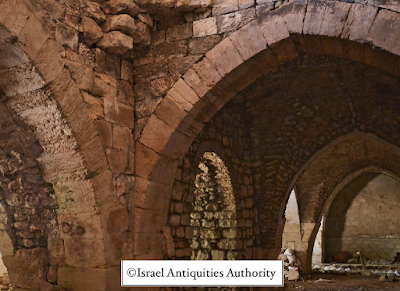
But there is a postscript. During excavations for a restaurant, he original structure was discovered and explored between 2000 and 2013 by the Israel Antiquities Authority. At its heyday, between 1099 and 1291, it was 150,000 square feet and could accommodate up to 2000 patients. Evidence exists that it served kosher food to Jewish patients, and that it also housed orphans, many of whom joined the Hospitallers. Bones from horses and camels found suggest it was also used as a stable. Part of a vaulted roof will be incorporated into the restaurant, and so the first home of the Hospitallers lives on in some small fashion.

But what about the "mad caliph" who destroyed a hospital and the kind caliph who let one be built? Would you believe they were father and son? Sometimes the apple does fall far from the tree, which we'll go into tomorrow.

04 March 2022

What About the Hospitallers?


Pope Clement V, who approved the order to arrest all the Templars, had earlier told them to merge with the Hospitallers, since it didn't seem necessary to him to have two groups who were performing the same function: guarding/assisting people traveling to the Holy Land. Who were the Hospitallers?

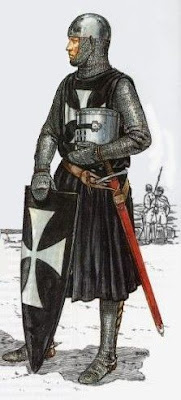
In 1023, a hospital was built in Jerusalem on the site of the Benedictine monastery of St. John the Baptist, to care for sick and injured pilgrims. When Jerusalem was taken over by the First Crusade, some Crusaders formed the Order of Saint John of Jerusalem—colloquially known as the Hospitallers—to support the hospital. A papal charter charged them with the care and defense of folk in the Holy Land. This evolved from caring for people to providing military escorts and then to fighting in wars for Christendom.

Once Jerusalem was retaken by Muslims, the Hospitallers made their home base in Rhodes. Even later they had to relocate to Malta. They spread far and wide, establishing a presence in England and Normandy by 1200. They spread to Ireland, to Hungary, to Russia, and of course around the Mediterranean. They even made a presence in North America: they briefly colonized four Caribbean Islands—including Saint Martin and Saint Barts—which they gave to France in the 1660s.

The Knights had a bad time during the Protestant Reformation of the 1500s when several large Northern European sections of the order broke from their Roman Catholic roots. The French Revolution abolished the Order in France along with abolishing feudalism and tithes.

The Sovereign Military Hospitaller Order of Saint John of Jerusalem, of Rhodes and of Malta, more commonly known now as the Sovereign Military Order of Malta, is considered the successor to the Hospitallers. The Order headquartered in Rome as of 1834; they performed extensive hospital work during the two World Wars. 

About that original hospital: it was excavated between 2000 and 2013, and was a replacement for an even earlier hospital. I'll talk about that next time.

02 March 2022

The Inner Temple

Why were two of the compounds for legal training in London named "Inner Temple" and "Middle Temple"? First, let's explain that "Middle Temple" was a nickname. There was an Inner and an Outer Temple at the location, and "Middle" was named that just because it was between the two, but it wasn't really a temple. The Inner Temple, however, was a temple, in that it was built and used by the Poor Fellow-Soldiers of Christ and of the Temple of Solomon, known these days as the Templars.

Founded in 1119CE and devoted to the emancipation of the Holy Land, their international presence made them popular as safe escorts and money-handling institutions. They maintained almost a thousand locations across all of Europe and the Near East, and were a popular recipient of donations.

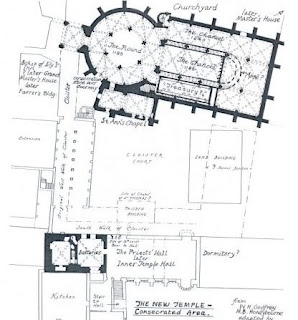
During the reign of Henry II, the Knights built their set of buildings on the banks of the Thames, laying down a new street that gave access to them. They called this New Street, but today it is known as Chancery Lane. It was obviously not a law school at the time, although lawyers were there as advisors for the Knights.

The Knights ran into trouble when, on 13 Friday 1307, France ordered the arrest of all Templars. (If the date makes you wonder, go here.) King Philip IV needed money after his wars with England, and relied on rumors of impropriety to convince Pope Clement V to outlaw them, allowing Philip to confiscate their wealth. England did not have any beef with the Knights, but their order faded quickly and was officially dissolved in 1312. The buildings in London were given to the Knights Hospitaller, an order whose activities were similar to the Templars.

You can read more about Clement's decision here, and why he was so aligned with Philip to go along with him here. I want to talk a little more about the Inner Temple and what happened to it later. See you next time.

13 December 2013

The Templars' Bad Luck Day

(This one may meander a little; just hang on.)

A few days after William Tell shot the apple from his son's head in 1307, another significant event took place on the other side of the Alps. On the 22nd of November, Pope Clement V issued a papal bull requesting that all countries in Europe arrest the Knights of the Temple and confiscate their property.

Clement had not always been an enemy of the Templars, but their purpose was fading. They existed, along with the Hospitallers, to escort pilgrims and maintain some security in the Holy Land, but European possessions in the Holy Land had all been re-taken by non-Christians. These Orders maintained their wealth and property in Europe, although the reason much of it had been awarded to them was now gone. A couple years earlier, in 1305, Clement had suggested that the Templar Knights and the Hospitaller Knights merge, since there seemed little reason for two such Orders under the circumstances. He invited the Grand Masters of each Order (Jacques de Molay for the Templars, Fulk de Villaret for the Hospitallers) to the Vatican to discuss it, but neither would agree to the merger.

This alone wasn't enough to turn Clement against the Templars, but he had some pressure. The King of France, Philip IV, owed the Templars a great deal of money, and decided that arresting all the Templars in France on charges of impropriety and confiscating their property would be a way to square his debts. Philip had taken action on October 13. It was a Friday. Jacques de Molay was burned at the stake, and it was downhill from there for the Templars. (Clement gave all their European possessions—that were not confiscated by Philip—to the Hospitallers.)

...and this has given rise to one theory about why "Friday the 13th" is considered an unlucky day. In fact, this is the theory that friends tell to me most often, since I am known to have an interest in the Middle Ages. Someone has also put forward the idea that the day has been considered bad luck since Chaucer, because the line "and on a Friday fell all this misfortune" appears in The Nun's Priest's Tale of The Canterbury Tales. (That is not an indication that Friday itself was unlucky; Chaucer often inserted small bits of info that make the tale seem more personal.) As I did with the nursery rhyme "Ring Around the Rosie," however, let me splash some cold water on this theory.*

References to an actual unlucky day being a Friday the 13th of the month don't appear prior to the 20th century. A Boston stock promoter (and some say manipulator), Thomas Lawson (1857 - 1925) wrote a book about an unscrupulous stock broker who creates a panic on Wall Street to take advantage of the situation. The book is called Friday the Thirteenth, and he chooses that day because on Wall Street it is "Bear Saints Day" (whatever that is), not because it is inherently unlucky. "Friday the 13th" becomes a popular superstition after this book, according to one writer. Searching Google's Ngram viewer (which scans texts that Google has entered into its electronic database) for the phrase "Friday the 13" shows a steady rise of references to the term after 1905. There are earlier references as well, but if you search for "Friday the 12" or "Friday the 10" you will find similar results. There is no hard evidence I can find that "Friday the 13th" dominated the cultural consciousness prior to our Modern Era.

13 October 2012

The Templars in England

In 1307, on Friday the 13th of October, King Philip of France ordered the head of the Knights of the Temple, Jacques de Molay, arrested along with scores of other Templars. That wasn't the intent outside of France, however. Philip's motive for crushing the Templars was his indebtedness to them, but his opportunity came when Pope Clement V asked the King's help in investigating charges made two years previously by an ex-Templar. Philip used this request as a reason to arrest them and appropriate their property. This is usually considered the "end of the Templars" and the start of their disgrace.

Under torture, many Templars confessed to heresy, idolatry, corruption and fraud, homosexuality. With that "evidence," the Pope had to issue a bull on 22 November 1307 demanding the seizing of the Templars and their property all over Europe.

In England, however, the Templars found refuge for a time. This was partially due to England being busy with other things. Edward I had died in July 1307, after illness and constant military engagements in order to keep Scotland under control. His successor, Edward II, was a disappointment on many levels, one of which was his lack of interest in administration. Worrying about giving orders for mass arrests was not on his agenda. He focused instead on sport and entertainment, gave up the Scottish campaign, and recalled his banished best friend (with whom he was considered to have an "unnatural" relationship). His hand on the Templar matter was probably forced when he accepted an alliance with France by marrying the daughter of King Philip—a woman in whom he showed no interest.

Once the marriage was arranged, Philip started urging Edward to respect the papal bull (and support Philip's personal prejudices) and arrest Templars. A trial in England was a much more mild approach than the French torture chambers, and the few Templars subpoenaed were made to admit that their order was in error on the subject of the order's master being able to give absolution. The trial lasted until March 1310, by which time the Templars were thoroughly discredited. Rather than arrests or executions for heresy, however, Templars in England generally just transferred to other monastic orders, such as the Order of Hospitallers (which happened to receive much Templar property) and the Cistercians. The Templars in France may have ended with stake-burnings and torture, but in England they simply faded away.

02 August 2012

Muslim-Christian Relations, Part 2 (of 2)

[Part 1 is here.]

Saladin
After Richard and Saladin each slaughtered their prisoners, Richard marched to Jaffa, which he hoped to make a base from which he could take Jerusalem. Saladin attacked, but Richard prevailed with his main troops in the front and the Knights Templar forces on the left and the Knights Hospitaller on the right. Saladin was surrounded on three sides. Richard took Jaffa in September 1191, and Saladin was willing to talk truce.

Richard and Saladin showed great mutual respect for each other's military prowess. A temporary halt to hostilities was declared so they could come to terms.  At one point, when Richard became ill, Saladin sent him fruit that was chilled with snow brought from the mountains, and offered his personal physician. Also, Saladin sent two horses as replacements for Richard's.

An attempt was made to join East and West by the marriage of Richard's sister, Joan (1165-1199), to Saladin's brother, Al-Adil (1145-1218), who was currently administrator of Egypt. Joan had been married to King William II of Sicily, but he had died in 1189; later she would become Countess of Toulouse by her marriage to Raymond VI. The plan was for Jerusalem to be their wedding gift, and would therefore pass into the hands of a dynasty that joined Western Europe (or, at least, England!) to the Muslim world. Negotiations fell through, however.

The two commanders did agree on a three-year truce. In summer 1192, the Treaty of Ramla determined that Jerusalem would remain under Muslim control, but Christians would be allowed safe passage. Also, the Crusaders would give up lands they had invaded except for a narrow coastal strip that extended from Tyre to Jaffa. Neither leader was wholly pleased, but each had reason to wish a swift end to the conflict. Richard had troubles at home due to his brother John. Saladin was losing control of his army because of his failure to re-take Acre or to route Richard's forces in their many engagements.

Saladin died of yellow fever in 1193. While his heirs fought over the succession, Western Europe was told tales of Saladin's military prowess and chivalrous actions toward the invaders. There is an anecdote that, in April 1191, a Frankish woman on pilgrimage had her baby stolen and sold into slavery. According to Saladin's biographer, Saladin bought the baby back with his own money and returned it to the mother, then ordered a horse to take her back to her camp. Poems were written in praise of him. Richard declared him the greatest leader in the Islamic world.

And the punchline? All the negotiations and gifts between Richard and Saladin were made by proxies. The two men who so praised and respected each other never met face-to-face.