Showing posts with label Bury St. Edmunds. Show all posts

18 May 2026

Saint Edmund

When King Edmund of East Anglia bought off the Vikings of the Great Heathen Army in 865, he might have thought he was safe from that point on. They returned to East Anglia in 868, however. According to the Anglo-Saxon Chronicle:

...here the army rode across Mercia into East Anglia, and took winter-quarters at Thetford; and that winter King Edmund fought against them, and the Danish took the victory, and killed the king and conquered all that land.

Originally buried at a chapel near the site of his death, years later it was removed and taken to a place then called Beodricesworth, but is now appropriately called Bury St. Edmunds.

About 890, moneyers who were responsible for minting the coins during Edmund's reign started minting new commemorative coins for Edmund. The coins (see illustration) are proof that a cult was cropping up around veneration of Edmund's burial place and his reputation. They are mostly half-pennies, but also include pennies with the inscription SCE EADMVND REX, "O St. Edmund King."

The coins were minted in numerous locations. The Cuerdale Hoard found in 1840 includes over 1800 commemorative Edmund coins.

The importance of Edmund as a saint did not attach him to liturgical calendars until three centuries after his reign. Abbo of Fleury (c. 945 – 13 November 1004), while running the school at Ramsey Abbey,  wrote the Passio Sancti Eadmundi ("Passion of Saint Edmund") that is no doubt highly fictitious, but nevertheless brought Edmund into prominence. Abbo depicts the Vikings as emissaries of the devil, there to make Edmund fall into despair. Edmund resists and is put to death (not dying in battle).

Whatever the strength of the Edmund cult was, the minting of coins declined by 910. In 1010, Edmund's remains were considered important enough (probably thanks to Abbo's account, which survives in several manuscripts) to translate them to London to keep them out of the hands of invading Vikings. They were kept there for three years before being returned to Bury St. Edmunds.

Edmund remained a symbol worthy of veneration, however, and was promoted by kings to come along, one of which was Canute. I'll explain what Canute did for the saint next time.


25 March 2024

Bury St. Edmunds' Darkest Day

Yesterday was Palm Sunday, so let's talk about a terrible Palm Sunday (18 March) event in 1190 in the English town of Bury St. Edmunds. We can probably blame the head of the local abbey for this. Abbot Samson of Tottington wanted to make sure his abbey was financially stable. His profligate predecessor, Hugh, borrowed a lot of money from Jews, and those debts with interest needed repayment. Several years earlier, the incident of Robert of Bury gave the abbey a chance to create a shrine to the martyred boy that would draw visitors and donations.

It was not uncommon that those in debt would stir up anti-Jewish sentiment and through death or false imprisonment of Jews manage to cancel their debts. Samson saw this option, but he also had another "problem" with Jews: by order of the king, Jews were allowed to practice their non-Christianity. The abbot was accustomed to have rights over the town similar to the king's rule over the country. The Jews were a threat to his authority, since they did not fall under it.

On Palm Sunday, preachers spoke out so strongly against the Jews that the congregation went out of the church to the Jewish quarter and dragged out from their homes and killed 57 Jewish men, women, and children. Part of the preacher's instigation was likely the memory of the death of Robert of Bury, whose shrine still exists in the crypt of the abbey church.

Abbot Samson then decreed that all Jews would be expelled from the town.

Later that same year was the massacre at Clifford's Tower in York.

In 2011, a medieval well was found to have 17 skeletons in it, all dating to the 12th or 13th centuries. Eleven of the 17 skeletons were of children. DNA analysis suggests that they were all Ashkenazi Jews and likely part of the massacre in 1190.

The story of Robert of Bury lacks any definitive records that have come down to us—such as arrest records—so it has been suggested that the frequent references to it are part of a growing story that was pushed to help justify Abbot Samson's and Bury St. Edmunds' actions.

In the abbey gardens there is now a memorial to the Holocaust that also specifically commemorates the 57 Jews killed in 1190.

And on the subject of child martyrs, we have not yet discussed the original example of blood libel in England, the story of William of Norwich. After we look at that tomorrow, we will move on to less grisly stories.

28 December 2012

Anonymous IV

[DailyMedieval is on semi-hiatus for the holidays, and I am re-cycling some older posts. Today's is new, however, inspired by a music CD I received: Secret Voices by the female a capella group Anonymous 4.]

In the post on the Las Huelgas Codex I mentioned that many of the pieces in the codex were new to scholars, but some were familiar. Where else had they been seen?

Notre Dame Cathedral
The collection of recorded polyphonic music produced by composers working at Notre Dame Cathedral from c.1160-c.1250 is referred to as the Notre Dame School of Polyphony. A majority of medieval polyphonic music up to this time was committed to parchment by the Notre Dame School.

This does not man, sadly, that we can set a manuscript in front of a modern musician and have the notes played as they were intended to be heard. Differences in musical notation and rhythm make it close to impossible to know precisely how these pieces were performed centuries ago. For us to make an attempt is only feasible because of analyses of music written by a handful of people. Franco of Cologne was one, John of Garland another (best estimates are that he was keeper of a bookshop in Paris who edited two treatises on music), and the later writing of the industrious student known only as Anonymous IV.*

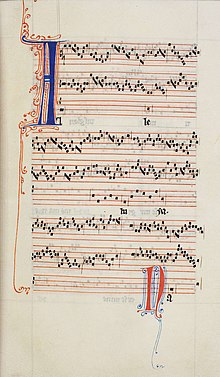
The "Alleluia nativitatis" by Pérotin
Thanks to Anonymous IV, we have contemporary definitions of what is meant by organum (a plainchant melody with one voice added to enhance harmony), discantus ("singing apart"; a liturgical style of organum with a tenor plainchant and a second voice that moves in "contrary motion"), the rules for consonance and dissonance, and other terms and rules of polyphony.

One "ironic" result of the writing of Anonymous IV is that. through him, we know the names of two composers who would otherwise have been lost to obscurity. He writes about Léonin and Pérotin with such detail and feeling that, although Anonymous would have lived several decades after they lived and composed, they were presumably so famous that their reputations lived on in the school. Léonin and Pérotin are some of the earliest names of artists that we can actually link to their works.

As much as we have been given by the treatise of Anonymous IV, his own identity and details of his life are unknown. Two partial copies of his work survive at Bury St. Edmunds in Suffolk, England; one is from the 13th century, and one from the 14th. Clearly, his work was considered important enough to copy and preserve—but not his name. He was likely an English student who was at Notre Dame for a time in the late 13th century. Thanks to his interests, we understand more about the development of medieval polyphonic music than we otherwise would have.

*His name is the inspiration for a modern female a capella group.