Showing posts with label Notker the Stammerer. Show all posts

17 August 2026

Pepin's Rebellion

There was a rebellion against Charlemagne in 792 by a handful of Frankish nobles headed by Charlemagne's eldest son, Pepin the Hunchback.

An anonymous Saxon poet known only as Poeta Saxo, writing in Annales de gestis Caroli magni imperatoris libri quinque ("Annals of the Deeds of Emperor Charlemagne in Five Books"; see the illustration), summed up the plot:

[W]icked men conceived a great crime which almost blotted out forever the shining light of the Franks, for they busied themselves in many ways plotting to put the king to death. For this purpose a cruel conspiracy is said to have been formed among the Frankish nobles. Conspicuous among them, the king's oldest son madly offered himself as the author of this crime, being more ignoble in his own worthless character than in his birth.

The plot was planned while Charlemagne was away from court, but a Lombard named Fardulf learned of it and informed Charlemagne. The co-conspirators were found out and accused of breaking their oaths of fealty to their king. The court found them guilty of oath-breaking and attempted regicide, confiscated their estates, and condemned them to death.

Charlemagne, however, overrode the death sentence on many, including that on his son. Loath to put his eldest son to death, Pepin was (at his own request, according to Einhard and Notker the Stammerer) tonsured and sent to a religious life at the monastery of Prüm (long before Regino of Prüm wrote his Carolingian history).

(And speaking of the religious life, the whistleblower, Fardulf, was given the position of abbot at St. Denis.)

The Lorsch Annals (covering 703 - 803) point out that, the following year, Charlemagne was extremely generous to his loyal retainers. It is possible that Pepin's rebellion was a perfect turning point in his reign. It gave him an excuse to excise Pepin the Hunchback from any chance of royal succession, it brought disloyal retainers out in the open, it made clear that the court would execute rebels, and it prompted Charlemagne to lavishly reward loyalty to ensure no future rebellions.

Pepin died at Prüm somewhere around 810 or 811.

This era of the Franks produced many contemporary chronicles. Einhard, Notker, the Lorsch Annals—all have been mentioned before, as has Paul the Deacon. We actually have a picture of Paul, so let's talk about him tomorrow.

16 December 2012

A Collection of Notkers

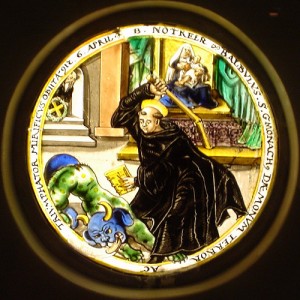
Notker Balbulus (the Stammerer)
Yesterday's post on cheese included an anecdote about Charlemagne, attributed to Notker the Stammerer. One would think that "Notker" was an unusual name in any day and age, but it turns out to have been very popular—especially at the Abbey of St. Gall. Ekkehard IV (c.980-1056), a monk of St. Gall, continued a chronicle that had been begun by others. Through the Casus sancti Galli (Doings of Saint Gall), we learn about the history of its inhabitants.

Notker the Stammerer (c.840-912) was called "delicate of body but not of mind, stuttering of tongue but not of intellect, pushing boldly forward in things Divine, a vessel of the Holy Spirit without equal in his time" by Ekkehard. He was a prolific writer, but the work he is most known for is a collection of anecdotes about Charlemagne that has been called a "mass of legend, saga, invention and reckless blundering." Supposedly, Notker wrote De Carolo Magno (Concerning Charles the Great) in honor of a visit to St. Gall by Charlemagne's great-grandson, Charles the Fat.* It is riddled with errors, such as when it claims that the Venerable Bede (672-735) devoted a book of his Ecclesiastical History to King Pepin the Short (714-768), who did not become a king until 752; when Bede died, Pepin's grandfather, Charles Martel, was king.

Notker Labeo ("the Thick-Lipped") was a nephew of the Ekkehard clan. He lived from c.950-1022 and had a reputation in the monastery as a voracious reader. He took up translating various philosophical texts into German, for which he was later called Notker Teutonicus ("the German"). When he died, he asked that he be buried in the same clothing he had always worn, to hide the fact that he wore a heavy chain around himself to mortify the flesh.

Notker Physicus, who died in 975, was called thus (according to the Catholic Encyclopedia) because of his very strict discipline. His knowledge of medicine is praised by Ekkehard, and he is probably the same Notker who was called Notarius (notable) who was known at the court of Emperor Otto I for his skill in medicine.

There was a Notker who was a nephew of Notker Physicus, of whom we know little except that he became Abbot of St. Gall in 971 and died 15 December 975. He was considered exceptionally pious.

Yet another Notker (c.940-1008) was the provost of St. Gall and became the Bishop of Liège. He established schools that became famous and drew numerous students. He is responsible for architectural projects, such as St. John's in Liège, designed after the Aachen Cathedral.


*Charles was the son of Louis the German, the son of Louis the Pious.

15 December 2012

Time To Talk of Cheese

Cheese-making; molds can be seen on the left.
Warm up some milk, add an acidifying agent, let it cool, drain off the whey to leave the curds, and the result is cheese. We don't know who first made cheese—the best guess is that milk stored in a vessel made from the stomach of a ruminant became cheese accidentally—but it has been around for thousands of years.

The Romans loved cheese—especially fresh goat cheese—and Pliny has much to say about the different kinds from different parts of the Empire. As cheese-making spread—often by the expansion of Roman culture into Europe—local varieties developed due to differences in climate and bacteria.

Cheese was a good addition to the Christian diet, since it was protein-heavy and could be consumed on days when meat was not allowed. A Monk of St. Gall (identified as Notker the Stammerer) wrote a biography of Charlemagne called De Carolo Magno (On Charles the Great), full of glorifying anecdotes. It has a revealing story about the emperor that involves cheese:
Now on that day, being the sixth day of the week, he was not willing to eat the flesh of beast or bird; and the bishop, being by reason of the nature of the place unable to procure fish upon the sudden, ordered some excellent cheese, rich and creamy, to be placed before him. And the most self-restrained Charles, with the readiness which he showed everywhere and on all occasions, spared the blushes of the bishop and required no better fare: but taking up his knife cut off the skin, which he thought unsavoury, and fell to on the white of the cheese. Thereupon the bishop, who was standing near like a servant, drew closer and said, "Why do you do that, lord emperor? You are throwing away the very best part." Then Charles, who deceived no one, and did not believe that anyone would deceive him, on the persuasion of the bishop put a piece of the skin in his mouth, and slowly ate it and swallowed it like butter. Then approving of the advice of the bishop, he said: "Very true, my good host," and he added: "Be sure to send me every year to Aix two cart-loads of just such cheeses." [Book I, Chapter 15]
We cannot say which variety of cheese tickled Charlemagne's palate. Gorgonzola is mentioned in 879, and cheddar around 1500, but we don't know if 9th century Gorgonzola or 16th century Cheddar tasted the same as the varieties we eat today.

Medieval Cookery has a recipe for fresh cheese, and you can find more at the Medieval Cheese Forum.