Showing posts with label Bishop Henry of Blois. Show all posts

30 December 2025

The Largest Bible Ever Made

Because Henry of Blois was Bishop of Winchester, the richest cathedral in England, and because he was known to be a patron of the arts and a donor of many valuable items to Winchester, it is assumed that it was he who ordered the creation of what is called the Winchester Bible. It was made by monks at the Winchester priory of St. Swithin.

The Winchester Bible is an enormous book (see the illustration with hands for scale) of 936 pages whose parchment was made from the hides of approximately 250 calves. The leaves are 23" by 16", making it the largest hand-made Bible. Its size demanded that it be made in two volumes, but it was re-bound in 1820 into three volumes, then again in the 21st century by the Bodleian Library in Oxford into four volumes for easier handling during research.

It contains the entire Vulgate (Old and New Testaments), two versions of Psalms, and the Apocrypha (several books that did not get included in the official Bible due to their doubtful origin and relevance). Perhaps because the book was so large and the materials so expensive, space was saved by starting each book of the Bible immediately following the ending of the previous book, not getting its own starting page as chapters usually do. Space was also saved by the use of many abbreviations and shorter spellings of words.

Many projects of this size and complexity would employ multiple scribes for different sections, and it is possible to detect the different "hand" of different scribes. The style of penmanship of the Winchester, however, is so consistent that the conclusion is that it was the work of a single scribe. If that is the case, it would have taken about four years to write the text.

Although all the text is complete, the illustrations are not. Many illustrations are mere sketches missing their color, or incompletely colored. The illustrations show the work of several different artists. A 20th-century medievalist examined the manuscript and found consistencies among certain illustrations that he claims allowed him to identify the artists. He referred to them as the Master of the Leaping Figures, the Master of the Apocrypha Drawings, the Master of the Genesis Initial, the Master of the Amalekite, the Master of the Morgan Leaf, and the Master of the Gothic Majesty. Some of these employed styles that show Byzantine influence.

Other "foreign influence" comes from the use of the very expensive ultramarine color that could only come from lapis lazuli from Afghanistan. The management clearly spared no expense.

I mentioned the source as the priory of St. Swithin at Winchester. Let's jump back in time a little to learn about Swithun.

29 December 2025

Henry's Choice

Life was good for Henry of Blois. His brother Stephen was the king of England, Henry was not only Abbot of Glastonbury Abbey and Bishop of Winchester, but also was the papal legate which gave him additional authority over even the Archbishop of Canterbury.

Then the Anarchy happened.

You see, King Stephen had seized the throne after the death of Henry I, even though Stephen had promised support to Henry's daughter Matilda. She was known as Empress Matilda by virtue of marriage to Holy Roman Emperor Henry V. She decided she was owed the throne of England, so she challenged Stephen.

Civil War ensued, and people chose sides. On 2 February 1141, the first clash between the two armies took place at the Battle of Lincoln. Stephen was captured and imprisoned, and Matilda assumed the throne.

Maybe it was because Stephen had not supported Henry in his idea to create a third archbishopric for himself, or simply because Matilda now had control, but Henry chose to support Matilda. But Matilda was not a kind ruler, and Henry changed his mind (especially after Matilda besieged Winchester Castle) bringing the force of the Church in support of the deposed king. Along with Stephen's wife (also named Matilda), forces loyal to Stephen turned the tide and deposed Empress Matilda.

Henry's papal legate position had come from Pope Innocent II, but hen Innocent died on 23 September 1143, the commission ended and Henry lost status. He even went to Rome to try to get it reinstated. He failed, but did manage to get some favors for Glastonbury.

After Stephen's death and the rise of King Henry II, Henry of Blois retired to Cluny and lived with his friend and mentor Peter the Venerable. In January 1164, King Henry II tried to formalize royal authority over the Church in the Constitutions of Clarendon, and Henry was one of the bishops forced to sign it. This later led to the problem with and trial of Thomas Becket, over which Henry presided.

Henry died on 8 August 1171. His exact burial site is disputed.

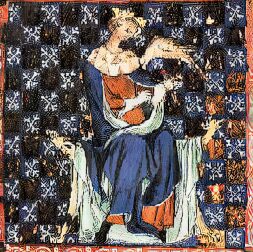
In his time he supported many art and architectural projects (the illustration was made by an artist from Belgium during Henry's time, depicting him as a patron of arts). One of his projects (we believe) was the Winchester Bible, the largest Bible ever made by hand (although incomplete). Let's take a look at that tomorrow.

28 December 2025

Henry of Blois

Count of Blois Stephen II and Adela of Normandy had several children who have appeared in this blog. One of them, Stephen of Blois, became King of England in 1135 after the demise of Henry I. Another, Henry (c.1096 - 1171) also did very well for himself. (For himself, not by himself; when your brother is king, you don't really have to go looking for work.)

The youngest of five sons, Henry was educated at Cluny, and brought to England by his uncle King Henry I to be Abbot of Glastonbury Abbey. (Henry and Adela were siblings; their father was William the Conqueror.) In 1129 he was made Bishop of Winchester as well, even though that location and the duties of a bishop were a far cry from those of the Abbot of Glastonbury.

Abbot Henry—like King Henry and, indeed, most of the kings of England—disliked being subjected to the ecclesiastical authority of the Archbishops of Canterbury. His idea was to create a third archbishopric in the southwest of England with himself at the head. (The second archbishopric was York.)

His brother the king was not keen on this idea, but Henry gained more prominence than the archbishop when, in March 1139, Henry was named papal legate. This position placed him above Canterbury in the parochial pecking order. If the king was away from England, Henry was the most powerful man in England.

Henry did wonders for the area, commanding hundreds of works projects. He built churches, abbeys, and canals. He also started construction projects at Winchester Cathedral, additions to manors and castles, Winchester Palace in London as the home for bishops of Winchester, and the Hospital of St. Cross at Winchester (which still exists).

He wrote books and was a patron of authors and bookmakers. William of Malmesbury was a close friend, and Henry sponsored On the Antiquity of the Glastonbury Church by Malmesbury. The largest Bible ever produced, the three-foot-tall Winchester Bible, was sponsored by Henry, as was the Winchester Psalter.

England experienced a period of civil war during this time called the Anarchy. There was a rival who claimed to have a better right to the throne than Stephen. Henry had a choice: support his brother, or the other claimant. We'll explore his choice tomorrow.

02 May 2013

Romsey Abbey: Its Ups & Downs

Romsey Abbey was, for a brief time, the home of Matilda of Scotland and her sister Mary. It is called "Romsey" because it was originally known as "Rum's Eg"—that is, the "area of Rum surrounded by marshes." It was founded by a granddaughter of Alfred the Great, Elflæda, in 907.

It went through some different stages, being refounded in 960 by King Edgar (943-975) as a Benedictine house under the control of the very pious (St.) Ethelflæda. The community thrived until it was sacked by Vikings in 993 and destroyed by fire. Rebuilt about 1000, it became a place to send the children of aristocrats for education (hence Matilda's time there).

A much larger building was erected in the original foundations around 1130 by Bishop Henry of Blois. That building still stands today. Between then and now, however, the Black Death wiped out all but 19 nuns of the religious community. The abbey never regained prominence, finally being suppressed (like so many others) in 1539 by Henry VIII (whose radical changes to the religious house of England was also mentioned here). The nuns were dispersed.

Even though the religious community was dissolved, however, the Abbey retained prominence in the town. Its church was being used as a parish church (St. Lawrence) by the larger community—an extra aisle had been added to the main structure so that townspeople had a place to attend services—and so Romsey did not suffer like many others: being left to fall into ruins or having its stone re-used in other building projects. Oddly, however, a few years later the townspeople purchased the building from the Crown and dismantled the extra aisle used as St. Lawrence, leaving the original Abbey church in which to worship.

In 1643, the English Civil War resulted in internal damage when soldiers tore up the seats and destroyed the organ. Many windows were damaged over the years and not replaced. The 19th century saw an attempt to restore the neglected structure, and now it has a thriving parish community.

18 April 2013

Theobald of Bec


Since we brought up Canterbury yesterday, and arguably its most famous archbishop, let us take a look at his predecessor, who was very much at odds with the King of England for the same reasons, but hasn't made it into as many history books.

Theobald (c.1090-1161) was born in Normandy. He joined the abbey at Bec as a Benedictine and became its abbot in 1137. A year later, King Stephen of England appointed him the Archbishop of Canterbury. Theobald's relationship with the king was not ideal, especially when he clashed with the king's younger brother, Henry of Blois, who happened to be the Bishop of Winchester. Theobald was Henry's superior, but when your brother is the king, I suppose you tend to think you can get away with a little insubordination. Henry was appointed papal legate by Pope Celestine II, giving him some extra authority, but when Celestine died and Pope Innocent II (mentioned here) took the throne of Peter, Henry lost his position. Innocent did not like King Stephen, and wanted to appoint Theobald as his legate. This required Theobald to travel to meet the pope, which King Stephen forbade. Theobald went anyway.

Which brings us to the major issue between Theobald and King Stephen—and it's the same issue that created the greatest difficulties between Thomas Becket and King Henry II: who makes the decisions, the leader of the country or the leader of the church? The Archbishop was appointed/approved by the king, but did that give the king authority over everything the archbishop did in the future?

(For more on Stephen of Blois and his attitude toward his own right to authority, see how he took the throne in during The Anarchy, Parts OneTwo, and Three, along with this.)

One of Theobald's acts that exacerbated this conflict between temporal and spiritual authority was a synod  Theobald called in 1151. It comprised mostly the bishops of the land, but the king and his son and heir, Eustace, were invited. The synod made eight new statutes, including ones forbidding taxing church property, or seizing church property, or prosecuting clergy in the royal courts as opposed to church courts.

An even worse slap in Stephen's face came a year later, when Stephen wanted to crown Eustace as his heir.* Theobald refused to participate, claiming that to crown Eustace and legitimize Stephen's dynasty would be perpetuating a crime. (See the four links above, describing how Stephen claimed the throne for himself.)

The civil war ("The Anarchy"; see above) that came not long after the death of Eustace on the White Ship tore England apart for years, until the Treaty of Wallingford. Ironically, the negotiations that brought peace between Stephen and Henry of Anjou (later King Henry II) were managed by Theobald and his long-time enemy, Henry of Blois. When Stephen died in October 1154, Theobald attended him on his deathbed; Stephen named Theobald regent until Henry could take up the reins of power. Although the two had feuded, there is evidence of mutual respect that allowed them ultimately to work together.

Theobald had the same relationship with Henry II, fighting over authority to try clergy in ecclesiastical courts rather than secular courts, and protecting church property from royal interference. Theobald helped his protégé, Thomas Becket, become chancellor. Becket seems to have become very close to the king, so close that the king was glad to make him Archbishop of Canterbury upon Theobald's death. That arrangement, however, if it was intended to make Henry's dealing with the church any easier than under Theobald, was surely a disappointment to the king. Becket proved to be as protective of the church and clergy as Theobald was. (But then, everyone knows how that turned out.)

*The Capetian Dynasty followed the practice of crowning the heir while his predecessor was still alive, previously posted about here.

10 November 2012

The Anarchy, Part 2 (of 3)

In 1135, upon the death of Henry I of England, his nephew Stephen of Blois (c.1192-1154) assumed the throne. All well and good, except that Stephen (and the top men of the country) had sworn an oath years earlier to uphold Henry's choice of his daughter Matilda as heir. Stephen's argument was that his oaths were not as important as a quick and successful transition. His opportunity came because Matilda was across the Channel and Stephen was able to travel faster than she—also, he was supported by many of the barons and Stephen's powerful younger brother, Bishop of Winchester Henry of Blois.

Stephen was crowned on 26 December. Shortly after, he had to go north to deal with Scotland. David I of Scotland (1084-1153) was laying claim to lands in the north of England, and Stephen dealt with this quickly and decisively. His court at Easter was lavish and well attended by the nobles of England. Stephen's position had been confirmed by Pope Innocent II. Later conflicts with Wales turned to victories for Stephen. All looked well.

Meanwhile, on the continent, Matilda and her husband, Geoffrey of Anjou, were taking control of the lands that had been joined to England since William the Conqueror—the mutual grandfather to many of the players in this drama. By 1144, Geoffrey and Matilda were styling themselves Duke and Duchess of Normandy. By 1139, she had gathered sufficient armed forces in France to be able to cross the English Channel and begin the conquest of southwest England. In February 1141, Stephen's forces besieged Matilda in Lincoln Castle; unfortunately, Matilda's illegitimate half-brother, Robert, 1st Earl of Gloucester, brought up his forces behind the king. Robert was aided by the Stephen-hating Welsh. Many of Stephen's forces deserted him, and the king was captured and imprisoned in Bristol, a city currently in the hands of Matilda's forces.

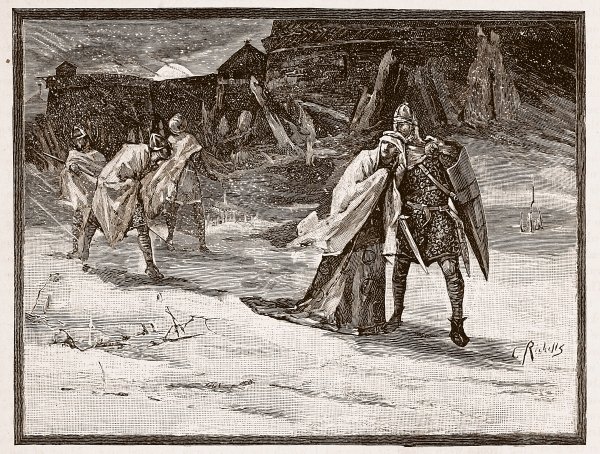
Matilda escaping Oxford
Matilda made a procession to London, sending word ahead that the "Lady of the English" (so she was calling herself) was coming to be made Queen, as was her right. Once she took up residence, emissaries from the city suggested what was probably her surest way to gain their hearts: cut their taxes in half. When she refused to do so, the citizens waited until she had left the city, and then shut the gates of London against her.

Meanwhile, the imprisoned Stephen's wife, also named Matilda, succeeded in capturing Robert of Gloucester, and used him to arrange an exchange of prisoners. With the release of both Stephen of Blois and Robert, hostilities resumed. The following winter, Queen Matilda was almost captured at Oxford, but she fled across the frozen Thames, camouflaged against the snow in a white cloak. The future of England's throne was looking more uncertain than ever.

[to be continued]