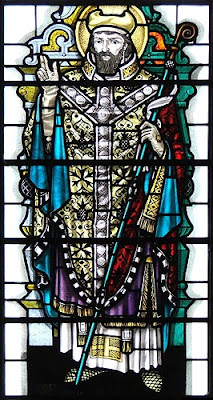
Oswald was actually Danish, and a nephew of Archbishop of Canterbury Oda (mentioned during the clash between Dunstan and Eadwig). Oswald was taught by the Frankish scholar Frithegod, a clergyman who served Oda, then was sent to an abbey at Fleury in France to become a monk. Oda called Oswald back to England, but died (2 June 958) before Oswald arrived.
Oswald looked for a mentor, and found it in the Archbishop of York, Oskytel. Oswald worked at York until he was made Bishop of Worcester in 961, succeeding Dunstan. One of his acts as bishop was to invite to England a monk he knew at Fleury, Germanus of Winchester. He wanted Germanus to be prior of a new monastic community at Westbury-on-Trym.
The continent had experienced a revival of Benedictine Rule that was much more strict than what was going on in England's monasteries. Oswald (along with the efforts of Æthelwold and Dunstan) wanted to bring that stricter lifestyle to the island. He also wanted to expunge the secularism he saw in the English Church, where indulgences were sold and positions were given to lay people for the monetary advantage instead of to clergy.
There were married clergy at the time, and one tradition states that Oswald expelled any priests who would not give up their wives and replaced them with monks. An alternate story is that he established monasteries near the cathedrals, allowing the secular priests to maintain their duties until he had enough properly trained monks to take over the cathedral duties, pushing out the priests.
He founded Ramsey Abbey, and in 985 invited Abbo of Fleury to run its school. Abbo taught computus, the method used to calculate the dates of Easter.
Oswald was named Archbishop of York in 972 but stayed Bishop of Worcester, an unusual arrangement that applied to the Archbishops of York for the next 50 years. It aided York financially to have a very wealthy diocese added to its holdings.
Oswald's daily custom during Lent was to wash the feet of the poor. On 29 February 992, while doing so at Worcester, he died. He was buried at the Church of St. Mary at Worcester. Miracles were reported at his funeral and tomb. Ten years later, his remains were translated to a spot at Worcester Cathedral.
The man who started him on his rise to fame, Archbishop Oda, has been named a few times in recent days, and we'll see what else he did, tomorrow.