Showing posts with label Black Death. Show all posts

28 November 2025

Learning After Black Death

While discussing how England tried to control the movement of laborers after the Black Death yesterday, I mentioned something about what we can learn from skeletons.

A while ago, I came across this article about Dr. Sharon DeWitte of the University of South Carolina, who examines skeletons from the Middle Ages to determine what she can about their lifestyle. So far, her research has included over 600 skeletons from the 11th through 14th centuries. She has particularly studied skeletons from the period just before and just after the Black Death. She found something curious:

“I found that a significantly higher number of people were living to really old ages after the Black Death. Many people lived beyond the age of 50 and particularly above the age of 70,” DeWitte said. “I honestly was surprised by how dramatic the difference was in their survival. I’ve analyzed risks of mortality within the pre-and post-Black Death populations, and the preliminary results suggest lower overall risks of mortality after the Black Death.” [source]

She attributes this to a few things: those who survived the Plague were more likely to be from a segment of the population that was healthier to begin with. Also, the population loss led to a food surplus that promoted greater health. We have already noted, for instance, the Statutes of Laborers, rules that were established (again and again) post-Plague to try to keep peasants from moving to other estates. The shortage of laborers meant workers had new opportunities to seek better wages that would lead to better living conditions.

In the future, she intends to collaborate with others to look at genetic variation in humans before and after the Plague. Perhaps she can learn how the massive "die off" perhaps reduced certain genes that made humans more susceptible to Plague, leaving future generations healthier.

Tomorrow we'll look at some of Dr. DeWitte's other conclusions from examining skeletons.

27 November 2025

Controlling the Workforce

“Whereas late against the malice of servants, which were idle, and not willing to serve after the pestilence, without taking excessive wages, it was ordained by our lord the king… that such manner of servants… should be bound to serve, receiving salary and wages, accustomed in places where they ought to serve… five or six years before; and that the same servants refusing to serve… should be punished by imprisonment…”

That is some of the wording of the Statutes of Laborers, also called Ordinance of Laborers..

After the Black Death (1348-50 in England), the workforce was radically reduced. In a culture where 90%+ of the workforce was involved in agriculture, and every bit of it done by manual labor, this was potentially disastrous for lords who relied on peasants to plant and tend and harvest crops. The obvious solution was to offer better wages if peasants would leave their homes and settle in the lords' villages that had been deserted by the Pestilence.

This competition for labor did not sit well with most of society, who saw it as a disruption of the way things had been for centuries. The first Ordinance of Laborers was established by Edward III in 1349 to try to prevent the disruption of society that a "free market" could create. It stated:

  • Everyone under the age of 60 must be willing to work
  • Employers must not hire more workers than they need
  • Wages must remain at pre-Pestilence levels
  • Food prices must not be increased

Did it work?

  • 1350 saw the Stature of Laborers that fixed the wages of laborers and artisans.
  • 1356 saw regulations placed on the trade of masons. (Freemasons use this as proof that Freemasonry has been fighting "the Man" for centuries.)
  • 1368 saw the Statute of Laborers reaffirmed.
  • 1377 saw an act restricting the freedom of serfs to move from domain to domain.

Clearly, the laws had to be re-enacted because no one was listening. The attempt to suppress the freedom of the lower classes continued for the next two centuries. In England the above led to the Peasants' Revolt of 1381

What else can we learn about life immediately following the Black Death? You'd be surprised what you can learn from examining skeletons. I'll explain that tomorrow.

(Full disclosure: much of this post is a repeat from 2012, with new info added.)

26 November 2025

After the Black Death, Part 2

As seen yesterday, the significant population loss resulting from the Black Death had a positive effect on laborers' wages. Reduction in the labor force made competition to hire laborers more keen, and those wishing to get their crops planted and harvested had to offer better rates to get laborers to travel to their demesne.

Unfortunately, this increase in wages did not result in an increase in quality of life. Inflation is not just a feature of modern economics. Because of the disruption in trade, etc., prices went up. Estimates from one scholar put the price increase at 27% just from 1348 to 1350. 

On the other hand, individuals had more cash on hand. With the deaths came a transfer of wealth to relatives, so there was more money in the hands of each individual. Barbara Hanawalt's research found, for instance, that the money lender in a town or village was likely to be a widow who inherited from her husband (sometimes a few husbands in a row) and used it to support her neighbors.

The changes mentioned in the preceding two paragraphs helped lead to the decline of the class called "serfs." There was more mobility, and the attempts to keep laborers tied to one lord's manor or demesne became increasingly difficult. Serfs could ask for higher wages or a larger percentage of the crops they harvested. The peasant class began to accrue more wealth. A generation or two would see a larger "middle class" forming.

Another change (difficult to quantify) came in the Church. St. Boniface centuries earlier was said to lament that "In the old days our priests were of gold and their chalices of wood; now the priests were of wood and their chalices are gold." The Black Death left many Church positions and parishes empty. The Church had to ordain many new priests quickly to fill appointments.

When the Black Death struck Europe in 1347, the increasingly secular Church was forced to respond when its religious, spiritual, and instructive capabilities were found wanting. The Black Death exacerbated this decline of faith in the Church because it exposed its vulnerability to Christian society.

... 

Part of the reason why the Catholic Church was so negatively affected by the plague was due to the deterioration in the quality of its clergy. A great number of priests succumbed to the pestilence, and the individuals whom the Church recruited to take their place could not adequately perform their duties. [link]

Tomorrow I'm going to talk about England's attempts to control the movement of peasants away from their obligated land to find new jobs.

25 November 2025

After the Black Death, Part 1

Although the cause of the Black Death has been questioned, what we know as the Bubonic Plague is the likeliest culprit, causing widespread mortality throughout Europe, killing as much as one-third of the population over just a few years (1347-1350).

This enormous demographic shift caused chaos on a scale hitherto unknown.

National estimates of mortality for England, where the evidence is fullest, range from five percent, to 23.6 percent among aristocrats holding land from the king, to forty to forty—five percent of the kingdom’s clergy, to over sixty percent in a recent estimate. The picture for the continent likewise is varied. Regional mortality in Languedoc (France) was forty to fifty percent while sixty to eighty percent of Tuscans (Italy) perished. Urban death rates were mostly higher but no less disparate, e.g., half in Orvieto (Italy), Siena (Italy), and Volterra (Italy), fifty to sixty—six percent in Hamburg (Germany), fifty—eight to sixty—eight percent in Perpignan (France), sixty percent for Barcelona’s (Spain) clerical population, and seventy percent in Bremen (Germany). [link]

What was the impact of the loss of population? We don't have census data, but there are records that survive from monasteries and landowners (lords) who did keep track of their finances.

...in England ... the immediate impact was to lower real wages for both unskilled and skilled workers by about 20% over the next two years. Estimated per capita GDP decreased from 1348 to 1349 by 6%. Similarly, in Spain, where the Black Death also arrived in 1348, real wages were 9% lower in 1350 and estimated per capita GDP decreased by 3.3%. [link]

Once the Black Death had passed and recovery began, wages started to rise for agricultural laborers (by far the majority of the population was agricultural, working lands for a lord). A landowner in need of workers could offer higher wages out of desperation, causing nearby landowners who offered less to lose their labor force. Laws called the Statute of Laborers were passed in England following the Black Death that required peasants to stay in one place, but the fact that these laws were passed every few years tells us that no one was actually following the law.

Not all wages rose. Those in the building trade found the demand for new construction at a historic ebb, so wages for laborers in that field were low.

We'll talk more tomorrow, especially about how prices skyrocketed.

24 November 2025

Before the Black Death

The greatest impact on European culture was not the Fall of Rome, the mass (forced) adoption of Christianity, the creation of the Holy Roman Empire, or any other event that seemed to make widespread change. The biggest event to affect European culture took place over the course of a few years.

Before we get to the changes wrought by this biological disaster, let's talk about a "pre-Plague" event.

The Black Death (which we now know was a major wave of the Bubonic Plague) arrived in Italy on 12 Genoese ships in October 1347. This event is often mentioned as the start of the Black Death. It's a completely Euro-centric approach, though, and as you know, this blog sometimes reaches eastward to discuss other events and people outside of Western Europe. We should ask ourselves: where did the 12 ships come from, and where did they get the Plague?

Genoa had extensive trade routes on the Black Sea, and built ports to serve themselves. One of these was Kaffa, on the Crimean coast (now called Feodosia or Theodosia, its original name when founded by Greek colonists 2000 years before the events we're talking about). Kaffa's part in our story begins when a Venetian (we recently discussed the hostility between Venice and Genoa, but the ultimate result allowed Venetians to use Genoese ports) killed a Mongol official in 1343. Janibek Khan, current ruler of the Golden Horde, assembled an army to bring the Venetian, who went to Kaffa, to Mongol justice.

China had been suffering from the Plague, and an outbreak of it while Janibek Khan besieged Kaffa weakened the army and diminished his ability to assault the city. He ordered one final attack:

The dying Tartars, stunned and stupefied by the immensity of the disaster brought about by the disease, and realizing that they had no hope of escape, lost interest in the siege. But they ordered corpses to be placed in catapults and lobbed into the city in the hope that the intolerable stench would kill everyone inside. What seemed like mountains of dead were thrown into the city, and the Christians could not hide or flee or escape from them, although they dumped as many of the bodies as they could in the sea. And soon the rotting corpses tainted the air and poisoned the water supply, and the stench was so overwhelming that hardly one in several thousand was in a position to flee the remains of the Tartar army. Moreover one infected man could carry the poison to others, and infect people and places with the disease by look alone. No one knew, or could discover, a means of defense.

(You can see how little they understood the spread of disease.)

Is the story true? It comes from Gabriel de Mussis, a notary from Piacenza in northern Italy not too far from Genoa, who wrote an account of the Plague as it was happening (he survived it). He could easily have got it from the Genoese.

I've talked about the Plague quite a bit. Now we've talked about"pre-Plague." Tomorrow we'll get to "post-Plague."

11 November 2025

Genoa versus Venice, Part 3

After the Battle of Curzola in 1299, in which Venice lost dozens of ships and thousands of men against Genoa, Venice was subdued for decades. Genoa maintained dominance in Black Sea trade, but Venice still had a presence there and throughout the Mediterranean. Constantinople's dislike of Venice helped Genoa establish a merchant colony across the Golden Horn from the city. This colony, Pera, became so powerful a trading town that it pulled trade away from Constantinople itself. 

In 1345, rebel Genoese called the Grimaldi were in Monaco, and Genoa wanted to take Monaco. A fleet was assembled for that purpose. It caused the Grimaldi to abandon Monaco for Marseille, and the fleet needed a new goal. Admiral Simone Vignoso led 29 galleys toward the Aegean Sea to deal with Venetian presences.

Vignoso learned that Humbert II of Viennois intended to capture the island of Chios (its ancient citadel is pictured above) and use it as a base to attack Turks as part of something called the Second Smyrniote Crusade. Humbert asked Vignoso to aid him in the venture, but Vignoso refused. Humbert was allied with Venice, and Vignoso wouldn't do anything to potentially aid Venice or its allies.

Vignoso chose to attack Humbert's fleet, taking horses and equipment, and capturing Chios. This move angered the Venetians and the Byzantines (who owned Chios), as well as Pope Clement VI who had called for the Smyrniote Crusade. Constantinople was dealing with a civil war, and so could not afford to worry overmuch about Chios.

In August 1350 Venice declared war on Genoa. At the end of August, 35 ships set sail for the Aegean. This was after a few devastating years of the Black Death, causing both Genoa and Venice to lose up to half their citizenry. The galleys were less well-manned than they would have been just a few years before, so Venice conscripted men from their other territories. This meant they went into a naval battle with inexperienced men who had not trained for war.

In the first encounter between the two navies, Venice attacked a merchant fleet, but once some of the ships were captured, the undisciplined conscripts abandoned fighting to plunder the Genoese ships, allowing the rest of the merchant fleet to escape and spread the word of the attack.

The senate in Venice was not happy with the behavior of the conscripts, but realized it could not dissuade them from desiring plunder without the risk of them mutinying. Riches had been one of the things offered to them during the drafting process.

The Genoese ships that had escaped joined with more at Chios. This small fleet then went and attacked the city of Negroponte, a Venetian base. Its Venetian governor fled (and was later tried for cowardice).

We'll see what happened after starting tomorrow.


10 September 2024

Arderne's Medical Manual

John Arderne (1307 - 1392), of whom I first wrote many years ago, has been called the father of English surgery. He earned this by producing a manual in Latin that was copied into English and widely used.

Although we know little of his personal life except that he practices in Nottinghamshire and London, his broad knowledge suggests someone who traveled and had a variety of experiences. Since he lived through the Black Death and the Hundred Years' War (during which he saw action in France), he had plenty of opportunities to learn about and deal with a wide variety of illnesses and injuries.

In 1370 he wrote the Practica Chirurgiae ("Practice of Surgery"), in which he detailed many of his techniques and boasted a for-his-time astonishing survival rate of 50%. There are not only detailed instructions, but detailed illustrations of the parts of the body being operated on, as well as illustrations of the instruments (many of which he designed) used.

More than the practical side of things, however, he gave advice to the surgeon open dress and behavior. He urged the university-trained doctor to dress the part, rather than wear the limited short (above the knee) robe of the typical "barber surgeon" (educated in a guild), to appear more important. Barber surgeons were looked down upon, and he advises his readers not to share techniques with them, lest they usurp the position of the university-educated surgeon. In a later century, in Paris, a distinction was made with the titles "Surgeons of the Short Robe" (who could offer their services never having taken an exam or proved their knowledge) and "Surgeons of the Long Robe."

Arderne's advice went beyond haughty classism, however. He also advised a pleasant bedside manner: the doctor should be able to tell tales "that may make þe pacients to laugh" and tales from the Bible to "make or induce a liȝt hert[light heart] to þe pacient or þe sike [sick] man." He should also, when speaking to a patient, not confuse him with complicated terms or harsh language:

“be the wordeȝ short, and, als mich as he may, faire and resonable and withoute sweryng”

make the words short, and, as much as he may, faire and reasonable and without swearing.

He felt that wealthy patients should be charged as much as possible, but poor patients treated for free.

More than 50 copies of his Practica exist today; 36 of them are copies with the original 250 illustrations. The expense of reproducing so many illustrations was significant, but it is a testimony to how valuable the work was considered to be. The illustrations were not only important to show how the body was being treated, but to understand the use of the instruments. These tools of the trade were not readily available, and had to be custom-made. I feel not enough has been said about the relationship of people with specific requests to the metal-workers of the age, so tomorrow let's talk a little about the blacksmith trade.

05 December 2023

Medieval Germ Theory?

It was Ignaz Semmelweis in the 1840s in Vienna who noticed a link between illness (and death) and unsanitary conditions, specifically a link between women dying during childbirth who were aided by people who also were performing autopsies. He spent years trying to implement a universal handwashing policy. He did not know what was causing the deaths, but he saw a link to something.

Figuring out the cause of disease was a goal for anyone practicing medicine from the beginning of the discipline. Long before germ theory was developed, the miasma theory was proposed by Hippocrates (c. 460 – c. 370 BC): that some form of "bad air" or even "bad water" arising from rotting matter caused diseases like the Black Death, cholera, and other infections. This was an important move away from the theory of supernatural causes of illness. (There was also the idea of an imbalance in the body's natural humors.) The miasma theory allowed infection to pass through a population because of the environment, not from personal contact.

To counter bad air, you would naturally want "good air."  medical faculty of the University of Paris, writing in 1348 to explain the causes of the Black Death, said "The present epidemic or pest comes directly from air corrupted in its substance" and recommends incense which "hampers putrefaction of the air, and removes the stench of the air and the corruption [caused by] the stench."

Earlier, however, there were counters to the miasma theory.

The Classical Era and Middle Ages did have theories of person-to-person contact. Thucydides (c.460BCE - c.400CE) believed that the plague of Athens was being spread by personal contact. Galen (129 - c.200CE) referred to "seeds of plague" in the air. Isidore of Seville also mentioned "plague-bearing seeds." Avicenna (c.980-1037) was widely studied, and he linked the miasma theory with personal contact, believing an ill person could infect others by transmitting the "bad air" through breathing. His example was tuberculosis, and he believed that disease could also be transmitted through dirt and water, anticipating Semmelweis by 800 years.

Recent posts have mentioned Bologna as an important center for medical study, so it is not surprising that it was a professor of Bologna, Tommaso del Garbo (c. 1305–1370), who in 1345 promoted Galen's "seeds of plague" idea in his works

It took Girolamo Fracastoro in 1546, however, to publish De Contagione et Contagiosis Morbis ("On Contagion and Contagious Diseases"), three volumes on different diseases and their avoidance and treatment. He believed that there were particles that could travel through the air or by direct contact.

The idea that these "seeds of disease" were living things (what we call "germs") and traveling from one person to another was not being entertained, simply because there was a long-standing theory that living matter could arise spontaneously from putrefaction, and no one believed in invisible living things floating in the air. The belief that life could spring from rotting organic matter hindered understanding of bacteria already existing in the air around us. As it turns out, there were plenty of examples of Spontaneous Generation; let's talk about those tomorrow.

28 October 2023

The Plague Continues

The Bubonic Plague, also called the "Black Death," first hit the European Middle Ages primarily in 1348-1351, but that wasn't the end. To be fair, it was revving up to the east long before 1348. It was responsible for deaths in the 1200s in China. In the 1340s it was killing people living around the Black Sea. In fact, we know that it existed among rodent populations high up in the Alps.

How do we know this?

The spread of the plague has been better understood in recent decades thanks to modern science and the sequencing of genomes. The bacterium Yersinia pestis has been sequenced, and modern science can detect it from bones of the long-dead. In many cases, those bones are easier to identify because the plague killed so many so fast that the corpses were thrown into mass graves quickly. In fact, the approach of the plague did prompt preparation: the mass graves in London were dug before the plague actually arrived. (The illustration shows a mass grave of plague victims in France.)

Therefore, by examining skeletons from different eras, we can track the spread and durability of the plague, which was endemic in Europe after the mid-14th century appearance. Plague returned approximately every decade or so for centuries. Whatever the cause (see the link in the first paragraph), folk realized they should try to stay away from those who were infected. This led to quarantining when news of a plague resurgence came to a community. You could either barricade yourself in your house or escape the town. In 1377, the town of Ragusa on the Adriatic initiated the first wide-spread, mandatory quarantine. In the second half of the 1400s, quarantines were common around the Mediterranean, whose warm weather and coastal ports allowed plague to thrive and spread.

Ragusa actually had a reputation for doctors. If you search for Ragusa on a map today, it will show you a city in southern Sicily, not on the coast of the Adriatic. That's because it's got a different name now: Dubrovnik. Let's talk about its medieval history tomorrow.

27 October 2023

Causes of the Bubonic Plague

The Bubonic Plague's first appearance in medieval Europe from 1348-1351, and it was terrifying. At least one-quarter to one-third of the population died in those few years; entire villages were depopulated, and no country was untouched.

King Philip VI of France asked the University of Paris to determine the cause. Forty-nine members of the medical staff studied the matter and wrote the Paris Concilium.

They produced more than one theory of why humans were suffering from it, while maintaining that the plague was too mysterious for human beings to ever truly understand the origin. They drew from the available authorities: Avicenna's work on pestilential fever, Aristotle's Meteorology on weather phenomena and putrefaction, Hippocrates' Epidemics on astrology in medicine.

Their theories:

—The Concilium followed Aristotle's idea that a conjunction of Jupiter and Saturn was disastrous. Albertus Magnus believed a conjunction of Jupiter and Mars would bring plague. A conjunction of Saturn, Jupiter, and Mars took place in 1345 right after solar and lunar eclipses, under the sign of Aquarius, compounding the disastrous effects of the planets. Jupiter was sanguine, hot and wet—the worst combination that would lead to putrefaction.

—Another possible cause was poisonous gases released during earthquakes. Disadvantageous conjunctions of constellations produced winds that distributed gases rising from rotting carcasses in swamps. The poisonous vapors would be inhaled and go straight to the heart (they thought the heart was the organ of respiration), and then cause the body's vital organs to rot from the inside.

—There was also the possibility of God's punishment for man's wickedness.

Of course, there was no reason to believe that these causes were mutually exclusive.

The plague was devastating, and also didn't end in 1351. It remained endemic to Europe, as I'll discuss next time.

25 September 2023

The Start of the Italian Renaissance

Because there are no "hard and fast" dates for cultural eras (although I nominate 1453CE for one), the Italian Renaissance painting is carefully divided up into four phases: the Proto-Renaissance (1300–1425), the Early Renaissance (1425–1495), the High Renaissance (1495–1520), and Mannerism (1520–1600, which we in this blog can safely ignore). Cimabue (c.1240 - 1302) is often called the first great artist of the Proto-Renaissance period in Italian art. Why "photo"? If it's new and part of the rebirth, why can't we just say he is the first of the Italian (prefix-free) Renaissance?

Part of the problem is that the Renaissance does not begin everywhere all at once. These phases represent trends in art and are tied to specific artists who tried something "new" and whose work influenced the style of others. The Proto-Renaissance in Italian art was dominated by two figures: Cimabue and Duccio of Siena (his Madonna and Child, now in the London National Gallery, is shown above). Along with two contemporaries, Guido of Siena and Coppo di Marcovaldo, they seem to have been influenced by the unknown the so-called Master of St Bernardino. They specialized in stylized religious paintings in which the angle of the head and position of the hands, for instance, were determined by traditional icon paintings in the Byzantine style.

Proto-Renaissance painting was dominated by religious art. During this Proto period the Black Death inspired a change in theme to the need to approach death in a state of penitence; images of death and the torments of Hell began to dominate church art. More than one painting is named "Triumph of Death" from this era.

Much of this was happening in Siena, ruled by a republic since 1125. I'd like to talk about its history next time.

18 September 2023

Boccaccio's Decameron

Giovanni Boccaccio's best known work to modern readers is his Decameron, a Greek word that means "Ten Days." In it, seven young men and three young women go into the hills above Florence to spend ten days in a villa to escape the Black Death, currently ravaging the cities and countryside.

One theory of the Black Death was that it resulted from bad air rising from swamps and cesspools, and going up into the fresh air outside the city was one way to escape it. Of course, whether the disease were being transmitted by fleas jumping from mammal to mammal or being spread by contact with those who were ill, getting away from crowded populations into fresh air would be an obvious smart choice.

The ten young people decide to pass the time by each telling a tale each day, resulting over the ten days in a collection of 100 tales. Each of the ten takes a turn being the king or the queen for a day, and gets to choose the day's theme. The themes include comedy, tragedy, romance, etc., but go beyond those simple topics.

One day is for stories of virtue, one is romances that end happily, while one is for romances that end in tragedy. There are tales of luck, tales about women who play tricks on men, and tales where the main character is in trouble but saves himself or herself by quick thinking at the climax.

The whole is not just a sequence of tales. Boccaccio gives us a description of other ways that the ten occupy their time, including songs that they sing to entertain each other. These songs, the daily activities, and the tales themselves with some of their recurring concepts of mocking the clergy, nouveau riche vs. old noble families, and the similarity between men and women's lust and ambition, paint a picture of 14th century Italian life in prose that is a useful introduction to the feelings of the time and place.

Boccaccio likely made up none of the tales, but that does not mean there is no original material. The medieval approach was to take a known tale and develop it in new ways. Most of the tales in the Decameron can be found in other forms in earlier sources...and later, since his tales were read and used by others, such as Geoffrey Chaucer in the Canterbury Tales.

Despite the name Decameron, Boccaccio also referred to the work by two other names, which are interesting anecdotes in their own way. I'll share those tomorrow.

17 September 2023

Giovanni Boccaccio

Giovanni Boccaccio (1313 - 1375) was eight years old when Dante died, but he revered the man and wrote a biography about him. He even gave a series of lectures in Florence on Dante's works—a first for a non-Classical Era writer. He was more than just a fan of another, however, becoming a treasured poet in hid own right.

Like Dante, Bocaccio wrote in Tuscan vernacular rather than Latin, and he wrote in prose, telling stories that captured the imagination and inspired others, including Geoffrey Chaucer.

Boccaccio grew up in Florence. His father worked for the banking/trading company of the Bardi; Giovanni worked there for a brief time, deciding that it was not a profession to his liking. His father came head of a branch in Naples, taking the family there, and Giovanni persuaded his father to let him study law at what is now the University of Naples (where Thomas Aquinas had been 100 years earlier). Six years of studying canon law taught him that he liked that profession no more than he liked banking.

Two good things came from his time in Naples. One was his love for Fiametta. That was not her name; simply what he called her in his writings. If she existed, she was really Maria d'Aquino, illegitimate daughter of King Robert the Wise of Naples, whom he saw and with whom he fell in love. He wrote a novel about her, and mentions her in many other writings.

The other good thing from his time in Naples was that he began writing. He produced works such as Il Filostrato, about star-crossed lovers during the Trojan War (which became a source for Chaucer's Troilus and Criseyde and Shakespeare's Troilus and Cressida), and Teseida, nominally about Theseus but dominated by the rivalry of two young knights over a woman (and the source of Chaucer's "The Knight's Tale" in The Canterbury Tales).

He also wrote the first Italian prose novel, Il Filocolo, the story (well-known in Europe) of Florio and Biancifiore, two lovers from different stations in life. Fiametta appears as the "queen" of a "noble brigade" who pose questions to each other about love.

Perhaps his best-known work is the Decameron ("Ten Days"), in which a group of young men and women flee who flee Florence during the Black Death to the hills outside, where they spend ten days telling stories. More on that tomorrow.

24 February 2023

Cats in the Middle Ages

Dick Whittington's cat might have made his reputation according to the legend, but cats were not always a welcome sight in the Middle Ages. They were used in many amusing  marginalia, but they were considered to be linked to the supernatural and paganism. Fear of their presence, especially in time of trouble such as during the Black Death, led to events such as the Kattenstoet in Ypres.

Technically, Kattenstoet means "Festival of the Cats," which sounds delightful. It commemorates, however, the medieval practice of throwing cats from a high belfry tower in the Cloth Hall. This was considered symbolic of banishing evil. Nowadays it is less fatal for felines: a jester tosses plush toy cats from the tower to waiting arms below.

(Associating cats with the evil of the Black Death, of course, may have led to eliminating one of the potential brakes on its spread, because of course cats might have helped keep in line the spread of rodents whose fleas would have carried the disease.)

Cats weren't always disliked: the number of cats in the margin of manuscripts suggest that they were actually quite common in the monasteries where such manuscripts were being created. Cats also appear in many illustrations of domestic scenes, suggesting that they were a common pet.

The Islamic world saw cats as more preferable than "unclean" animals like dogs, probably because cats are seen cleaning themselves daily. Cats were even acceptable in mosques. Their reputation was probably enhanced by Abu Hurairah, a companion of Muhammad, whose name means "father of the kitten." He fed and cared for stray cats at his mosque. Abu Hurairah was not likely his real name, and his attachment to cats was not his most significant feature. I'll tell you more about him tomorrow.

18 September 2022

Catherine of Siena

Catherine of Siena is an example of how one can be connected to a religious order and still influence events "in the world."

She was born on 25 March 1347 as Caterina di Jacopo di Benincasa, and survived the imminent Black Death that was about to ravage Europe. A happy child, she had a vision of Christ with Peter, Paul, and John when she was only five or six, and decided shortly after  to devote herself to God.

This was not her parents' plan for her, however, and at 16 they wanted her to marry the widower of a sister who had died in childbirth. Catherine cut off her hair and started fasting to show her opposition to this plan and to make herself less attractive to a husband.

Quiet rebellion won out, and eventually her father relented and allowed her to choose her own life's path. She would later advise Raymond of Capua how to manage adversity: "Build a cell inside your mind, from which you can never flee." In her imagination, she pictured her father as Christ, her mother as Mary, her siblings as apostles. She treated them with respect and used this approach as a path to spiritual growth.

After she had a vision of St. Dominic she expressed a desire to join the Dominicans; this upset her mother, who tried ways to change her mind, but eventually allowed her to join a local group of devout laywomen, the Mantellate Sisters, a third order devoted to the education of youth and caring for the ill and poor. They taught Catherine to read. She still lived with her family, but seemed to have taken a personal vow of silence. Also, she would give away food and clothing, upsetting her family.

At 21, she had a vision which she described as a mystical marriage to Christ (pictured above by Giovanni di Paolo, 1400s). She claimed that she received a wedding ring during this vision, but not a typical ring, rather Christ's foreskin from the time of his circumcison when he was eight days old. (She would claim that she wore this ring, but it was invisible.) During this vision, Christ told her to give up her quiet life at home and go into the world. She became more active in her charity, helping the ill or poor in hospitals or homes.

Eventually, Siena became too small a venue for her desire to do good works, and she started getting involved in much larger issues. What she did, and how she even fixed a "problem" with the papacy, we will talk about tomorrow.

03 June 2022

The Hundred Years' War, Part 3

(If you want to see parts one and two.)

The second part of the Hundred Years' War was the Caroline Phase, named after Charles V of France, who ignored the Treaty of Brétigny and started reclaiming sections of land from the English-held territory.

Charles had a reason to think the time was right for this move. Problems in Castile caused Pedro the Cruel to ask England for help in restoring him to his throne. Edward, the Black Prince, spent a lot of money raising an army to help. Once Pedro was restored, he broke his promise to repay Edward. Edward decided the best way to recoup his losses was to raise taxes in Aquitaine.

The people of Aquitaine, since they were French citizens, appealed to King Charles for aid, who summoned Edward to Paris in May 1369. When Edward did not appear, Charles declared war. An ailing Black Prince had returned to England in 1371 where his father was also elderly and in poor health. While Aquitaine was in turmoil, Edward's forces were no longer helping Pedro, who was once again deposed. His enemy was his half-brother, Henry of Trastámara. Henry was now more than willing to throw his military power behind the French forces against England. The English fleet was defeated soundly in the Battle of Rochelle in June 1372.

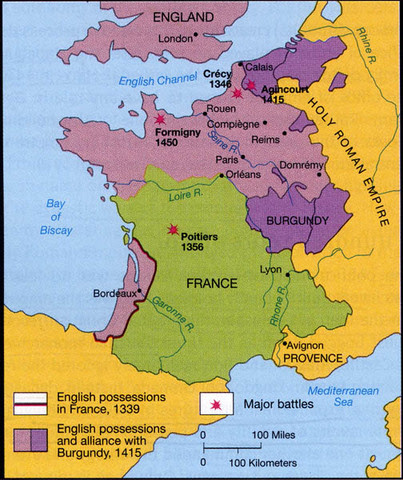
The Black Prince died on 8 June 1376; his father died 21 June 1377, leaving the throne to the Black Prince's son and heir, crowned Richard II, who was 10 years old. A pre-teen king was not going to conduct a war, so England's territory on the continent was mostly the town of Calais.

We should also remember the the Black Death struck between 1348 and 1351, killing up to 33% of English and 40-50% of the French. Raising and outfitting armies could not have been easy. Moreover, the Plague returned every several years, although it did not kill as many each time.

The war would be renewed by Henry V. Stay tuned.

19 May 2022

Richard Rolle

Richard Rolle (c.1300 - 30 September 1349) was born to a North Yorkshire farming family. He showed promise as a young man and was sponsored by the Archdeacon of Durham to attend Oxford to study philosophy. He gravitated more toward theology and biblical studies, but left Oxford while still in his teens to become a hermit.

At first he tried to live simply near his family's home, but became worried that they would disapprove and try to "reclaim" him. One day he encountered a former fellow Oxford student, John Dalton, who was willing to set him up in a cell with the necessary provisions.

A few years after leaving Oxford, while living an ascetic life on Dalton's property, he had his first mystical experience. He expressed the feeling of mystical experience as calor, canor, and dulcor. Calor was a feeling of heat. Canor was an experience of sound. Dulcor was a sweetness that accompanied both the feelings of calor and canor. A combination of these feelings was with him always after that, about which he says "I did not think anything like it or anything so holy could be received in this life."

Having attained this level of mystic expression, he left Dalton's cell and started to travel. We know he spent time in Hampole, sharing his experience with a Cistercian convent. He also visited Margaret Kirkby, whom he had set on the path to the anchorite life. He was able to cure her seizures by his presence.

He stayed near the Hampole convent for the rest of his life. He died there in 1349, possibly having succumbed to the Black Death, although by fall of that year the worst of the plague was over. He was originally buried in the convent cemetery, but later moved to his own chapel space because of the attention his grave drew: visitors and supplicants came to pray and make offerings; miracles were claimed to result.

In the 1380s, canonization proceedings were begun; many of the details of his life (other than details he included in his many writings) came from recording the anecdotes from people who knew him or had heard of him during the process of preparing a biography as part of the canonization process. The process was never completed, however, so he never became Saint Richard Rolle, although the Church of England commemmorates him on 20 January. In the Episcopal Church in the USA, he is commemorated on 28 September along with the mystics Margery Kempe and Walter Hilton.

His writings were so popular that over 450 manuscripts survive that were produced between 1390 and 1500. His writings were more popular than Chaucer. We can look at some of them next.

06 July 2017

Protecting the Jews

The Plague, also called the Black Death, spread across Sicily shortly after the arrival of a fleet of a dozen Genoese galleys bringing goods from the far eastern end of the Mediterranean. This was in October of 1346. A few months later, in January 1348, galleys from Kaffa (in Crimea) reached Genoa and Venice, where outbreaks also began.

The rest of Europe might have been spared—crossing the Alps would be difficult for the Plague carriers—but one of the galleys was driven away from Italy and found shelter in the port of Marseilles on the southern coast of France. That was the real introduction to continental Europe, after which there was no stopping it.

There is plenty of information about the Black Death to be found online—including in the blog—so there is no need to go into details here. There is, however, a specific event related to the Plague that took place on today's date.

Many populations throughout history, unhappy with their lot, either due to general difficulties or tragedy, have looked for a scapegoat. That scapegoat often takes the form of other people who can be labeled as "outsiders" who are not us and whose presence or actions are hurting us. In the case of the Plague, that scapegoat in many locations was the Jews, who were persecuted and killed, accused of poisoning wells (despite the fact that they drank from the very same sources of water), or of general wickedness that had brought down the wrath of God.

Pope Clement VI was moved to produce a papal bull, Quamvis perfidiam, defending the Jews against the accusations, and urging his fellow Christian prelates to defend them in their territories. It was released on 6 July, 1348. Unfortunately, persecution persisted, and so he re-issued it on 26 September.

10 December 2015

The Demonization of Cats

Here is a description of a medieval cult:
At length, when the novice has come forward, [he] is met by a man of wondrous pallor, who has black eyes and is so emaciated [and] thin that since his flesh has been wasted, seems to have remaining only skin drawn over [his] bone. The novice kisses him and feels cold, [like] ice, and after the kiss the memory of the [C]atholic faith totally disappears from his heart. Afterwards, they sit down to a meal and when they have arisen from it, the certain statue, which is usual in a sect of this kind, a black cat descends backwards, with its tail erect. First the novice, next the master, then each one of the order who are worthy and perfect, kiss the cat on its buttocks. Then each [returns] to his place and, speaking certain responses, they incline their heads toward to cat. 
This is from a papal bull called Vox in Rama ["A Voice in Ramah"], issued by Pope Gregory IX somewhere from 1232 to 1234, condemning a German heresy. There is more, outlining the practices of this form of devil worship, requiring German authorities to root out and stop this practice, and kicking off a demonization of cats that caused them—especially black cats—to be killed in large numbers. This destruction of cats, and the subsequent increase in rodents population, enhanced the spread of the Black Death a little over a century later.

...and it is all very likely untrue.

Let us start with the Black Death: killing all the black cats—or even more cats—in Western Europe would not stop the spread of the Plague in India, China, Constantinople, etc. The earliest text we have of Vox in Rama is from an 1883 collection printed in Germany of Latin texts. It is possible that Gregory sent a letter to Germany that got collected here, but it does not sound like a typical papal bull. If his injunctions were applied at all, they may have been applied only locally in a very few areas.

Some even question whether it is a late forgery: Gregory was very erudite, and a lawyer. This document is very unlike any of his writings. It seems like a document created later to support a theory of devil worship.

This was not necessary to stain the reputation of cats, however. The 12th century English author Walter Map had already associated cats with witches who take feline form in De nugis curialium [Latin: "The trifles of courtiers"]. He relates many supernatural folktales.

Maybe the independent nature of cats bothered people, who felt that creatures were created by God to be subservient to man. Maybe the fact that Muslims liked cats—Muhammad speaks well of them—made cats seem pagan and suspicious. Some combination of circumstances singled out cats for vilification. We will probably never know for certain the underlying reason.

18 June 2014

Henry of Nordlingen

The walled town of Nördlingen in Bavaria
Henry of Nördlingen was an interesting character. We don't know when he was born, nor when he died, but we know that he was very active for many years in the "German mystic" circles.

The British Museum holds a manuscript which contains 58 letters written by Henry between 1332 and 1351; in fact, they are considered the earliest collection of personal letters written in German.

His life's goal—the only goal of which we know, based on the letters—was to guide and advise mystics, of which his mother was one. He wrote letters to, or visited, several mystics in order to encourage them. Among his correspondents were Christina Ebner, Margareta Ebner (no relation to Christina), Henry Suso, Johannes Tauler, and others.

He translated the memoirs of the 13th century mystic Mechthilde of Magdeburg, and used it as an example to other mystics to write their revelations. He also sent them books on theology, such as the works of Thomas Aquinas. His activities and letters shed a great deal of light on the thread of mysticism running through 14th century German religious society.

He was also a preacher in his own right; he was very popular, traveling to Avignon and Switzerland, where he was welcomed by the "Friends of God," a group inspired by the teachings of another German mystic, Meister Eckhart (c.1260 - 1328). He left them and preached in Alsace during the height of the Black Death there, then returned to Germany in 1350. His last known correspondence was with Christina Ebner in 1351; after that, we have no knowledge of the end of his life.