Showing posts with label Archbishop Wulfstan. Show all posts

03 November 2026

On False Gods

Now that we understand Euhemerism we can look at Ælfric of Eynsham's example of it in his essay De falsis deis ("On false gods"). A handful of manuscripts survive, at least one of which is a translation from Anglo-Saxon to Old Norse.

Ælfric's goal was to explain away all the heathen stories of gods and legends and put the world into a Christian context. Archbishop Wulfstan of York (previously mentioned here) "borrowed" Ælfric's writing for his own homilies, also known as De falsis deis as well as Homily XII. Wulfstan's became very well-known and copied throughout the island. From him we have more complete versions, and we'll use it below.

Of course the problem with heathens is caused by the devil:

Alas, it is because of the devil that many things went wrong long ago, and mankind disobeyed God too greatly, and heathenism altogether did harm too greatly and still does widespread harm. However, we do not read anywhere in books that man established any idolatry anywhere in the world in the time before Noah's flood.

Then they also took it as wisdom, through the devil's teaching, to worship the sun and moon for gods because of their shiny brightness, and they made sacrifices to them that they did not know before, but learned through devil's teaching,

Some men also said that the shiny stars were gods and began some believed gods were also in fire because of the sudden heat, some also believed there were gods in water, and some believed gods were in the earth, because she nourishes all things.

Yet heathens would not be restricted to as few gods as they had before, but took to worshipping various giants and violent men of the world who became mighty in worldly powers and were awe-inspiring while they lived, and they foully followed their own desires.

He then becomes very specific:

One man was in former days living on the island that is called Crete, and he was named Saturn, and he was so savage that he did away with his own children, all except one, and unlike a father he destroyed their lives in their youth.

He nevertheless reluctantly left one alive (though he did away with his brothers) who he was called Jove, and he became a savage fiend. He expelled his own father from the same aforementioned island called Crete, and he would have destroyed him eagerly if he could. This Jove became so wanton that he took his own sister as his wife; she was named Juno, and she became a greatly exalted goddess according to heathen reckoning.

He continues to explain away the named deities of the Classical Era:

There was also a man called Mercury, he was very crafty and deceitful in deed and trickeries, though his speech was fully clever. The heathens made him a renowned god for themselves; ... This false god was honored among the heathens in that day, and he is also called by the name Odin in the Danish manner. Now some of the Danish men say in their error that he, whom they call Thor, was Jove, the son of Mercury, whom they call Odin—but they are not right, for we read in books, both in heathen and in Christian ones, that the evil Jove is, in truth, Saturn's son. 

There was also a woman named Venus; she was Jove's daughter and she was so foul and wicked in lust that she copulated with her own brother, or so the men say, through the devil's teaching, and the heathens also worshipped that evil woman as an exalted woman.

Wulfstan's copying of Æfric's work was only fair, since Ælfric himself based his version on a 6th-century sermon by Martin of Braga. Let's check out Martin tomorrow and see what else he did.

03 March 2025

Trouble in Northumbria

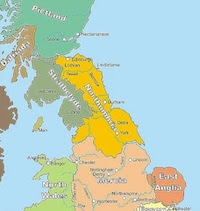
In 947/948, the folk of Northumbria decided to oust Amlaib Cuarán, the Viking ruler who came from Dublin with his cousin, Olaf Guthfrithson, and took over when Olaf died. They invited Eric (later called "Bloodaxe") from Norway to take his place. This request for another Scandinavian ruler seems to be a response to the Anglo-Saxon family of Æthelstan continually subduing the north to keep England united.

Archbishop of York Wulfstan supported Eric, but the current Anglo-Saxon king, Eadred, came north in 948 and destroyed part of Northumbria as punishment, even burning several buildings at Ripon (a significant place, it was founded by St. Wilfrid and housed the remains of St. Cuthbert at one time). When he departed the north, Eadred advised that he would return with greater devastation if they did not get rid of Eric.

That did not resolve the "northern trouble," however, because shortly after, King Malcolm I of Scotland raided Northumbria and took captives and stole cattle. Moreover, with Eric gone and Eadred back south, Amlaib returned in 949, so one record claims. That only lasted until 952 when, once again, the Northumbrians expelled him, whereupon Eric returned to reign from 952 - 954.

Eric might have stayed longer except for a betrayal. A history written a century later by Roger of Wendover says:

King Eric was treacherously killed by Earl Maccus in a certain lonely place which is called Stainmore, with his son Haeric and his brother Ragnald, betrayed by Earl Oswulf; and then afterwards King Eadred ruled in these districts.

After this, Oswulf administered Northumbria and was loyal to Eadred and the following English kings. Northern control by Vikings was a thing of the past. The identity of Maccus is unknown. It is assumed that Roger of Wendover had access to a text with details of the death that is no longer available to modern scholars.

Tradition tells that Oswulf ruled all of Northumbria for about the next decade, so I think he's worth talking about, although we know very little about him. See you tomorrow.

02 March 2025

Eric Bloodaxe

I mentioned yesterday that the control of northern England passed in and out of Anglo-Saxon and Viking hands until finally the inhabitants themselves drove out the last Viking ruler in 954. That ruler was Eric Bloodaxe.

Details of Eric's life are few, and this has caused the sometime King of Northumbria in the 940s and 950s with an Eric of Norway mentioned in Norse sagas who ruled the Norwegian Westlands in the 930s. This possibly erroneous conflation of the two gives us a richer history, but cannot be proven. If true, however, then Bloodaxe is the son of Harald Fairhair and half-brother of Haakon the Good, and left the kingship of Norway to rule over northern England.

At least we have evidence of his status in England from the existence of coins minted during his reign. Shown are coins minted at York with "ERIC REX" on them, accompanied by a sword.

The epithet "Bloodaxe" comes from mentions by a Norse poet writing in the 900s, and is given to him because he supposedly slew his half-brothers to ensure his rule over Norway. Other poets and historians refer to him as a "brother killer" or simply the he was vicious as a Viking raider. The Anglo-Saxon Chronicle omits "Bloodaxe" and refers to him simply as "Harald's son."

Let's talk about northern England. When Æthelstan died in 939, he was succeeded by his teenage brother Edmund. It seems that Olaf Guthfrithson almost immediately left Dublin to reclaim what he once claimed. He was joined by his cousin, Olaf Sihtricsson (known in Ireland and usually referred to in chronicles as Amlaib Cuarán). When Guthfrithson died in 941 or 942, Amlaib succeeded him. He had (for a time, at least) the support of Archbishop Wulfstan of York. Edmund then marched north and subdued Amlaib (and Wulfstan), and negotiated a treaty: Amlaib would be an ally and could hold onto Northumbria.

This second Olaf, however, was supposedly not as acceptable as the first, so Wulfstan and others helped drive him out in 952 and invited Eric from Norway to come and rule them. This is where he starts minting his own coins. Tomorrow we'll continue the back-and-forth possession of Northern England from Viking to Anglo-Saxon hands.