Showing posts with label humors. Show all posts

21 July 2026

Urinalysis, Part 2

We started a conversation yesterday on the use of urine by medieval Western European physicians to determine health. I thought today we'd go into exactly how the urine was an indicator of health.

Examining sediment in the urine was one case, which was described yesterday in a paragraph from Giles Corbeil's (fl.1200) poem De urinis. Later elaborations on this suggest the urine would settle into layers of different colors. A large layer on top could indicate a problem with the head. Some sediments indicated kidney stones.

Smell and taste were also ways to examine urine. Smell was obvious, but taste was also used at times; sweetness was an indication of diabetes.

Visual examination was the first and most common method, and was the reason why a glass flask became the symbol in illustrations of a physician. Hippocrates (c.460–375 BCE) started the business of the look of urine having significance. He felt it was the output of all four humors of the body, could indicate which was deficient or superabundant, and could be used to predict the progress of a disease.

White or pale yellow urine was healthy, but black or foul-smelling urine predicted an increase in disease. White sediment meant the illness would be long but not fatal. Completely colorless urine was the sign of a disease of the brain (these days it means excess hydration with water).

If there were bubbles in the urine, long-term kidney disease was the cause. The modern term proteinuria is now used for this condition, denoting protein in the urine and indicating damaged kidneys.

In the circular diagram above (found in the 14th-century manuscript Bodleian Library MS Savile 39), we see the "color codes" for urine. They range from the pale urine of decent health to the reddish-gold denoting healthy digestion to the dark flasks of impending death.

Urine travels in containers, and could be collected and sent to a physician or an expert urologist if you had none nearby. Isaac Judaeus, an expert on urology, criticized this idea; he believed diagnosis without seeing the patient in person was pointless.

Tomorrow we'll discuss the punishment for urinal malpractice, and look at a couple urinalysis patients.

19 July 2026

Blood & Health

We've been talking about blood as food, and some recipes using blood in cooking, but now let's talk about health-related blood.

Blood was considered one of four "humors" that were the key to health and personality. I wrote about these humors before. When the four humors were in balance, health was maintained.

Hippocrates would have it that "The people who have red blood are friendly. They joke and laugh about their bodies, and they are rose tinted, slightly red, and have pretty skin." The adjective sanguine to denote a person who was optimistic or notably positive in their outlook starts in the Middle Ages. The word comes from Old French sanguin(e) "blood red," from Latin sanguineus "of blood," from sanguis, "blood."

The other humors were yellow bile, phlegm, and black bile, but blood was the easiest one to see. Galen believed that blood carried the pneuma, the spirit, which accounted for its red color. Blood was associated with the element of air, and an excess of blood was thought to be responsible for inflammation, fever, and aggression.

To rid a suffering person of excess blood, phlebotomy, the practice of opening a vein and letting blood out, was developed. Ancient Egypt and the 5th-century BCE time of Hippocrates used bloodletting to help patients heal from illness. Just as menstruation was believed to purge women of "bad humors," bloodletting became a common technique.

In 1163, Pope Alexander III decided it was inappropriate for monks and priests to shed blood (repeated at the Fourth Lateran Council), so their time as practitioners of the medical techniques came to an end. Clergy could still be physicians, but not surgeons.

Medieval art symbolized a physician with a man holding up a flask. That flask, however, was not filled with blood.What it was filled with, and how it was used to diagnose illness, we'll discuss next time.

30 November 2023

Humorism

Trying to understand biology had many false starts. You probably have some idea of "humors" and the adjectives cold, hot, wet, and dry. These four provided a nice symmetry, and as you can see in the illustration, they also fit with the foursome of elements.

Other cultures came up with different paradigms. Indian Ayurveda medicine believed in three humors (tissues, waste, and dosha, "that which can cause problems") and five elements (adding "space" to the four seen here).

These qualities were supposed to explain the functioning of the body as a balanced mixture. An unhealthy state was the result of the balance being thrown off, the excess or absence of one of the humors.

The arrangement familiar to the West likely started with Hippocrates (although there were others around his time who also expressed ideas about the four elements), who systematized the idea of different substances being balanced in humans:

The Human body contains blood, phlegm, yellow bile, and black bile. These are the things that make up its constitution and cause its pains and health. Health is primarily that state in which these constituent substances are in the correct proportion to each other, both in strength and quantity, and are well mixed. Pain occurs when one of the substances presents either a deficiency or an excess, or is separated in the body and not mixed with others. [On the Nature of Man, attributed to either Hippocrates or his son-in-law, Polybus]

Galen furthered this theory, tying it to seasons and stages of life. For instance, a child corresponded to spring. Blood was hot and wet, which corresponded to spring. Yellow bile, hot and dry, corresponded to summer, corresponding with the life stage of a young man, and so on.

The humors could also influence personalities; one Greek text put it thusly:

  • The people who have red blood are friendly. They joke and laugh about their bodies, and they are rose tinted, slightly red, and have pretty skin.
  • The people who have yellow bile are bitter, short tempered, and daring. They appear greenish and have yellow skin.
  • The people who are composed of black bile are lazy, fearful, and sickly. They have black hair and black eyes.
  • Those who have phlegm are low spirited, forgetful, and have white hair. [from link]
These attributes were not predictive, like astrology. If a person's manner changed, it could be because the mix of humors in him had changed.

Humorism, or humoral theory, "explained" so much about physical health and temperament for 2000 years. The 1600s brought more exploration via surgery and the use of microscopes to better understand the function of the organs of the body and the fluids inside it. With the advent of germ theory, proposed in 1546 and expanded in the 18th century, the idea of humors fell by the wayside. 

Of course, there was much more to medical treatment in the Middle Ages than just fiddling with the balance of humors. Sometimes you had to get out the knives. Let's talk about medieval surgery tomorrow.

29 November 2023

The Maintenance of Health

The modern Italian word for a notebook is taccuino. It comes from the medieval (and later) popularity of the Tacuinum Sanitatis. That name is a Latinized version of the Arabic Taqwīm aṣ‑Ṣiḥḥa ("Maintenance of Health"). It was written in the 11th century by Ibn Butlan of Baghdad, a physician and Christian theologian during the Abbasid Era.

The original was organized in synoptic tables: a way to present data in a simple and condensed manner, previously used for astrological tables. Ibn Butlan used them to present not just ways to treat illness and to maintain health, but also ways to prepare food and how and what to grow for health. Later manuscripts were lavishly illustrated, especially after the 14th century. (The illustration is of a facsimile edition made in 1986.)

Ibn Butlan set out the essential elements of health and well-being:

  • sufficient food and drink in moderation
  • fresh air
  • alternations of activity and rest
  • alternations of sleep and wakefulness
  • secretions and excretions of humors
  • the effects of states of mind

If one is not paying attention to these elements, illness occurs.

The Tacuinum includes lists of many vegetables, fruits, nuts, and herbs that are good for treating certain conditions. It also includes the dangers of excess consumption. As the manuscript was copied and distributed, changes were made, and not every copy includes every list. Some added remedies that were not in the original.

The word "humors" was italicized in Ibn Butlan's list because I wanted to draw attention to it. I've ignored discussing the medieval idea of humors for over a decade because I assumed people have already heard of them and I want this blog to focus on all the things that are not generally known. Of course, the details of humors are probably worth talking about. See you tomorrow.

30 March 2022

The Book of Pee

One of the medical texts composed by Isaac Israeli ben Solomon was translated from Arabic to Latin and called De Urinis ("Concerning Urine"). One manuscript copy (Ms. 690) in the University of Utrecht Library shows signs of frequent use, and yet has survived for 800 years with its original binding, showing extreme care being taken by any of its owners.

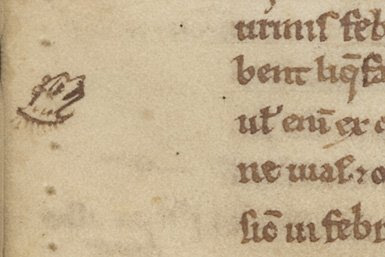
De Urinis was not one of the books translated at Toledo; the Latin version that was used in the Middle Ages was translated by Constantine the African, a Benedictine monk and physician who spent the first part of his life in Ifriqiya, then brought Isaac's work and others from Tunisia to his retirement at the Benedictine Abbey of Monte Casino. Unfortunately, Constantine often did not include in his translation the name of the original author, leading many to think that he himself wrote the medical texts. It took other references to these works to be able to affix the proper author's name. (The illustration here shows a dog's head added to the margin by a bored copyist.)

There are ten sections to De Urinis, as follows:

  1. The science of uroscopy, placing it in context of the four temperaments*, particularly in relation to the blood;
  2. The importance of nocturnal urine;
  3. Types of urine in relation to pathology;
  4. Urine as humor-discharging fluid;
  5. Types of urine by colour;
  6. The state of the body judging by its colour;
  7. Types of urine based on clarity and viscosity;
  8. Sediment in relation to pathology;
  9. Types of urine in coherence with sediment;
  10. Different types of urine and sediments and their meaning.
According to the Utrecht summary of the manuscript:

This text influenced islamic medicine to a great extent (where uroscopy was of great importance) and contributed to the rise of uroscopy as one of the most important branches of medicine in the Middle Ages (Prioreschi 2001). Ms. 690 is a remarkably early witness of this.

If you would like to see the manuscript in digital form, click here.

This is the second post in a row that mentions Ifriqiya, which sounds like "Africa" and should be addressed. I shall do so next.

*Referring to the four humors whose proportions determined a human being's temperament and health: yellow bile, black bile, phlegm, and blood.