Showing posts with label Sweyn Forkbeard. Show all posts

30 May 2026

Sweyn's Daughter, Estrid

Estrid Svensdatter, daughter of Sweyn Forkbeard and sister of Cnut, was born c.990 and lived at least until 1057. We do not know about her early life, and there is a great deal of speculation about who her mother was.

One story is that she was the daughter of Sigrid the Haughty, the wife of King Eric the Victorious of Sweden. After Eric's death Sigrid married Sweyn. Other stories about Sweyn say his wife was a Polish princess, Świętosława, the daughter of Duke Mieszko I of Poland.

If she were the daughter of Sigrid, it would make her the sister of Olof Skötkonung. Olof, also called Olof the Swede, became King of Sweden. When Estrid's son, Sweyn II, married Gunnhildr Sveinsdóttir, Pope Leo IX annulled it on the grounds of consanguinity. Gunnhildr was the maternal granddaughter of Olof Skötkonung, whose mother we are certain was Sigrid. This is the anecdotal evidence that Sigrid was her mother.

When Sweyn Forkbeard died in 1014, Estrid came under the guardianship of her brother, King Cnut. She had at least three marriages proposed and/or contracted, the order of which is uncertain because they are all mentioned in different sagas and histories. There is no definitive history written of her life by contemporaries.

One marriage supposedly was to a Kievan Rus son of either Grand Prince Vladimir the Great or Yaroslav the Wise, making her a Rus princess. Whomever it was, that prince died shortly after. She seems to have been, married to a Duke of Normandy, either Richard II or his son, Robert I (depending on which chronicler you read), but these seem unlikely, and most Western European chroniclers do not mention this, or they mention it as very short-lived with no children.

The longer-lasting union seems got have been with Ulf Thorgilsson (also called Ulf Jarl), a Danish earl. Their children were Sweyn II Estridsson, Beorn Estridsson, and Asbjørn Estridsson. 

Ulf was a trusted earl, and Cnut even gave his son, Harthacnut, to Ulf and Astrid to raise. Unfortunately, Cnut and Ulf had a falling out, and Ulf was killed, apparently with Cnut's blessing. (I wrote about it here.)

Although Estrid had not been a consort to a king, during the reign of her son Sweyn she was referred to as dronning, which means "queen." She was also known as Estrith, and sometimes as Margaret. We do not know when she died, but it was recorded that Bishop William of Roskilde officiated at her funeral. Since he was bishop from 1057 to 1073, she must have died during those years.

Her son Sweyn II became King of Denmark, and it is he that we will talk about tomorrow.

29 May 2026

Sweyn Invades

It may well have been news of the wholesale slaughter of Danes in 1002 that was ordered by King Æthelred that motivated Sweyn Forkbeard to invade England. The St. Brice's Day Massacre is said to have killed Sweyn's sister Gunhilde and her husband, Pallig.

According to John of Wallingford, a Benedictine monk in the early 13th century, Sweyn was behind invasions between 1002 and 1012, many of which were commanded by Thorkell the Tall. Despite the massacre, an apparent arrangement between Sweyn and Duke Richard II of Normandy to sell Sweyn's plunder in Normandy suggests that one reason for invasion was, as always, loot. Of course the Danes were often bought off with Danegeld, and Sweyn accumulated a lot of it in those invasion years.

Sweyn is said to have personally led an invasion force in 1013, accompanied by Cnut. According to the Peterborough Chronicle:

before the month of August came king Swein with his fleet to Sandwich. He went very quickly about East Anglia into the Humber's mouth, and so upward along the Trent till he came to Gainsborough. Earl Uchtred and all Northumbria quickly bowed to him, as did all the people of the Kingdom of Lindsey, then the people of the Five Boroughs. He was given hostages from each shire. When he understood that all the people had submitted to him, he bade that his force should be provisioned and horsed; he went south with the main part of the invasion force, while some of the invasion force, as well as the hostages, were with his son Cnut. After he came over Watling Street, they went to Oxford, and the town-dwellers soon bowed to him, and gave hostages. From there they went to Winchester, and the people did the same, then eastward to London.

London resisted, partly because by then they had Danish help from Thorkell the Tall, who had defected, with many men and ships loyal to him, because he objected to the stoning of the Archbishop of Canterbury, Ælfheah. Sweyn then went to Bath and other locations where they all surrendered. London soon followed, fearing how severe his revenge would be if they continued to resist.

With the capitulation of London, Æthelred went to the Isle of Wight and sent his sons to Normandy. Sweyn started to manage his new kingdom, but he died five weeks later, on 3 February 1014. His body was embalmed and returned to Denmark for burial.

His position in England was taken over by Cnut, of whom much has been said. Who has never been mentioned is Sweyn's daughter, Estrid, who lived a long and not-dull life. Let's talk about her next time.

28 May 2026

The Oxford Massacre

One site of the St. Brice's Day Massacre in 1002 seems to have been Oxford. Æthelred called it in a 1004 charter "a most just extermination" of Danes, because of the rumor that they intended to kill him and all his council and take over the entire island, not just the part known as the Danelaw.

The sad part of the situation in Oxford was that the Danes there saw it coming and decided to take advantage of sanctuary. Sanctuary allowed anyone to take refuge in a church. Sanctuary had a time limit of 40 days, but in that time the refugee could get aid from outside to create a defense on their behalf against the persecutors.

The Danes in Oxford went to St Frideswide's Church (now Christ Church Cathedral), which Æthelred's charter tells:

For it is fully agreed that to all dwelling in this country it will be well known that, since a decree was sent out by me with the counsel of my leading men and magnates, to the effect that all the Danes who had sprung up in this island, sprouting like cockle amongst the wheat, were to be destroyed by a most just extermination, and thus this decree was to be put into effect even as far as death, those Danes who dwelt in the afore-mentioned town, striving to escape death, entered this sanctuary of Christ, having broken by force the doors and bolts, and resolved to make refuge and defense for themselves therein against the people of the town and the suburbs;

This should have been recognized as a safe haven for them,

...but when all the people in pursuit strove, forced by necessity, to drive them out, and could not, they set fire to the planks and burnt, as it seems, this church with its ornaments and its books. Afterwards, with God's aid, it was renewed by me.

Were the Danes all stuck inside while it burned? Or did they flee and meet the angry mob outside?

In 2008, an archaeological dig found the remains of 37 people who had been massacred. So far as could be determined, they were all male, between the ages of 16 and 25, and some had scars suggestive of previous injuries such as would be incurred by warriors. There were, however, newer injuries all over the bodies that did not have time to heal, as if attacked by a crowd from all sides. Radiocarbon dating suggests they all died between 960 and 1020 CE.

This was not the only site of aggression against Danes, but the king's decree and stories about St. Brice's Day may have been the impetus for what Sweyn Forkbeard did next. Let's get back to him.

26 May 2026

Sweyn Forkbeard

European history classrooms in America often talk about the Danish King Cnut (Canute) and his conquest of England. The modern world also hears about Cnut's grandfather, Harald Bluetooth, from whom the wireless protocol Bluetooth™ gets its name.

Whom we don't hear enough about is the generation sandwiched between these two familiar names, Harald's son and Cnut's father, Sweyn Forkbeard, who managed to be King of Denmark, King of Norway, and King of England (although in England only for a little over a month). He also fathered two kings and a queen.

His birthdate is unknown, but in the mid-980s he was old enough to rebel against his father, Harald, driving Harald into an exile in which he died in either 985 or 986. Despite this treasonous act, the Encomium Emmæ Reginæ ("Encomium for Queen Emma"), written for Emma of Normandy (widow of Æthelred the Unready and later Cnut's wife), claims Sweyn was universally loved:

Sveinn, king of the Danes, was, I declare, as I have ascertained from truthful report, practically the most fortune of all kings of his time, ... The Divine Power granted him such great favor that even as a boy he was held by all in close affection, and was hated only by his own father. No fault of the boy deserved this: it was due only to envy. When he grew to be a young man, he increased daily in the love of the people, and accordingly, his father's envy increased more and more, so that he wished not in secret, but openly, to cast him out, affirming by oath that he should not rule after him.

Some reports say that it was Sweyn embracing Christianity that ultimately turned his father so against him that Sweyn had to depose Harald and take the throne. One German historian, Adam of Bremen, claimed Sweyn was a rebellious pagan, upset that his father embraced Christianity. We also read in some chronicles that Harald was baptized by a cleric named Poppo, who performed a miracle that convinced Harald that Christianity was true. (Other versions claim Poppo performed for Sweyn instead.)

We know about Sweyn's invasion of England in 1003. Now, Danes were frequently invading England, and had established an enormous foothold, an occupied area known as the Danelaw, an agreed-upon compromise between the Danes and Alfred the Great. Was there a reason why Sweyn felt he had to start ravaging other parts outside of the Danelaw?

He might have had a very good reason, we could even say a legitimate reason, because of an incident in November of 1002. Tomorrow we'll learn about the St. Brice's Day Massacre.

25 May 2026

Defectors

It must have been a shock when Thorkell the Tall, a leader and warrior of the early 12th-century Danish invasion of England, changed his stance and defected to join the English forces of King Æthelred the Unready, taking 45 ships' worth of loyal men with him. There is some reason to believe that Thorkell was married to a daughter of Æthelred, possibly Eadgyth (Edith).

As mercenaries for Æthelred, the Danes fought in 1013 against their former liege lord, King Sweyn Forkbeard of Denmark and his son, Cnut (whom Thorkell had helped raise and educate). Sweyn was successful, forcing Æthelred into exile by the end of 1013. Sweyn died not long after, however, on 2 February 1014, and Cnut was declared his successor.

The remaining English nobles called Æthelred back from the continent to reclaim the throne (Cnut was back in Denmark). While Cnut was preparing a fleet to re-take England, Æthelred's eldest son Æthelstan died, making his second son Edmund Ironside the new heir to the throne of England.

Cnut's invasion arrived in September 1015 with numerous mercenaries and help from Poland and Sweden. Thorkell decided to leave the employ of Æthelred, defecting to join up with Cnut. While they plundered southern England, the elderly and ill Æthelred left leadership of the army to Edmund. Edmund's army was joined by an army raised by Eadric Streona, but Eadric betrayed Edmund and the English, convincing 40 ships to defect with him and join Cnut.

During a Battle of Otford (near the village of Otford in Kent), Eadric defected from Cnut back to the English. This seems to have been simply a ruse, because at the following crucial Battle of Assandun he defected again, leaving Edmund's army alone to fight Cnut. A majority of English nobility were killed, defeated by Cnut. 

For Thorkell's defection back to Cnut, he received East Anglia. Eadric received Mercia, but Cnut knew he could not be trusted. Eadric must have acted true to form for the dastardly fellow he was, because less than two years later Cnut had him beheaded.

Thorkell, again, had some falling out with Cnut, in 1021. Cnut banished Thorkell, who returned to Denmark. Fearing Thorkell's reputation as a powerful leader, Cnut didn't want Thorkell to defect again to join some enemy of Cnut, so he made him an earl of Denmark and foster-father to Cnut's son, Harthacnut.

Mentions of Thorkell end in 1023. The details of his death are unknown. One of his sons was in the retinue of Harthacnut, but after Harthacnut's death Thorkell's wife and sons were expelled from Denmark, suggesting there was suspicion on the family.

Now: mentioned several times but never discussed in detail, let's talk about Cnut's father and Thorkell's lord, Sweyn Forkbeard.

20 May 2026

Edmund Ironside

Edmund, son of Æthelred the Unready and his first wife Ælfgifu of York, was likely born between 990 and 993, one of several siblings. He was raised in Wessex by his grandmother, Ælfthryth, wife of King Edgar the Peaceable. He might have had an education at Wherwell Abbey, a place important to his grandmother.

In his youth, there were constant raids on England from Vikings. He may have been put into the field early as a soldier, but we don't really have any evidence of his actions until about 1014 when his older brother Æthelstan Ætheling died. Edmund and Æthelstan were still in England, even though his father had taken the family to Normandy to flee from the invasion of Sweyn Forkbeard, King of Denmark. Æthelstan's will left most of his goods to Edmund, including estates and a sword that had belonged to Offa, King of Mercia c.730 - 796.

Edmund became angry with his father when Æthelred allowed the execution of two friends, Sigeferth and Morcar. They were killed by Æthelred's enforcer and son-in-law, Eadric Streona, probably so that the king could seize their lands. Edmund boldly married Sigeferth's widow and occupied the area that had been controlled by Sigeferth. Edmund began issuing charters, in one of which he referred to himself as king.

His revolt against his father didn't last, since Sweyn's son Cnut invaded in the summer of 1015. Edmund was forced to raise an army and fight alongside Eadric and Æthelred, but distrust caused their effort to collapse. After Æthelred died in 1016 the succession passed to Edmund. Edmund was successful in several battles, inspiring all the English to unite. Eadric fled, however, from the climactic Battle of Assandun, and the English were suddenly outnumbered. Edmund was forced to give most of his kingdom to Cnut, leaving himself with only Wessex.

Edmund's total rule was 222 days. Cnut executed or exiled all of Edmund's relatives and consolidated the rest of England under his rule. Although Cnut was his enemy, on the tenth anniversary of Edmund's death, Cnut visited the grave at Glastonbury Abbey and honored it with a cloak of peacock feathers to symbolize Christian resurrection. Henry VIII's Dissolution of the Monasteries destroyed Glastonbury and the location of the remains of Edmund are unclear.

Why was he called "Ironside"? The Anglo-Saxon Chronicle refers to a lost history called Life of King Edmund Ironside. We can guess that it was the source for the nickname "Ironside" denoting a strong and relentless warrior. It also is where we find the source to call Eadric "Streona" meaning "The Acquisitive" must originate.

Speaking of Eadric Streona, what an interesting man. Let's talk about him next.

19 July 2024

Richard the Good?

Richard II, Duke of Normandy, was the eldest surviving son of Richard I and Gunnor. We don't know his birth date, but when his father died in 996, Richard was young: the first five years of his reign his uncle Rodulf of Ivry was regent along with Gunnor. (Richard's grandmother, Sprota, married after the death of his grandfather, William Longsword; Rodulf was the son of Sprota and her second husband, Esperleng.)

In the early 11th century, Vikings started plundering England and then crossing the English Channel to sell their goods on the continent. Richard welcomed them, which angered England. Richard's father had signed a treaty with King Æthelred II (the Unready) that Normandy would not aid the enemies of England. Æthelred led an attack on the Cotentin Peninsula that Richard was forced to repel. Æthelred tried to have Richard captured and brought to England, but the Normans successfully prevented this.

Richard tried to make it up to Æthelred by offering his sister, Emma, as a bride. It was a great idea at the time, but down the road the arrangement would lead to a justification for William of Normandy in 1066 to...well, you know that story already.

Later, when Sweyn Forkbeard (father of Cnut) intended to attack England, Richard made him welcome in Rouen and made an alliance with him. The attack forced Emma and her husband to flee to Normandy, where Richard also sheltered them.

Wanting to amend his reputation and that of Normandy, Richard commissioned his confessor, Dudo of Saint-Quentin, to write a history of Normandy, rehabilitating his ancestors and making them seem more noble and Christian than they were in their time.

After reigning for three decades, Richard died, leaving the title to his son, Richard III, who signed 49 weeks and died childless. I'll tell you about him next time.

01 June 2024

Edward's Path to the Throne

Æthelred the Unready had several children by two wives. His seventh son (and first by his second wife, Emma of Normandy), was named Edward, born c.1003. He must have been alive by 1005 (although not very old) because he is listed as a "witness" to a royal charter, but his name came after those of his older brothers by his father's first wife, Ælgifu of York.

When Sweyn Forkbeard attacked England in 1013, his mother fled to Normandy along with Edward. Sweyn's death a year later led to the English nobles inviting Æthelred back on the condition he rule "more justly." there'd and family returned, but Æthelred died in April 1016, leaving Edmund Ironside (Edward's older half-brother) to succeed him.

Sweyn's son, Cnut, picked up the Danish fight against England and Edmund, but Edmund died in November 1016 and Cnut married Emma. Cnut would not allow any claimants to the throne, so he killed some of them, like Edward's eldest half-brother Eadwig Ætheling. Others (like Edward) wisely fled to the continent. At this point, Edward dropped out of the historical record for about 20-25 years. His sister married Count of the Vexin Drogu of Mantes, so perhaps he had a home at her court.

Despite his complete lack of royal standing, however, he had royal aspirations. There are four charters in Normandy in the 1030s witnessed by Edward in which he signs himself "King of England" despite his political and geographical distance from the throne. As Cnut's queen, Emma seemed more interested in supporting the prospects of her and Cnut's son, Harthacnut.

When Cnut died in 1035, Harthacnut became embroiled in maintaining power in Denmark. Harthacnut went to Denmark, leaving his half-brother Harold Harefoot as regent.  His absence from England created an opportunity for Edward to cross the Channel with his brother Alfred. Unfortunately, not all nobles were interested in regime change, Godwin, Earl of Wessex, captured Alfred and handed him over to Harold, who made him unsuitable as a king by blinding him with red-hot pokers thrust into his eyes. The tortured and blind Alfred died soon after.

Edward did some fighting near Southampton, but retreated to Normandy until he could gather a larger army and assure other loyalties among the English.

Harold became king in 1037 and expelled Emma, who went to the continent and asked Edward for his help in supporting Harthacnut. I am sure you can guess his answer to his mother, but in case you're wondering how it went, I'll explain next time.

04 January 2022

Emma of Normandy


Emma of Normandy (c.984 - 6 March 1052) was queen of England, Denmark, and Normandy. As the daughter of Richard the Fearless of Normandy, she was a desirable marriage prospect for King Æthelred to form better relations between England and Normandy. Æthelred hoped the union would help stave off Viking raids on England, which were often staged from Normandy.

Her wedding gift included properties in Devonshire, Oxfordshire, Rutland, Suffolk, and Winchester, as well as the city of Exeter. Her children by Æthelred were sons Edward the Confessor and Alfred Ætheling, and daughter Goda of England. Upon her husband's death in 1016, she remained prominent in politics.

This made her a valuable prospect for marriage when Cnut of Denmark went looking for a bride. Actually, Cnut was looking to conquer England, and Emma may have had a hand in saving her sons' lives by agreeing to marry Cnut. She became Queen of Denmark and England with Cnut starting in 1018. When Cnut conquered Norway in 1028, she became queen likewise of Norway.

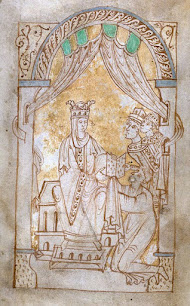
She was not, however, just a pretty face or a way to link kingdoms peacefully through matrimony. As the richest woman in England in her time, she also held significant authority over ecclesiastical offices in the lands she owned. She is also one of the first medieval queens to have her likeness portrayed in documents. Pictured here is a page from the Encomium Emmæ Reginæ, or "Praise for Queen Emma." The title is clearly meant to flatter her, since the three-part history within discusses the conquest of England by Sweyn Forkbeard, the defeat of England by Cnut and his reign, and the events after Cnut's death (which do involve Emma's seizing of the royal treasury to keep it safe from Earl Godwin of Wessex, who disputed the choice of Cnut's successor).

She was buried alongside Cnut in the Old Minster in Winchester, but parliamentary forces during the English Civil War disinterred and scattered the remains. They were eventually recovered; Winchester has a mortuary chest that contains the remains.

Emma's life was eventful and influential, which may have been luck or a trait she got from her mother, Gunnor. We'll take a look at Gunnor next.