Showing posts with label Wulfstan the Cantor. Show all posts

01 January 2026

Æthelwold of Winchester

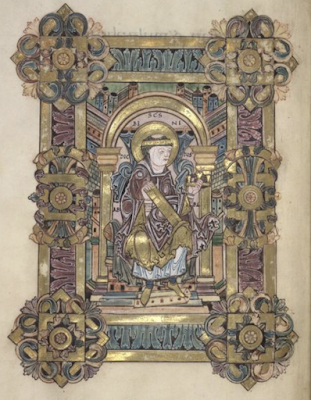
It was a Bishop of Winchester who made a former Bishop of Winchester so prominent. Æthelwold of Winchester decided to rededicate the church at Winchester to St. Swithin instead of Saints Peter and Paul. What was Æthelwold's background?

He was born into a noble family somewhere between 904 and 909 CE, and from the time he was at least a teenager he served in the court of King Æthelstan, supposedly as his very close companion according to Æthelwold's biographer, Wulfstan the Cantor. The king had Æthelwold ordained a priest on the same day as his friend Dunstan by another Bishop of Winchester, Ælfheah the Bald.

Dunstan became Abbot of Glastonbury Abbey, and in the late 930s Æthelwold moved there where he studied grammar and other topics, eventually being made dean of the school there. When Æthelwold wanted to travel the continent and study more, the current king, Eadred, refused to give permission for him to abandon his post. Eadred then put him in charge of Abingdon Abbey, which had fallen into the hands of secular priests. Æthelwold established Benedictine Rule at Abingdon.

When Eadred died, Eadwig (reigned 955 - 959) became king, and drove Æthelwold's friend Dunstan into exile. Æthelwold served Eadwig during his short reign, and when Eadwig was succeeded by Edgar the Peaceable, who as a youth had been taught by Æthelwold, Dunstan was brought back and made a bishop.

Æthelwold's interest was in monasteries, not in secular clergy. Æthelwold was named Bishop of Winchester on 29 November 963, and one of his first steps was to, with the help of King Edgar and a military force, drive the priests out of Winchester and establish it as a monastery with monks from Abingdon Abbey.

Tomorrow we'll look more at his work with monasteries and at the role he envisaged for the king and queen.

P.S. Happy New Year!

26 January 2022

St. Æthelwold's Miracles

Æthelwold, one of the Three English Holy Hierarchs, saintly figures who spurred the revival of monasticism in England, was a truly saintly man. We know a lot about him from a surviving biography written by Wulfstan the Cantor.

He rebuilt or built many monasteries, including in Milton Abbas in Dorset, Chertsey in Surrey, Peterborough, and Ely. He reformed existing monasteries, driving out undisciplined monks and introducing the Rule of St. Benedict. His severity gives us the first example of miraculous events surrounding him: it is said that some monks who disliked his heavy hand put poison in his food, but he showed no signs of illness whatsoever. Speaking of food, while in Glastonbury, one of the duties he gave himself was cooking. One time, he resolved a scarcity of meat by praying, leading to a miraculous increase in the provisions.

Wulstan reports that he recovered unnaturally quickly from broken ribs after a fall from some scaffolding. Near the end of his life he was gravely ill, but bore his suffering patiently. After his death, on 1 August 984, miracles started taking place near his final resting place, and in response to prayers made to him for aid. A blind man from Wallingford was healed through prayers to St. Æthelwold.

His relics were then taken to the Cathedral in Winchester to signify their (and his) importance. Later, Abingdon Abbey received a finger, some hair, and arm, and his shoulder bone.

There is a single church dedicated to Æthelwold; it is St. Adelwold in Lincolnshire, in what would be fair to call an Elf village. I'll explain that tomorrow.

24 January 2022

Wulfstan the Cantor

Of the countless people who lived in the Middle Ages and accomplished things—writing, building, etc.—a very few are remembered by name. One of them is Wulfstan, known as Wulfstan of Winchester or Wulfstan the Cantor.

A cantor sings liturgical music. The monk Wulfstan was a cantor of the Old Minster in Winchester, who became a precentor. A precentor is responsible for composing liturgical music himself, training the choir, and leading the choir or congregation in the music, singing solo lines to which they respond. He was a poet as well as a musician, and wrote a biography of St. Æthelwold, who was probably his mentor. He wrote several works, making him one of the most prolific Latin authors pre-Norman Conquest.

A 15th century commentary refers four times to a "Wulstan" and his work on musical theory, De tonorum harmonia ("On the harmony of tones"). It is likely that this reference is to Wulfstan; unfortunately, this work of Wulfstan's no longer exists. It would be the only known work on music written by an Anglo-Saxon. He is also responsible for the longest (3386 lines) Anglo-Latin poem extant, the Narratio metrica de S. Swithuno (A metrical narrative of St. Swithin).

The work for which he is best know, however, is the Vita S. Æthelwoldi (The life of St. Æthelwold), the principal source of information on St. Æthelwold, about whom I think we should talk next.

23 January 2022

The Winchester Troper

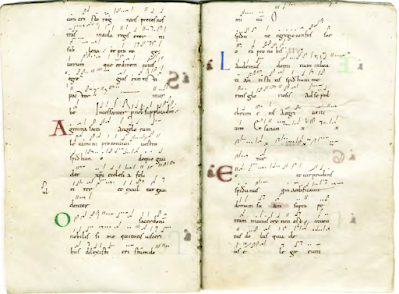
When priests and monks prayed the Canonical Hours, praising God through hymns was considered an important part of the experience. We are fortunate to have a thousand-year-old manuscript that holds many examples of the music used at such times.

trope is a theme or motif, and the Winchester Troper was named that because it includes different musical styles or motifs. The Winchester Trooper actually refers to two manuscripts of liturgical plainchant and polyphony, although the two manuscripts are not exactly connected; that is, they are not two parts of the same collection, just two manuscripts of the same type of music.

The music is in two forms: liturgical plainchant and two-voice polyphony. Plainchant (or plainsong) is simply a collection of chants used in the Western European Catholic Church, in which all singers follow the same tune. It was the primary type of Christian liturgical music until the development of polyphony in the 9th century, when two or more singers would harmonize. The Winchester Troper's examples of polyphony are for two voices.

As usual with many early manuscripts, authorship is unknown. A person once connected with scribing the Troper, but now determined to have been dead by the time the Troper was put together, was a character called Wulfstan the Cantor. I'll tell you more about him tomorrow.

If you would like to hear a sample of music from the Winchester Troper, click here.