Showing posts with label Glastonbury Abbey. Show all posts

04 January 2026

Promoted by a Miracle

St. Dunstan's life had its ups and downs, as the Wheel of Fortune predicts. Driven from one king's court because of the jealousy of others, returned to a later king's court, and then driven away by the jealousy of others—his life was developing a dismal pattern.

The second king was Edmund, and he was becoming increasingly disillusioned with Dunstan as a minister because of the lies of others. Dunstan was prepared to leave, even asking representatives of the kingdom of East Anglia to let him go with them when they left Edmund's court.

Before that event, however, Edmund went out hunting in the Mendip Forest. I'll let someone else take it from here:

He became separated from his attendants and followed a stag at great speed in the direction of the Cheddar cliffs. The stag rushed blindly over the precipice and was followed by the hounds. Eadmund endeavoured vainly to stop his horse; then, seeing death to be imminent, he remembered his harsh treatment of St. Dunstan and promised to make amends if his life was spared. At that moment his horse was stopped on the very edge of the cliff. Giving thanks to God, he returned forthwith to his palace, called for St. Dunstan and bade him follow, then rode straight to Glastonbury. Entering the church, the king first knelt in prayer before the altar, then, taking St. Dunstan by the hand, he gave him the kiss of peace, led him to the abbot's throne and, seating him thereon, promised him all assistance in restoring Divine worship and regular observance. [link]

Dunstan's childhood dream of restoring Glastonbury Abbey to its former glory was in his grasp. Edmund also sent Æthelwold to help. The two began to rebuild the abbey (see illustration for how it might have looked before Henry VIII) and established Benedictine Rule, although probably not as strictly as it was being reformed on the continent. Unlike Æthelwold, Dunstan was not opposed to the presence of secular priests.

Dunstan had a brother, Wulfric, who was given responsibility for the material upkeep of the abbey, so that the cloistered monks did not have to "break enclosure." The first project was to rebuild the church of St. Peter.

Things were looking up for Dunstan and Glastonbury. When Edmund was assassinated in 946, his successor's policies looked to make things even better for Dunstan. Eadred promoted unification of all parts of the kingdom, both Saxon and Danish, along with moral reform and rebuilding of churches. Dunstan's position grew in authority. But Eadred died in 955, and Eadwig was a very different kind of king.

The 45-year-old Dunstan clashed with the 15-year-old Eadwig on the very day of the coronation, setting up another turn of the wheel. I'll tell that awkward story next time.

03 January 2026

Saint Dunstan

There were three men in the 10th century in England who were called the "Three English Holy Hierarchs" for their work in reviving English Orthodox monasticism. Æthelwold of Winchester was one, Oswald of Worcester another, and Dunstan.

From Dunstan's biographer "B" (who claimed to be a member of Dunstan's household) we can estimate that he was born c.910 to a couple named Heorstan and Cynethryth near Glastonbury, and that he was related to Bishop of Winchester Alfheah the Bald and to Bishop of Lichfield Cynesige. He studied under the Irish monks who had occupied Glastonbury Abbey, at that time in a state of disrepair. Supposedly he dreamed of restoring the Abbey to its former glory. He would get his chance as its abbot, but that was a long time coming.

Known for his religious devotion and his learning, he was sent to the court of King Æthelstan, where he became such a favorite of the king that he aroused jealousy among others. They accused him of witchcraft and black magic, which caused the king to send him from the court. On his way out, his enemies attacked him, beating him so severely that he could barely crawl out of the cesspool into which they finally threw him. He hid with a friend until he was well enough to travel to Winchester and join the household of Alfheah.

Alfheah thought Dunstan should become a monk, but Dunstan wasn't sure he was made for a celibate life. He was so ill, however (possibly from the beating and the cesspool), that he decided to try the monastic life. He took Holy Orders in 943 and went to live at Glastonbury. He built a 5 by 2.5 foot cell to stay in; he studied, played the harp, and practiced art like silversmithing and illuminating manuscripts. A later legend says the devil tempted him during this time and Dunstan held the devil's face in a pair of tongs.

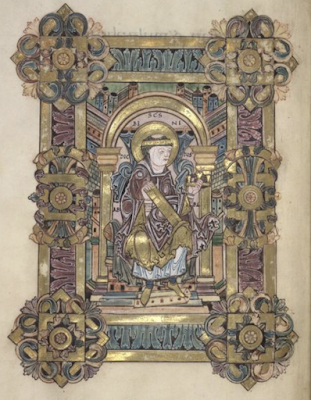
He worked in the scriptorium. An illustration of a monk kneeling next to Christ (see the illustration) is thought to have been drawn by Dunstan.

Despite his reputation at Æthelstan's court, the king's niece Lady Æthelflæd made him her advisor and left him a considerable sum of money at her death. Around that time Dunstan also had a large inheritance after the death of his father. Suddenly he had secular power through his fortune. Æthelstan died in 940, and his brother Edmund became king. Edmund summoned Dunstan to court as an advisor.

Once again, the jealousy of others at court threatened Dunstan's position and even his life, but he was saved by a miracle. I'll tell you about it tomorrow.

01 January 2026

Æthelwold of Winchester

It was a Bishop of Winchester who made a former Bishop of Winchester so prominent. Æthelwold of Winchester decided to rededicate the church at Winchester to St. Swithin instead of Saints Peter and Paul. What was Æthelwold's background?

He was born into a noble family somewhere between 904 and 909 CE, and from the time he was at least a teenager he served in the court of King Æthelstan, supposedly as his very close companion according to Æthelwold's biographer, Wulfstan the Cantor. The king had Æthelwold ordained a priest on the same day as his friend Dunstan by another Bishop of Winchester, Ælfheah the Bald.

Dunstan became Abbot of Glastonbury Abbey, and in the late 930s Æthelwold moved there where he studied grammar and other topics, eventually being made dean of the school there. When Æthelwold wanted to travel the continent and study more, the current king, Eadred, refused to give permission for him to abandon his post. Eadred then put him in charge of Abingdon Abbey, which had fallen into the hands of secular priests. Æthelwold established Benedictine Rule at Abingdon.

When Eadred died, Eadwig (reigned 955 - 959) became king, and drove Æthelwold's friend Dunstan into exile. Æthelwold served Eadwig during his short reign, and when Eadwig was succeeded by Edgar the Peaceable, who as a youth had been taught by Æthelwold, Dunstan was brought back and made a bishop.

Æthelwold's interest was in monasteries, not in secular clergy. Æthelwold was named Bishop of Winchester on 29 November 963, and one of his first steps was to, with the help of King Edgar and a military force, drive the priests out of Winchester and establish it as a monastery with monks from Abingdon Abbey.

Tomorrow we'll look more at his work with monasteries and at the role he envisaged for the king and queen.

P.S. Happy New Year!

29 December 2025

Henry's Choice

Life was good for Henry of Blois. His brother Stephen was the king of England, Henry was not only Abbot of Glastonbury Abbey and Bishop of Winchester, but also was the papal legate which gave him additional authority over even the Archbishop of Canterbury.

Then the Anarchy happened.

You see, King Stephen had seized the throne after the death of Henry I, even though Stephen had promised support to Henry's daughter Matilda. She was known as Empress Matilda by virtue of marriage to Holy Roman Emperor Henry V. She decided she was owed the throne of England, so she challenged Stephen.

Civil War ensued, and people chose sides. On 2 February 1141, the first clash between the two armies took place at the Battle of Lincoln. Stephen was captured and imprisoned, and Matilda assumed the throne.

Maybe it was because Stephen had not supported Henry in his idea to create a third archbishopric for himself, or simply because Matilda now had control, but Henry chose to support Matilda. But Matilda was not a kind ruler, and Henry changed his mind (especially after Matilda besieged Winchester Castle) bringing the force of the Church in support of the deposed king. Along with Stephen's wife (also named Matilda), forces loyal to Stephen turned the tide and deposed Empress Matilda.

Henry's papal legate position had come from Pope Innocent II, but hen Innocent died on 23 September 1143, the commission ended and Henry lost status. He even went to Rome to try to get it reinstated. He failed, but did manage to get some favors for Glastonbury.

After Stephen's death and the rise of King Henry II, Henry of Blois retired to Cluny and lived with his friend and mentor Peter the Venerable. In January 1164, King Henry II tried to formalize royal authority over the Church in the Constitutions of Clarendon, and Henry was one of the bishops forced to sign it. This later led to the problem with and trial of Thomas Becket, over which Henry presided.

Henry died on 8 August 1171. His exact burial site is disputed.

In his time he supported many art and architectural projects (the illustration was made by an artist from Belgium during Henry's time, depicting him as a patron of arts). One of his projects (we believe) was the Winchester Bible, the largest Bible ever made by hand (although incomplete). Let's take a look at that tomorrow.

28 December 2025

Henry of Blois

Count of Blois Stephen II and Adela of Normandy had several children who have appeared in this blog. One of them, Stephen of Blois, became King of England in 1135 after the demise of Henry I. Another, Henry (c.1096 - 1171) also did very well for himself. (For himself, not by himself; when your brother is king, you don't really have to go looking for work.)

The youngest of five sons, Henry was educated at Cluny, and brought to England by his uncle King Henry I to be Abbot of Glastonbury Abbey. (Henry and Adela were siblings; their father was William the Conqueror.) In 1129 he was made Bishop of Winchester as well, even though that location and the duties of a bishop were a far cry from those of the Abbot of Glastonbury.

Abbot Henry—like King Henry and, indeed, most of the kings of England—disliked being subjected to the ecclesiastical authority of the Archbishops of Canterbury. His idea was to create a third archbishopric in the southwest of England with himself at the head. (The second archbishopric was York.)

His brother the king was not keen on this idea, but Henry gained more prominence than the archbishop when, in March 1139, Henry was named papal legate. This position placed him above Canterbury in the parochial pecking order. If the king was away from England, Henry was the most powerful man in England.

Henry did wonders for the area, commanding hundreds of works projects. He built churches, abbeys, and canals. He also started construction projects at Winchester Cathedral, additions to manors and castles, Winchester Palace in London as the home for bishops of Winchester, and the Hospital of St. Cross at Winchester (which still exists).

He wrote books and was a patron of authors and bookmakers. William of Malmesbury was a close friend, and Henry sponsored On the Antiquity of the Glastonbury Church by Malmesbury. The largest Bible ever produced, the three-foot-tall Winchester Bible, was sponsored by Henry, as was the Winchester Psalter.

England experienced a period of civil war during this time called the Anarchy. There was a rival who claimed to have a better right to the throne than Stephen. Henry had a choice: support his brother, or the other claimant. We'll explore his choice tomorrow.

27 December 2025

The Last Abbot of Glastonbury

This is the story of Richard Whiting, a faithful steward of Glastonbury Abbey, chosen by Henry VIII's most faithful servant (Cardinal Wolsey), who agreed that Henry was the head of the Church of England, and who believed that his abbey was safe from Henry's intention to close down all monasteries.

In September 1539, Glastonbury was the last abbey in southwest England. In September, Thomas Cromwell (Lord of the Privy Seal) sent a small delegation whose purpose seemed to be to find reasons to close the place down.

One of the purposes of shutting down monasteries was so the king could assume their property. Glastonbury was a wealthy abbey, and the delegation expected to find treasure, but it was not readily apparent. They then made a more determined search and found money and valuable items hidden away in vaults, and assumed there might have been other valuables sent to other locations to hide them from the king.

Whiting was sent to the Tower of London to be examined by Cromwell himself, who wrote:

Item, Certayn persons to be sent to the Tower for the further examenacyon of the Abbot, of Glaston... Item. The Abbot, of Glaston to (be) tryed at Glaston and also executyd there with his complycys... Item. Councillors to give evidence against the Abbot of Glaston, Rich. Pollard, Lewis Forstew (Forstell), Thos. Moyle.

From Whiting's entry in the online Catholic Encyclopedia we can learn that the French ambassador at the time wrote:

The Abbot of Glastonbury. . . has lately, been put in the Tower, because, in taking the Abbey treasures, valued at 200,000 crowns, they found a written book of arguments in behalf of Queen Katherine. [link]

Whiting was sent from the Tower to Wells where he was tried and convicted of robbing Glastonbury. He and his treasurer and sacristan were taken to Glastonbury on the following day, dragged by horses to the top of Glastonbury Tor, then hanged, drawn, and quartered.

Whiting is considered a martyr for the Church and was beatified in 1895 (immortalized in the stained glass window above).

There was an earlier abbot of Glastonbury who also fell afoul of a king, which was even more interesting because the king was his brother. I'll tell you about him next time.

26 December 2025

Richard Whiting

Richard Whiting (1461 - 15 November 1539) was educated as a young man at Glastonbury Abbey, then furthered his education in Cambridge at the Monk's Hostel. (Monk's Hostel was founded as a Benedictine hostel for those studying at Cambridge, it was later named Buckingham College and eventually refounded as St. Mary Magdalen).

Whiting earned his MA at Cambridge and was ordained a deacon in 1500 and a priest in 1501, then returned to Cambridge to study for a doctorate in 1505. Once back at Glastonbury he was put in charge of the physical plant essentially as a chamberlain, managing dormitories, lavatories, and the wardrobe.

In 1525, when Whiting was 64 years old, Abbot Richard Beere died. (Beere may have been Whiting's uncle.) The monks of Glastonbury asked Cardinal Thomas Wolsey (by this time Lord High Chancellor under King Henry VIII) to choose their new abbot. Wolsey, with Henry's permission, chose Richard Whiting. Whiting was abbot for a decade, and was well-liked according to contemporary accounts.

When the Act of Supremacy came about, appointing the rulers of England as the heads of the Church of England, Whiting signed it in 1534.

Not everyone was willing to submit to this Act. History has made much of the executions of Thomas More and Bishop of Rochester St. John Fisher (also a Cambridge graduate) for denying the king this title. Was Whiting truly accepting of the king's new title as head of the church, or was he being politic in an attempt to keep the king's favor? Either way, his position was precarious. Richard Layton, a churchman and diplomat under Henry and Wolsey, came to Glastonbury to examine its administration, giving Whiting some injunctions for changes to be made, and removing the abbot's jurisdiction over the town of Glastonbury.

In 1535, the Suppression of Religious Houses Act dissolved several smaller monasteries, but Whiting was always told that Glastonbury was safe. By the beginning of 1539, Glastonbury was the only abbey left in Somerset.

One of the effects of the Dissolution was that the king assumed control of property and material goods, of which Glastonbury had much. In September of 1539, a delegation from London arrived to "take stock" of Glastonbury's possessions. This is where things went very poorly for Richard Whiting, as I'll explain tomorrow.

25 December 2025

The Richest Abbey, Part 2*

We started on Glastonbury yesterday. Glastonbury was popular and wealthy and a target for others' attempts at acquisition. The bishop of Bath and Wells in 1197, Savaric FitzGeldewin, offered Bath to John Lackland (standing in for his brother, King Richard Lionheart, who was first on Crusade and then was captured on the way home by Leopold of Austria) if John would make him abbot of Glastonbury.

Pope Celestine III supported this, as did Archbishop of Canterbury Hubert Walter. Dioceses and monasteries were different species, however, and the monks of Glastonbury did not want a bishop making decisions for them. King John may have been all right with this, but before long he was no longer on the throne: Richard was released (thanks to Celestine excommunicating Leopold for interfering with a Crusader), and supported the monks. Richard let them choose their own abbot instead of FitzGeldewin. They chose William Pica.

Then Richard died in 1199, John became rightful king, Bishop FitzGeldewin forced his way into the abbey, set himself up there as the seat of his bishopric, and excommunicated William Pica. The monks sent word to the pope, who at this time was now Innocent III. Pica also headed to Rome to appeal to the pope, but died in 1200. For some reason Innocent changed his mind and reinstated FitzGeldewin.

FitzGeldewin, happy with his successful power play, tried to assume control of other monasteries, but died soon. His successors used the title "Bishop of Bath and Glastonbury" until 1219.

As for being the "richest abbey," only Westminster was wealthier. The magnificence of Glastonbury is attested to by the ruins of the Abbot's Kitchen: the kitchen was obviously enormous, needing to serve a large community. The ability to do so meant they also had enormous stores of food.

So what happened? Well, Henry VIII happened. Tomorrow I'll tell you about Richard Whiting, the last abbot of Glastonbury, who thought that loyalty between a subject and a king would go both ways.

He was wrong.

*If you were looking for a Christmas-themed post, try 2022 or 2018 or 2015 or 2013 or 2012.

24 December 2025

The Richest Abbey, Part 1

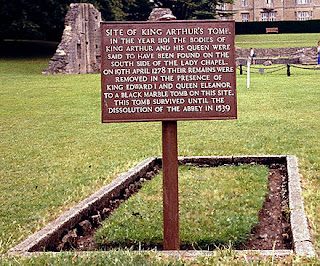
I've mentioned Glastonbury Abbey before, most notably here and here, but it was important for more than its legend as the dubious discovery of the burial place of King Arthur.

The legend of its founding by Joseph of Arimathea has been easily proven wrong by the complete lack of archaeological evidence that anything Christian existed there in the 1st century CE. Robert de Boron connects Glastonbury to King Arthur and the Holy Grail, but his mention of Joseph does not include bringing Joseph to Glastonbury.

The earliest evidence for an abbey comes from the 7th century. William of Malmesbury records a grant of land made to the "old church" at Glastonbury in 601 from King Gwrgan of Damnonia. The town of Glastonbury fell into Saxon hands in c.660 when they defeated the Britons of Somerset. The Saxon leader, Cenwalh of Wessex, was a Christian, so the abbey was not harmed.

King Ine of Wessex a couple decades later made gifts to the monks at Glastonbury Abbey and directed that a stone church be built. It was enlarged in the 10th century by Abbot (later Saint) Dunstan, who made it a Benedictine monastery.

The abbey instituted some projects to drain excess water from the surrounding Somerset Levels, a coastal plain and wetland area that covers about 160,000 acres. This made the land more suitable for farming. The Abbey also created the Glastonbury Canal to link it with the River Brue (a little more than a mile away) to more easily transport goods to and from the Abbey. The Abbey was important and prosperous enough to import ceramic wine jars from the Mediterranean.

William the Conqueror wanted to control the wealth of Glastonbury, so in 1086 he appointed a Norman named Turstinus as its abbot. Turstinus expanded the church. In Domesday Book, Glastonbury Abbey was listed as the richest monastery in the country.

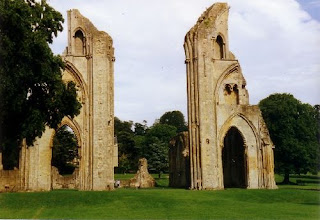
How did it go from the richest in the country to the ruin we see in the illustration? Well, of course we'll go into that tomorrow.

24 May 2024

King Cnut of England

After over a year of fighting for control of England, Cnut of Denmark and Edmund Ironside made an agreement: Edmund would have London and everything south of the Thames; Cnut would take everything north of the Thames. If Edmund pre-deceased Cnut (the two were of similar age), Cnut would inherit all.

Unfortunately, Edmund had been wounded in the most recent Battle of Assandun. The historian Henry of Huntingdon, writing a century later, says Edmund died in Oxford from multiple stab wounds while using the privy. It is more likely that he died in London, on 30 November 1016. More contemporary records like the Encomium Emmae Reginae ("Encomium of Queen Emma") do not mention murder. Death from battle wounds is a more likely outcome. His burial place at Glastonbury Abbey was destroyed during Henry VIII's Dissolution of the Monasteries, so an examination of his remains is impossible.

Cnut was now King of England. Archbishop of Canterbury Lyfing crowned him in 1017. As King of England with ties to Denmark, he made sure that both Danes and Anglo-Saxons flourished, with exceptions: he had to make sure that there would be no challenges to his throne. The children of Edmund Ironside, and his father Æthelred's other children, fled to Normandy. Edmund's brother Eadwig Ætheling fled, but was followed and killed by Cnut's men.

Cnut then wed Emma of Normandy, Æthelred's widow. He was, of course, already married to Ælfgifu of Northampton, but this caused no problem. Setting aside one wife for another was common, especially if the first marriage was not by a Christian ceremony. Ælfgifu remained part of the family and the royal court, and her sons by Cnut still had standing.

There was another piece of business he had to conclude: paying off the thousands of mercenaries he had hired to help him conquer England. They had joined for the promise of payment once the country was secure. Cnut collected a Danegeld of £72,000, and a further £10,500 from London alone. He paid his army and sent most of them away, keeping some ships and men. He then used an annual tax called heregeld ("army gold") to maintain a standing army.

Cnut ruled  England for about two decades, and we'll go into some of his accomplishments (and his orchestrated failure) next time.

31 January 2022

Arthur's Grave

In 1184, Glastonbury Abbey was devastated by a fire in the monastic buildings. A new Lady Chapel was consecrated in 1186, after which progress slowed down. Pilgrimages—and the donations they bring—had fallen off.

In 1191, however, an excavation on the grounds was undertaken, inspired by (we are told) information passed onto King Henry II from "an aged British bard." The excavation turned up a large flat stone. On the underside of the stone a leaden cross was attached. When the cross was detached, on the side facing the stone they found letters proclaiming Hic jacet sepultus inclitus Rex Arturius in insula Avallonia ["Here lies buried famous King Arthur on the Isle of Avalon"]. Several feet below this was found a large coffin made from oak containing a very large set of bones, along with a smaller set. These were understood to be Arthur and Guinevere.

Well, pilgrimages soared, of course. The relics and lead cross were put in the church; a few eyewitnesses mention them, but they are long vanished now. So...what was it about? Does anyone today really believe that King Arthur's bones were found under Glastonbury? If the king were involved, what was his return on the investment?

Arthur was considered a national hero, and legend said he would return in time of the nation's need. Henry wasn't British: he was the current monarch resulting from the Norman Conquest of Britain. He didn't even speak English. Some have suggested that his involvement was to discourage Welsh nationalism by showing that their legendary king was truly dead and would never return. I believed this for awhile, until I noticed the dates involved.

That idea doesn't quite fit history. The story that Henry had the clue to finding the body comes from Gerald of Wales, a historian writing a few years after the discovery. Interestingly, Henry had died two years prior to the excavation, so Gerald's suggestion that Henry got his information from that anonymous British bard seems spurious to me. It is more likely that the Abbey itself arranged this to increase attention and income.

Henry was a fascinating character in his own right, however, and worth looking at next time.

30 January 2022

Glastonbury Abbey


Glastonbury Abbey in Somerset may be the best-known of English abbeys. Originally founded in 712 with the construction of a stone church, it has been rebuilt and expanded many times. One of the expansions was under Dunstan (mentioned here) when he reformed it, expelled all the monks he considered unfit, and instituted the Rule of St. Benedict. It became an important site: King Edmund I was buried there, and an important charter of King Cnut's was disseminated from there.

Legend claims that an abbey was founded there in the 1st centuryCE by Joseph of Arimathea, the New Testament figure who provided the tomb for Jesus. This legend was described by Robert de Boron, a French poet of the late 12th century. His claim was that Joseph brought to Glastonbury 12 disciples as well as the Holy Grail containing drops of Jesus' blood, collected as he suffered on the cross.

For these and other reasons, Glastonbury became prominent as a pilgrimage site and a political power. A fire in 1184 destroyed the monastic buildings. Not wanting for money, reconstruction began right away, but the building of a large church and many buildings takes time. Pilgrimages—and the donations they bring—declined. In 1191, however, a discovery took place during excavation that would bring attention to Glastonbury once again, and shed light on an age-old legend.

But that's a story for tomorrow.

26 January 2022

St. Æthelwold's Miracles

Æthelwold, one of the Three English Holy Hierarchs, saintly figures who spurred the revival of monasticism in England, was a truly saintly man. We know a lot about him from a surviving biography written by Wulfstan the Cantor.

He rebuilt or built many monasteries, including in Milton Abbas in Dorset, Chertsey in Surrey, Peterborough, and Ely. He reformed existing monasteries, driving out undisciplined monks and introducing the Rule of St. Benedict. His severity gives us the first example of miraculous events surrounding him: it is said that some monks who disliked his heavy hand put poison in his food, but he showed no signs of illness whatsoever. Speaking of food, while in Glastonbury, one of the duties he gave himself was cooking. One time, he resolved a scarcity of meat by praying, leading to a miraculous increase in the provisions.

Wulstan reports that he recovered unnaturally quickly from broken ribs after a fall from some scaffolding. Near the end of his life he was gravely ill, but bore his suffering patiently. After his death, on 1 August 984, miracles started taking place near his final resting place, and in response to prayers made to him for aid. A blind man from Wallingford was healed through prayers to St. Æthelwold.

His relics were then taken to the Cathedral in Winchester to signify their (and his) importance. Later, Abingdon Abbey received a finger, some hair, and arm, and his shoulder bone.

There is a single church dedicated to Æthelwold; it is St. Adelwold in Lincolnshire, in what would be fair to call an Elf village. I'll explain that tomorrow.

25 January 2022

St. Æthelwold

Æthelwold was born about 910CE to a wealthy Winchester family. He served at the court of King Æthelstan (reigned 924-939), learning as much as he can and yearning toward a religious life. He and his friend Dunstan were ordained about 939 by the Bishop of Winchester, St. Alphege. Æthelwold and Dunstan went to the monastery in Glastonbury in Somerset about 940, where Dunstan was made abbot

At this time, Danish incursions into England had sacked and destroyed many monasteries. Monastic life in England was at a low point. Dunstan, who like Æthelwold was later made a saint, adopted the Rule of St. Benedict (mentioned a few times) for the Glastonbury monastery, and led the revival of monasticism in England. Dunstan, Æthelwold, and Oswald of Worcester and York would be called the "Three English Holy Hierarchs" for their work in reviving English Orthodox monasticism.

Æthelwold wanted to go to Cluny in France to experience their version of monasticism, but Dunstan and then-King Edred did not want to lose him, and they sent him to Abingdon-on-Thames to run the derelict monastery there. The patron saint of the place was St. Helena, because legend had it that she built a church there.

Abingdon became a strong monastic community. Æthelwold brought singers from Corbie in France to teach Gregorian chant, which was not common at the time in England.

When Æthelwold became Bishop of Winchester in 963, the priests were illiterate, lazy, guilty of drunkenness and gluttony; they were not good at the services, and most were married men. Æthelwold expelled the married men, tightened up discipline, and brought in monks from Abingdon as the nucleus of a new "monastery/cathedral" institution.

I'll say a little more about him tomorrow, including about the miracles attributed to him.

25 March 2016

The Name Glastonbury

Glastonbury is a small town in Somerset, England, that has been inhabited since Neolithic times. A recent post discussed the discovery of early medieval glass-making furnaces at the site of the now ruined Glastonbury Abbey. This prompted some to point out to me that Glastonbury "must have been known" for glass production—it is "right there in the name." Let us address that.

Remains of the nave of Glastonbury Abbey
In his book The Flowering Hawthorn, Hugh Ross Williamson tells the story of St. Collen. Collen was a 7th century hermit who took up residence at what is now Glastonbury. Williamson relates how the saint encountered Gwyn, King of the Fairies, in a magical glass castle on Glastonbury Tor. Rejecting the fairies' offer of food and drink, he cast holy water on them, causing all to vanish. Numerous versions of this story exist, but Williamson's 1962 book is the only version that introduces glass as the material involved. As a source for the site's name, this is not reliable.

William of Malmesbury refers to its earliest name as Ynys Witrin, which some translate as "Isle of Glass" based on the fact that English "vitreous" comes from Latin "vitrum" meaning "glass." "Isle of Glass" would more properly be Ynys Gwydr, however. "Witrin" is a puzzle, but no serious scholar thinks it is from Latin for "glass." (The "Isle" makes sense because, in earlier times, higher sea levels turned some hilly areas into islands.) Malmesbury does suggest that the place was named for someone named Glast. Since the first recording of the name is Glestingaburg, the place of Glestinga. No one knows exactly to what Glestinga refers.

But it's not about glass.

24 March 2016

Glass and Recycling

In 1977-79, a shipwreck off the southern coast of Turkey was investigated. It was determined to have sunk about 1025. The ship's hold contained three tons of broken glass and chunks of glass. (This amount of glass would make about 12,000 Coke bottles.)

Jesse Tree at York Minster (1150-70); some of the oldest
stained glass of the Middle Ages
Glass requires extreme heat applied to a mixture of silica, soda, and lime. Silica was derived from sand; soda happens to reduce the temperature at which glass can form; lime makes the glass "chemically stable." Impurities—by accident or design—added color to the glass.

We know little about how glass-making came about; records do not explain the technique, but anecdotal mentions tell us a little. Pliny's Natural History tells us that the best sand for glass comes from the mouth of the Belus River near Akko, Israel. The shells in that sand provide the lime needed to make the glass stable. William of Tyre (1130-1186) and Jacques de Vitry (1170-1240) around 1200 both mention the same source. It is thought that the ancients did not understand why that source was the best, chemically, that they did not understand that the shells contained necessary lime.

In England, the Glastonbury Abbey Project has discovered evidence of a stone structure on the site of Glastonbury Abbey dating to c.700. They have also found evidence of early Roman and Saxon activity from before the Abbey's founding. Remains of glass-making furnaces have been uncovered, showing archaeologists that Saxons were recycling Roman glass brought from Europe. The Glastonbury site was possibly the first Saxon glass-making factory in England.

The remarkable thing about glass is that it is recyclable, like metals. Although it took a lot of energy to process, every bit of broken material (unlike wood or stone or pottery) could be re-smelted and re-cast. It is possible that the glass in windows like the example above was even older than our estimates, having been re-used from earlier glass objects that broke or had outlived their usefulness.