16 March 2025
William of Tyre
15 March 2025
The Poet Hilarius
A single manuscript of verses exists in the Bibliothèque Nationale in Paris. Hilary wrote three rhyming miracle plays in mixed Latin and French. One, "The Play of the Image of St Nicholas," tells of a Muslim invasion that slaughters everyone they find but cannot harm a single man praying before an image of St. Nicholas.
Most of the poems included in the manuscript are addressed to young boys, possibly erstwhile pupils of Hilary. In "To a Boy of Anjou," Hilary begins:
Beautiful and singular boy,Kindly inspect, I implore you,These writings which are sent by your admirer;Look at them, read them, and profit by what you read.Prostrate at your knees,On bended knee, with clasped hands,As one of your suppliants,I spare neither tears nor prayers.I am afraid to speak face to face;Speech escapes me, I am held speechless,So I admit my sickness in writing,Confident that I shall merit healing.Enough, wretch! I barely bore itWhen I tried to hide my love;Now that I can no longer dissemble,I finally extend my hands, bound together.As a patient I demand a doctor,Holding out my hands in supplication.You alone have the only medication;Therefore save me, your clerk.
William of Tyre mentioned a Hilary at Orléans c.1150 with whom William was reading Classical literature. This Hilary often gets offered as a possible additional appearance of Hilary the Englishman. This seems unlikely, because what little we know of this other Hilary is that he was connected to northern Italy and wrote in Latin and Italian. I've made one mention of William of Tyre before, but there is a lot more to say about the man who was an archbishop, a chronicler, and a European born in Jerusalem. See you next time.
14 March 2025
Eve of Wilton
Eve of Wilton (c.1058 - c.1125) was given to Wilton Abbey as a child by her Danish father when she was about seven years old, eventually becoming a Benedictine nun. Goscelin was the chaplain at the time, and seems to have taken a special interest in her.
She left the Abbey when she was 22, going to Normandy and Chalonnes-sur-Loire in the Anjou region. Apparently, Goscelin was unaware of her departure, and was bothered that he was not consulted on her change of venue. She became an anchoress, living in a small cell with a single window through which books and food were passed for her.
Goscelin was moved to write a book for her, the Liber confortatorius ("Book of Consolation"). It starts out:
O my soul, dearer to me than the light, your Goscelin is with you, in the inseparable presence of the soul. He is with you, undivided, in his better part, that part with which he was allowed to love you, that part which cannot be hindered by any physical distance. ... Since your soul mate cannot and does not deserve to visit you in the flesh, he now seeks you out with anxious letters and long laments. ...
God's provident mercy has afforded us the consolation that, though distant in space, we can be present to each other in faith and in writing. Despite these torments of separation, which I deserved because of my crimes [italics are mine], a letter shuttling back and forth can reconnect us and keep us warm.
You have relinquished me and banished me from your sight, but your love will be able to see me in your reading and to take in my voice and my sighing words, using your eyes for ears ... Therefore do not think me cut off from you.
The second paragraph's "which I deserved because of my crimes" suggests an Abelard and Heloise situation, an improper relationship between a male mentor and a female mentee in a religious setting. The Liber seems to be a guide for anchoresses, predating the Ancrene Wisse by several decades, but describes their relationship in a way that has caused modern readers to describe it as a "love letter."
The two never met again, and Goscelin encourages anyone finding the book to somehow get it to her.
We don't know if Eve ever saw the book written for her. Her life as an anchoress took an unusual turn. Anchoresses and anchorites usually stayed in their cell until death, but Eve forsook the anchoress life to live with a former monk named Hervé. This was highly unexpected, but we are told they were given approval by an abbot, Geoffrey of Vendôme.
The story of her on the continent was written about by an English poet called Hilary the Englishman. I want to talk about him next time.
13 March 2025
Goscelin of Canterbury
Goscelin (c.1040 - c.1106) may have been Fleming by birth. He became a monk at St. Bertin's in Saint-Omer in France before traveling to England and joining the household of Herman, Bishop of Ramsbury. (Some of this information comes from William of Malmesbury, some from Goscelin himself.) He probably arrived after the Norman Conquest in 1066.
He became secretary to the bishop and chaplain to the nuns. He was known for writing hagiographies—lives of saints—and these were always designed to put the saint's life in the best possible light. There is no doubt that he faithfully portrayed in his life of Saint Edith what the legends of Wilton Abbey said about her, but the tales of her visions as she appeared to others and urged her own canonization are suspect, as are the few miracles around her relics. He may also have written to please the rulers who believed in her.
After the bishop's death in 1078, his successor was not someone whom Goscelin respected. Osmund of Sées was a Norman, coming in with William of Normandy, and Goscelin for whatever reason did not approve of him. Goscelin traveled around after that, writing hagiographies of various saints. He wrote an account of translating (moving) the relics of St. Augustine in 1091, and dedicated the work to Anselm.
One of his writings was not a hagiography but a book of advice to a young woman at Wilton. He wrote this book not knowing if she would ever see it. The unusual circumstance, the book, and the young girl, will be tomorrow's topic.
12 March 2025
The Politics of Saints
She wore clothing befitting a princess, had a special metal container for heating bath water, and a collection of exotic animals provided by her father, King Edgar, and others. She also kept contact with her father that enabled her to use his influence in various ways. Goscelin of Canterbury wrote that her influence with her father was so profound that people from other countries and Rome would visit her, bringing her gifts for her growing zoo and asking for help with the king.
Christianity and politics were deeply entwined: kings were believed to rule by divine right, and Christian counsel was sought by rulers. Having a saint in the family was a good sign, so it makes sense that, 13 years after her death, her half-brother Æthelred pushed her canonization with the support of St. Dunstan.
Even King Cnut, who conquered half of England from Æthelred's son, Edmund II, supported her sainthood, perhaps as a way to ingratiate himself to the Wessex royalty, although marrying Æthelred's widow might have been sufficient. Cnut claimed that Edith appeared and saved him from a storm at sea.
Edith's "miracles" were mostly not of helping people with curing illness, but of appearances in visions, and often, shall we say, self-serving. Prior to canonization, she appeared to people urging them to support her elevation to sainthood. Afterward, when a Wilton nun tried to take one of her relics, a headband, Edith's head appeared to warn her off.
Of course, all of this comes from Goscelin of Canterbury, writing several decades after her death. We should take a closer look at him, next time.
11 March 2025
Saint Edith
Her mother was Wulfthryth, who was taken from the nunnery at Wilton Abbey by King Edgar the Peaceable, who initially wanted Wulfthryth's sister, Wulfhild. After bearing him a daughter, Wulfthryth decided to return to the nunnery, taking her daughter and leaving Edgar to find another wife (which he did in Ælfthryth).
There is a later story that, when Edith was two, her father came to Wilton and laid before her royal clothing and jewelry, while her mother presented her with religious objects. Edith supposedly reached for the religious objects, displaying her devotion to religion. This story is likely apocryphal, but Edith did, in fact, devote her life to religion. It is also said that, when she was 15, Edgar offered to make her an abbess and gave her a choice of three convents, but she chose to remain at Wilton for the rest of her life.
A saint's life written a century later by Goscelin of Canterbury suggests that Edgar was a supporter of his daughter, his former wife, and the Abbey. Goscelin describes her as wearing very grand clothing at the Abbey, annoying the other residents. Her choice of these royal garments was tested when a candle fell on the chest containing them; the chest burned, but the clothing inside was unharmed.
Edith may have remained a secular member of Wilton and not become a nun. She seems to have lived a grand life. Edgar sent her two foreign tutors, gave her clothing, financed the re-building of the convent with a chapel designed by Edith, and Edith occasionally visited her father's court. Edith also had a private zoo of exotic animals at the convent.
In 984, she built a chapel dedicated to the 3rd-century Saint Denis. The dedication ceremony was performed by St. Dunstan, who predicted that Edith would die in three weeks. She did. At the moment of her death, a nun at Wilton saw ranks of angels singing in the abbey church.
After her death, there were only a few miracles attributed to her, so the progress to canonize her was slow, but she was eventually named a saint by her brother King Æthelred II 13 years after her death.
Of course the stories, especially written long after her death and relying on legends told by the abbey, cannot be taken at face value. There was a great deal of politics to be found in acknowledging certain saints. Tomorrow I want to talk about Edith's sainthood and what it meant to the king.
10 March 2025
Wulfthryth and Edith of Wilton
With Wulfthryth he had a child, Edith, born c.961. The relationship did not last long, however: in a year or two Wulfthryth chose to return to Wilton Abbey, and took Edith with her. Although Wulfthryth had born a daughter, that did not disqualify her from becoming Wilton's abbess later.
St. Dunstan (supposedly) did not approve of Edgar's actions, taking Wulfthryth away, impregnating her, and then whatever action caused her to leave. He described penance for Edgar, who did not wear his crown for seven years. Edgar also gave Wulfthryth six estates—although that may have been out of actual care for her, not as penance—which later she gave to Wilton Abbey. When bailiffs wanted to arrest a thief who had requested sanctuary at Wilton, she was able to prevent it by her connection to the king. Likewise she secured the release of two priests who had been imprisoned.
Like Wulfthryth, Edith was raised and educated at Wilton Abbey, and chose to enter the religious life. There is a story that, when she was two years old, King Edgar visited her and placed before her a set of clothing and jewelry suitable for a royal princess. At the same time, her mother placed before her religious objects. Edith reached for the religious objects. This story is likely apocryphal, and existed to emphasize her piety by turning away from riches to religion.
At the age of 15, Edgar offered her the chance to be abbess of one of three different convents, but she chose to remain at Wilton. Edgar continued to be supportive of his only daughter, and the balance between her identity as a royal personage and her status as a nun at Wilton remained an issue. I'll talk about her progress to become a saint tomorrow.
09 March 2025
After Killing a King
Or was it possibly a Becket situation, with the retainers acting on their own to remove an obstacle to Æthelred's accession to the throne, knowing this was what he or his mother wanted?
Whatever the case, the murder of a king was shocking. Kings were considered to hold their position by divine right, and killing one was an egregious sin. The hasty burial at Wareham was "unceremonious," to say the least. A year later, the body was removed to Shaftesbury Abbey. When they dug him up, he was deemed "uncorrupted," a sign of saintliness.
Contemporary chroniclers telling the tale of the murder do not name the murderer(s), which is unusual since they would be known, and presumably punished. This reticence could be explained by the writers avoiding naming publicly the person they deemed the real culprit, Ælfthryth. Naming the woman who had been crowned a queen as a plotter of assassination was a bold move.
Chroniclers might also have avoided naming the murderer(s) because they were retainers of Æthelred, and since he was by default the next king, any suggestion that he might have instigated or planned the murder was a chancy idea to put into writing.
In any case, the young Æthelred became king. I've written about him several times, so I want to fulfill a promise I made two days ago, when I said here that I would have more to say on Edgar's "middle" family, his second consort and her daughter. See you tomorrow for the story of Saint Edith.
08 March 2025
Ælfthryth's Plans
Edgar had an older son, Edward, born c.962 by his first wife, Æthelflæd. Upon Edgar's death in July 975, the question of succession came down to Edward and Æthelred. Ælfthryth tried to cast doubt on the legitimacy of the marriage to Æthelflæd, trying to convince the nobles and populace that Æthelred was the only legitimate son and therefore should take the throne.
There is some additional evidence supporting Ælfthryth's claim. A charter of 966 lists Ælfthryth as the "legitimate wife" and Edmund as the "legitimate son," whereas Edward is mentioned as "begotten by the same king."
Neither of the boys had reached his majority—and the evidence suggests that Edward may, indeed, have been born out of wedlock, but by the backing of the Archbishop of Canterbury, Dunstan, and the powerful Ealdorman of East Anglia, Æthelwine, Edward was chosen over Æthelred. An account written many decades later claims that Dunstan, seeing the opposition to Edward, pushed forward with declaring Edward king in a drastically abbreviated ceremony. In compensation, Æthelred was given the lands traditionally granted to the king's eldest son. He and his mother retired to Corfe Castle.
After Edgar's support of monastic reform—replacing secular clergy in monasteries with monks following the Rule of St. Benedict—Edward's was a very different reign. One almost-contemporary priest, Byrhtferth, described it thus:
the commonwealth of the entire realm was shaken; bishops were perplexed, ealdormen were angry, monks were struck with fear, the people were terrified, and the secular clerics were made happy, because their time had come. Abbots are now expelled, together with their monks; clerics are brought in together with their wives; and 'the last error was worse than the first'
In light of this, Ælfthryth may have been the savior of the people. In March 978 the king decided to visit his brother at Corfe Castle. When he arrived, he was met at the gate by Ælfthryth and some retainers. Some sources say he was offered a cup by his step-mother to quench his thirst after the ride. He was then pulled from the horse and stabbed by her retainers. It is said his foot was caught in the stirrup, and that his horse bolted and he wa dragged for some distance.
He was 16 years old. The body was buried quickly somewhere nearby. We'll talk about the immediate aftermath tomorrow.
07 March 2025
Edgar's Families
The first woman with whom he "consorted" and married was Æthelflæd Eneda ("The White Duck"). An 11th-century scholar named Eadmer wrote a Life of St. Dunstan in which he relates that she was the legitimate wife of Edgar by 957-959, and that she died "a few years later." The two had a son, Edward, born c.962. Edgar was known to have relations with two others not long after 962, so Æthelflæd may have died not long after Edward's birth.
Edgar next (or concurrently) consorted with Wulfthryth of Wilton in the early 960s, but by 964 was married to Ælfthryth. By Wulfthryth he had a daughter, Edith of Wilton, who was born c.961 (yes, before the birth of the son, Edward). The story goes that Edgar took Wulfthryth out of the nunnery at Wilton Abbey and to Kent, where Edith was born. William of Malmesbury wrote that they were married, but that she renounced the marriage after Edith's birth, leaving Edgar and taking Edith with her back to Wilton Abbey, where Wulfthryth remained for the rest of her life (more on them later).
The third consort—whom he married—was Ælfthryth. This was her second marriage; her first was to Æthelwald, son of Æthelstan Half-King (mentioned in Edgar's link above), and there is an interesting story about that marriage.
Ælfthryth was considered exceptionally beautiful, and Edgar sent his trusted lieutenant Æthelwald to see if the rumors of her beauty were true and to propose that she marry Edgar. It turns out the rumors were true, and the proposal was from Æthelwald himself, who married her and told Edgar that she was not beautiful at all. Hints of this betrayal got back to Edgar, who said he would visit the poor woman, whereupon Æthelwald told her to make herself as unattractive as possible. Instead, she set her eyes on being a queen and made herself as beautiful as possible. Edgar fell for her, and either killed Æthelwald during a hunt or simply posted him to Northumbria. In either case, he got Æthelwald out of the way and married Ælfthryth in 964/65.
Ælfthryth was from the Wessex royal line, and was the first wife of a king of England to be crowned herself as queen, a ceremony which took place on 11 May 973. Queen Ælfthryth was very involved in the administration of the realm, being an advocate in at least six legal cases. She was also interested in the dynastic succession, and looked carefully at Edgar's children from his previous women. Ælfthryth had her own children with Edgar, and wanted them to succeed Edgar. I'll tell you tomorrow what steps she took to ensure that outcome. Yes, it is what you think.
06 March 2025
Edgar the Peaceable
His mother Ælfgifu seems to have died shortly after childbirth, so he was raised by Ælfwynn, the wife of Æthelstan Half-King, an ealdorman of East Anglia, whose nickname is recorded in a Life of St. Oswald and explained as the result of the authority he wielded in East Anglia and the value of his advice to the five kings of England he served. Ælfwynn was very religious, and Edgar's upbringing was exposed to the idea of monastic reform.
His teacher in this was Æthelwold of Winchester, the abbot of Abingdon Abbey.
As king, therefore, he supported English Benedictine Reform, the late 10th-century religious and intellectual movement to replace monasteries (which at the time were largely staffed by often-married secular clergy) with celibate and contemplative monks who would follow the Rule of St. Benedict. Edgar's influence in this matter was more prominent in southern England; as yet his sway over practices in the north was tentative, a holdover from the previous decades of their independence under Viking rule.
In fact, most of the contemporary or near-contemporary sources we have on Edgar come from accounts of the Benedictine Reform movement—logical, since literate clergy were the likeliest sources of writing and recording at the time. The Anglo-Saxon Chronicle only has ten entries that mention him.
Later historians have a lot to say about Edgar, his three consorts—one or two of which he might have actually married—and the children he fathered with them. They make for interesting reading, and we'll start those stories tomorrow.
05 March 2025
Oslac and Eadwulf Evil-Child
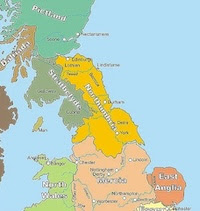
On the map shown, Jorvik (its original name) refers to the kingdom of York. The area north would have been Eadwulf's.
Their names appear in official documents. Oslac appears as witness to three charters in 963 as a thegn, not quite the earl status that later histories gave him. Eadwulf likewise appears as witness to royal charters between 968 and 970. Still, those charters—assuming the names on the charters are the same persons as the men administering the north—show that each of them was a trusted member of the court and traveled to meet with the king, who at the time was Edgar the Peaceable (who succeeded Eadwig who succeeded Eadred, who had worked diligently to re-unite Northumbria with southern England).
By 994, a charter is attested by Waltheof, Eadwulf's successor, suggesting that Eadwulf was either deceased or simply no longer in charge for some reason that no histories mention. Oslac was banished from England not long after the death of King Edgar. Edgar's death had led to a conflict over the succession, and some suggest that both Oslac and Eadwulf backed the unsuccessful Æthelred the Unready instead of Edward the Martyr, and lost their positions because of that misplaced loyalty (Æthelred was not even a teenager yet; Edward was older, but illegitimate; hence the debate over the succession.)
Whatever the case, Oslac and Eadwulf have their footnote in history. Oh, and why the nickname "evil child"? Who knows? His given name means "happy wolf"; perhaps it was simply a joke: "happy wolf, evil boy." Or he was truly considered to be less than a good person. Anyone who knows the reason for the name is long dead.
As is King Edgar the Peaceable, but at least we know more about him, and I'll share some of the with you next time.
04 March 2025
Oswulf I of Bamburgh
Primus comitum post Eiricum, quem ultimum regem habuerunt Northymbrenses, Oswulf provincias omnes Northanhymbrorum sub Edrido rege procuravit.First of the earls after Erik, the last king whom the Northumbrians had, Oswulf administered under King Eadred all the provinces of the Northumbrians.
03 March 2025
Trouble in Northumbria
Archbishop of York Wulfstan supported Eric, but the current Anglo-Saxon king, Eadred, came north in 948 and destroyed part of Northumbria as punishment, even burning several buildings at Ripon (a significant place, it was founded by St. Wilfrid and housed the remains of St. Cuthbert at one time). When he departed the north, Eadred advised that he would return with greater devastation if they did not get rid of Eric.
That did not resolve the "northern trouble," however, because shortly after, King Malcolm I of Scotland raided Northumbria and took captives and stole cattle. Moreover, with Eric gone and Eadred back south, Amlaib returned in 949, so one record claims. That only lasted until 952 when, once again, the Northumbrians expelled him, whereupon Eric returned to reign from 952 - 954.
Eric might have stayed longer except for a betrayal. A history written a century later by Roger of Wendover says:
King Eric was treacherously killed by Earl Maccus in a certain lonely place which is called Stainmore, with his son Haeric and his brother Ragnald, betrayed by Earl Oswulf; and then afterwards King Eadred ruled in these districts.
After this, Oswulf administered Northumbria and was loyal to Eadred and the following English kings. Northern control by Vikings was a thing of the past. The identity of Maccus is unknown. It is assumed that Roger of Wendover had access to a text with details of the death that is no longer available to modern scholars.
Tradition tells that Oswulf ruled all of Northumbria for about the next decade, so I think he's worth talking about, although we know very little about him. See you tomorrow.
02 March 2025
Eric Bloodaxe
Details of Eric's life are few, and this has caused the sometime King of Northumbria in the 940s and 950s with an Eric of Norway mentioned in Norse sagas who ruled the Norwegian Westlands in the 930s. This possibly erroneous conflation of the two gives us a richer history, but cannot be proven. If true, however, then Bloodaxe is the son of Harald Fairhair and half-brother of Haakon the Good, and left the kingship of Norway to rule over northern England.
At least we have evidence of his status in England from the existence of coins minted during his reign. Shown are coins minted at York with "ERIC REX" on them, accompanied by a sword.
The epithet "Bloodaxe" comes from mentions by a Norse poet writing in the 900s, and is given to him because he supposedly slew his half-brothers to ensure his rule over Norway. Other poets and historians refer to him as a "brother killer" or simply the he was vicious as a Viking raider. The Anglo-Saxon Chronicle omits "Bloodaxe" and refers to him simply as "Harald's son."
Let's talk about northern England. When Æthelstan died in 939, he was succeeded by his teenage brother Edmund. It seems that Olaf Guthfrithson almost immediately left Dublin to reclaim what he once claimed. He was joined by his cousin, Olaf Sihtricsson (known in Ireland and usually referred to in chronicles as Amlaib Cuarán). When Guthfrithson died in 941 or 942, Amlaib succeeded him. He had (for a time, at least) the support of Archbishop Wulfstan of York. Edmund then marched north and subdued Amlaib (and Wulfstan), and negotiated a treaty: Amlaib would be an ally and could hold onto Northumbria.
This second Olaf, however, was supposedly not as acceptable as the first, so Wulfstan and others helped drive him out in 952 and invited Eric from Norway to come and rule them. This is where he starts minting his own coins. Tomorrow we'll continue the back-and-forth possession of Northern England from Viking to Anglo-Saxon hands.