11 June 2022

English-Irish Hybrids?


When King Edward III sent his son Lionel as viceroy of Ireland, there were issues on the agenda regarding the presence of the English in Ireland. Many English had been living in Ireland for generations, and they were, shall we say, "going native":

Whereas at the conquest of the land of Ireland, and for a long time after, the English of the said land used the English language, mode of riding and apparel, and were governed and ruled, both they and their subjects called Betaghes*, according to the English law, ...; but now many English of the said land, forsaking the English language, manners, mode of riding, laws and usages, live and govern themselves according to the manners, fashion, and language of the Irish enemies; and also have made divers marriages and alliances between themselves and the Irish enemies aforesaid...

This is the opening of the Statutes of Kilkenny, addressing the grave concern that English folk were acting more like the Irish in whose land they were living. Established by Lionel in 1366, the 35 statutes were intended to keep the English true to their heritage. Some samples follow.

II. Also, it is ordained and established, that no alliance by marriage, gossipred**, fostering of children, concubinage or by amour, nor in any other manner, be hencefoth made between the English and Irish of one part, or of the other part; and that no Englishman, nor other person, being at peace, do give or sell to any Irishman, in time of peace or war, horses or armour, nor any manner of victuals in time of war; 

III. Also, it is ordained and established, that every Englishman do use the English language, and be named by an English name, leaving off entirely the manner of naming used by the Irish; and that every Englishman use the English custom, fashion, mode of riding and apparel, according to his estate; and if any English, or Irish living amongst the English, use the Irish language amongst themselves, contrary to the ordinance, and thereof be attainted, his lands and tenements, if he have any, shall be seized into the hands of his immediate lord, until he shall come to one of the places of our lord the king, and find sufficient surety to adopt and use the English language, and then he shall have restitution of his said lands or tenements, his body shall be taken by any of the officers of our lord the king, and committed to the next gaol, there to remain until he, or some other in his name, shall find sufficient surety ... 

The desire to create an Irish-English Apartheid was so remarkable, it is worth looking at more examples tomorrow.

*A note on "Betaghes": the word come from Old Irish bíattach "providing food," and refers to those workers who provided food for the ruling class.
**A note on gossiprede: the noun gossip referred to a close friend or confidant; rede means advice or counsel. The English and Irish were not allowed to be partners in any manner.

10 June 2022

Lionel of Antwerp

Lionel of Antwerp, like many royal children, was obligated to be a political tool as well as a person. Born 29 November, 1338 in Antwerp (his parents were there temporarily because of the start of the Hundred Years War), he was the second son of Edward III and Philippa of Hainault to survive infancy. 

On 9 September, 1342, he was married to Elizabeth de Burgh, who as a ten-year-old was six years his senior. The year after Elizabeth was born, her father died. He had been the Earl of Ulster, and marrying Elizabeth allowed Edward III to grant Lionel that title as early as 1347; Lionel also gained possession of vast estates in Ireland. In 1352 the couple lived together as husband and wife, aged 14 and 20 respectively. They had one daughter, Philippa, born 16 August 1355.

While Edward was heading to the continent as part of the Hundred Years War, he appointed Lionel as his representative in England in 1345 and 1346. Lionel was old enough to join his father and brothers on military campaigns to France in 1355. He grew to be about 6'10" tall, and would have been an imposing figure on the battlefield.

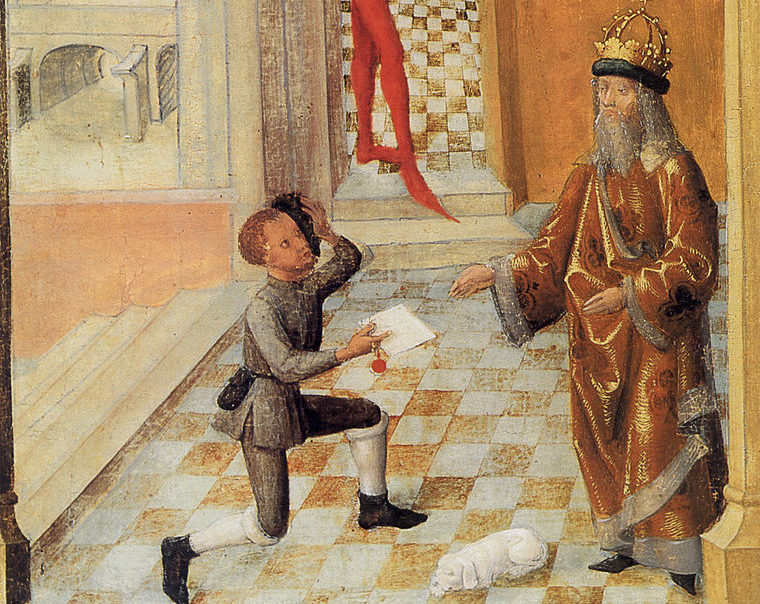
Lionel was present in 1360 for the signing of the Treaty of Brétigny, during which time he sent his page, Geoffrey Chaucer (then in his late teens) back to England with letters (discussed here). With the war with France "settled" (little did they know), Lionel went to Dublin in 1361 to be governor of Ireland. The following year, Edward created a dukedom and named Lionel Duke of Clarence. Edward also hoped to make Lionel King of Scotland, but that was less successful even than trying to control Ireland. In 1366, the Statutes of Kilkenny made an attempt to control some of the issues in Ireland that were disturbing to England.

Prior to this, however, tragedy struck with the death of Elizabeth in 1363. This left Lionel open to another advantageous marriage. This time, ties with Italy were sought through marriage to Violante Visconti. Arrangements had been made earlier by, among others, Geoffrey Chaucer, who traveled to Italy (mentioned previously here); the marriage itself was mentioned here.

Lionel and Violante were married in June 1368, kicking off months of festivities. Lionel took ill and died 17 October of the same year. His father-in-law, the ruthless Galeazzo II Visconti, was suspected of poisoning him, but it could not be proven. Visconti wanted the alliance with England, and Violante was not going to inherit anything of value with the death of Lionel, so there is no rational reason for Lionel's father-in-law to have him killed.

His body was buried in Pavia, but later returned to be laid to rest beside his first wife at Clare Priory in Suffolk. His daughter, Princess Philippa of Clarence, inherited the earldom of Ulster.

What was the perceived need for the Statutes of Kilkenny? It addressed the concern about English residents of Ireland becoming "too Irish." I'll tell you about that next.

09 June 2022

Mailing a Letter

Large empires such as the Roman Empire needed ways to communicate quickly and efficiently with their far-flung domains. For the Romans, it was the cursus publicus, a series of stations along the main Roman roads where messages were passed along to fresh couriers. After the decline of the empire, the value of the  cursus publicus caused it to be maintained. Theodoric maintained the Roman postal system in his own domain, as did the Carolingian Empire in theirs.

When the Carolingian Empire ended (888 CE), however, there was no longer any organized attempt for a postal system throughout any part of Europe. Kings and popes, of course, had the large staff available and could appoint someone to deliver a message, but outside of those official types of correspondence, what were the options?

One of the more efficient systems was created by Italian merchants centuries later. A lot of travel and trade used the Mediterranean, and the Mediterranean was dominated by Genoa, Florence, and Venice. Italian businesses became so large that branches were created, and the owners could not be everywhere that needed them. Orders and messages needed to be sent to subordinates, customers, deliverymen, etc.

The large businesses set up posting stations with fast horses and riders at several points along their trade routes, but eventually they realized they were duplicating each others' work. In 1357, seventeen companies in Florence collaborated on a single message delivery system. Florence to Paris was 700 miles, and ideally a message was delivered in three weeks. Weather could be a mitigating factor, but their system was the best option.

Couriers were not worthy of being named historically, but we do know one. Geoffrey Chaucer was paid nine shillings by his master, Lionel of Antwerp, to deliver letters from France to London while Lionel and his father (Edward III) took part in the Treaty of Brétigny. (Footnote: Chaucer was in London for two weeks before Lionel returned. What can an unattached page do in a fortnight? That is the frame for my mystery novel A Death in Catte Street, available via the links in the upper-right of this blog's main page.)

Lionel, a younger son of Edward III, does not get the attention given to Edward's other progeny like the Black Prince or John of Gaunt. He will get a little more of what is due him next time.

08 June 2022

Making Ink

When the oak gall wasp lands on a species of oak, it secretes a chemical that interferes with the tree's normal growth, producing a bulb, or gall, into which its eggs are inserted; they will grow to be wasps that crawl out of the gall.

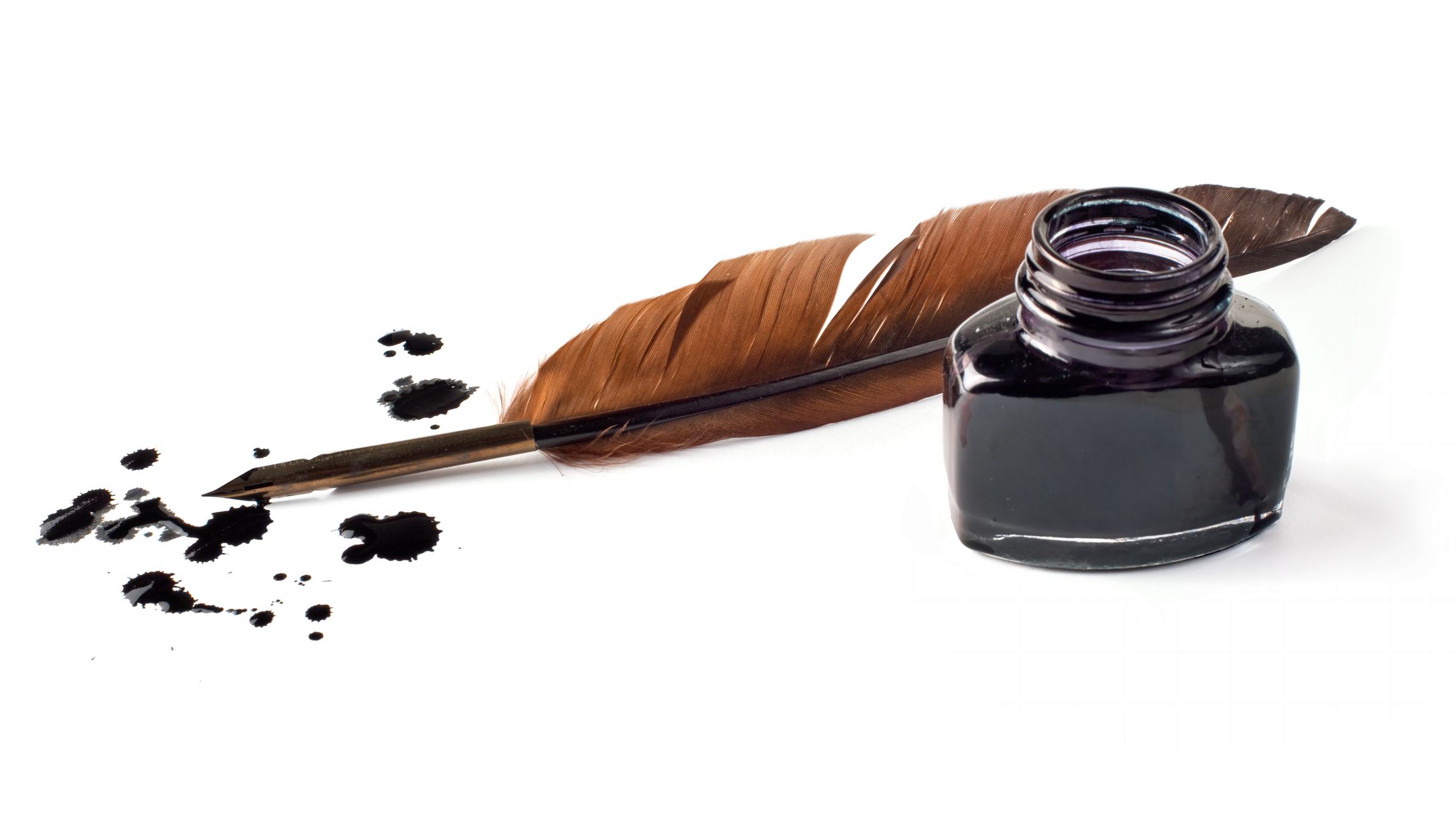
Somewhere along the way, folk learned that the galls could be used for something other than a wasp hatchery. Pliny makes a vague reference to oak gall ink. The typical way to make ink from oak galls was to crush the galls, add water, and boil the concoction; sprinkling in some iron sulfate turns the mixture black.

Too much iron could be problematic, however. It turned the ink corrosive, and too much iron could destroy (over time) the document for which it was used. But oak gall ink was the popular ink for 1400 years, and some of the oldest manuscripts have easily survived. The Codex Sinaiticus, the oldest Bible known (from c.325 CE), used oak gall ink.

Oak gall ink, sometimes called iron gall ink, was prevalent for at least 1400 years. The majority of manuscripts from the Middle Ages were made with oak gall ink, which dries to a light brown. Great Britain and France mandated oak gall ink for legal records. The popularity extended to the Renaissance: Leonardo da Vinci used oak gall ink. Even later, the U.S. Postal Service had its own prescribed version of oak gall ink at their branches.

One of the reasons the popularity of iron gall ink faded was the rise of the fountain pen. The ink was suitable for dip pens, but dip pens hold only a little ink on the tip, and the writer had to constantly re-dip the pen point into the ink and be careful not to splatter ink drops while traveling from the ink bottle to the page. Fountain pens were developed that stored more ink and released it slowly, as the ink was drawn from the tip. The fountain pen uses capillary action to raw the ink along a thin barrel, and the iron in iron gall ink could create deposits in the barrel that would impede the smooth flow of the ink. The development of other ink formulations made fountain pens more useful.

Oak gall ink is still manufactured for those few who want it. The U.S. Postal Service no longer uses it. But that suggests a direction for tomorrow: how did mail service work in the Middle Ages?

07 June 2022

A Brief History of Ink

You see it everywhere, yet we never give it a moment's thought. Almost everything printed uses ink. (There are heat-sensitive labels/receipts, and photocopiers don't use liquid anymore.) Carving in stone or wood, pressing into clay—these were sufficient ways to make records, but the result was a cumbersome piece of material to lug around or deliver. Once we started using thin, flat sheets of light material, we needed something to create images on it that would be durable and neat, not become illegible over time.

Just about every culture in the early stages of writing developed lampblack, carbon mixed with a liquid that would allow it to be spread neatly. Egypt added iron and ocher for red ink. China was grinding graphite mixed with water and applied with brushes. China also used soot and animal glue as of the 3rd century BCE.

India ink has been around for thousands of years, having been invented in China. A mixture of fine soot and water, it was used at least a thousand years BCE. It became known as "India ink" (in British English, "Indian ink") because the materials were sourced from India. It is still used for comic books and other purposes.

Countless materials were experimented with to create cheap and Latin inks. Ferrous sulfate and oak galls produced an ink that dried to a dull brown and is familiar on numerous medieval manuscripts.

During the time of Gutenberg, most inks were of two kinds: a mixture of soot, water, and glue as a binder, used since the Classical Era; and the medieval combination of ferrous sulfate, gall, water, and gum as a binder. (The binder was to make it water-resistant and therefore more durable.) Unfortunately, while fine for writing, they were unsuitable to the printing press because of their tendency to "blur" when applied with pressure. Even worse, iron gall ink can be corrosive to paper; the presence of iron causes oxidation of the cellulose in the paper. Johann Sebastian Bach's original works are being eaten away by the ink he used. 

Gutenberg's innovation was oil-based, mixed with lampblack (soot), varnish and egg white. This combination made a sharper impression when pressed onto paper or vellum, producing a clear image that did not blur or fade over time.

Oak gall ink, however, was popular in the Middle Ages and even used by Pliny. It might be worth taking a closer look at. Stay tuned.

06 June 2022

Movable Type

Movable type—the process of using interchangeable parts to create a page rather than carving/casting an entire page—revolutionized the production of the written word.

Prior to using movable type, pages were printed by carving an entire wooden block...backwards. One mis-carved letter would prompt the carver to start with a new block. Even without typos the process was time-consuming, and a block could only be used for that one page. Moreover, the ink would eventually soak into the wood, not just sit on it, softening the wood so that the letters lost their sharpness.

The invention of movable type is credited to Bi Sheng, whose process was described by a Chinese scholar, Shen Kuo:
During the reign of Chingli ..., 1041–1048, Bi Sheng, a man of unofficial position, made movable type. His method was as follows: he took sticky clay and cut in its characters as thin as the edge of a coin. Each character formed, as it were, a single type. He baked them in the fire to make them hard. He had previously prepared an iron plate and he had covered his plate with a mixture of pine resin, wax, and paper ashes. When he wished to print, he took an iron frame and set it on the iron plate. In this, he placed the types, set close together. When the frame was full, the whole made one solid block of type. [Dream Pool Essays, 11th century]
As seen in the illustration above, Chinese needed many more individual blocks to accommodate the characters in the Chinese writing system.

Korea developed movable type, but the process was more laborious than Bi Sheng's carving into clay:
At first, one cuts letters in beech wood. One fills a trough level with fine sandy [clay] of the reed-growing seashore. Wood-cut letters are pressed into the sand, then the impressions become negative and form letters [moulds]. At this step, placing one trough together with another, one pours the molten bronze down into an opening. The fluid flows in, filling these negative moulds, one by one becoming type. Lastly, one scrapes and files off the irregularities, and piles them up to be arranged. [Thomas Christensen (2007). "Did East Asian Printing Traditions Influence the European Renaissance?" Arts of Asia Magazine. 2006-10-18.]

The large number of individual characters needed for Korean—Korean used Chinese characters in a system they called hanja—made this process laborious. A solution was found several years before Gutenberg: Sejong the Great created a simplified alphabet of only 24 characters—called hangul—that would speed up the process of setting type. This did not catch on, however, as the elite refused to give up hanja in favor of making things easier for the masses. Another reason why movable type did not take off in Korea as it would in Europe under Gutenberg was a Confucian prohibition: the new printing method was only to be applied to government publications.

Johannes Gutenberg is described as having perfected movable type because of his experience with metals: he figured more efficient ways to make the numerous letters he needed to be able to compose many pages at once.

Although the oldest books extant made with movable type are Asian—the oldest extant book printed with movable type is Korean, made 78 years prior to Gutenberg's invention—there is no evidence that Asia influenced Europe. Gutenberg's method that produced cheap copies of books revolutionized scholarship and learning.

There was one more thing Gutenberg did that changed printing, and it never gets mentioned although in its way it is significant as part of the printing process. Tomorrow I'll tell you about something you see and use every day and don't give a moment's thought: ink.

05 June 2022

1453-The End

Historic periods rarely have well-defined dates, unless they can point to a specific event that created definitive change. One can say there's an "Atomic Age" that started with the dropping of the bomb on Hiroshima, for instance. Human history is divided into three periods: Classical Antiquity, The Middle Ages, and Modern History. There is, of course, "pre-history" where we have evidence of human beings but no written records (we are ignoring cave paintings).

The Middle Ages itself spans such a long time that it is convenient to split it into Early (late 5th century to 10th century), High (1000 CE to 1300s), and Late Middle Ages (about 1250 CE to 1500). You can't help noticing that High and Late overlap by at least 100 years.

For me, the Middle Ages ends in 1453. That year is not quite as arbitrary as the "official" year of 1500, picked (I assume) because it was a nice round number. I like 1453 because there are events—two specific and one approximate—that make large enough changes politically and culturally that it seems to me things in Europe will never be the same.

The first is the final end of the Hundred Years War. The economies and cultures of England and France were dominant through much of the previous centuries; their political alliances and hostilities affected several other countries, their trade partners as well helped create a "global" economy. With the French victory at the Battle of Castillon in 1453, a long period of instability that had started in 1066 came to and end. (Yes, there were military conflicts between France and Great Britain afterward, but no large or sustained campaigns. They are sometimes referred to as "The Second Hundred Years War." In fact, there was a period of 1159-1259 referred to as "The First Hundred Years War." [sigh])

The second specific event is the final Fall of Constantinople. (I feel obligated to designate it "final" because of the disastrous Fourth Crusade, which for some reason I have avoided discussing. Some day...) The result of a 53-day siege by the Ottoman Empire, it not only altered the history of one of the constants of history—Constantinople had never lost its reputation the way Rome did after the Goths—but it also marked a change in siege warfare. Until then, strong walls/ramparts had prove effective against siege warfare, and Constantinople had very strong ramparts. They were defeated, however, by the use of gunpowder. Defeating a well-defended city became easier. Constantinople became the new capital of the empire. There was a secondary result of this conquest: an influx of new (and classical) learning through Greek texts brought to Western Europe by scholar fleeing Constantinople. The Renaissance had already started in Italy and elsewhere, and now would be enhanced by the new scholars and scholarship.

My third (and the "approximate" event) was a development brought about by a German named Johannes Gensfleisch, whose expertise with metal work helped him perfect a process that had actually been around for 200 years—just not in Europe. We know him now as Johannes Gutenberg. The famous Gutenberg Bible took about two years to set and print, and was completed in 1454. We are certain his press was in operation as early as 1450. The cultural sea-change brought about by the relatively easy method of providing the world with books without fear of scribal errors cannot be calculated. There were fears that learning would not be appreciated properly or used wisely—once you let just anyone have a book, the less-educated could misinterpret it and spread misinformation. It is likely that an elite class would oppose widespread dissemination of learning in order to maintain their elite status (which is why movable type did not become widespread two centuries earlier). The cat was out of the bag, however. It is likely that the choice of printing an impressive Bible helped some see the beauty and utility of mass-produced books.

...and that, for me, is why post-1453 would never be the same in Europe and the very-near East. Now, as much as I want to talk about that "First" Hundred Years War, you may be sick of that topic and the petty fighting between England and France. For a change, let's look at the "failure" of movable type to catch on in the 13th century, and for that we have to turn to a country never before mentioned in this blog: Korea.

04 June 2022

The Hundred Years' War, Part 4

(If you want to see parts one and two and three.)

If we follow Shakespeare's themes, King Henry V surprised his subjects when his coronation transformed him into an able and savvy ruler, as compared to the frivolous youth he had recently been.

He had plenty of military experience, however, prior to his father's death. He had commanded the English forces in Wales during the revolt of Owain Glendower. By 1410, with Henry IV ailing, the 24-year-old young Henry had been running much of the government (albeit with the help of his uncles, Henry and Thomas Beaufort; Thomas was named Chancellor at this time).

Still, Henry might have been content to rule England when he was crowned on 9 April 1413, but for the situation in France. Charles VI—whose first bout with delirium happened at the age of 24 in 1392, when he attacked his own men during a military expedition—was becoming increasingly unstable. Placed under the regency of two uncles, the Dukes of Berry and Burgundy, he became a pawn between them and his own brother, the Duke of Orléans, who wanted control by being a regent. These opposing forces created the Armagnac-Burgundian Civil War that lasted from 1407 until 1435.

A France in military and political turmoil looked ripe for a resumption of hostilities; and France had given support to Owain Glendower. Meddling in England's affairs was reason enough.

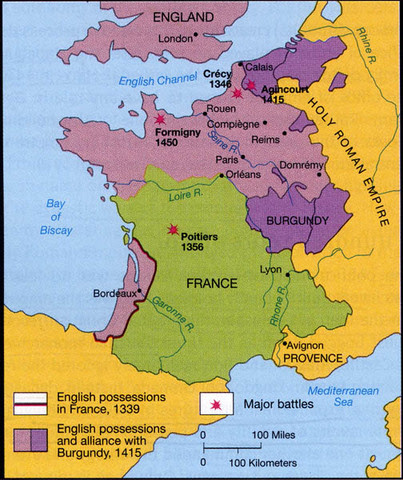
Henry sailed for France on 12 August 1415. His first target was the principal seaport of Harfleur. The siege took weeks, and dysentery hit the English troops hard. Henry had to leave a part of his army in Harfleur while he marched toward Calais, but an approaching French army forced him inland, away from his ships and his target. Unfortunately, this move by the French forced the encounter at Agincourt, where the French soldiers were bogged down in the muddy fields, making them easy targets for the longbow men commanded by Henry. The victory of the English was sufficient to lead to the Treaty of Troyes, in which Charles "disinherited" his son: Henry V would become King of France upon Charles' death. Charles' daughter Catherine de Valois married Henry in 1420. They had a son, Henry.

The deaths of both Charles V and Henry V within two months of each other in 1422. Henry VI became king of both England and France; he was nine months old, and the only English king to have been officially named King of France. Skipping over decades of rocky reign, the English lost control of France decisively at the Battle of Castillon on 17 July 1453, which lost Gascony/Aquitaine, the English throne's major territory on the continent for the previous three centuries.

This has been (necessarily) a much-abbreviated look at the Hundred Years War, which ended in 1453. Next I want to explain why I think 1453 is a good year to say the Middle Ages were well and truly over.

03 June 2022

The Hundred Years' War, Part 3

(If you want to see parts one and two.)

The second part of the Hundred Years' War was the Caroline Phase, named after Charles V of France, who ignored the Treaty of Brétigny and started reclaiming sections of land from the English-held territory.

Charles had a reason to think the time was right for this move. Problems in Castile caused Pedro the Cruel to ask England for help in restoring him to his throne. Edward, the Black Prince, spent a lot of money raising an army to help. Once Pedro was restored, he broke his promise to repay Edward. Edward decided the best way to recoup his losses was to raise taxes in Aquitaine.

The people of Aquitaine, since they were French citizens, appealed to King Charles for aid, who summoned Edward to Paris in May 1369. When Edward did not appear, Charles declared war. An ailing Black Prince had returned to England in 1371 where his father was also elderly and in poor health. While Aquitaine was in turmoil, Edward's forces were no longer helping Pedro, who was once again deposed. His enemy was his half-brother, Henry of Trastámara. Henry was now more than willing to throw his military power behind the French forces against England. The English fleet was defeated soundly in the Battle of Rochelle in June 1372.

The Black Prince died on 8 June 1376; his father died 21 June 1377, leaving the throne to the Black Prince's son and heir, crowned Richard II, who was 10 years old. A pre-teen king was not going to conduct a war, so England's territory on the continent was mostly the town of Calais.

We should also remember the the Black Death struck between 1348 and 1351, killing up to 33% of English and 40-50% of the French. Raising and outfitting armies could not have been easy. Moreover, the Plague returned every several years, although it did not kill as many each time.

The war would be renewed by Henry V. Stay tuned.

02 June 2022

The Hundred Years' War, Part 2

In what can be called the Edwardian Phase of the Hundred Years' War, King Edward III of England fought to keep what territory he had on the continent. Much of the war was guided by his son Edward,  now called The Black Prince.

(About the nickname: there is no record of that label during his lifetime; the first recorded use is around 1540 by an antiquarian who claims he was known as "The Black.")

England took years to gather its forces, sailing for France in July 1346. Prince Edward was 16 years old, but upon landing, his father knighted him. On 26 August, the first big battle of the War took place at Crécy. The two Edwards commanded different flanks; when word came to the king that his son was in dire straits, having charged bravely into the French troops but then being surrounded by a fierce counter-attack, he declined to send help, wanting to give the prince an opportunity to prove himself.

The prince was in trouble, however, being thrown off his horse. His standard-bearer dropped the standard and stood over the prince, defending him while he recovered. Help did arrive, and the English ultimately were the victors.

The next big event was the taking of Calais, after which the prince burned and pillaged several square miles of the surrounding area. Calais would stay in English hands until 1558. The Battle of Poitiers in 1356 was another success for the English.

The Edwardian Phase took several years, and overlapped with the first appearance of the Black Death. It also experienced a devastating storm called Black Monday. This phase ended with the Treaty of Brétigny in 1360, leaving England with a large section of southwestern France as well as hostages captured in battle who needed ransoming. John II of France had been captured and his ransom set at 3,000,000 crowns. England was content. A few years later, however, Charles V ( trivia about Charles here) became King of France, and he had no intention of adhering to the treaty.

His phase comes next.

01 June 2022

The Hundred Years' War, Part 1

Simply put, the Hundred Years War was an argument over the rightful ruler(s) of England and France. Officially, it ran from 1337 to 1453, making it 116 years long. It was not an ongoing battle, but a series of battles depending on who decided it was time to assert a claim to the other's throne, and a series of truces depending on who thought they could make a deal that was advantageous to their country.

It started with Duke William of Normandy, alias William the Conqueror. He was a vassal to the king of France because he held Normandy and other territories in France, even though he became king of England in 1066. Here's the issue: should a king be subordinate to another king, just because he holds territory in the other king's country?

France did not like having large swaths of territory held by the English king, and would occasionally occupy and "take back" those territories when England's army was busy elsewhere, such as when it was fighting Scotland. The real sticking point came in 1328 when King Charles IV of France died. He had no sons, and no brothers. France held to something called Salic law, that determined only males could inherit, not females. Charles had a sister, Isabella, who had married Edward II of England. Their son, Edward III, was the closest male heir to Charles, and Isabella claimed that Edward should be King of England and France.

France did not want a non-Frenchman ruling their country, and so they went up the family tree instead of down and the throne was offered to Philip VI, Count of Valois, a cousin through Charles' father. Edward fumed, but gave in, offering loyalty to Philip through Edward's possession of Gascony. This might have settled things, but Philip got greedy. In 1337, he called a Great Council in Paris where they decided that Gascony should not belong to the English king.

Edward III was not going to stand for this insult (and confiscation of his lands), so the war was on. Tomorrow we will see how the first phase went.

31 May 2022

Medieval Cavalry

The Middle Ages in Europe recognized the value of cavalry and put resources toward evolving it. Stirrups so the rider can brace himself (seen on the Bayeux Tapestry), high-backed saddles for the same reason, and spurs to urge the mount on faster were all modifications that enhanced the use of cavalry as a swift and formidable strike force. Armor also became more elaborate and enclosing for horse and rider.

The importance of the armed cavalryman in battle transferred to his social status outside of battle. Knights ranked higher than foot soldiers. Part of this was the cost of outfitting a mounted warrior: few could afford it, which made knights not only special for their ability, but also because of their rarity (compared to infantry).

This special significance in warfare ultimately faded, especially once the English longbow men proved to be so valuable and deadly during the Hundred Years War, such as at Agincourt. The cavalry evolved into a way to get fighters to the battlefield fast, who then dismounted and used swords, maces, and poleaxes to fight on foot, engaging the enemy on its own level.

It occurs to me that the Hundred Years War has been mentioned many times, for instance here, but never explained. I'll give it a crack tomorrow.

30 May 2022

The Cavalry is Coming

St. Martin of Tours as a young man was a cavalryman, and likely a member of the Equites cataphractarii. Of all the cavalry styles Rome used, the cataphractarii were the most heavily mailed. Although equites is Latin for Knight/horseman, cataphractarii was Greek, κατάφρακτος, meaning "covered over."

The Romans did not invent the heavy-armoured horseman: on the contrary, the innovators were the Assyrians, whose monuments uniquely illustrate the evolution of cavalry technique in antiquity. [link

Cavalry with lances/spears could be formidable: swift and deadly. We have a detailed contemporary description by Julian the Apostate (331 - 26 June 363). Julian was a nephew of Constantine who became emperor; he was called "Apostate" because he rejected Christianity and turned back to Greek beliefs. He wrote:

...their limbs were fitted with armour that followed closely the outline of the human form. It covers the arms from wrist to elbow and thence to the shoulder, while a cuirass made of small pieces protects the shoulders, back and breast. The head and face are covered by a metal mask which makes its wearer look like a glittering statue, for not even the thighs and legs and the very ends of the feet lack this armour. It is attached to the cuirass by fine chain-armour like a web, so that no part of the body is visible and uncovered, for this woven covering protects the hands as well, and is so flexible that the wearers can bend even the fingers.

The horse was the weak point, however, since charging into a crowd of enemy soldiers risked a sharp blade to the horse. An excavation in Syria at Dura Europos, a Roman border city above the Euphrates, uncovered two iron/copper horse armors with some of the fabric backing still attached. Besides those rare examples, we have a few carvings showing samples of the equine armor. (The illustration gives an Assyrian example.)

Let's look at what the later Middle Ages did with cavalry next.

29 May 2022

St. Martin of Tours

In "The Shipman's Tale" of Chaucer's Canterbury Tales, a monk gains the trust of a friend's wife by invoking St. Martin of Tours, a testament to the power of even the name of this enormously popular saint.

Martin was born in Pannonia (Hungary) in Gaul to pagan parents, he was raised in Italy and forced into military service at the age of 15. He started learning about Christianity and was baptized at 18. (Note: there are very conflicting reports about his birth year, with 316 and 336 offered up, neither of which can be verified. His death on 8 November 397 is certain, but whether he was 60 or 81 we cannot know. The 336 year is preferred by modern scholars.)

His position was with the cavalry, likely the heavily armed Equites cataphractarii. Once he became a Christian, however, he refused to fight. His biographer, Sulpicius Severus, writes that he was jailed for this refusal, and that he offered to go unarmed to the front of the line in an imminent battle in Gaul. This was deemed acceptable, but the opponents made peace with Rome, the battle never happened, and Martin was released from service.

Martin vowed to be a monk, and went to Caesarodunum (Tours) to become a follower of Bishop Hilary of Poitiers (see here) and join his quest against the Arians. In the ensuing years, he fought against Arians, sometimes losing; converted many, including his mother (but not his father); rejoined Hilary in 361, where he established a hermitage nearby. This developed into the oldest monastery in Europe, Ligugé Abbey. As of this writing, the abbey has 25 monks.

In 371, Martin was asked to come to Tours to aid a sick person; he was enticed into the church, where he was convinced to be named the third bishop of Tours. His demeanor very public life of a bishop disd not suit him, especially the negative attention he received when demolishing pagan sites of worship. He soon withdrew to Marmoutier Abbey, which he founded.

His best known anecdote (pictured above) is as a soldier when he cut his cloak in half with a sword to give half to a freezing beggar. His half of the cloak was preserved by the Merovingians in Marmoutier Abbey. The king would even carry it into battle for protection. It is specifically mentioned in the inventory of a royal villa in 679. The priest who cared for the half cloak was called a cappellanu, plural cappellani. In French that becomes chapelains, and in English chaplain.

Martin is the patron saint of several groups, including the U.S. Army Quartermaster Corps, beggars, innkeepers, vintners, equestrians, and many more. His feast day is 11 November, aka Martinmas.

There are more details and many anecdotes/miracles attributed to him, but I think it would be interesting, since the subject has been raised, to see next an example of early medieval cavalry, namely the Equites cataphractarii.

28 May 2022

Marmoutier Abbey

American author Henry James took a six-week tour of France in 1883, in which he mentions the "chatty nun" who guided him through Marmoutier Abbey. By that time, most of it had been demolished or simple fallen into disrepair, after having been "disestablished" in 1799 during the French Revolution. (You can see an artist's rendition from 1819 to the left.)

St. Martin was made bishop of Tours in 371 CE. The job was too conspicuous for his taste, so he founded an abbey in 372 into which he could withdraw from the press of public life. Martin's contemporary, Sulpicius Severus, in his biography of St. Martin, describes the restrictions Martin placed on those who wished to join him:

No one there had anything which was called his own; all things were possessed in common. It was not allowed either to buy or to sell anything, as is the custom among most monks. No art was practiced there, except that of transcribers, and even this was assigned to the brethren of younger years, while the elders spent their time in prayer. Rarely did any one of them go beyond the cell, unless when they assembled at the place of prayer. They all took their food together, after the hour of fasting was past. No one used wine, except when illness compelled them to do so. Most of them were clothed in garments of camels' hair. Any dress approaching to softness was there deemed criminal, and this must be thought the more remarkable, because many among them were such as are deemed of noble rank.

This was prior to the strict set of rules for monastic living formulated by St. Benedict and adopted by so many abbeys.

The abbey fell on had times when the Normans invaded and damaged it in 853, killing over 100 monks. Abbot Majolus of Cluny (Cluny was mentioned here) restored it in 982; a generation later, it was thriving and becoming one of the richest abbeys in Europe. You can read here how a monk of the abbey attended the Battle of Hastings and suggested to William the Conqueror that an abbey be built on the site. That abbey was "seeded" with monks from Marmoutier, which led Marmoutier to claim control over it, but the idea was rejected.

Now it is a Catholic school, the Institution Marmoutier, whose webpage begins Sur les pas de Saint Martin, symbole universel du partage. "In the footsteps of St. Martin, the universal symbol of sharing."

Time to take a closer look at St. Martin, I think.