08 December 2022

Boudica

History doesn't usually commemorate the losers, but in some cases the figure involved has fought (and lost) so spectacularly that the events are not forgotten. Such is the case with Boudica.

In stature she was very tall, in appearance most terrifying, in the glance of her eye most fierce, and her voice was harsh; a great mass of the tawniest hair fell to her hips; around her neck was a large golden necklace; and she wore a tunic of divers colours over which a thick mantle was fastened with a brooch. This was her invariable attire.

This description was by Roman historian Cassius Dio, writing a century after her death. He called her Buduica, his Latin version of the Brittonic name by which she is known now, Boudica. (The second 'c' often found in her name was a typo added by Tacitus.) That was probably not her real name, however, given that Common Brittonic (the British Celtic language used by the inhabitants before Roman and Viking invasions started adding new words) includes the feminine boudīkā, "victorious." What we know her by was likely a title given to her, in which case we have no idea what her birth name was.

Boudica was a queen of the Iceni tribe, wife of Prasutagus. The statue shown here includes their two daughters. The Iceni inhabited the area now known as Norfolk in the 1st century CE. Under the Romans (Claudius' forces had conquered Britain in 43), Prasutagus was allowed to be king, so long as he named Caesar his co-heir along with Prasutagus' two daughters. Rome also achieved local support by making loans of money and real estate to influential Britons.

When Prasutagus died before 60 CE, his will was not honored. Romans claimed the kingdom, loans and real estate were confiscated, Boudica and her daughters were beaten and raped. Cassius Dio says that the philosopher Seneca had made loans to some Britons, and called them in.

The stage was set for an uprising of the Iceni against the Romans, and Boudica was ready for it. Their initial success was sufficient to prompt the current emperor, Nero, to consider abandoning Britain altogether. That became unnecessary as the war went on.

Details to come.

07 December 2022

Women of Legend

The word for a Slavic epic hero is bogatyr. One of the best-known was patterned on Prince Vladimir's uncle, Dobrynya. His battle with a dragon to save a princess would have resulted in most other folklores in being married to the princess, but his bride came from a different story.

Slavic folklore included female bogatyr called polianitsa, who are known to be as brave and strong and skilled as the bogatyr, and who often rescue their husbands. Dobrynya "met" a polianitsa named Nastas'ya Nikulichna when he saw her riding her black horse across he plains. (Without explanation) he fired an arrow at her that struck the side of her helmet. The strike had no effect; the arrow bounced and fell to the ground. He fired another with the same result. A third arrow finally caused her to stop and look around.

She rode up to him, grabbed him off his saddle by his hair, stuffed him into her saddlebag, and continued her ride. After four days, her horse stumbled, complains to her that he was carrying too much weight. Nastas'ya then pulled Dobrynya out of her pouch, asked him who he was, and gave him her terms: if he were older than she, she would kill him; if he were younger, she would treat him like a brother; if they were the same age, she would marry him.

Dobrynya did not want to risk revealing anything, so he refused to talk. Her horse recognized him, however, and identified him as Dobrynya Nikitich who was her age. Nastas'ya said they should get married, and they rode to Kyiv to make it happen. Prince Vladimir attended the wedding feast, which lasted three days, and Nastas'ya went to live with Dobrynya's widowed mother, Amelfia Timofeyevna, while Dobrynya went to fight a war in Lithuania.

While Dobrynya was away for many years, Nastas'ya (believing him dead) agreed to marry Alyosha Popovich (the second of the three best-known legendary bogatyr). Dobrynya was not dead, however, and learned of the wedding plans. He rushed back in time to attend the wedding disguised as a minstrel. After singing for the couple, he revealed himself, forgave this wife, and threatened to kill Alyosha. He was stopped by the third legendary bogatyr, Ilya Muromets. Dobrynya and Nastas'ya then lived happily ever after, agreeing to never speak of or to Alyosha ever again.

Whew.

There were actual women performing legendary acts in history. Vladimir's grandmother was one of them, in fact. Another was a 1st century British queen—a little early for the Middle Ages, but mentioned in medieval literature—Boudicca. Let's talk about her next.

06 December 2022

Slavic Epic Legends

A bylina (plural byliny) is an Old Russian epic poem. They often contain tales of a bogatyr, a legendary hero. Early examples are like any other culture's folklore, containing tales of giants and dragons, acts of magic and miracles, etc. With the era of Vladimir the Great, Grand Prince of Kyiv, the so-called Kievan Cycle included bogatyr who were more rooted in real historical figures and (slightly) more realistic events.

I have mentioned Dobrynya, based on Vladimir's maternal uncle. The bylina of Dobrynya Nikitich starts with his mother advising him to avoid doing four things, all of which he winds up doing. She tells him not to travel the Saracen Mountains, not to trample baby dragons, not to rescue Russian captives, and not to bathe in the Puchai River.

He bathes in that river and meets a female dragon. He defeats the dragon, who pleads for a treaty, which he grants. The dragon immediately breaks the treaty, flying to Kyiv and kidnapping Prince Vladimir's niece Zabava. Vladimir orders Dobrynya two choices: rescue my niece, or be executed (sounds historically accurate!) Dobrynya's mother gives him a legendary horse Burko and a magic silk whip. Dobrynya tracks down the dragon's lair in the Saracen Mountains and tramples her dragon pups, one of whom cripples Burko with a bite to the leg; the magic whip (riding crop?), however, restores the horse with its application.

The dragon refuses to give up Zabava, and they fight for three days. Dobrynya, exhausted, wants to give up, but a voice from Heaven tells him to continue for three more hours, at the end of which he kills the dragon. This tale is so popular that it is still told: the illustration above is from a 2006 animated feature.

The happy ending would be Dobrynya marrying the rescued Zabava, but alas! Dobrynya is a peasant and not suited to the niece of a prince. Zabala's hand in marriage goes to Alyosha Popovich (second of the three best-known bogatyr). Dobrynya marries Nastas'ya Nikulichna, a polyanitsa (a female bogatyr).

From here I was thinking of talking about the medieval belief in dragons, but a female bogatyr is too interesting to leave alone with a single sentence. Dobrynya's marriage to Nastas'ya isn't part of the dragon story. It starts when he shoots her with an arrow. But that's a story for tomorrow.

05 December 2022

Slavic Epic Heroes

Grand Prince of Kiev Vladimir the Great (958 - 1015) expanded the territory for the Kievan Rus. He cared about his reputation, showing his religious devotion by erecting a temple to the various gods of the people he had conquered. (He abandoned this when it became politically prudent to convert to Christianity.) The conversion to Christianity was politically prudent when he married a royal from Constantinople, abandoning his Kievan wives. (I think it stemmed from trying to overcome his illegitimacy, his mother being his father's housekeeper.)

Something else happens during his reign that I have to assume is not a coincidence, and that he encouraged it: the rise of the Kievan Cycle, legends about heroes, some of whose origins can be traced to real people during Vladimir's reign among his elite warriors and personal companions.

Now for some terms: a bogatyr (etymology uncertain) is a hero, a knight errant similar to Arthur's knights of the Round Table who travel the land having adventures recorded in the Rus' epic poems called bylinas (from the past tense of the Russian verb for "to be," indicating "something that was"). Prior to Vladimir's reign and the Kievan Cycle, Slavic/Russian legends include supernatural elements; the bogatyr often wield magic. The Kievan Cycle is more rooted in fact and national pride. The heroes are often depicted in defending the homeland.

One of the bogatyr is Dobrynya, shown to be based on Vladimir's maternal uncle of the same name. Vladimir had been sent to Dobrynya in Novgorod as a youth. One story claims that Vladimir's rape of Rogneda (see the link above) was orchestrated by Dobrynya, after Rogneda insulted his sister, Vladimir's mother Malusha. It was Dobrynya who forced Novgorod's Christian conversion "by fire" after Vladimir's decision.

The picture above is an 1898 painting the three best-known bogatyr: Dobrynya Nikitich, Ilya Muromets, and Alyosha Popovich. Bogatyr were sometimes known for specific characteristics. Dobrynya was known for his courage, Alyosha for his wits, and Ilya excelled in strength and integrity and his defense of the homeland.

Tomorrow we'll delve into some of the fictional and not-so-fictional bogatyr and their bylinas.

04 December 2022

Christianization Aftermath

Vladimir the Great's mass conversion plan for the Kievan Rus was not acceptable to everyone. Less than a decade earlier he hd built a temple to several gods of the local tribes he had conquered, and picked Perun as the chief god.

Perun was the top god of the Slavic pantheon, a sky god with the power of thunder and lightning and storms. He was god of war and law, fertility and oak trees, and his symbols were the eagle and the hammer or axe (many "Axes of Perun" amulets have been found in archaeological digs). Perun was important to many peoples in the region, and even to Vladimir's own military.

So when Vladimir commanded that everyone come to the Dnieper to be baptized in the river or be named his enemy, people were upset, and many resisted. Dobrynya, Vladimir's uncle—Novgorod chronicles claim that it was he who raised Vladimir as a child, and later persuaded him to take control from his older brother—is said to have driven Novgorod to Christianity "by fire."

Pagan protests took place in areas outside of main population centers, such as in the Upper Volga and in the northeast in what is now Rostov in the Yaroslavl Oblast in Russia. Even decades later, in 1071, the bishop was being threatened by a mob opposed to Christianity, but the local prince bisected a "sorcerer" with an axe, saving the bishop and discouraging the uprising. Pagan culture could not be eradicated completely, surviving for centuries: a medieval epic poem composed probably shortly after 1200 called The Tale of Igor's Campaign blends Christian motifs with pagan gods.

Mass conversion was a political move, but it did not immediately change the hearts and minds of the subjects or the culture in win they lived.

But since we've touched on Slavic literature, I want to talk more about Vladimir's uncle Dobrynya, and the Kievan version of the Round Table. More on that tomorrow.

03 December 2022

The Christianization of the Kievan Rus

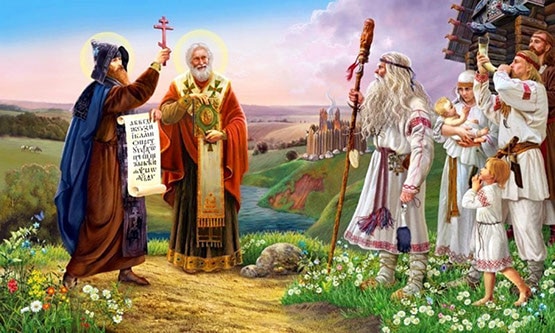
Although his grandmother, the cruel and vicious Olga, is considered by some to be the reason the Kievan Rus became Christian, Vladimir the Great is the one who made it "official." The "Baptism of Kyivan Rus"*  is celebrated every year. The reason he converted himself and the country is worthy of debate.

The account of the Primary Chronicle is that he looked for the best religion of the three major ones (Christianity, Judaism, Islam) to submit to, settling on Christianity because it didn't have the dietary prohibitions of the others. The Chronicle also contains what is called the "Korsun Legend." In it, Vladimir captures Korsun—part of the Byzantine Empire—in the Crimean Peninsula. He uses this to negotiate with the Emperor Basil II for Basil's unwedded sister in marriage. Vladimir already had a few wives, but this would be the highest-born wife he could get, and forge an alliance with a large empire. Basil consents if Vladimir will be baptized a Christian. He does so, and marries Anna Porphyrogeneta.

Several Arab sources cast this event in a slightly different light. They tell us that two rebels joined forces against Emperor Basil, one of whom actually declared himself emperor in September 987. Basil wanted help dealing with them, and so turned to Vladimir, despite their less-than-friendly history. Vladimir offered his help in suppressing the rebels, in exchange for Anna's hand in marriage. Vladimir also agreed (although he seemed to have had the upper hand in this deal) to be baptized and to Christianize his whole nation. Once this agreement was finalized, Vladimir sent 6000 troops to Basil's aid.

Whichever version is accurate, Vladimir married Anna, but had a problem at home: several wives. He had to divorce Rogneda (who entered a monastery), Adela, and Malfrida. He also had all the residents of Kyiv meet him at the Dnieper River for a mass baptism. He baptized his children and all the nobility. Messages went to all residents of Kyiv to come to the river and be baptized or be declared Vladimir's enemy. Priests from Korsun performed the ceremony.

Afterward, less than a decade after setting up shrines and temples to pagan deities to please the various tribes, he had them all torn down or burned. 

In our high school History of Western Civilization classes we often hear about entire countries being forced into Christianity. We never hear about paganism fighting back. In this case, let's see how Vladimir's people felt about their forced conversion. See you tomorrow.

*The Russian attack of Ukraine in 2022 has resulted in a change in many places to use the Ukrainian spelling "Kyiv" over the Russian "Kiev." I still use "Kievan Rus" because it is historically what the group has been called; when I mention the capital city, I will use the Ukraine spelling.

02 December 2022

Vladimir the Great

Vladimir the Great (also Vladimir I, also St. Vladimir/Volodymyr) was Grand Prince of Kyiv and ruler of Kievan Rus from 980 to 1015. He was the third son of Sviatoslav I, whose death in 972 resulted in Vladimir fleeing to Scandinavia after his oldest brother, Yaropolik, murdered their middle brother, Oleg, to eliminate a potential rival to his rule.

Yaropolik might not have considered Vladimir a threat, since Vladimir was the son of their father and their father's housekeeper.

The ruler of Norway, Haakon Sigurdsson, was a relative. Haakon helped Vladimir (who was only 21) to gather a Varangian army and defeat Yaropolik, taking over Novgorod. He was crowned 11 June 980.

On his way to defeat his brother, he sent to the Prince of Polotsk (in Belarus) asking for his daughter Rogneda's hand in marriage. Rogneda refused to marry the son of a housekeeper, so Vladimir diverted to Polotsk, conquered it, kidnapped Rogneda, killed her parents, and used Polotsk as a fortress base to capture Kyiv.

During his reign and expansion of his father's territory, Vladimir lived the life of a staunch pagan, erecting shrines to gods and enjoying 800 concubines. He was keenly aware of the religious beliefs of the various tribes and areas he was conquering, and wanted to ensure loyalty to himself by showing reverence for their deities, at one point building a temple to six different gods worshipped by different groups.

This attempt to exploit the gods for his own purposes was overt enough that people resented it. Vladimir, fascinated with the power religion had, sent emissaries to explore the major religions of the world: Islam, Christianity, Judaism. Islam's prohibition against alcohol and pork made it unsuitable, and Jews' loss of Jerusalem showed that God did not favor them. His people returned having been most impressed by the grandeur of Constantinople and its religious rituals.

There are two different versions of what happened next: the local sources that say Vladimir decided Christianity was preferable, and Arab sources that offer a more cynical reason for his conversion. I'll give you the details next time.

01 December 2022

From Scandinavia to Constantinople

The Varangian Guard were personal bodyguards for Byzantine emperors from the 10th to 14th centuries. The guards were primarily hired from Northern Europe. Hiring mercenaries from far away was a common practice in many countries (Italy, for example) to avoid soldiers having any local loyalties that might motivate them to help someone overthrow the government.

Vikings traveled everywhere, not only on northern seas, but also the Black Sea, the Marmara, the Aegean, and the Mediterranean. An ethnic group called the Rus, believed to be Norse who settled around the Black and Baltic Seas and merged with Slavic locals, created a culture now called the Kievan Rus. They were the first recruits for the Varangian Guard, after their Christianization.

Over time, Constantinople sent emissaries north seeking to hire more. In 1195, Alexios Angelos sent requests for 1000 warriors each from Denmark, Norway, and Sweden to help him overthrow the emperor, who was his brother, and make himself Emperor Alexios III.

Many Norse, mostly Swedes, made the trip south on their own, seeking employment in the lucrative business of guarding the Byzantine emperor in Miklagarðr, ("Great City"). The number of them—and the consequences of their absence—was sufficient to create new laws. Sweden forbade receiving an inheritance if you lived in Greece. Norway decreed that departing for Greece forfeited your place in line regarding inheritance. Clearly they were happy if citizens brought money back, but were against seeing wealth leave their country for southern climes.

The Christianization of Kievan Rus that brought them to the attention of Byzantium and made them the source of the first Varangians has been touched on before, as has been the person who brought it about, but he did more than that. Next time we look more closely at Vladimir I of Kyiv.

30 November 2022

The Greece Runestones

Several of the Norse Runestones are part of a subset called Greece Runestones. These refer to Grikkland (Greece) or Grikkjar (Greeks), and two refer to grikkfari (traveler to Greece). To Scandinavians, Grikkland was any part of the Byzantine Empire. Some stones were raised to commemorate Scandinavians who died in Greece as part of the Varangian Guards, some to recognize men who returned with wealth from their time down south.

There is variety in size of runestones, and the Greece examples are no different. One is a carved whetstone (3.3 x 1.8 x 1.3), mentioning two men who traveled to Greece, Jerusalem, Iceland, and Serkland (the name referring to land of Muslims). (This was originally thought to be a forgery; the claim was that a worker found it while digging a shaft for a telephone wire. It was considered authentic partially because of a few misspellings of place names: mistakes a forger would not make when every available document one might use as reference spelled those locations accurately.)

One is a boulder 59 feet in circumference, known as U 112, side A of which is shown here. It reads:

Ragnvaldr had the runes carved in memory of Fastvé, his mother, Ónæmr's daughter, (who) died in Eið. May God help her spirit.

Side B reads:

Ragnvaldr had the runes carved; (he) was in Greece, was commander of the retinue.

 U 112 is an example of how the runestones are valuable to modern scholars and historians as far more than an example of art. The name Ragnvaldr indicates that was likely a member of a noble family. The reference to his mother and her father are useful in connecting Ragnvaldr to his family. Ónæmr is mentioned on two other runestones, through which we know that Ragnvaldr had two aunts and a cousin who received Danegeld three times. Ragnvaldr was part of a wealthy family. Also, "commander of the retinue" makes him captain of the Varangian Guard, and well-paid in his own right.

The link between Scandinavia and the Byzantine Empire lasted a long time, especially because of the Varangian Guard, and even motivated Norway and Sweden to create laws specifically about those who went south, especially regarding inheritance. I'll talk about this north-south connection, the Varangian Guard, and keeping family wealth in the country next time.


29 November 2022

The Jarlabanke Runestones

Of the thousands of runestones created up until the 12th century, 20 fall into a special category because they were all raised by or on behalf of the same man. These are the Jarlabankestenarna (Swedish "Jarlabanke stones") in Upland, Sweden.

Jarlabanke Ingefastsson was likely a hersir, a chieftain or military commander, of a hundred, which was an administrative division of a hundred men (and their families). He would have been responsible for organizing military support in times of war. (Hundreds were used extensively in Europe, and even in the United States: Delaware, New Jersey, and Pennsylvania used hundreds in the 17th century.)

Jarlabanke likely was very well-off financially thanks to the Danegeld, the practice of being paid off by England to stop attacking it. Another source of revenue would have been from men of his hundred being paid as mercenaries in the Varangian Guard and fighting in Kievan Rus.

He used them to commemorate fallen family members and comrades, and public works. The inscription for the one pictured reads:

Jarlabanki had these stones raised in memory of himself while alive, and made this bridge for his spirit, and (he) alone owned all of Tábýr. May God help his spirit.

Tábýr is modern Täby. There is a bit of controversy based on an Old Norse verb over whether he actually "owned" or was simply a chieftain appointed by the King of Sweden.

The bridge mentioned is actually a causeway. There are three other stones raised to give him credit for constructing roads and bridges. 

There are two Jarlabanke Runestones that mention men who traveled abroad. One of them is broken and now shows only the fragment Hann ændaðis I Grikkium, "He ended [died] in Greece." This is considered part of a subset of stones referred to as Greece Runestones, which will be our next (and final) look into the practice of raising runestones.

28 November 2022

Runestones

When King Harald Bluetooth chose to be baptized in the 960s, he decided to commemorate the radical change he was instigating for the Danes turning Christian by having a runestone erected. This kicked off a trend for Scandinavian nobles to have their own runestones created to memorialize themselves or others. There are about 3000 in existence now.

Harald's was not the first, however: runestones as old as the 4th century exist, and they are scattered wherever the Norse traveled and settled. The Isle of Man has several, and there is even one as far away as the Black Sea. (Curiously, this never caught on in Iceland.)

The majority of total stones (percentages differ in different locales) are Christian, and crosses appear on many, as well as one of the oldest depictions in Scandinavia of Jesus on Harald's. The conversion to Christianity altered some practices: instead of burials taking place in the family plot, folk would be buried in the church graveyard and a runestone commemorating them erected with the deceased ancestors.

Runestones carried a lot of text to get their message across. The one pictured here is called Rök, which in Old Norse means "monolith." You cannot tell from this picture, but it is a five-ton stone, eight feet tall and with five sides covered in more runes than any other. It dates from around 800.

The usual formula was to mention the person for whom it was raised, their chief accomplishments, how they died, a prayer for them, and sometimes the connection between them and the person who raised the stone. Because the Varangian Guard were mercenaries all over, especially in the Mediterranean, many runestones were raised in memory of someone who never returned home, and "he died in Greece" (generic term for anywhere in or near the Byzantine Empire) is found on many stones.

One of the largest collections of runestones devoted to a single man is found in Runriket, Rune Kingdom, in Vallentuna, Sweden. Tomorrow I will tell you about the Jarlabanke Runestones.

27 November 2022

Kingdom of the Isles

North and west and south of Scotland are numerous islands, the Shetlands and Orkneys, the Hebrides, and the Isle of Man, respectively. From the 9th to 13th centuries, they were collectively known as the Kingdom of the Isles.

Their widely spread locations made them vulnerable to invasion and take-overs. Ireland looked at the Hebrides and Man with desire, and Norway was interested in the Orkneys. Magnus Barefoot of Norway managed to conquer the Kingdom for a time in the 11th century, until the previously ruling family reclaimed the rulership.

We might know very little about this part of the world, but the Isle of Iona had a prominent monastery, whence came many prominent religious figures like Adomnán and others whose activities are recorded starting in the 6th century, although Viking invasions starting in the mid 9th century disrupted life and record-keeping.

The Norse referred to the islands as Suðreyjar ("Southern Isles"). The Laxdaela Saga (one of the Icelandic sagas) refers to people coming to Iceland from Sodor, meaning the southern isles. "Sodor" remains in the name of the Church of England diocese for some of the isles.

The natives of the Isles were Gaels, and Gaelic remained the spoken language even under Norse occupation, although Gaelic place-names all but disappeared in favor of Norse names. Norse occupation on the Isle of Man left 26 runestones, when all of Norway has only 33!

Possession of the Hebrides and the Isle of Man came to a head in the war between Magnus VI of Norway and Alexander III of Scotland. Their conflict ended with the Treaty of Perth in 1263, which recognized Scotland's ownership of the Isles.

Next, let's go into a little more detail on runestones.

26 November 2022

The Bishop Pirate

William of Newburgh tells the story of a bishop whose actions were contrary to what was expected by a man of God. More recent research offers hypotheses for why a bishop might turn into a pirate and the scourge of Scotland.

"born in the most obscure spot in England," Wimund was educated at Furness Abbey. He was tall and fair, and had a good speaking voice, but had a proud heart and expected to accomplish great things. He claimed to be the son of the Earl of Moray, which seemed unlikely, but more recent theories are that he was possibly the illegitimate son of Óengus of Moray, who became Earl after Wimund was born, or possibly the illegitimate grandson of King Duncan II.

At some point Furness is asked to create a sister abbey at Rushen on the Isle of Man, part of the Kingdom of the Isles. The well-spoken Wimund was made Bishop of the Isles by Thurstan, Archbishop of York. While bishop, according to Newburgh, at some point he started claiming that he wa deprived of his proper inheritance by the King of Scotland. He gathered supporters, promised them to share in his successes and riches, and embarked on a career of descending on

...the provinces of Scotland, wasting all before him with rapine and slaughter; but whenever the royal army was dispatched against him, he eluded the whole warlike preparation, either by retreating to distant forests, or taking to the sea; and when the troops had retired, he again issued from his hiding-places to ravage the provinces.

Unable to stop Wimund's reign of terror, bought him off by giving him Furness and the territory around, giving him some feudal opportunity to collect taxes, etc. Those who suffered under him, however, did not appreciate this. They waited until they could find him separated from his men, captured him, castrated him, and blinded him.

He was forcibly retired to Byland Abbey, where William of Newburgh resided. He had no regret for his actions, however. In Newburgh's words:

Afterwards he came to us at Byland, and quietly continued there many years till his death. But he is reported even there to have said, that had he only the eye of a sparrow his enemies should have little occasion to rejoice at what they had done to him.

If you want to read his story according to Newburgh, you can find it here.

His success in piracy was probably because his attacks were in the Kingdom of the Isles, a series of locations far enough apart that it wasn't easy for the king to send troops to deal with him, as opposed to on the Scottish mainland. We will look at the geography and history of the Kingdom of the Isles tomorrow.

25 November 2022

William of Newburgh

William of Newburgh (c.1136 - c.1198) criticized Geoffrey of Monmouth for his inaccurate History of the Kings of Britain, but Newburgh's Historia rerum Anglicarum (“History of English Things/Events”) included a lot of unverified and unverifiable anecdotes. To be fair, he had to rely on other writers for events that took place prior to his lifetime; his chronicle starts in 1066.

He was quite useful at discussing The Anarchy in detail, and his chronicle gives a lot of insight to regular life in the 12th century. He is the only source for an event that happened in his lifetime: a bishop that became a pirate.

The 12th century in England had an interest—by no means unique to that time or place—in "revenants": animated corpses that haunted the living. I previously shared one of Newburgh's anecdotes in A Vampire at Melrose. Newburgh, who was a priest (an Augustinian canon), considered revenants a "warning to posterity" about living a spiritual life. To him, examples of revenants were so common that "were I to write down all the instances of this kind which I have ascertained to have befallen in our times, the undertaking would be beyond measure laborious and troublesome."

He acknowledges that these stories seem unlikely, but cannot bring himself to dismiss them:

It would not be easy to believe that the corpses of the dead should sally (I know not by what agency) from their graves, and should wander about to the terror or destruction of the living, and again return to the tomb, which of its own accord spontaneously opened to receive them, did not frequent examples, occurring in our own times, suffice to establish this fact, to the truth of which there is abundant testimony. [find the entire translated Historia here]

Another example offered by Newburgh is a criminal who flees York and marries a woman whose faithfulness he doubts. Hiding in the rafters of their house, he sees her with another man in their bed, but falls from the rafters, resulting in a fatal wound:

A Christian burial, indeed, he received, though unworthy of it; but it did not much benefit him: for issuing, by the handiwork of Satan, from his grave at night-time, and pursued by a pack of dogs with horrible barkings, he wandered through the courts and around the houses while all men made fast their doors, and did not dare to go abroad on any errand whatever from the beginning of the night until the sunrise, for fear of meeting and being beaten black and blue by this vagrant monster.

In fact, the revenant killed several people, whereupon the village decided to take action:

Thereupon snatching up a spade of but indifferent sharpness of edge, and hastening to the cemetery, they began to dig; and whilst they were thinking that they would have to dig to a greater depth, they suddenly, before much of the earth had been removed, laid bare the corpse, swollen to an enormous corpulence, with its countenance beyond measure turgid and suffused with blood; while the napkin in which it had been wrapped appeared nearly torn to pieces. The young men, however, spurred on by wrath, feared not, and inflicted a wound upon the senseless carcass, out of which incontinently flowed such a stream of blood, that it might have been taken for a leech filled with the blood of many persons. Then, dragging it beyond the village, they speedily constructed a funeral pile; and upon one of them saying that the pestilential body would not burn unless its heart were torn out, the other laid open its side by repeated blows of the blunted spade, and, thrusting in his hand, dragged out the accursed heart. This being torn piecemeal, and the body now consigned to the flames.

Newburgh doesn't seem to have tried to verify any of these stories, with any statement like "... and I heard this myself from one of the villagers who did the digging."

He was not the only person who recorded stories of revenants. Walter Map (mentioned in The Demonization of Cats post) relates more incidents.

I am hoping, though, that Newburgh 's account of a bishop who became a pirate—not referred to in any other known historical account—is true. I will check that out and report to you tomorrow. Until then...

24 November 2022

Geoffrey of Monmouth

Geoffrey of Monmouth may have been born in Monmouth, Wales, since he refers to himself that way (in Latin, he writes it "Galfridus Monemutensis"). He is called by some contemporaries "Galfridus Arturus" (Geoffrey Arthur), which may allude to his father's name or be a nickname based on his interests, since he writes about King Arthur. We assume he was born between 1090 and 1100. We don't really know his country of origin, and some assume his parents came over with William the Conqueror, but Galfridus and Arthur were common names among the Bretons.

A half-dozen charters in Oxford between 1129 and 1151 were witnessed by him, so he was definitely in the Oxford area during that time. He was ordained Bishop of St. Asaph by Archbishop Theobald of Bec in 1152, although he doesn't seem to have ever actually spent time at St. Asaph's because of the wars of Owain Gwynedd. He likely died by Christmas 1154, when he was succeeded by Bishop Richard.

His importance to the modern world was the time he spent writing, especially the Historia Regum Britanniae ("The History of the Kings of Britain"). Although he claimed it was a translation of an ancient book—a common boast of medical writers to give authenticity to their work, which was more important than claiming originality—it is a combination of the works of Bede, Gildas, the Historia Britonum, anecdotes from oral tradition, and his own powers of invention. Future writers like Henry of Huntingdon drew on it without question, and from Geoffrey's time until the 16th century it was accepted as accurate history. (To be fair to medieval historians, William of Newburgh (1136 - 1198) did declare that everything Geoffrey said about Vortigern and Arthur was made up.)

He starts his history with Brutus the Trojan, the great-grandson Æneas, founding (and giving his name to) Britain, and Corineus the Trojan founding (and giving his name to) Cornwall. One of his descendants, Leir, divides his kingdom between his three daughters (General, Regan, and Cordelia), giving a later Shakespeare fodder for one of his tragedies. Books Five and Six deal with Vortigern and Merlin, then Book Seven breaks up the history with a series of prophecies by Merlin, setting up not only the later chapters, but also events in Geoffrey's own time. Books Eight, Nine, and Ten tell the Arthurian story, ending with the return of the Saxons after Arthur's death.

Geoffrey's Historia was enormously popular, with about 200 extant manuscripts known as of the 20th century. His section on Arthur—and the Prophetiae Merlini ("Prophecies of Merlin") and the (attributed to him) poem Vita Merlini ("Life of Merlin")—have provided modern retellings of the Arthurian myth in story and cinema with plenty of dramatic details.

As mentioned above, there were historians like William of Newburgh who were more critical when it came to selecting their material and relating it to an audience. William, however, was not immune to relating stories whose interest for the audience was more important than his ability to confirm them. Medieval clickbait? Let's find out tomorrow.