06 February 2025

The Italo-Byzantine style

Yesterday I introduced the Florentine artist Coppo di Marcovaldo (c. 1225 – c. 1276), who painted in the Italo-Byzantine style, which became the major style of Italian painters in the 13th century, continuing for some painters into the 15th century. (Cimabue and Giotto started developing their own styles, helping to usher in the Italian Renaissance.) The illustration here is of a 13th-century Italian triptych in the Italo-Byzantine style.

The original Italo-Byantine artworks were religious icons, primarily of the Madonna and Child; small framed works, often with a golden background. The term is also applied to some architecture, and is apparent in a few very old structures, such as San Marco in Venice.

Whence came this influence? You may remember recently this post that discussed the presence of Byzantines in parts of Italy. Emperor Constans II had moved his headquarters to Sicily in the 7th century, and although the following emperors remained in Constantinople, there was still a lot of Greek culture and cultural influences in the middle part of the Mediterranean.

Although the 7th century influx of Byzantine influence in Sicily and southern Italy may have hung around until the 13th century, there was a later event that brought a larger influx of Byzantine artistic influence to the West. I'm talking about the Fourth Crusade and the events of 1204.

Called by Pope Innocent III, it did not attract as much excitement as he would have liked. Saladin had reconquered Jerusalem, and the Third Crusade had barely finished, so enthusiasm for the Crusades was waning. One result was a lack of donations to finance the venture. One must plan ahead, however, and so six envoys were sent to Venice to discuss arrangements for ships to transfer thousands of men, their horses, and supplies across the sea to the Holy Land. What these envoys did not know, of course, was how much (few) the donations were back in England and France.

It is fortunate for us that one of the envoys was a literate man who wrote a detailed account of the negotiations (after the fact, so we have to question how faithful he was to his own part in everything, once he knew how badly things had gone). He, and why the Fourth Crusade was crucial to bringing Byzantine art to Western Europe, will be a subject worthy of a few entries, starting tomorrow.

05 February 2025

A Known Artist

One of the things that makes Coppo di Marcovaldo (c. 1225 – c. 1276) interesting is that he is one of the earliest artists from Florence whose work can be reliably attributed. His most famous work, the Madonna del Bordone ("The Madonna of the Pilgrim's Staff") was signed and dated, and came about under sightly unusual circumstances.

It is a large (7.5 x 4 feet) tempera painting (seen here) in a basilica in Siena, produced in the year 1261. What makes it particularly interesting is that one of the first records including Coppo's name is a list of Florentine soldiers in the war with Siena that ended in 1260, which the Sienese won.

The assumption of some historians is that Coppo may have been taken prisoner in Siena, and that his reputation as a painter must have been so well-established that he was asked (required) to produce the Madonna del Bordone, perhaps as a condition of his release. Otherwise, perhaps he was not a prisoner and was commissioned as part of ongoing peace-keeping attempts between the two city-states.

Many depictions of Madonna and Christ Child up to this point focused on the abstract nature of divinity, and the child and mother are displayed looking straight at the viewer, sometimes sitting in a very symmetrical pose facing outward. Coppo's painting shows the child looking tenderly at his mother, while she has her head turned slightly towards him but with her eyes looking toward and engaging the viewer.

Although the clothing of the two figures is indicative of northern Italy, the poses of the two figures are similar to the way Byzantine art at the time was representing Madonna-Child art. This Italo-Byzantine style is well-known to art historians, and we'll look at some further examples (and the reason for them) tomorrow.

04 February 2025

Medieval Hell(s)

The concept was simple: be good and go to Heaven, be bad and go to Hell. Each of these outcomes was eternal: you either had bliss or torment forever. Eternal bliss was a fairly straightforward concept, but eternal torment opened the gates for imagination.

We've recently seen some version of Hell specifically for Judas Iscariot in posts here and here. Dante Alighieri of course offers his version of Hell in the Divine Comedy. The Gospel of Luke tells of the rich man and the beggar Lazarus; when they die, Lazarus is carried to Heaven, from which he can look down on the rich man (called Dives), tormented in flame so badly that he wants Lazarus to be sent by Abraham with just the water from the tip of his finger to cool the rich man's tongue. 

Modern theology has abandoned this imagery, and describes Hell is being as far distant from God as it is possible to be. Medieval theologians, however, preferred to make Hell such a ghastly outcome that avoiding sin in this world was preferable.

Some individuals had visions of Hell that were shared to help others avoid that fate. The Vision of Tnugdalus shows what an evil life can lead to, and saves the man from continuing in his wicked ways. Even the non-wicked had visions: Hildegard of Bingen in her 1171 Liber Vitae Meritorum ("The Book of the Rewards of Life") relates a vision she had (which surely wasn't needed to turn her away from a sinful life):

I saw a great swamp. A black cloud of smoke hung over it and a mass of little worms swarmed all over it. In the swamp were the souls of those who had enjoyed foolish fun when they were alive. And I saw a great fire, black, red and white, and in it horrible fiery vipers spitting flame; the vipers tortured the souls of those who had been nasty to others. And I saw a great fire burning in the blackness, and there were dragons in it. Nearby was an icy river. The liars were punished here. To escape the heat, they went into the river. Then, because of the cold, they returned to the fire, and the dragons tormented them. And I saw the thickest darkness. In it were those people who had not obeyed their bishop. They lay on a fiery pavement and were bitten by sharp-toothed worms. And I saw high in the air a hail of ice and fire falling ... and I saw demons with fiery whips beating here and there.

Common aspects of Hell for the Middle Ages were heat/flames, often including brimstone (sulphur), being immersed in blood or boiling water, demons conducting torture, different punishments for different sins, and a subterranean nature (as in the Greek hades), with an opening somewhere on the surface of the Earth that would resemble a gaping maw.

The torturing being conducted in the illustration above is an example of how artists tried to capture the horrific nature of the afterlife for the damned. This particular illustration was by a 13th century Florentine painter by the name of Coppo di Marcovaldo. I think four posts in four days about sin and Hell are sufficient, and it's time to move to something a little more wholesome, like Italian art by Marcovaldo. I'll see you tomorrow.

03 February 2025

Other Versions of Judas

The character of Judas in the New Testament fascinated the Middle Ages, even so far as creating more stories about him that take place after his death. One of the common places to find him is the various versions of the voyage of Brendan. Whether there is an original, authentic version of this tale is unknown; what is true is that 1) almost every version of the tale (and there are about 100) includes the encounter with Judas, and 2) the accounts do not all match. Different authors produced different versions of the meeting.

Judas is found on a rock in the ocean. One version does not tell of the encounter in "real time," but has Brendan mention it afterward to his companions. His companions, set with the cold and hail they've been enduring, complain that the warmth of Hell would not be worse. Brendan says:

We have seen Judas, the betrayer of our Lord, in a dreadful sea, on the Lord’s day, wailing and lamenting, seated on a rugged and slimy rock, which was now submerged by the waves and again emerged from them somewhat. Against the rock there rushed a fiery wave from the east, and a wave of coldness from the west alternatively, which drenched Judas in a frightful manner; and yet this grievous punishment seemed to him a relief from pain, for thus the mercy of God granted this place to him on the Sundays as some ease amidst his torments. What, therefore, must be the torments suffered in hell itself?

Some think that, because this is such a simple way to describe it, that this is an earlier version that gave later writers the motivation to expand with more detail. The author might have wanted to skip over (if he knew them) some of the details of the version we saw yesterday, since they have had theological implications that would be unorthodox and unwelcome.

Another version describes a devil that appears on the ship, visible only to Brendan, who questions why he is present. The devil explains that he is being tortured in the deep dark sea, and shows Brendan a vision of Hell. There Brendan sees various torments, and, at the very bottom of Hell, hears weeping. There he sees Judas on a rock in the sea (but this is in Hell), being buffeted by fire at the front and ice from behind. Judas looks up and explains that this will continue until Judgment Day. There are no mollifying circumstances because of any good deeds he may have performed in his lifetime, as we saw yesterday.

(Interesting that Dante also puts Judas at the very bottom and that ice is involved.)

An Anglo-Norman version has him clinging to the rock himself lest he be washed away, and he tells Brendan his whole story, claiming that his punishment is because he despaired of Christ's mercy and killed himself instead of asking forgiveness. This Judas lists two Hells, and that he is the only soul tortured by both: one is a hot mountaintop, one is a cold and odorous valley, with a sea in between. Six days of the week he is tortured in a different way in the alternate Hells, and on Sunday he gets to cling for life to this rock in the middle sea.

Scholars have tried to match details of Brendan's voyage with geography, linking the voyage to the Canary Islands, the Azores, Faroes, or even as far as Greenland or North America. One person thinks the rock on which Judas is found is Rockall, a granite islet of <8500 square feet (see illustration).

But away from geography and back to literature. There is a lot of variety in Judas' suffering because of his status as (probably) Hell's most famous citizen. Writers felt comfortable outing various methods of suffering. So what was the medieval concept of Hell? Was there a uniform, agreed-upon version of what Hell was for, who went there, and how souls were treated? Let's take a very un-Dante-esque trip starting tomorrow.

02 February 2025

Judas and Brendan

I discussed the medieval attitude toward Judas yesterday, and how the Middle Ages found a place for him in literature and legend outside of his brief appearance in the New Testament. One of the oddest ideas is that, because of a good deed or two attributed to him during his life, he is allowed time out of Hell.

I have written before of Brendan the Navigator, who was the main character of a "medieval best-seller." Over 100 manuscripts exist, from as early as the 10th century, about Brendan undertaking a voyage with 16 monks (or 14, or three) to find the Isle of the Blessed (or the Garden of Eden). The story produced several versions, with Brendan experiencing different lands and strange beings. The most consistent anecdote that appears in all versions, however, is the meeting with Judas Iscariot.

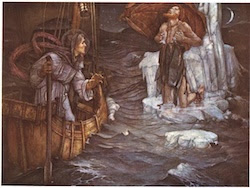
After passing by the fiery mountain which is the entrance to Hell, and the loss of a crew member, Brendan and the remaining crew sail south and see something protruding from the ocean. It is a stone, with an unkempt man one it. He wears a cloak, attached to two forks in a way that allows the wind and waves to lash the cloak folds against his face constantly.

Brendan asks the man his identity and the reason for his punishment. It turns out that this is Judas Iscariot, and the punishment they observe is actually a respite from Hell. He is normally stuck on the fiery mountain they saw, where he is constantly burned. But this is not for every day of the year. On certain days he is freed from the fire and put on this rock. Those days are Sundays, the Twelve Days of Christmas (25 December to 6 January), from Easter to Pentecost, and the feast days of the Purification and Assumption of Mary (quite a few, really).

Brendan asks Judas about the significance of this "respite" and why it is arranged this way. The cloak he wears is granted him because he once gave a cloak to a leper who was exposed to too much sun. The rock is because he once put a rock as a stepping stone in a trench to make a journey easier. The forks represent forks that Judas gave to priests to hold up a cauldron. But why does the cloak whip him around the face and eyes, if it is supposed to represent a good deed? Because originally he stole the cloak that he later gave away.

While they talk, Brendan and crew become surrounded by demons who have come to return Judas to Hell. Brendan invokes the name of Jesus and holds the demons at bay. Threatening to torture Judas doubly because they are being prevented from torturing him at the mountain, Brendan tells them they have no authority to do so. The demons eventually drag Judas away and Brendan continues his voyage.

I mentioned that an encounter with Judas was standard in the various version of Brendan's voyage. This version is very detailed, but there were other versions. Let's cover them tomorrow before moving on.

01 February 2025

Judas in the Middle Ages

The character of Judas (mentioned yesterday) from the New Testament both horrified and fascinated Christians of the Middle Ages. Although he does not survive after the Crucifixion like the other apostles, who went on to travel and proselytize, he lived on in the imagination and in literature. Someone in the 2nd century CE created the Coptic Gospel of Judas, a series of dialogues between Judas and Jesus that express 2nd century theological ideas. It paints Judas' actions as directed by Jesus himself, rather than a disgruntled (for whatever reason) apostle turning on his leader.

Matthew 27:5 says he hanged himself. Acts 1:18 says he fell into a field that he bought with the silver and his body burst open. Judas does not get mentioned outside of Acts and the Gospels. The canonical New Testament has nothing else to say about him. Although Judas' end is mentioned in the Bible, not every early Christian writer knew his story, leading some to extend it, which in turn gave later centuries fodder for literature.

Papias, Bishop of Hieropolis, writing around 130 CE, relates how Judas, rather than killing himself right after the betrayal:

went about in this world as a great model of impiety. He became so bloated in the flesh that he could not pass through a place that was easily wide enough for a wagon – not even his swollen head could fit. They say that his eyelids swelled to such an extent that he could not see the light at all; and a doctor could not see his eyes even with an optical device, so deeply sunken they were in the surrounding flesh.

The 12th century Latin Vita Judae ("Life of Judas") creates a biography for him, painting him as a tragic figure with an anecdote that might seem familiar to fans of Greek tragedy:

Before the child is born, his father has a vision that his son will kill him; so when Judas is born, his legs are wounded and he is abandoned outside of Jerusalem. Some shepherds find the baby and he is raised by a woman in a town called Scariot. As a grown man, Judas enters the service of King Herod. When Herod desires fresh fruit for one of his feasts, Judas steals some from a local orchard, and when caught he kills the farmer, not knowing it is his own father. When the townspeople threaten to kill Judas, he finds protection in Herod, who has him married to the murdered farmer’s wife (Judas’s mother, though unknown) to make peace. Judas’s true identity is revealed when his mother sees him naked and recognizes the scars on his legs.

Judas flees and meets Jesus; the rest happens as the Gospels tell it.

So there he is, turned from a demonic betrayer into a villain, but a villain perhaps worthy of pity because of fate and circumstances out of his control. Even more interesting than that, however, is the medieval idea that Judas was not completely bad, and that during his life he performed one or more good deeds. Those good deeds had a softening effect on his post-death existence. Tomorrow I'll tell you how his good deeds allowed people (like a Celtic saint) to meet him and speak to him.

31 January 2025

Great and Holy Wednesday

Yesterday's post mentioned how Kassia the Blessed was the only female poet whose verse was used in the Byzantine liturgy. It is recited on Great and Holy Wednesday, the Wednesday before Easter, and commemorates the Bargain of Judas. The story behind it is found in the Gospels of Matthew, Mark, and John.

The story in the Gospels is that, on the Wednesday before Passover, Jesus was in the house of Simon the Leper. Before dinner, a woman named Mary anoints Jesus' head and feet with spikenard, an expensive oil derived from a plant in the honeysuckle family. The apostles feel that the oil should have been sold and the money distributed among the poor. The Gospel of John says that Judas wanted to sell the oil and keep the money for himself. It is after this event that Judas decides to go to the Sanhedrin and make a deal that he will deliver Jesus into their hands in exchange for money.

Roman Catholicism calls this day Holy Wednesday in the lead up to Easter. In Ireland it was referred to as Spy (meaning an "ambush") Wednesday. Where does the poetry of Kassia fit in the Byzantine liturgy? Towards the end of matins (a morning prayer service), the Hymn of Kassiani speaks from the viewpoint of the woman, Mary, who washes and anoints Jesus:

O Lord God, the woman who had fallen into many sins, having perceived Thy divinity received the rank of ointment-bearer, offering Thee spices before Thy burial wailing and crying: "Woe is me, for the love of adultery and sin hath given me a dark and lightless night; accept the fountains of my tears O Thou Who drawest the waters of the sea by the clouds incline Thou to the sigh of my heart O Thou Who didst bend the heavens by Thine inapprehensible condescension; I will kiss Thy pure feet and I will wipe them with my tresses. I will kiss Thy feet Whose tread when it fell on the ears of Eve in Paradise dismayed her so that she did hide herself because of fear. Who then shall examine the multitude of my sin and the depth of Thy judgment? Wherefore, O my Saviour and the Deliverer of my soul turn not away from Thy handmaiden O Thou of boundless mercy."

The italicized line is the one supposedly added by the Emperor Theophilos (in an anecdote explained in yesterday's post).

The figure of Judas Iscariot fascinated the Middle Ages. Since he kills himself shortly after betraying Jesus, there are no tales as there are with the other apostles about traveling, converting people, and performing miracles. The Middle Ages did not let him go from their imaginations, however, and his life story was not only expanded, but continued, even to the point where medieval people met him! Let's take a look at what Judas Iscariot meant to medieval legend, starting tomorrow.

30 January 2025

Kassia the Poet

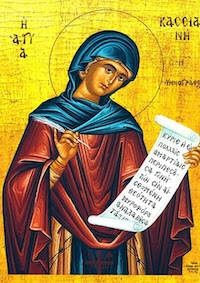
Kassia was born to a wealthy family in Constantinople sometime between 805 and 810 CE. By 843 she had founded a convent and was its first abbess. This convent had a connection to the monastery of Theodore of Stoudios, who supported her work and was, like her, in favor of religious icons.

Her "work" was poetry and hymns. She is distinguished as the only woman whose hymns are part of the Byzantine liturgy, and she shares a distinction with Anna Comnena as the only woman of the early Byzantine Middle Ages who composed works under her own name. Her "Hymn of Kassiani" is chanted each year on Great and Holy Wednesday that commemorates the bargain made by Judas.

There is a tradition around this Hymn that, as she was writing it alone in her cell, the Emperor Theophilos rode to see her. Why would this be? The answer to that goes back to the year 830, when they were both very young.

In that year, the unwed Theophilos was presented with a "bride show" arranged by his mother of suitable woman from whom was supposed to pick a wife. His mother, Euphrosyne, had given him a golden apple to present to his choice. With his eye on the beautiful Kassia, he approached her with the apple but made a tactless remark to which she made a reply. The story is recorded by a few writers of that era, and the exchange went like this:

Theophilos: "Ἐκ γυναικὸς τὰ χείρω." (By a woman came bad things.)

Kassia: "Kαὶ ἐκ γυναικὸς τὰ κρείττω." (But out of a woman came better things.)

Theophilos was referring to Eve's transgression in Eden. Kassia's reply was referring to the Virgin Mary. Theophilos did not like this retort, and passed her by, choosing instead Theodora.

Back to the story: the tradition says that Theophilos never forgot the beauty of Kassia and wanted to see her again. She heard the noise of an imperial retinue arriving, and did not want to face the emperor and risk the temptation of breaking her monastic vows. She hid in a closet, and quietly observed Theophilos enter her cell alone. He cried at not finding her, saw what she was writing, and added one line to the Hymn: "those feet whose sound Eve heard at dusk in Paradise and hid herself for fear."

Kassia was in favor of religious icons at a time when Theophilos (and many others) were iconoclasts. Several contemporary historians wrote that she was exiled to Italy during the iconoclasm conflicts and died some time after 867. She was named a saint in the Orthodox Church with a feast day of 7 September. In 2022, her sainthood was embraced by the Episcopal Church.

Now, about Great and Holy Wednesday and the bargain of Judas, I know your mind went immediately to "30 pieces of silver." There's more to it, however, and tomorrow we'll look at legends of Judas in the Middle Ages.

29 January 2025

Theophilos and Theodora

In yesterday's post we saw how Emperor Theophilos got his bride, Theodora the Blessed, in a bride show. Afterward, Theophilos' stepmother, Euphrosyne, who helped arrange the bride show (and maybe pre-picked the winner) retired to the Monastery of Gastria, which had been founded by Theoktiste, the mother of Theodora. The new husband and wife went on to have seven children.

Theophilos was an iconoclast, and Theodora an iconodule, which caused them to clash. The Monastery of Gastria supported the use of icons in religious worship, and Theodora would sometime send their daughters to Gastria to visit their step-grandmother. This secret was revealed when the two-year-old daughter Pulcheria mentioned to her father about the "beautiful dolls" kept in the monastery, and how the people would kiss their faces. Theophilos forbade the girls from seeing Euphrosyne ever again.

The marriage lasted 12 years, until Theophilos died of dysentery on 20 January 842. (The illustration, from the Manasses Chronicle, shows him on his death bed.) As his health was failing, he feared that his chosen successor would be supplanted by Theophobos, a general who had married Theophilos' aunt. Theophobos was invited for a stay in the palace at Constantinople. When Theophilos died, his officers had orders to immediately execute Theophobos, removing the potential rival.

This left his youngest child as the heir, with Theodora (and other advisors) named as regent for the two-year-old Michael III. Theodora turned out to be a capable leader in her own right. Although she had several advisors chosen by her husband before his death, coins minted right after his death show her and no advisors on one side, Michael III and eldest daughter Thekla on the other.

Theodora in March 843 at the Council of Constantinople did away with iconoclasm definitively. One step taken was to release the iconodule Methodios I, imprisoned by Theophilos, and make him patriarch of Constantinople to get rid of the iconoclast patriarch John the Grammarian.

When Michael III turned 15 (in 855), he took a mistress. His interests seemed to be in youthful pursuits rather than governance. Theodora arranged a bride show to find him a suitable wife, hoping this would help him settle down. The mistress, Eudokia Ingerina, was allowed to be present, but Theodora disqualified her because she was not a virgin. Michael was forced to marry a wife he did not want, so he decided to overthrow his mother and the regents. He had one advisor killed and proclaimed himself sole ruler on 15 March 856. Theodora did not fight back, retiring from power but living in the palace until Michael sent her and his sisters to Gastria. Our last recorded mention of Theodora was at Michael's funeral; she was buried at Gastria when she died.

Speaking of bride shows, it seems that Theodora might not have been Theophilos' first choice. Tomorrow I'll tell you about "the one that got away."

28 January 2025

Michael's Bride Show

I mentioned yesterday that Euphrosyne arranged a "bride show" for her step-son Theophilos (c.813 - 842) in 830 CE. Euphrosyne herself had been pulled out of a convent to marry Theophilos' father, Michael II, who needed her as the daughter of a previous emperor to help add legitimacy to his own reign.

There was no similar candidate immediately available, so Euphrosyne sent people out to the province to gather a collection of beautiful and well-born females. Theophilos was very keen on the whole business, and had it take place in the Triclinium of the Pearl (a new hall he had prepared) in the Great Palace in Constantinople. (The illustration is a 20th century depiction of the event.)

Between 788 and 882, there were five bride shows held in order to find a suitable Byzantine empress. The marriages that resulted were not always happy. Constantine VI divorced his winner and married again, causing controversy. The offspring of Theophilos, Michael III, would simply ignore his bride and keep a mistress. Leo VI "the Wise" went through four disastrous marriages, starting with a bride show. The ultimate efficiency of finding the "right wife" through a bride show is questionable.

A later Byzantine chronicler—much later, but he seemed to have access to a source closer to the event itself—named Symeon Logothete offers details about 830. Euphrosyne gave her step-son a golden apple to hand to the woman he chose, signifying her as his new bride. Symeon tells that Theophilos, while surveying the potential brides, approached a particular beautiful one named Kassia and remarked that evil had come to man through a woman (referencing Eve in the Garden of Eden). Kassia promptly replied that better things had also come to man from a woman (referring to Christ's mother, the Virgin Mary). Theophilos did not like her retort, and passed her by.

Theophilos then went on to choose Theodora, daughter of an army officer. Theodora was known to be devout; after her coronation, she donated 15 pounds of gold to the Patriarch of Constantinople (Antony I at the time) and to the clergy. The couple had seven children, including the future Emperor Michael III. Theophilos took great interest in his daughters as well as his sons. He had coins struck with two of the daughters on each side.

The couple were on opposite sides of an important Byzantine issue. Theophilos was an iconoclast like his father; Theodora was an iconodule, one in favor of religious icons, like Euphrosyne (some think the show was rigged and Euphrosyne picked Theodora to win because of their similar positions). This affected the way they raised their children. Tomorrow I'll delve into their family life.

Because I like to link each day's blog post to the previous and the following, I have to make choices about which direction to take. I'm going to "pre-load" a link, so to speak: after tomorrow, I'll come back to the "one that got away" at the bride show, Theophilos' first pick of Kassia. I really think you should meet her.

27 January 2025

The Empress Euphrosyne

Yesterday's post mentioned the desperate and failed attempt of Constantine VI to get a male heir. His legitimate daughter, however, went on to sit on a throne in Constantinople.

Euphrosyne was born c. 790 to Constantine and his first wife, Maria of Amnia. Constantine divorced Maria and sent her and his daughters to a convent so that he could marry his mother's lady-in-waiting, the teenage Theodote. Constantine succumbed to a palace coup arranged by his own mother. Maria never left the convent, but Euphrosyne had a grander life ahead of her. To understand, we have to introduce the man she married.

Michael II (770 - 829) started his career as a soldier, a companion of a man who rose to be emperor himself (in 813), Leo V the Armenian. Michael actually helped Leo overthrow the previous emperor, Michael I Rhangabe. Leo, in an act of ingratitude years later, decided that his friend was too accomplished at managing palace coups, and sentenced Michael to death. Michael therefore managed to arrange a conspiracy and had Leo assassinated at Christmas in 820.

Michael then took the throne, but spent the first few years dealing with revolt of another military commander, Thomas the Slav. Having finally put down the revolt, he decided he had to shore up his reputation as a fit emperor. He had originally married Thekla, the daughter of a general, by whom he had a son. Sadly, Thekla died c.823.

Michael decided that he could enhance his legitimacy as emperor by marrying into the family of a previous emperor. The ideal candidate was Euphrosyne, in her early 30s and completely devoid of any romantic entanglements since she had been raised in a convent. She was brought to court, married to the emperor, and became empress. (They are pictured above from a later German history text.)

They had no children. When Michael II died on 2 October 829 (kidney failure is deemed to be the cause), his son Theophilos was only 16/17, so Euphrosyne aided him in the early years. She arranged a "bride show" (as her grandmother Irene had done for Euphrosyne's father). Michael chose the teenage Theodora the Armenian from the line-up by handing her a golden apple.

With this step-motherly duty done, Euphrosyne decided to return to the convent. She stayed in touch with the doings of the court and her step-son, however. When rumor reached Constantinople that Theophilos had been killed during a campaign in Anatolia, senior officials began to pick a successor without waiting to confirm the rumor. Euphrosyne sent a letter to Theophilos urging him to return at once. He did; the rumor was false. Michael Synkellos (c. 760 – 4 January 846), who later was made a saint, records that while he was imprisoned Euphrosyne offered him food and drink. That is the last we hear of her in any written record.

This is the second time in a few days that we have heard mention of a "bride show." Tomorrow I'll tell you about Michael's bride show, and the one that got away (probably wisely).

26 January 2025

Constantine VI, Part 2

As I mentioned yesterday, Constantine VI (771 - c.805) had proven himself a poor excuse for a Byzantine emperor to the military and government. He also got on the wrong side of the religious leaders when dealing with the lack of a male heir.

He had married Maria of Amnia (pictured here), who had been chosen by Constantine's mother, the Empress Irene, in a "bride show." Thirteen candidates were brought before Irene (this was after Irene called off the engagement to Rotrude, daughter of Charlemagne). The emperor and his bride were married in 788, but after six years of marriage they had produced two daughters and no son.

So Constantine took the steps taken by so many others in his position: he divorced his wife, sending her and their two daughters (Euphrosyne and Irene) to a convent on an island. This was bad enough so far as the Church was concerned, but it didn't solve his dynastic problem. For that he decided to marry his mistress, Theodote, who had been a lady-in-waiting to Empress Irene. Theodote was 15 or 16 at the time.

The wedding of an emperor was usually conducted by the patriarch, but Patriarch Tarasios refused to perform the ceremony. Theodote's uncle Plato, a minor official, expressed his disapproval of the relationship, and condemned Tarasios for not speaking out publicly against the emperor's actions. Constantine found a monk named Joseph who would perform the ceremony.

This second marriage created what is known as the Moechian Controversy, from the Greek moicheia, "adultery." Abbot Theodore of Stoudios of the Sakkudion monastery loudly condemned the pair and demanded the excommunication of the emperor and of Joseph. Constantine responded by sending his men to the Sakkudion Monastery, having Theodore flogged, and exiling him and his monks to Thessalonica. Theodote's uncle was imprisoned in Constantinople.

Constantine had lost the support of almost everyone. Irene organized a conspiracy against her son, for which she found many willing supporters to aid her. In August 797 Constantine was deposed, blinded, and confined to a private palace. Theodote went with him. We do not know how long he lived after that. Ironically, Theodote had born him a son, Leo, in 796, but the child lived less than a year. Abbot Theodore mentions in a letter that another son was born sometime after Constantine was deposed.

Maria remained a nun; the last mention of her is c.823. Constantine's attempts to create a dynasty by divorcing her did not bear fruit, but his daughter with Maria, Euphrosyne, did become empress of the Byzantine Empire! Let's look at that story next time.

25 January 2025

Constantine VI, Part 1

As I mentioned yesterday, Constantine VI's death was not from natural causes, and if you knew about his life, you might understand. 

Born on 14 January 771, he was named co-emperor with his father, Emperor Leo IV, when he was five years old. Leo died on 8 September 780 of tuberculosis, leaving the nine-year-old Constantine as sole emperor, although under the regency of his mother, Irene of Athens, until 790.

In the ten years of the regency, Irene exerted much control over the Byzantine administration. (She was behind the Second Council of Nicaea, condemning iconoclasm.) In 790, Constantine began making plans to wrest control from Irene—he was coming into his majority, after all—but his plot to do so was reported to Irene by Alexios Mosele, a general of Armenian descent. Irene had her son placed under house arrest. To forestall further problems, she demanded that all heads of the army pledge their loyalty to her. The Armenian troops refused, and Irene sent Alexios to manage them. In a twist, the Armenians declared Alexios their new commander and declared their loyalty to Constantine.

This move, when made public, motivated other troops and cities in Asia Minor to follow suit, declaring their allegiance to Constantine alone and demanding that Irene release her son from house arrest. Constantine, released, placed his mother under house arrest and dismissed all of her retinue and counselors.

Unfortunately, Constantine did not prove to be a wise ruler or smart military strategist. Recent military failures, such as the attempt to restore Adalgis to the Lombard throne, had left the armies eager for a turnaround in their track record, but it wasn't going to happen under Constantine's leadership. The army lost faith in him, and two years after confining his mother to the palace, he released her, declared her "empress," and made her role in government official, hoping that she could help him restore order and regain the respect of the army and citizens. (See above the gold coin struck with both their countenances.)

The desired successes were not forthcoming, however. Fearful that he would be deposed in favor of someone else in the dynasty, he had his uncle blinded. His father, Leo, had four half-brothers whom Constantine considered too close to him blood-wise and therefore potential candidates, so he had their tongues cut out. He also feared that the popular Alexios had plans to usurp the throne, and so had him flogged, tonsured, imprisoned, and eventually blinded.

Speaking of dynasties: he had two daughters by his wife Maria of Amnia, but after six years no son. Since he had lost the loyalty of the military forces, why not take steps to alienate the religious part of the empire by doing something inappropriate regarding his marriage?

But that's tomorrow's tale.

24 January 2025

The Byzantines Come to Italy

I outlined yesterday the complicated relationship between the Franks under Charlemagne, the Lombards in Italy, and the Byzantine Empire. The final straw seemed to be the breakdown of plans to betrothe the seven-year-old Emperor Constantine VI to Charlemagne's daughter Rotrude. As a result, the Byzantine Empire wanted to drive the Franks out of Lombardy and restore Adalgis, son of the previous ruler Desiderius, as king.

Adalgis earlier had made contact with Emperor Constantine V. Many Lombards did not submit to Frankish rule, assuming that Adalgis would return and claim the throne. The Byzantine army arrived in southern Italy in late 788, led by Adalgis and a Byzantine administrator named John who had experience leading the army against the Abbasids in 781 when they invaded Asia Minor.

Unfortunately, some Lombards had accepted Charlemagne's overlordship. The prince of Benevento, for instance, Grimoald III, had chosen alliance with the Franks and led part of the combined force of Lombards that met the Byzantine army. Along with Grimoald was Duke Hildeprand of Spoleto, who had originally fought the Franks but had paid homage to Charlemagne 10 years earlier in exchange for the Franks' promise to defend his land from further invasions. A small number of Franks were involved in this army.

The clash between Byzantins and the Franks/Lombards took place at Calabria (the "toe" of the "boot" of Italy). Details are few, though the victory of the Lombards is undisputed. Alcuin of York, in a letter dated a year after the encounter, offers the details that there were 4000 Byzantines killed and 1000 captured, upon which the remaining force fled to the ships. One of those captured was Sisinnios, the brother of Patriarch Tarasios. Adalgis did not get his throne, and in fact disappears from the historical record, although you can see a portrayal of him above from 1664.

Several years later, in 797, Constantine VI sent a strategos ("general") to Charlemagne's seat of power, Aachen, probably to discuss the release of prisoners from the battle. Sisinnios was not released until 798 following negotiations by Empress Irene. By that time, Constantine VI was dead...

...and it wasn't from natural causes. Let's look at the (fairly brief) life of Emperor Constantine VI tomorrow.

23 January 2025

Relations with Charlemagne

When the report of the Second Council of Nicaea (in 787 CE) was written up approving the use of icons for religious purposes, it mentioned the firm agreement between the pope in Rome and the emperor of Constantinople. As a document that would be made public to let everyone know the outcome of deliberation, it was going to upset at last one person: a powerful person with strong religious views who felt he deserved the pope's respect, and who had unorthodox connections with the Byzantines.

Before we go on to try to explain the controversy involved, let's explain the map you see here. The orange sections are the Byzantine Empire, which include Rome (and Sicily, Sardinia, and Corsica), since the Byzantines had effectively been the guardians of the Roman Empire. The rest of the areas were controlled by Lombards.

Let's try to spell this out. Charlemagne was the king of the Franks. There was a Frankish presence in Lombard-controlled northern Italy (part of Lombardy), having driven out King Desiderius and his son Adalgis in 774. Constantinople wanted to restore Adalgis to the throne, and so they started an expedition to Italy in 788 to try to regain Lombardy from the Franks. This, of course, put them at odds with Charlemagne. The pope wanted an alliance with Charlemagne, as the closest strong ruler and a good person to have on your side. But the pope had just had a major agreement with the Byzantines.

It gets a little more twisted when we find out that Adalgis, hanging out in Pavia after being ousted from Lombardy, hosted the widow and children of Carloman I, Charlemagne's younger brother who had been forced to renounce the throne and go to a monastery. Even more twisted is the fact that Desiderius had been Charlemagne's father-in-law by virtue of his daughter Desiderata's marriage to Charlemagne (who had divorced her in 771).

The proceeds of the Council did not mention Charlemagne at all as being important to the adoption of the new policy among the Christian world. This was a public embarrassment for the pope, and things got worse when the Byzantines came to Italy to free Lombardy.

One of the other reasons for the attempt to drive the ranks out of Lombardy was the breakdown of negotiations for a royal marriage: Charlemagne's daughter Rotrude to Constantine VI, the seven-year-old emperor still under the regency of Empress Irene.

That's a lot to digest. Let's look at the actual fighting tomorrow and see who won.