04 March 2023
Liutprand of the Lombards
03 March 2023
Abd-al-Raḥmân al-Ghafiqi
For a 731 attempt by the Umayyad Caliphate to cross the Pyrenees and invade Western Europe, al-Rahman was put in charge of the army. This time, the Muslim army made swift progress. Toulouse had been won by surprise, but this time Duke Odo's light infantry faced a Muslim cavalry in open battle. Al-Rahman took Bordeaux and then defeated Odo at the battle of Garonne.
Odo fled northward to Charles Martel, who had declined to help him in 721. Martel had been planning since then, however, and with a financial loan from Pope Gregory II had hired, trained, and equipped a standing army to defend Christendom from the invading Saracens. He marched his people south and set up on a hill south of Tours.
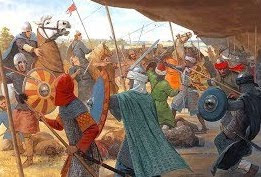
Al-Rahman came upon Martel's army on 10 October 732 and paused. Martel had taken a superior position: high ground, with a wooded area at its foot that would impede the organized progress of the cavalry. After seven days when neither army made an offensive move, al-Rahman finally decided he could not delay. His cavalry charged uphill and broke through the Frankish phalanxes several times. The phalanxes did not scatter, however, and little progress was made by the Muslims.
Al-Rahman was killed in one of the charges, and the remaining officers could not agree on a leader or a new strategy. They were also concerned with the spoils of war they had gathered along the way, and the risk of losing and having their camp plundered motivated them to retreat.
Four years later, al-Rahman's son made another attempt at the request of the Caliph, this time by sea. His fleet landed at Narbonne on the Mediterranean coast, proceeded to Arles on the coast (already under Muslim rule), and then prepared to march north.
Charles Martel was ready. He brought his army south, along with help from King Liutprand of the Lombards. They liberated Avignon, Nîmes, and others. He then drove the Muslims out of Arles and burned the city to the ground to prevent its future use as a Muslim base. Once again, the Muslim invasion of Europe was turned back.
Liutprand of the Lombards was one of the most successful Lombard rulers, and we'll take a closer look at him next time.
02 March 2023
The Battle of Tours, Part 2
Still, their approach to Tours galvanized Charles Martel to bring his army south to meet them after he got word from Odo the Great. He arranged his army south of Tours in defensive mode, rather than going on the offensive. He set up his army in phalanxes on hills with a wooded area in front of them, which would force the Muslims to break up among the trees. The trees also prevented the Muslims from seeing beforehand the size and arrangement of the Frankish forces. The hills also meant that the Umayyads would have to attack while running uphill.
Al-Rahman's army arrived to the area on 10 October, but he did not want to attack immediately. After seven days of waiting, the Umayyads attacked, leading with their cavalry. The cavalry charged several times at the Frankish phalanxes, breaking through them repeatedly. The phalanxes were well-trained infantry, hired and extensively trained by Martel over recent years thanks to financial support from Pope Gregory II. They were disciplined and did not scatter.
The Mozarabic Chronicle of 754 goes on to say:
The northern peoples remained as immobile as a wall, holding together like a glacier in the cold regions. In the blink of an eye, they annihilated the Arabs with the sword. ... But suddenly, within sight of the countless tents of the Arabs, the Franks despicably sheathed their swords postponing the fight until the next day since night had fallen during the battle. Rising from their own camp at dawn, the Europeans saw the tents and canopies of the Arabs all arranged just as they had appeared the day before. Not knowing that they were empty and thinking that inside them there were Saracen forces ready for battle, they sent officers to reconnoiter and discovered that all the Ishmaelite troops had left. They had indeed fled silently by night in tight formation, returning to their own country.
Call it luck or call it the result of clever strategy by Charles Martel, the Umayyad Caliphate retreated to the Iberian Peninsula, abandoning Europe to Europeans. Al-Rahman was killed in battle. Despite the defeat, he is praised for being an able commander, and we should take a closer look at him next time, as well as his son, who attempted another invasion of Gaul just a few years after Tours!
01 March 2023
The Battle of Tours, Part 1
We have very little detail about the battle. Most of what we think we know is from the Mozarabic Chronicle of 754, a Latin history by a Christian chronicler which mentions the Europeans defeating Saracens at Tours. (The word it uses for the victors, europenses—"people of the place Europa"—is the first use of the word that became modern "Europe" and "Europeans." Europe is called that because of a Greek myth.)
Modern historians estimate that the Umayyad force outnumbered the Frankish force under Charles Martel by about 80,000 to 30,000, but some maintain that bringing and supporting 80,000 troops into Gaul was logistically impossible. Armies like this had to live off the land, and the land could not have easily supported feeding the tens of thousands involved. On the other hand, scarce rations and the subsequent low energy levels could explain the defeat of a large army forced to fight in unfamiliar territory.
One "casualty" at the time was Odo the Great's army. Although successful 11 years earlier at Toulouse, for the Umayyads to get to Tours they had to go past Toulouse again, which they managed to do. Odo's surprise attack in 721 did not translate to victory in 732: his army was defeated at Bordeaux and Garonne, largely because they were foot soldiers fighting Muslim cavalry. The devastation in southern Gaul this time spurred Martel to gather as large a force as he could.
In fact, Martel had been preparing for this since Toulouse, even though he had chosen not to help Odo. He had taken out a large loan from the Pope Gregory II in order to hire and train and equip a large army. How he used this army, and what we know about how he directed the fighting is a topic for tomorrow.
28 February 2023
The Battle of Toulouse
The Umayyads had already taken over the southern coast of the Mediterranean, but it was their presence in the Iberian Peninsula that put them up against the borders of Aquitaine, whose Christian duke, Odo the Great, prepared to ensure the stability of his borders. Anticipating the potential conflict, he left his capital of Toulouse to gather military support. When the Umayyad army under Malik al-Khawlani besieged Toulouse, Odo was away.
Odo tried to gather help from Charles Martel, but "The Hammer"—who is often given credit for protecting the Christian West from the Muslim East—refused Odo, preferring to take a "wait and see" attitude about the spread of Islam. (To be fair, Odo and Charles were rival rulers, not friends, so Charles may have been happy to see his southern neighbor get weakened.)
The siege lasted three months before Odo returned with his gathering of Aquitanian, Frankish, and Gascon troops. (The Frankish troops were not likely part of Charles Martel's people; there were Franks living closer to Odo's territory who were not necessarily formally part of the Carolingian culture.) The Umayyad army had grown overconfident after three months of no opposition, so they had minimal outer defenses, making Odo's attack unexpected and hard to counter, especially when folk from inside Toulouse joined the fight. The Umayyads scattered, al-Khawlani died very soon afterward, and no secondary attempt on Toulouse was made.
Odo claimed (in a letter to Pope Gregory II, who like the caliphate was also focused on spreading his chosen faith, though with a less-warlike approach) that he had killed 375,000 Saracens and lost only 1500 men. Odo was praised as a champion of Christianity and received gifts from Gregory.
Eleven years later, however, Charles Martel could no longer "wait and see" when the Umayyads tried another surge into Western Europe, resulting in the Battle of Tours, which happens to be our next topic.
27 February 2023
The Umayyad Caliphate
26 February 2023
The Rashidun Caliphate
Abu Bakr died two years later and was succeeded by ʿUmar ibn al-Khaṭṭāb, Muhammad's father-in-law. Umar had originally been opposed to Muhammad, but had come around. As the second caliph, he expanded the caliphate to cover two-thirds of the Byzantine Empire as well as part of Persia. Jewish tradition claims Umar allowed Jews into Jerusalem to worship. Umar was assassinated in November 644 by a Persian slave.
Umar's successor was Uthman, who advanced Islam into Byzantine territory until he was assassinated in June 656.
From 656 until 661 the caliphate was headed by ʿAlī ibn Abī Ṭālib, a member of Muhammad's clan and had married Muhammad's daughter, Fatima. His election was opposed by the members of Uthman's clan, and they did not recognize his authority. After Ali, there were those who felt the caliphate should be ruled by heredity, as opposed to being ruled by political choices. Ali's rule was the beginning of the Shia-Sunni civil war.
Sunnis say that the first four caliphs were all related to Muhammad through marriage and were among his closest companions. They were the Rashidun, the "Rightly Guided" caliphs. The Shia group (about 10-15% of Muslims) claims that originally Muhammad chose Ali as his successor, but he was passed over for Abu Bakr. They said Islam should be led by descendants of Muhammad and Ali. Sunnis believe the leader should be chosen by political means, as were Abu Bakr, Umar, and Uthman.
This clash between the two groups ended the Rashidun Caliphate and gave rise to the Umayyad Caliphate, which has been mentioned a few times in this blog. The Umayyads expanded Islam even further and started clashing with Western Europe. We will see how that turned out tomorrow.
25 February 2023
The Father of the Kitten
Abu Hurairah followed Muhammad in his travels, listening and learning from him. He was known for having a prodigious memory, and could recite thousands of hadith. Hadith (Arabic; "talk" or "discourse") are reports of what Muhammad said (or approved of based on his actions or inactions). He was so famous for his knowledge of these that one of the foremost authorities on jurisprudence admitted to marrying Abu Hurairah's daughter to be closer to Abu Hurairah and his knowledge of hadith.
Horses were also important to Abu Hurairah, but in a different way: he made himself a wealthy man by horses. Well, not just by breeding horses. He participated in the Ridda Wars, begun after Muhammad's death by the Rashidun Caliphate to bring to heel rebellious Arabian tribes. The Rashidun Caliphate was successful in all engagements, and the process of uniting all of the Arabian Peninsula under one rule was begun.
A mausoleum was constructed to honor him in 1274 by the Mamluk Sultan Baibars. There has been some scholarly disputation over the trustworthiness of the hadith attributed to Abu Hurairah, but it is mostly along Sunni-Shia lines: Abu Hurairah falls into the Sunni camp, and the minority Shia arguments are mostly ignored.
The Rashidun Caliphate was the start of Islam spreading westward in the Mediterranean and toward Europe. I'll start talking about that campaign next time.
24 February 2023
Cats in the Middle Ages
Technically, Kattenstoet means "Festival of the Cats," which sounds delightful. It commemorates, however, the medieval practice of throwing cats from a high belfry tower in the Cloth Hall. This was considered symbolic of banishing evil. Nowadays it is less fatal for felines: a jester tosses plush toy cats from the tower to waiting arms below.
(Associating cats with the evil of the Black Death, of course, may have led to eliminating one of the potential brakes on its spread, because of course cats might have helped keep in line the spread of rodents whose fleas would have carried the disease.)
Cats weren't always disliked: the number of cats in the margin of manuscripts suggest that they were actually quite common in the monasteries where such manuscripts were being created. Cats also appear in many illustrations of domestic scenes, suggesting that they were a common pet.
The Islamic world saw cats as more preferable than "unclean" animals like dogs, probably because cats are seen cleaning themselves daily. Cats were even acceptable in mosques. Their reputation was probably enhanced by Abu Hurairah, a companion of Muhammad, whose name means "father of the kitten." He fed and cared for stray cats at his mosque. Abu Hurairah was not likely his real name, and his attachment to cats was not his most significant feature. I'll tell you more about him tomorrow.
23 February 2023
The Mayor's Cat
A poor orphan, Dick Whittington (the real Whittington was the son. of a Gloucestershire knight), seeks his fortune in London. Falling asleep on a stoop of a wealthy family, he is given a place to sleep and work as a scullion, cleaning the kitchen. He lives in a rat-infested garret, which is made safe because he has a cat (which he bought for a penny that he earned from shining shoes). Eventually, glad of a room but resentful that he is not paid money for his work, he leaves the house. During his journey, he hears the "London Bells" ringing, and they seem to be telling him to "Turn again, Whittington" and tell him he will become mayor. He returns to the house. At the spot where he heard the bells, the foot of Highgate Hill, is a monument to his cat (see illustration).
Skipping over a bit (a great deal, actually), there is a situation overrun by rats and mice. Dick's cat turns out to be exemplary at dealing with the rodent problem, and he is subsequently offered a great deal of money for the cat. Whittington becomes rich, marries his master's daughter (Alice Fitzwarren, which was the name of the real Whittington's wife), joins his new father-in-law in business, and is later elected mayor of London three times. (He was actually mayor four times, but once was when the king appointed him.)
The folk tale of a man with a useful cat is not unique to England. Two Italian versions are known. A German version is known from the 13th century. A 14th century Persian chronicle tells the same story of a widow's son who made his fortune because of his cat's hunting ability. Although the motif is found much earlier than the English version, the Aarne-Thompson classification system calls it the "Whittington's cat" motif.
Just as today, cats are everywhere, and had both good and bad reputations, which we will study next time.
22 February 2023
Dick Whittington
By that time he had been a councilman, an alderman, and a sheriff as well as a powerful member of the Mercers' Company. In 1397, Mayor Adam Bamme died. London and the King were in the middle of a serious dispute: asserting mismanagement, King Richard had appropriated London's real estate. Richard forced London to accept Whittington as mayor. Richard owed Whittington money, and could simply default on the loan. If Whittington wanted his money, he would work with Richard to resolve the dispute. Within days, they struck a deal by which London would receive back all its real estate and right to self-government in exchange for £10,000. That was in June; in October, the citizens elected Whittington mayor in his own right.
In all, he was elected mayor 4 times (though not consecutively). When Richard II was deposed in 1399, Whittington's situation did not suffer: he also had business dealings with Bolingbroke, now King Henry IV, and so he remained on good terms with the (new) King. He also loaned large sums to Henry V, and continued to be successful, as a member of parliament representing London, and even as a judge in usury trials in 1421! Henry V also appointed him supervisor of the funds for rebuilding Westminster Abbey.
He was a magnanimous figure. Money from him helped to rebuild the Guildhall (used as town hall for centuries). He financed drainage systems for parts of London, a ward for unmarried mothers at a hospital, the rebuilding of his ward's church, and "Whittington's Longhouse," a public toilet that seated 128 and was situated so that high tide in the River Thames would flush it out. His will left £7000 to rebuild Newgate Prison, repair St. Bartholomew's Hospital, install public drinking fountains, and more.
Historians know him well, but schoolchildren in England know the name for things he never did, and we will look at that next. (There's a clue in the illustration.)
21 February 2023
At Sixes and Sevens
The two livery companies involved were the Merchant Taylors Company and the Skinners Company.
The Merchant Taylors represented tailors and Linen Armourers. Linen Armourers made the padded tunics worn underneath a suit of armor to provide cushioning and prevent chafing from the metal armor. This group grew in importance because everyone needed clothing, and war was an ongoing concern much of the time.
The Skinners represented a luxury item: fur. Fur as part of clothing was expensive to import and therefore carefully regulated. Upper class needs included ermine and sable; lower class needs had to be satisfied with rabbit and cat.
Both livery companies received their royal charters in 1327 from Edward III, who not only loved opulence but also a year later was going to gear up for what became the Hundred Years War.
Rivalries between livery companies were not uncommon, but the rivalry between these two was particularly keen for some reason. The order of preference given to livery companies was not just "on paper": it determined who preceded whom in processions. In 1484, during the Lord mayor's river procession, the Skinners and Merchant Taylors treated the occasion as a boat race. This public display of rivalry (and public disruption) needed to be addressed. The Lord Mayor, Robert Billesdon (from the Haberdasher Company) created what is called the Billesdon Award.
The Billesdon Award requires each Company to host the Master and Wardens of the other company once each year. Also, each company should alternate precedence in processions each year. So all is settled and the two companies are reconciled? Not completely: the Merchant Taylors spell the Lord Mayor's name as Billesden, while the Skinners spell it Billesdon.
This is why in the previous post they were listed as alternating in positions 6 & 7. It is believed that the Billesdon Award is the origin of the phrase "at sixes and sevens," denoting a state of confusion or disarray.
Speaking of Lords Mayor and livery companies: one of the Lords Mayor was a wealthy Mercer who accomplished a lot during his life and term in office, but is perhaps most remembered now because of a cat. I'll tell you about him (the mayor, not the cat) next time.
20 February 2023
The Great Twelve
1. The Mercers: the word is related to "merchandise" and was a collection of all the shopkeepers of non-edible goods, a wide-ranging group!
2. The Grocers: they started early as the Guild of Pepperers, responsible for dealing in spices, but changed over time to represent more edibles. They were also charged with maintaining the official standards of weights and measures.
3. The Drapers: they regulated wool (and other) cloth in the City. The wool trade was enormously important to England's finances.
4. The Fishmongers: got their first royal charter from Edward I in 1272. Thanks to the Thames, fish was a popular staple.
5. The Goldsmiths: regulated the quality of gold and silver, crucial for coinage and trade. Gold and silver goods needed to be brought to their hall (currently on Foster Lane) for assay and approval, and marked legitimate; hence the term "hallmark." They were also responsible for checking quality of the output of the Royal Mint.
6 & 7. The Merchant Taylors & the Skinners:
8. The Haberdashers: besides hats, they sold caps, gloves, pins, and ribbons. They did not get a royal charter until 1448.
9. The Salters: salt could make a man rich. Not only used in cooking, it was part of the process for cleaning, bleaching, and degreasing leather. Salt was used for dying fabric. This group was expert in salting meat and fish.
10. The Ironmongers: they regulated the quality of iron which was necessary for use in wheels and other items.
11. The Vintners: they controlled the import of wine, which accounted for one-third of all imports in the 14th century! Today they still retain the right to sell wine besides (as with most other livery companies) doing charitable work.
12. The Clothworkers: in 1528, the Fullers (who prepared cloth by removing impurities like grease nd dirt) and the Shearmen (finishers who made sure the surface of the cloth was smooth) merged to become the Clothworker's Company.
But what was the deal with positions 6 and 7? Was it a tie for most important? Not quite: they agreed to take turns about who had precedence over the other. For those details, you'll have to come back for the next post.
19 February 2023
The Livery Companies
Livery was often worn by the servants/household of a nobleman, often incorporating elements of the nobleman's coat of arms. Households would have "Livery Cupboards" for the storing of uniforms.
Livery could also be used by members of a particular group to show their connection. Chaucer's General Prologue to the Canterbury Tales mentions:
An Habersasshere and a Carpenter,
A Webbe, a Dyere, and a Tapycer —
And they were clothed alle in o lyveree
Of a solempne and greet fraternitee.
Ful fressh and newe hir geere apiked was;
[A Haberdasher and a Carpenter,
A Weaver, a Dyer, and a Tapestry-maker—
And they were clothed all in the same livery
Of a solemn and great guild.
Very fresh and new their gear was adorned;]
London's guilds and trade associations were called "livery companies" because of the specific forms of dress they would use to distinguish themselves. They also each developed a coat of arms (some of which are pictured above). They provided regulation and quality control over their particular field, and were the only legitimate source of training and commerce if you wished to apprentice. You were not allowed to ply your trade unless you were a member of the appropriate livery company.
In 1516 the existing 48 livery companies were given an order of preference by the Lord Mayor (mostly based on their wealth and influence), of which there were a dozen designated as the most important, the so-called "Great Twelve." Ultimately, there were (and still are) 110 livery companies in London. These days their chief purposes are charitable giving and networking, similar to Rotary.
Who were the 12 most important? I'll delay discussion on that until tomorrow.
18 February 2023
Guild of Pepperers
Pliny, however, complained about pepper in his Natural History:
It is quite surprising that the use of pepper has come so much into fashion, seeing that in other substances which we use, it is sometimes their sweetness, and sometimes their appearance that has attracted our notice; whereas, pepper has nothing in it that can plead as a recommendation to either fruit or berry, its only desirable quality being a certain pungency; and yet it is for this that we import it all the way from India! Who was the first to make trial of it as an article of food? and who, I wonder, was the man that was not content to prepare himself by hunger only for the satisfying of a greedy appetite?
He also claimed that Rome spent 50 million sesterces a year on pepper!
The Guild of Pepperers managed prices and purity for not only spices like pepper, but also herbs, perfumes, drugs, and even sweets. This variety led to the name of the guild changing in 1345 to the Worshipful Company of Grocers of London. The illustration is their coat of arms.
Many of their members, however, were more than grocers; they fell into the category of what we would call apothecaries, and in 1617 this group formed their own Worshipful Society of Apothecaries. This Guild still exists today.
The Worshipful Company of Grocers of London, however, had its chief purpose taken over by Customs and Excise after 1666. Now they are mostly a charitable organization. Their headquarters, the Grocer's Hall, is where they receive and process applications for grants and scholarships. They are still one of the Great Twelve City Livery Companies.
...and what, you might ask, are the Great Twelve City Livery Companies, and are they important? I'll talk about that next time.