07 May 2023

The Family of Saints: Florentina

Severianus and Theodora were members of well-to-do Hispano-Roman families in the 6th century who bore four children, all of whom became saints. The family lived in Cartagena, or Carthago Nova ("New Carthage"), on the southeast coast of Spain. The family moved to Seville about 554 CE, but their parents died before the children were all grown up.

Younger than Leander but older than Isidore, Florentina was being raised by Leander. His embracing of the monastic life probably influenced her to do the same, so she and a number of virgins banded together to form a religious community. Leander wrote for her a guide to living an ascetic life away from the world; since he died in 600 or 601, she must have chosen the cloistered life prior to that year.

Among his "rules" were to avoid interactions with men, especially young men; and to avoid interactions with women who were still living in the world. The women should be temperate in their eating and drinking. They should read Holy Scripture and meditate on it. Those living in the community should hold each other in equal love and friendship.

She died about 612, and her feast day is 20 June. She is considered the patroness of the diocese of Plasencia. The statue above is from the Cathedral in Seville. Her bones are interred in two places in Spain: a few are in the cathedral of Murcia, but most of her remains are in Berzocana, along with those of her brother Fulgentius, of whom I will have more to say next time.

06 May 2023

The Family of Saints: Leander

Severianus and Theodora were members of well-to-do Hispano-Roman families in the 6th century who bore four children, all of whom became saints. The family lived in Cartagena, or Carthago Nova ("New Carthage"), on the southeast coast of Spain. The family moved to Seville about 554 CE, but their parents died before the children were all grown up.

Leander (shown), the eldest, became a Benedictine monk about 576, and a few years later was appointed Bishop of Seville. The co-ruler of the Visigoths in Spain, Liuvigild, had arranged for his son Hermenegild to marry the 12-year-old Ingund, sister of the Merovingian Childebert II, who became King of Austrasia. While Ingund traveled through Gaul to Iberia, she met a Catholic bishop who warned her not to accept Arianism, the heresy still practiced by many Visigoths, such as her new husband and his family. Hermenegild's mother, Queen Goiswintha, tried to baptize Ingund into Arianism, but the girl refused. Gregory of Tours tells us what Goiswintha did next:

the Queen lost her temper completely ... seized the girl by her hair and threw her to the ground: then she kicked her until she was covered with blood, had her stripped naked and ordered her to be thrown into the baptismal pool.

Liuvigild sent the two to rule in Seville and get them away from his wife. In Seville, however, Ingund encountered Leander. Leander, like his parents and his siblings, was a powerful voice against Arianism. Seville had a strong catholic population. No doubt from the influence of his wife (no doubt "transitively" from Leander, although from 580-582 Leander was traveling to Constantinople and back), Hermenegild converted to Catholicism in 582.

Hermenegild's father was not pleased: he saw Catholicism as "Roman" and Arianism as part of the Visigothic identity. Liuvigild besieged Seville, capturing it in 584, along with his rebellious and (to Liuvigild) heretical son. Leander fled eastward to Constantinople. Hermenegild was imprisoned and urged to renounce Catholicism, which he steadfastly would not do, refusing the Eucharist from an Arian bishop at Easter. His father had him beheaded on 13 April, 585, making Hermenegild a martyr in the Catholic Church.

Depending on the chronicle, Ingund had one of two different fates. One story from Gregory of Tours is that she fled to Constantinople with their son, Athanagild. She did not survive—at this time, plague was going around the Mediterranean—and was buried in Carthage, but Athanagild was delivered to Constantinople where he was raised by Emperor Maurice II. The other version is that she returned to her family in Gaul where Athanagild was raised by her and her mother, Brunhilda.

Leander remained in the East, preaching and writing against Arianism. After the death of Liuvigild in 589, Leander returned to Seville, where he remained bishop until his death in 600 or 601. In 589 he held the Third Council of Toledo, in which Visigothic Spain (or at least its representatives at the Council) renounced Arianism for good.

His younger brother Isidore said of him "This man of suave eloquence and eminent talent shone as brightly by his virtues as by his doctrine. By his faith and zeal the Gothic people have been converted from Arianism to the Catholic faith."

Two of his writings survive: one is an essay about his triumph of the church on the conversion of the Goths. The other is a monastic rule composed for his sister, Florentina, whom I shall talk about next.

05 May 2023

The Etymologies of Isidore

The Etymologiae of Saint and Bishop Isidore of Seville (c.560 - 636) is an early encyclopedia that summarizes in 20 volumes all the knowledge that he considered important. It is most remembered and mentioned for the section on etymologies, but he also wrote about (or quoted from Greek and Roman sources) the trivium (grammar, rhetoric, logic) and quadrivium (arithmetic, geometry, music, astronomy), law and medicine, the Church and various heresies, buildings and roads, materials and tools, war, foods, clothing, languages, pagan philosophers, architecture, and more. (Pope John Paul II named Isidore the patron saint of the Internet.)

His etymologies were worthy of the father in My Big Fat Greek Wedding who linked every concept to a Greek word. (The evidence suggests that Isidore was not well-versed in the Greek language.) Examples are that dominus (master) begins with "D" because so does domus (house), and a dominus is the master of a domus. Also, the Latin verb "to teach" is docere, which is related to docile (compliant) because compliant people can learn easily. He finds the origin of mendicus, the Latin word for beggar, in the Latin phrase manu dicere, "to speak with the hand," because (he says) there was an ancient custom for beggars to close their mouths and hold out their hand for food. Prostitutes (fornicatrix and fornicarius) are named from fornix, "arch," because they would hang about under an arch waiting for a client.

Among his other offerings:

—A table that explains family relationships ("Who is your second cousin twice removed?") and the terms for each family member.

—The classic "T" map of the world, the mappa mundi.  (The illustration is from a 10th century copy, showing such a map.)

—How the four elements make up the body:

But flesh is composed of four elements: earth is in the fleshy parts, air in the breath, water in the blood, fire in the vital heat. The elements are mingled in us in their proper proportions, of which something is lacking when the conjunction is dissolved.

—Bodily functions:

The mouth is compared to the door of the belly which receives and passes on food to the intestines through the esophagus which is near the windpipe, and which is closed off by the epiglottis during deglutition. 

The intestines are arranged in long circular entwinings so that food can be gradually digested. The abdominal viscera are separated from the heart and lungs by the diaphragm and covered by the omentum. Food, when first passed into the small intestine, is called jantaculum. The large intestine, the “blind gut,” is identified and it is pointed out that the gastrointestinal tract is open at each end. The rectum and anus are turned away from our faces to spare us the indelicacy of witnessing their evacuation.

—Medicine:

The poppy is the sleep-bearing herb, of which Vergil says [Georgics 1. 78]: Lethaeo perfusa papavera somno, ‘Heavy sleep, pressed out of the poppy,’ since it stupefies the sleeper. Some poppies are common; others are stronger, namely those from which flows the juice called opion.

...and many other topics, as mentioned above.

His Etymologiae was studied and copied and illustrated through the Middle Ages, and many versions of the manuscript exist in various museums.

One of the other notable things about Isidore is his family. His parents died early in the life of Isidore and his siblings, but all four children became saints; three became bishops. His older brother Leander has been mentioned, but not the rest. A brief look at his family next time.

04 May 2023

Isidore of Seville

Isidore of Seville was probably born about 560, in Cartagena, Spain. His devout parents were both members of influential families that were involved in the conversion of the Visigoths to Catholicism from Arianism. The upbringing provided by his parents inspired Isidore and his siblings to enter the religious life, all of whom became saints.

He was educated at the liberal arts Cathedral school at Seville, learning the trivium and quadrivium. He mastered classical Latin and learned some Hebrew and Greek. Records are scarce about his early life and whether he ever joined a monastery, but in 619 he declared anathema harassing a monastery or monks. When his brother Leander, bishop of Seville, died in 600 or 601, Isidore was named his successor. He set about to eradicate any remaining traces of Arianism among the Visigoths, and was largely successful. He presided over a couple synods and a Council of Toledo.

His influence on the following centuries came more from his writings than his efforts against heresy. One was the De fide catholica contra Iudaeos, ("On the Catholic Faith against the Jews"). Like Augustine of Hippo, Isidore recognized the importance of the Jews because of their role in the Second Coming of Christ. In the Fourth Council of Toledo, however, he advocated removing children from the parents of "Crypto-Jews": Jews who were hiding their Judaism by acting as Christians. His argument was that the parents had probably had the children baptized as part of their subterfuge, and so educating the children as proper Christians was appropriate. (The Summa Theologica of Aquinas in the 13th century would state "it was never the custom of the Church to baptize the children of Jews against the will of their parents.")

He also wrote Historia de regibus Gothorum, Vandalorum et Suevorum ("History of the Kings of the Goths, Vandals and Suevi"), covering from 265 to 624.

He was the earliest Christian writer to try to summarize the knowledge of the world. His encyclopedic work, the Etymologiae, compiled his own thoughts with pieces from numerous Roman handbooks and miscellanies. It was so extensive (20 volumes with 448 chapters total)—one bishop described it as "practically everything that it is necessary to know"—that some of the works he drew from were no longer thought to be necessary to be copied and preserved.

The Etymologiae deserves its own treatment, which I will give it tomorrow.

03 May 2023

The Spanish Come to Ireland

The 9th century Historia Brittonum (History of the Britons) tells of three invasions of Ireland from the Iberian Peninsula. The Partholón die of plague, the Nemedians return to Iberia, but the Milesians stay and become the Irish people. The Milesians are called that because they descend from a miles Hispaniae, sometimes called Miled. The settlers came with 30 ships, each of which held 30 wives.

According to the Lebor Gabála Érenn (The Book of the Taking of Ireland), written by Christians and incorporating Irish mythology, Noah's son Japheth had a descendant who was a Scythian king named Fénius Fairad, who was one of 72 chieftains who built the Tower of Babel. His son wed the daughter of an Egyptian pharaoh. Their son, Goidel Glas, invents the Gaelic language after the confusion in languages caused by Babel.

Goidel's descendants leave Egypt for Scythia, then leave Scythia and wander for 440 years, eventually reaching Iberia/Hispania. One of the settlers, Íth, builds a tower there so tall that he spots the island of Ireland. Íth sails there, meeting three kings/gods of the Tuatha Dé Danann. Íth is killed, his people return to Iberia; then the sons of Íth's brother, Mil, lead an invasion force for revenge.

Landing in Ireland, they meet three queens/goddesses of the Tuatha, one of whom, Ériu, prophecies good fortune for them if they name the Ireland after her (this is where we get the name Eire). The Milesians and the Tuatha meet and agree to a three-day truce, during which the Milesians must take to their ships and wait off shore. The Tuatha create a storm that prevents the ships from landing again, but a Milesian, Amergin, knows a magical verse that calms the storm. The ships return, and the agreement is made with the Tuatha that the Gaels will live above ground, and the Tuatha must live below ground.

Why the link to Iberia/Hispania, Spain? One reason might be the coincidental similarity between the names Iberia/Hiberia and Hibernia, as well as the names Galicia and Gael. Isidore of Seville made many erroneous (but widely believed) concordances based on words and his take on history. Isidore also described Iberia as the "mother[land] of the races" (we don't know why). Historians Orosius and Tacitus thought Ireland was situated between Iberia and Britain, and one modern scholar (read his essay "Did the Irish Come from Spain?" here) sees this as a reason to think that Irish arrivals would have started from Spain. 

In truth, DNA analysis shows close relations between modern Irish and northern Iberians. Hmm.

Regarding Isidore of Seville, whose works were considered the encyclopediae of his time and generations after: he has been mentioned, but has never been the subject of a post. I'll fix that tomorrow.

02 May 2023

The Tuatha Dé Danann

The Tuatha Dé Danann, or "the folk of the goddess Danu," are a cornerstone of early Irish literature and mythology. Arriving from the north on dark clouds, they demand half of Ireland from the current inhabitants, the Fir Bolg, who refuse and are slaughtered. The Tuatha, in turn, are defeated years later when the Milesians arrive in Ireland. The result is that Ireland is shared 50-50: the Milesians (ancestors of the Gaels) get the aboveground Ireland, and the Tuatha have to live below the surface, eventually become the sidhe of Irish folklore. They are described as gods and goddesses, kings and queens, druids and bards, warriors and healers, all with supernatural powers. They are also the possessors of the Four Treasures of Ireland.

They are sometimes described as descendants of Nemed; the Nemedians were an earlier group of settlers who were driven out by the Fomorians. Some of the Nemedians fled to Greece, returning years later as the Fir Bolg. Some fled north, and somehow became the Tuatha. Therefore, many of the Irish "Invasions" are groups fighting other groups who were descendants of a common ancestor.

Attempts to determine their origin/meaning linguistically have led to many theories, none of them universally agreed upon. The phrase Tuath Dé meaning "tribe of god(s)" was used by Irish monks to refer to the Israelites. The word tuatha was commonly used for the various kingdoms/tribes under different chieftains. Adding Danann was done by Irish monks recording "history" to distinguish the Israelites from the Tuatha of legend. Tuatha Dé Danann, however, prompts the question "Who was Danu?"

Skipping over the initial consonant, scholars leap to Anu, called "mother of the Irish gods" by the 10th century king (and bishop) of Munster, Cormac Mac Cuilennáin. Others point to Danu, a goddess of Hindu mythology, and wonder if this shared name is "simply" an Indo-European parallel.

Danu may be a blend of the goddess Anann and the word dán, "skill" or "craft": maybe the magical powers attributed to the Tuatha in history come from their introductions of smithing, weaving, tanning, brewing, etc. After all, the Tuatha are sometimes referred to as Eladan, "children of art."

Some seeking to explain the name look to proto-Celtic don meaning "earth," which compares to the Old Irish doman, "earth." A 7th century bishop and biographer of St. Patrick, Tírechán, describes the sidhe as dei terreni, "earthly gods."

Whatever their origin, their stories are foundational to Irish mythology. It is one of their goddesses, Ériu, whose name is the origin of the modern name Éire. Eventually, however, medieval historians had to eliminate them from the scene to explain their absence, and the Milesians were the instrument of their elimination.

Who were the Milesians, the ancestors of the Gaels? They were a little more grounded in history—a little—and we'll look at their "Spanish" origin tomorrow.

01 May 2023

The Four Treasures of Ireland

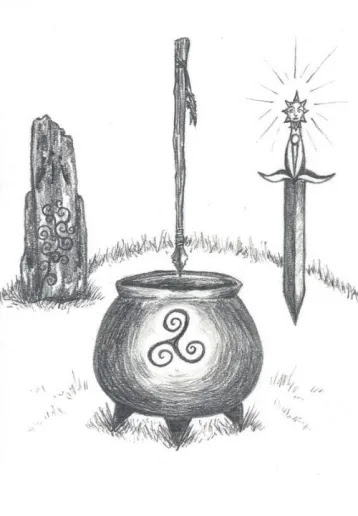
In early Irish literature, there are three texts that each refer to four special objects. These are the Four Treasures of Ireland, sometimes called the Four Treasures of the Tuatha Dé Danann because they were brought to Ireland when the Tuatha—according to the Lebor Gabála Érenn or the Book of the Taking of Ireland, also known as The Book of Invasions—came from the north to Ireland on dark clouds.

The legend says they came from four cities, and from each they brought a treasure.

From the city of Falias they brought the Stone of Fál, that would cry out when the rightful king of Ireland sat on it. It was on the Hill of Tara, and mentioned here.

From Gorias came the Spear of Lugh. The man who wielded it never lost, nor did the army of the wielder. Lugh was a mythological figure associated with war and the arts. The harvest festival Lughnasadh on 1 August is named for him.

The Sword of Light from the city Findias was another weapon. Once drawn from its sheath against a foe, that foe could not win. It belonged to Nuada (literally "champion"), the first king of the Tuatha, one of whose significant stories is the loss of an arm in battle that gets replaced with one of silver.

The final treasure was the Cauldron of Dagda from Murias. Dagda was a king, a druid, and a father-figure. The Cauldron never ran out of food. No one ever left unsatisfied after eating from the cauldron. It is also said that paired with it was a ladle that was so big it took two men to lift it. (He also owned a harp that could influence the listerner's emotions and change the seasons, but that's not enough to be a treasure, I guess.)

The Four Treasures (sometimes called the Four Jewels) appear in the stories of battles and adventures involving the Tuatha, who eventually disappear from the scene with the arrival of the Milesians, going underground and becoming the supernatural entities that provide much folklore.

Who were the Tuatha? Their presence in literature is so pervasive that they deserve some attention. It would be impossible to "tell their story" in the confines of a short post on a daily blog, but we can at least take a stab at their literary origin. See you next time.

30 April 2023

The Six Invasions of Ireland

The Lebor Gabála Érenn or the Book of the Taking of Ireland, also known as The Book of Invasions, is a compilation of Christian and Irish myths in poetry and prose, telling the history of Ireland. Starting with the Biblical Flood and ending in the Middle Ages, it describes six invasions or colonizations of Ireland.

The first wave is led by Cessair, a daughter of Noah, who sails westward on a journey that ends in Ireland with 50 women and only three men. Each of the men takes 16 wives, but when two of the men perish leaving only Fintan Mac Bóchra, he flees from the "responsibility" and is turned into a hawk. This hawk lives 5,500 years, advising the kings of Ireland until the 5th century and the time of Finn Mac Cumhaill.

Three centuries after Cessair, another descendant of Noah named Partholón arrives in Ireland with followers. Ireland is wild, with only one open plain and three lakes. They clear more plains, and more lakes appear from the ground. They go about introducing cattle, farming, brewing, etc. They encounter the Fomorians (pictured above in a 1912 painting by John Duncan), monstrous and hostile supernatural beings, and defeat them. Partholón's people, however, numbering 5000 men and 4000 women, all die from a plague within a week. Ireland is left uninhabited, until...

A Scythian named Nemed leads a group of settlers to Ireland. They suffer from plague as well, and also encounter the Fomorians. Losing to the Fomorians, Nemed's people must give two-thirds of their children and wheat and milk to their enemies each Samhain. The Nemedians eventually rise up against the Fomorians, but only 30 survive and are scattered, some going east to become the ancestors of all Britons, some going to Greece, some going north.

The fourth "invasion" is 200 years later, when the descendants of the Nemedians who went to Greece return. This is around the time of the Israelite's Exodus from Egypt. They are called the Fir Bolg, the "men of bags," because while in Greece they were enslaved and made to haul bags of soil and clay. They divide Ireland into five areas ruled by five chieftains.

(An oddly-specific) 37 years later, the fifth wave arrives on dark clouds of fog. They are the Tuatha Dé Danann, bringing the Four Treasures of Ireland (one of which is the Stone of Destiny). They may be descended from the Nemedians who went north. They possess powerful magic, and they demand half of Ireland from the Fir Bolg, who refuse and are slaughtered.

Finally, the Milesians arrive. Their battle with the Tuatha results in an agreement to share the island 50-50: the Milesians get the part above ground, and Tuatha live below the surface. The Milesians are the ancestors of the Gaels. The Tuatha become the Otherworld inhabitants who occasionally encounter humans and exhibit magical powers.

Although humans become the chief peoples of Ireland, the Tuatha part of the story explains the presence of supernatural elements, such as the Four Treasures. What exactly were the Four Treasures and their significance? For that you'll have to come back tomorrow.

29 April 2023

The Book of Leinster

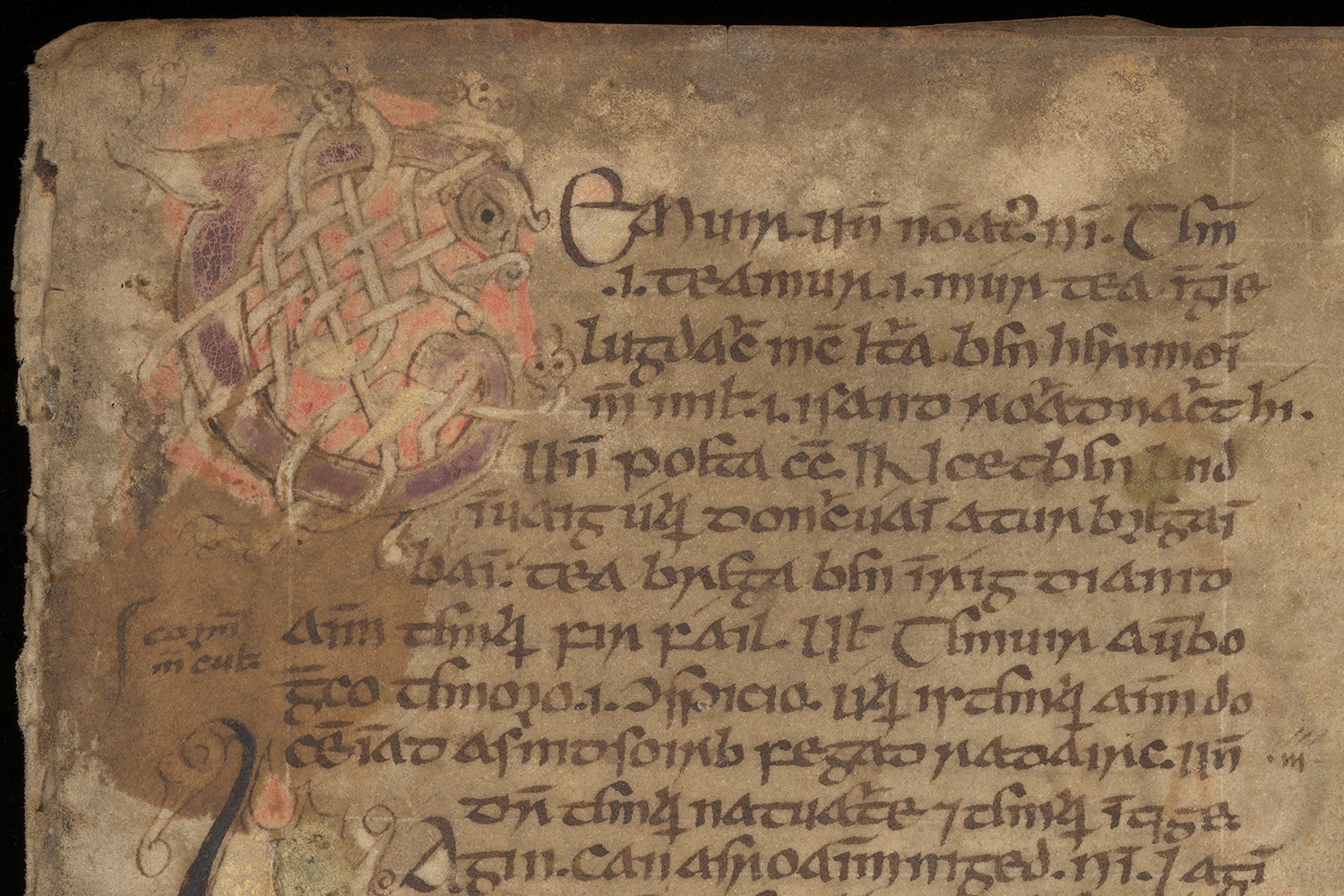
Between 1151 and 1224 CE a manuscript was compiled, probably in what is now Terryglass in County Tipperary, by the abbot of a Terryglass monastery and his followers. The abbot, Áed Ua Crimthainn, actually signed one of the pages, stating that he "wrote this book and collected it from many books." Originally called Lebar na Núachongbhála, the "Book of Oughaval," it is now referred to as the Book of Leinster. Oughaval, now called "Oak Vale," was a 6th century monastery founded by a student of St. Columba. The Book of Leinster was there for many years.

Its second name is because it is believed that it was commissioned by a king of Leinster, Diarmait Mac Murchada (d. 1171), and then passed from him to a few others, getting "lost" until it surfaced at Oughaval in the 14th century. An Irish language scholar in the 19th century gave it its present name because of the associations of its contents with Leinster.

It contains 187 13" by 9" leaves. Internal evidence suggests that 45 leaves are missing. It is one of our most important sources of genealogy, mythology, and Irish literature. It contains the most complete version of of Táin Bó Cuailnge, "The Cattle Raid of Cooley."

The manuscript contains many different types of document. The illustration above is from one part called Dindshenchas, "place-name lore," and begins with the words Temuir, unde nominatur, "Tara, whence is it named." Speaking of Latin: Latin was moving into Ireland because of ecclesiastical involvement, and replacing Irish as a scholarly language. That may be the reason why the Book includes Lebor Gabála Érenn, literally the "Book of Invasions" (considered the Irish "Book of Genesis" and a history of the world),  in which we are told that Irish was created after the confusion of languages caused by the incident of the Tower of Babel. Because it was created later, it avoids the "shortcomings and confusion" of other languages and is therefore special.

The Lebor Gabála Érenn tells of six times that Ireland was invaded, which is a great topic for tomorrow.

28 April 2023

The Culdees

The Culdees were Christian ascetics in Ireland (later spreading to Scotland, Wales, and England). The name comes from Irish Céilí Dé, "Spouses of God." Some lived in monastic communities, some lived as hermits.

Máel Ruain was an abbot-bishop in Dublin. His real name is unknown; Máel Ruain was his monastic name, from Old Irish máel meaning "one who is tonsured" and Ruain meaning "of Rúadán," so he likely started at the monastery of St. Rúadán. Some credit him with bringing to the Culdees the same kind of organization that Chrodegang of Metz brought to the continent with his Rule.

Máel Ruain founded the monastery of Tallaght, a few miles south-west of Dublin. The Book of Leinster (compiled about 1160) includes a reference to the land at Tallaght being given to Ruain from the king in 774. It had round towers designed as bell towers that doubled as sites for relics he brought from the continent of Saints Peter and Paul, along with hair from the Virgin Mary. It became an important center of learning and produced two early martyrologies, one about Máel Ruain himself.

The rule at Tallaght was similar to the Rule of Chrodegang. A 1911 book, The Monastery of Tallaght, published by the Royal Irish Academy, presents information from historical documents about Tallaght and describes their shared asceticism thusly:

Not a drop of beer was drunk in Tallaght in Maelruain’s [sic] lifetime. When his monks used to go anywhere else, they used not to drink a drop of beer in Tir Cualann, whomsoever they might happen to meet. However, when they went a long distance, in that case they were allowed to drink. Nor a morsel of meat was eaten in Tallaght in his lifetime [unless] it were a deer or a wild swine. What meat there was [at Tallaght was served to] the guests.

Máel Ruain died in 792. The monastery survived viking attacks, but not the Norman Invasion. In the 12th century it was attached to the Archdiocese of Dublin. It went through a few changes of hands, but only one tower remains of the original structure. Today it is the site of St. Máelruain’s Church of Ireland, built in 1829.

While we're in Ireland, we should look at other records, such as the Book of Leinster...next time.

27 April 2023

Chrodegang of Metz

First, some background.

In what is now eastern Belgium there was a territory called Hasbania. In French it is now referred to as Hesbaye. The Romans established a town here in the 1st century, which centuries later was settled into by Salian Franks. By the 8th century there was a Count of Hesbaye named Robert. (Robert's wife, Williswinda, founded Lorsch Abbey.) Robert had two sisters, Landrada, who married Sigramnus (who became the next count after Robert's death thanks to his marriage). The other sister, Rotrude, married Charles Martel. Sigramnus and Landrada had a son in the early 8th century, named Chrodegang (died 6 March 766), who was therefore a nephew of Charles Martel who was effectively king of the Franks.

After being educated at the cathedral school of Metz, he joined his uncle's court as referendary, then as chancellor, and finally prime minister. After 742 he is recorded as the Bishop of Metz and prime minister.

When Pope Stephen II came to France for help with the Lombards, Chrodegang was his escort. When Saint Boniface died, Stephen conferred on Chrodegang the pallium that made him an archbishop (although  he did not turn Metz into an archbishopric, so the title was honorary without increased administrative controls).

In 762 he fell ill, and at the first Council of Attigny he established listed the "League of Attigny" signed by the bishops and abbots present pro causa religionis et salute animarum ("for the sake of religion and the salvation of souls"). The intent was to support each other spiritually in case of death. Each signee pledged to sing 100 psalms and (if a priest) say 100 masses for the should of the departed.A bishop was only required to celebrate 30 masses, or to designate another to do so if the bishop were ill. Abbots (if they were not a bishop themselves) were to ask a bishop to say the 30 masses. Monks were to sing 100 psalms, but if they were also priests would say 100 masses.

Chrodegang was central to a spiritual revival in Carolingian culture that carried through Charlemagne's reign. He founded Gorze Abbey near Metz and St. Peter's Abbey on the Moselle River. He encouraged the Roman rite and musical chant in Metz, and introduced the "Rule of Chrodegang" to regulate the practices of canons and canonesses. Although canon life involved ministering to those in need rather than being cloistered, Chrodegang's rule urged them to embrace communal living with a communal dining hall.

Similar development among those following a religious life in Ireland can be seen taking place a generation later, and some think it is likely that Irish monks brought Chrodegang's ideas westward, altering the lifestyle of anchorites. Máel Ruain's rules for Culdees is evidence for this, which means I suppose that we should turn to Ireland next and explain. See you next time.

26 April 2023

The Synods of Aachen

We are accustomed to a world of laws and regulations. Most social institutions have existed long enough that there are well-known expectations for the members of those institutions. History contains the origins of many new institutions—political, religious, social—that experienced great variety in their functions, leading to attempts to codify their actions.

For religion, this meant calling Synods. "Synod" is from Greek syn ("together"; think "synthesis") and odos (pronounced with an initial "h" sound; "road" or "journey"). A synod meant traveling along together, and was intended to make sure everyone was, let's say, synchronized.

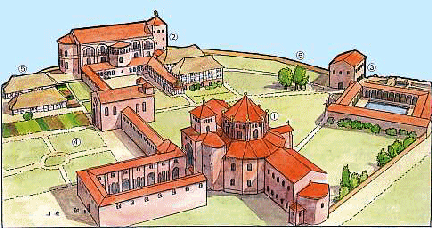
The Synods of Aachen, held at the Carolingian palace complex of Aachen (pictured above), were an attempt to standardize certain practices for those following a religious life, of which there were two kinds: monastic and canonical. For the monastic, Emperor Louis the Pious (who called the synod in 816) gave to Benedict of Aniane the task of applying Benedictine rule (named for St. Benedict, not Benedict of Aniane) uniformly throughout the empire. Aniane had been mentioned here as a mentor of Theodulf.

There were difficulties in this task: the Benedictines had their own liturgical practices, but monasteries were under the rule of the local bishop, and many bishops preferred that everyone in their diocese adhere strictly to the Roman rite instead of the Benedictine variations. Aniane was flexible in allowing some deviations for the sake of good will.

Canons and canonesses lived a lifestyle that was monastic, but they were allowed to keep personal possessions. Chrodegang of Metz (died 766) had, in 755, established rules for the life of canons, known as the Rule of Chrodegang. It was founded on the Rule of St. Benedict, but recognized the different needs of those who lived a communal life but were working in the world to administer to spiritual needs of the faithful, instead of withdrawing from the world.

The Synod of Aachen incorporated much of Chrodegang's work. Canons were to celebrate the liturgy of the hours and general services and maintain a common dormitory and dining hall. Canons were overseen by a provost; canonesses were overseen by an abbess.

Another synod was held at Aachen in 817, building on the decisions of the year before. A further synod in 819 detailed the services owed by monasteries to the crown.

I was thinking a second reference to Benedict of Aniane meant he might need some more details, but Chrodegang had a more interesting life (not being a monk like Aniane, he "got out" more), so I'll tell you more about him tomorrow.

25 April 2023

The Council of Attigny

Attigny is a commune (an incorporated municipality) in northeast France. Clovis II built a palace there in 647 that was a Carolingian residence for several generations. Charlemagne spent many Christmas and Easter holidays there. Attigny is where Charlemagne baptized his enemy, Widukind.

Charlemagne's father, Pepin the Short, held a council there that brought together the Frankish leaders and religious figures for some political management followed by religious matters. Among other things, this first Council of Attigny made a decree pro causa religionis et salute animarum" ("for the sake of religion and the salvation of souls") that all who signed (several bishops and abbots) would pledge to sing a certain number of psalms (usually 100) and/or celebrate a certain number of masses for the soul of any of the signees who died.

In 822, Pope Paschal I convened the Second Council of Attigny, partially for the purpose of dealing with Louis the Pious. (Paschal also wanted to confirm some rules from 816 about the conduct of canons and monks.) Louis was Charlemagne's son and successor, and had done his best to eliminate any potential opposition to his rule by dealing with his relatives, sometimes very harshly. Some he simply tonsured and sent to monasteries, such as his younger brothers Hugh, Drogo, and Theodoric. His nephew, Bernard of Italy, however, had a worse fate.

Bernard feared that Louis would take Italy from him. Fearing rebellion, Louis captured Bernard and intended to blind him, but the process went too far and Bernard died. This was not acceptable behavior from the man who was Holy Roman Emperor. Louis was made to apologize in public for the treatment of his brothers, and perform public penance for the death of Bernard. (You see an illustration of the penance above.)

Louis also reconciled with his brothers. Hugh was made abbot of St-Quentin, and Drogo was named Bishop of Metz. Some of the co-conspirators of Bernard were released from monastic confinement and allowed to take positions at court. Louis also confessed to offenses that would not ordinarily have been significant offenses by a ruler, but he was, in fact, a pious man who cared about the church and his soul as well as his secular power.

Louis ruled for almost another two decades, with a couple civil wars and several other notable events, but tomorrow I will go back to the Council of Aachen of 816 and the attempt to regulate monasteries and the relationship of church property to the king in whose territories they lay.

24 April 2023

Blinding the King

When Louis the Pious inherited the empire after the death of his father, Charlemagne, he took steps to organize his kingdom and ensure the succession. In 817 he chose how the kingdom would be divided among his sons. His nephew, King Bernard of Italy, was left in his current position, but was to become a vassal of Louis' son Lothair.

Bernard, a grandson of Charlemagne through Pepin of Italy, saw this as a potential threat to ultimately take over Italy. Some of his counselors advised him to act, even though he had always had a decent relationship with his uncle Louis. Louis started hearing rumors that Bernard was planning to make Italy independent, so he marched an army south.

Bernard met him at Chalon to talk, but was captured and taken to the palace at Aachen where he and others were tried for conspiracy and treason. Although an appropriate sentence was execution, Louis decided to simply remove Bernard's ability to rule by blinding him and his co-conspirators. This was done by pushing a red-hit stiletto to the eyeballs. Unfortunately, the procedure went too far, and Bernard died in agony within two days. Above you see his tomb, along with his consort, Cunigunda of Laon. As mentioned here, Louis also forced other relatives who might have become the focus of rebellion into monasteries.

One of the supposed co-conspirators was Theodulf of Orléans, but proof was lacking. Still, Theodulf was removed from his bishopric and imprisoned in a monastery in Angers in 818. Released in 820, he tried to go to Orléans, but died along the way, on 18 January 821. His body was taken back to Angers for burial.

The Kingdom of Italy was given to Lothair. Italy's feared fate had become fact, perhaps because Bernard tried to prevent it.

Not long after, in 822, the affair of the blinding had an epilogue, which would require a trip to Attigny in northeast France. I will take you there tomorrow and explain.

23 April 2023

Theodulf of Orléans

When speaking of the Carolingian Renaissance, the most common name mentioned is Alcuin, but there were many other scholars involved. One of them was Theodulf of Orléans, mentioned here years ago as a maker of acrostics.

Born in the mid 8th century in Visigothic Spain, the Moorish occupation drove him to Aquitaine, eventually joining a monastery in Gaul under Benedict of Aniane. Traveling to Rome in 786, he was impressed by the numerous schools he saw, and wrote letters to abbots and bishops in Gaul, encouraging them to create public schools.

Back in Gaul, Charlemagne was impressed by Theodulf's appreciation of learning and made him Bishop of Orléans and put him in charge of many monasteries. Charles relied on him for theological advice and to establish many schools. Theodulf knew Greek and Hebrew, and was tasked by Charlemagne to make new translations of many works into Latin. He produced many original works as well, including one reminding priests of the importance of manual labor and chastity, poems and hymns, and a codification of what penance was necessary for different sins.

It is also very likely that Theodulf was the author of the Opus Caroli regis contra synodum ("The work of King Charles against the Synod"), known usually as Libri Carolini ("Charles' Books"),  commissioned by Charlemagne to counter the work of the Second Council of Nicaea regarding the use of sacred images. (You can purchase an English translation here.)

In 806 he built an oratory at Germigny-des-Prés (the remaining part is pictured above), patterned after Charlemagne's palace at Aachen. It was mostly destroyed by the Normans after 1066, which deprived the modern world of all its art except the only surviving Carolingian mosaic (badly restored in the 1860s) depicting the Ark of the Covenant. The Ark of the Covenant was probably an important image because it represents God's approval of religious images. 

Theodulf was a witness to Charlemagne's will, and after the emperor's death in 814, served his son, Louis the Pious. An incident involving Louis' nephew, King Bernard of Italy, led to Louis accusing Theodulf of conspiring against him, and the bishop was imprisoned.

But that's a story for tomorrow. See you then.