26 January 2024

Dealing with Lice

There are plenty of examples of combs from centuries gone, and sometimes they are two-sided, with one side having the teeth extremely close together. These were "nit combs," designed to be run through hair and pull out the "nits" and eggs that were part of the life cycle of the louse.

I should say "of lice," since if your hair was home to one, it was home to many. Also, there are over 5000 species of louse, 800 of which prey on mammals. Humans experience just a few. (The others? 4000 species prey on birds; even penguins in the Antarctic have at least 15 species.)

The scientific details on lice don't interest us, however, as much as how the Middle Ages dealt with them, because they were ubiquitous. After Thomas Becket's death, when they went to prepare the body, they discovered he wore a hair shirt under his clothing. It was so infested with lice that “The vermin boiled over like water in a simmering cauldron, and the onlookers burst into alternate weeping and laughing” [Rats, Lice and History, Hans Zinsser Page 185].

Combing the hair was a common way to get rid of lice. It was also considered a contemplative act, and recommended to put oneself into the right mood for devotion. The 13th century French liturgist William Durand in his Rationale divinorum officiorum ("Rationale for the Divine Offices"), said combing "symbolized the removal of worldly or superfluous thoughts." When the tomb of St. Cuthbert was opened in 1104, it contained a comb; was it more for contemplation or hygiene?

Lice had to be dealt with in every walk of life, including among the religious set. The late 14th century canon regular (a priest in a church, not a monk) John Mirk in his Instructions for Parish Priests said that if a louse or lice entered the chalice, they needed to be consumed with the wine (unless it was a poisonous insect).

Besides the comb, there was other methods for dealing with head lice. A concoction of pork grease, incense, lead, and aloe was supposed to stop them (probably by asphyxiation). The simplest method, available to everyone, was having someone look through your hair and remove them by hand. Montaillou by French historian Emmanuel Le Roy Ladurie reconstructs (from contemporary records) the lives of villagers from 1294 to 1324. One recollection that he finds is of a woman named Vuissane Testanière, who observed her neighbors chatting while their daughters picked through their hair, looking for lice.

In fact, the story of the village of Montaillou would be a refreshing change from talking about lice, so let's use that last paragraph as a transition to tomorrow. See you then.

25 January 2024

Hair and Religion, Part 2

What does hair have to do with piety? Well, monks would get tonsured so that their outward appearance signified their role in society. As mentioned, hair outside the monastery was a way to make oneself more attractive, and so shearing most or all of it off was a way to make the individual less attractive and less "worldly."

On the other hand, excessive hair could also be a sign of piety. Anchorites—people who removed themselves from the world in order to devote themselves to prayer—could find separation by being enclosed in a small chamber (often connected to a church or monastery), or by becoming hermits, living away from others in the wilderness.

St. John Chrysostom (c.347 - 407, mentioned here) was a hermit. In the later Middle Ages, he is represented in illustrations as being excessively hairy. Another early hairy saint, Onuphrius, who became popular in Spain and Italy in the 13th and 14th centuries, proved his devotion by leaving his Egyptian monastery and living alone, naked, for 70 years near Thebes. He grew thick hair all over his body to protect himself from the elements.

Hairiness may have been seen as a a sign of such a strong rejection of worldly things that the saint was living simply, like a wild beast in the wilderness.

There were also several female hairy saints. Pictured above in a late 15th century manuscript is St. Mary of Egypt. Mary ran away from home in Egypt to Alexandria where she lived a dissolute life. Eventually turning to religion, she stopped focusing on her appearance, and is shown with matted and dirty hair as well as hair all over her body.

So if hirsute bodies could be a sign of turning from material cares toward spiritual purity, could the opposite take place? Here is where we turn away from the topic of "hair and religion" and look at simple "hair care." The artist Jean Bourdichon painted for King Louis XII the scene of Bathsheba bathing and being watched by King David [2 Samuel 11]. The water is transparent, and every part of her is visible in the water. The pink-red coloring of parts of her body show the she is pictured without pubic hair. If Michelangelo could carve it out of stone, there's no impediment to artists drawing it. The contention is that women must have shaved their pubic hair. Was this considered a choice for vanity's sake? Was it supposed to be a way to enhance sexuality or sensuousness? These questions are not answered in any contemporary texts.

Of course, there may have been an obvious reason for shaving hair around the genitals, one we rarely have to deal with in the Modern Age. Next time, let's look at the problem of lice in history.

24 January 2024

Hair and Religion, Part 1

Paul in the First Epistle to the Corinthians calls a woman's hair her "glory" and says it must be covered, because no one should enjoy it but her husband. The man, however, does not cover his head, because he is the image and "glory" of God.

Shocking to modern sensibilities, maybe, but not unique to Paul. The Latin nubere used for "to marry" literally means "to veil oneself" (probably related to nubes, "cloud"). Roman women wore head coverings once they were married.

Medieval Europe was all about this "fashion." 14th century theologian Heinrich von Langenstein (1325 - 1397), a student of Nicholas Oresme and a fan of spontaneous generation, said that, for a woman, the veil is a:

symbol of her subservience. The woman wears a headdress so that it may be recognized that she is subordinate to the man, who ranks above her. The veiled head is also a sign that woman [i.e., Eve] transgressed the first commandment [not to eat the fruit of the Tree of the Knowledge of Good and Evil] and violated its terms.

As mentioned yesterday, long flowing locks on a woman were considered very sexy and seductive, and so a married woman was required to keep her hair under wraps in order not to tempt anyone other than her husband. Illustrations like the one here of the Harlot of Babylon, from the Apocalypse Tapestry commissioned by Louis I, Duke of Anjou, c.1380, show her combing her hair as a symbol of her sensuousness. A Good Wife’s Guide, written by a 14th century Parisian to his 15-year-old bride, warns her that hair allowed to show from under her veil is a sign of “drunken, foolish, or ignorant women.”

The opposite—controlling or removing hair—could be a sign of piety. Men and women entering religious orders were given severe haircuts: men lost their beards and had the crown shorn, leaving them with a tonsure that resembled the crown of thorns; women could be shorn or have their hair cut very short and then covered with veils. Hair had power and status, and removing it signaled separation from worldly things. (The ultimate expression of shorn hair denoting loss of power was seen in Frankish culture, where a shorn man could in no way be allowed to rule. Shaving the head of an enemy was a way to humiliate him—yes, even though hair grew back.)

On the other hand, could excess hair also be a sign of piety? And could lack of hair be a signifier of sensuality? We will find out tomorrow, for perhaps the most NSFW ("Not Safe For Work") post ever.

23 January 2024

More About Hair

Hair is a fascinating resource. It is a crop that renews without any special tending, producing thread and cushioning. It can be cut, dyed, and shaped into various patterns that can denote different things in society: high or low status, and even religious status. It can be used to denote maturity or your fitness for the ruling class.

Let's talk for a moment about sumptuary laws, designed (to quote Britannica.com) "to restrict excessive personal expenditures in the interest of preventing extravagance and luxury." They started long before the Middle Ages. A province of Sparta forbade residents to own furniture or even a house that could not be made simply with an ax and saw. Anything more elaborate was excessive and shameful. Spartans only were allowed iron money, not gold or silver. Roman law also had rules governing the materials for garments.

Medieval Europe adopted many sumptuary laws, often to make sure the increasing wealth of the growing middle class did not encourage them to dress extravagantly similar to the ruling class. French kings restricted the use of gold and silver embroidery, etc.

Sumptuary law could embrace hairstyles as well. We know this because Florentine women in 1326 asked the Duchess of Calabria to speak on their behalf to the duke. The women of Florence were restricted (unfairly, they felt) from wearing "false hair": wigs and hair extensions. The law was intended to prevent lower-class women from appearing aristocratic—an affront to the fabric of society. Pope Eugene IV (1383 - 1447; briefly mentioned here) issued a statement that women should be allowed to wear "false hair." To be fair, his reasoning was that it could be pleasing to her husband and reinforce domestic bliss and marital fidelity, so a woman's satisfaction was not necessarily foremost in his mind.

Long and flowing hair was attractive and seductive on a woman, and so once she was married the hair had to be put under a wimple or bound up, so that she did not appear seductive to other men. The image of a woman combing long hair, in many cases being watched by a man, appears in medieval art, and is even painted on combs.

While combing [sic] the sources, I have found so much more regarding hair than I expected, including some items that might not be rated PG. More to come.

22 January 2024

Time for a Haircut

The legend of Piast the Wheelwright begins with a visit by strangers who ask to join the celebration of his son's (Siemowit) 7th birthday. A 7th birthday was significant in pre-Christian Poland because it was the time of the child's first haircut.

This early rite of passage was common in Slavic culture. The age of seven was a common age, but it could range from seven to ten. Some scholars believe the child had a temporary name until this time. It was part of the ritual to give the child a new and permanent name, often one more descriptive of his physical appearance or personality.

Part of the significance was the transference of the boy from his mother's to his father's care. Until that time, his hair could be left long like a woman's, and he would be raised in the home. The haircut would be administered by his father or a zerca, a Slavic priest, making it as much a magical turning point as well as a societal one. After the rite of passage, his hair would be burned and he would start following his father and learning non-home-based skills. The ritual was usually accompanied by a celebratory feast. In Poland this persisted until the 18th century.

The ritual haircut is found in other cultures. Mongolian babies had their first haircut between the ages of two and five, with boys receiving the cut in an odd-numbered year (age three or five) and girls in an even-numbered year. Many Orthodox and Hasidic Jewish boys get their first haircut at the age of three, called the upsherin ("shear of").

The Niuean of Polynesia let the hair on boys grow until they are teenagers. Until then, it is cared for by the whole family: sisters, mothers, and fathers. During a ceremony when teen age has been achieved, the women tend the hair for the last time. Then, while it is being cut, the extended family members give money to the young man.

Length of hair has had significance for a long time and in many cultures. The Merovingians prized long hair, associating it with kingship so closely that shearing a rival was one way for a ruler to deprive the rival of the feature required for rule.

Dealing with hair in the Middle Ages was far more widespread than just as a rite of passage for the young. Let's talk more about hair tomorrow.

21 January 2024

The Piast Dynasty

I suppose it starts with Piast the Wheelwright. According to Gesta principum Polonorum ("Deeds of the Princes of the Poles"), Piast and his wife, Rzepicha (the two are pictured here), are visited one day by two strangers who request to join them in a celebration of the 7th birthday of their son, Siemowit.

Piast agrees to this, and in return the strangers bless his cellar so that it is always full of food. This magical cellar so impressed Piast's neighbors that they made him a prince, ousting Prince Popiel.

For his part, Popiel deserved ousting. He was a 9th century ruler of two proto-Polish tribes, the West Polans and the Goplins. A cruel man who cared only for his own pleasure, with a wife equally corrupt and power-hungry, he had twelve uncles poisoned at a feast because he heard they were going to depose him. He refused to give the bodies a proper burial. The townspeople, learning this , rebelled, and Popiel and wife fled to a tower. Miraculously, a mass of mice and rats that were feeding on the corpses of his uncles went to the tower, gnawing through the walls and devouring the corrupt couple.

Piast is unique in Polish annals, and its precise origin is unknown. It could come from Polish piasta, meaning "hub"; the could be what led to him being called a wheelwright. It could also mean he was a "hub" of activity/goods to support his people. Another theory relates the name to Polish piastun, "custodian." The theory there is that he was a steward or custodian of sorts for the ruler, who wound up replacing him. Something similar happened with the Carolingian Mayors of the Palace replacing the weakening Merovingians in Frankish Gaul.

Whatever the case, the first ruler of an independent Poland was Mieszko I (c.930 - 992), and he was a proud member of the Piast Dynasty, the first official one in a line that lasted until Casimir the Great, who died without a heir.

So ... what was the deal about the 7th birthday? Was that a special occasion? In pre-Christian Slavic tradition, it was time for a haircut, but I'll explain that next time.

20 January 2024

Casimir III the Great

The king of Poland from 1333 to 1370 was Casimir III, later called "the Great" (the only Polish monarch to be given that title). When he ascended to the throne after Władysław the Elbow High, he was only 23. Poland had been transformed by war into several separate territories, with a depleted economy, and Casimir was derisively referred to as merely "King of Krakow." He was something of an underdog, but he set out to make significant changes.

One of his first moves was to fortify several towns and start a program of castle building; during his reign he built 50 castles, leading to a famous Polish saying: Zastal Polske drewniana a zostawil murowana ("He found a Poland made of wood and left it made of stone.")

Besides rebuilding infrastructure, one year into his reign, he also reformed the culture: he reaffirmed privileges that had been granted to Polish Jews by King Boleslaw V 70 years earlier. He forbade forced baptism of Jewish children under penalty of death. It is said that 70% of Ashkenazi Jews are descended from the Jews of Poland thanks to the welcoming atmosphere created by Casimir. There is also a rumor (unconfirmed) that he had a Jewish mistress, Esterka (Esther).

He invited Dutch, Moravians, and Saxons to emigrate. With the blessing of Pope Urban V, he founded the University of Krakow, still the oldest university in Poland.

He was also willing to relinquish some power, in that previously all land belonged to the Piast dynasty (of which he was the last member), and now Polish lands were independent of the Crown. Casimir reformed the legal code, balancing the privileges and power in law of the three estates: nobility, commoners, and clergy. For this he was nicknamed "the Peasants' King."

Between diplomacy and waging war, he doubled the size of the Poland that he inherited. He married four times, and though he fathered children, none of them survived to be his heir. He named Louis I of Hungary as his heir. Louis was Casimir's nephew, and choosing him as heir made an alliance with Hungary that would be useful to Poland. Louis was of the House of Anjou, however, and therefore with his succession to the throne of Poland the legendary Piast Dynasty was no longer in the center of Polish nobility and politics. Marrying into the Piast Dynasty became a popular pastime in the future to increase your standing in Poland.

What was so special about the Piasts, why were they "legendary," and from where did they originate? Check back here tomorrow and I'll tell you.

19 January 2024

The Marriages of Jogaila

After the death of his second wife, Anna of Cilli, Jogaila looked for another suitable match. Because he was Lithuanian, and ruling that country and Poland from marriage to his first wife, Jadwiga (pictured with him here), he needed to find a Polish wife. Polish nobles wanted him to marry a Polish wife not only to satisfy the Poles over which he continued to rule, but also because they would have liked their king to have a male heir. Jadwiga had born a daughter, Hedwig, who was five at the time of her mother's death. There were a few suitable suggestions for his third wife, but Jogaila ignored them all and married Elizabeth Granowska.

The Polish chronicler Jan Długosz (from whom we draw much of our knowledge of these times) says Granowska at the time was an ugly, middle-aged widow. Her husband had died suddenly; there was suspicion of poison. Granowska was a friend of Jogaila's sister, Alexandra*, who introduced the two. Jogaila (middle-aged himself and perhaps tired of child brides) became enamored of her and gave her gifts. They were married in March 1417, a year after Jadwiga's death. Sadly, she died less than a year later, in early 1419, having not produced an heir.

The quest for a queen consort and subsequent male heir began again. He found one in the niece of his cousin Vytatutas' wife. Sophia of Halshany (c.1405 - 21 September 1461) was very young, and Jogaila was at least in his 60s when they met in the winter of 1420-21. Polish nobles opposed this match because she was not Polish enough. Also, she was not Christian.

She was baptized Christian in February 1422 and married later that month, but not crowned queen consort until 1424. After the marriage she moved to Wawel Castle, where those who favored Princess Hedwig were hostile to her reason for being there: to provide a male (and less Polish) heir to the throne of Poland, bypassing the half-Polish Hedwig. Her husband was off traveling, leaving her with little support. In April 1423, Jogaila took her to Russia with him. At the end of October she had a son, Władysław III. In 1426 she gave birth to Casimir, who died at 18 months. A third son in 1427, also named Casimir, survived.

Jogaila now had two potential male heirs, but Princess Hedwig was still first in line, and favored by Polish nobles as a member of the much revered Piast dynasty. Sadly, she died in 1431 after a year-long illness. Of course there was suspicion that Sophia had something to do with it, trying to eliminate her in favor of Sophia's own children.

Be that as it may, Hedwig was gone, so when Jogaila died in August 1381, Władysław III succeeded him as King of Poland and Supreme Duke of Lithuania. He was succeeded by his brother Casimir. Sophia lived until 21 September 1461. She is still remembered for having the Bible translated into Polish (never finished, but what exists is beautiful). She was buried in Wawel Cathedral, where she had funded the construction of the Holy Trinity Chapel.

The Polish throne was then being held by less-Polish rulers, and the Piast dynasty was shut out. Regarding the Piasts: we should look at one of the prominent members who has been mentioned a few times recently. Next time let's take a look at Casimir III and what made him "Great."


*Alexandra had married Siemovit, his consolation for being turned down by Jadwiga.

18 January 2024

Anna of Cilli

The first ruling dynasty of Poland was the House of Piast, starting c.960 with Duke Mieszko and ending in 1370 with the death of Casimir the Great. Branches of the Piast dynasty were extensive, and intermarriage with them was a way to strengthen your standing with the Polish people.

Therefore, when Jadwiga of Poland was on her deathbed due to complications from delivering her only child (who had died shortly after birth), she advised her husband, Jogaila of Lithuania, Supreme Duke of Lithuania and King of Poland by virtue of marriage, to marry into the Piast dynasty to help his standing with the Polish people. Her suggestion was Anna of Cilli (also known as Anne of Celje).

Anna was born in 1386, making her only 13 years old at the time. Jogaila waited until 1401 to request Anna's hand in marriage from Herman II, Count of Celje. (Anna's father had died when she was ten, and she was raised by his cousin, Herman.) Herman was related to Jadwiga on his mother's side, and Anna and Jadwiga were cousins, both being descended from Casimir. Herman saw that not only would this match benefit Jogaila, it would bring the House of Celje higher standing, if Anna were to become Queen of Poland and Lithuania.

Anna arrived in Krakow on 16 July 1401, and was met at the gates by Jogaila (the pair are pictured above). Whether it was the 30-year age gap between them, Anna's reported lack of beauty, or some other reason, Jogaila was supposedly not pleased with the choice of bride. The wedding was postponed until January 1402 so that Anna could learn Polish. She lived in a monastery prior to the wedding, which took place at Wawel Cathedral, the site of Jadwiga's burial. She was not crowned queen until the following year.

King Jogaila was frequently traveling, leaving her alone at Wawel Castle. It was five years before Anna became pregnant. She was accused of infidelity by the castellan, with fingers pointing to a couple of knights. One of them was imprisoned, but Polish nobles defended the queen and the prisoner was freed. Other accusations of infidelity arose, but none came to anything substantial.

Anna bore a child on 8 April 1408. It was a daughter, Hedwig (Jadwiga); when Hedwig was five years old she was declared heir presumptive, since it did not appear likely that a male heir would come along. Having finally produced an heir, Anna's life changed somewhat: she started becoming more involved in state functions. She started traveling with Jogaila for diplomatic meetings. Hedwig at five years old went with her parents to Lithuania to be presented to the Lithuanian nobles as their Supreme Duke's heir. Anna even wrote a report to the Council of Constance after observing the Christianization of Samogitia (now called Žemaitija), one of the cultural regions of Lithuania.

In February of 1416, messengers were sent to Jogaila in Lithuania to inform him that Anna was gravely ill in Krakow. He arrived in Krakow in May (he did not hurry), a few days prior to her death. She was buried ai Wawel Cathedral...

...and Jogaila went looking for another wife ... and then another, until he finally got what he wanted: a male heir. But what to do about Hedwig? All will be revealed ... next time.

17 January 2024

Sigismund's Change of Heart

Although Sigismund, King of Hungary and brother-in-law to Jadwiga of Poland, had tried to annex parts of Poland and allied himself with the Teutonic Knights (who were engaging in a Crusade against Lithuania) against Poland, he had a change of heart. While the reason for the change of heart is unknown, it is possible that a major defeat against the Ottomans at the Battle of Nicopolis depleted his military sufficiently that he no longer was confident in a potential attempt to take territory from his neighbors.

The Battle of Nicopolis in 1396 was part of a European Crusade, and incredibly demoralizing for Europe, because the Ottomans defeated an army of Hungarian, Croatian, Bulgarian, Wallachian, Polish, French, Burgundian, German, English, Knights Hospitaller, Iberian, Italian, Bohemian, Serbian, and Byzantine troops. Sigismund was at their head, so it was particularly bad for him. The defeat and loss of several men angered Hungarian lords and led to instability in Hungary. It was at this point that Sigismund met with Jadwiga and Jogaila and offered to mediate between them (Poland and Lithuania) and the Teutonic Order, starting the process that would lead to cessation of the Teutonic Crusade against Lithuania.

Although Jadwiga and Jogaila had seemed to be a good match, working together now for over a decade, they had not yet produced an heir. Contemporary chroniclers claim this was a source of friction for her husband. She finally became pregnant in late 1398. The current Grand Duke of Lithuania, Jogaila's cousin Vytautas, sent a silver cradle for the child, who was predicted by astrologers to be a son. On 22 June, 1399, a daughter was born and given the name Elizabeth Bonifacia. Elizabeth was the name of Jadwiga's mother, and the second name was for Pope Boniface IX, who agreed to be godfather.

Sadly, Elizabeth Bonifacia died a few weeks later, followed four days afterward by Jadwiga. Mother and daughter were buried at Wawel Cathedral on 24 August, 1399.

What followed for Jogaila? Jadwiga had a hand in that. On her deathbed, she advised him to marry again, this time a granddaughter of Casimir III "the Great." And so Jogaila took a second wife on the advice of his first, the teenaged Anna of Cilli. I'll tell you her story tomorrow

16 January 2024

Enemies of Poland

The unifying of Poland and Lithuania after the marriage of Jadwiga of Poland and Jogaila, the Grand Duke of Lithuania, did not resolve all problems. Jadwiga's older sister, Mary, was passed over for rule of Poland when she was married to Sigismund, now King of Hungary.

Sigismund no doubt felt he had some rights to Poland through his bride, and in 1392 began talking to the Teutonic Knights about allying to partition Poland and incorporate part of it into Hungary. Hungary was being assailed on its southern border by Ottomans, however, which slowed the process of marching on Poland.

Sigismund did invade Moldavia (the purple region below the red of Poland in the illustration), and forced its ruler, Prince Stephen I, to swear allegiance to Hungary instead of Poland. Immediately after Sigismund's forces left Moldavia, however, Stephen went to Jogaila and Jadwiga, telling them he wanted to join them against Hungary and the Ottomans and the Teutonic Order.

Mary and Jadwiga's mother, Elizabeth, had been a sharp negotiator on behalf of her daughters. When Mary died on 17 May 1395, by agreement her heir was Jadwiga: Mary had no children (and neither did Jadwiga, for that matter, an issue that for years bothered her husband). A vassal of Hungary, Vlad I of Wallachia, acknowledged Jadwiga as the legitimate successor, for which he was driven out of Wallachia by a close supporter of Sigismund. Poland prepared to march on Hungary, but they were prevented by the archbishop of Hungary.

Konrad von Jungingen, Grand Master of the Teutonic Order, convinced the Holy Roman Empire that bringing Hungary as well as Poland and Lithuania under Jogaila's influence would be a bad idea for Christendom (Jogaila's recent conversion to Christianity obviously did not engender confidence in the Church of his future actions). Sigismund was away fighting the Ottomans, and his court would not agree to any major changes in government in his absence. Negotiations by them with Poland to create peace led to Jadwiga being named "heir to Hungary" but without any real claim.

In 1396, Jadwiga and Jogaila invited Konrad von Jungingen to Poland to talk. Konrad was still claiming his efforts were a Christian Crusade, so Poland made sure that many aldermen were replaced with Christians. Things were not going well, however, until a surprising twist when a former enemy turned up and offered to smooth things over with the Teutonic Knights. That story, and the next stage in Jadwiga and Jogaila's union—finally having children—will wrap up in tomorrow's post.

15 January 2024

The Marriage of Poland and Lithuania

In 1385, Lithuania was a very large territory on Poland's eastern border. Poland's throne was held by the pre-teen Jadwiga, who was supposed to marry William of Austria, then Siemovit of Poland, and finally the 30-year-old Jogaila, Grand Duke of Lithuania. An arrangement like this takes a lot of planning and legal wrangling. In the case of Jadwiga and Jogaila, that legal wrangling was embodied in the Union of Krewo, whose document is seen here.

The prenuptial arrangements in the Union of Krewo (called so because it was signed at Krevo Castle) included a certain sine qua non: Jogaila had to convert to Christianity. Poland was a Christian country; Lithuania was exposed to Eastern Orthodoxy on its eastern border with Russian people, but still embraced polytheism. Jogaila was defending Lithuania from Teutonic Knights, who kept attacking under the pretense of a Crusade. He understood that becoming Christian would create an alliance with other countries and pull the rug out from under the Teutonic Order.

The other promises of the document:

  • Conversion of Jogaila, Lithuanian nobles and all pagan Lithuanians to Roman Catholicism
  • Paying 200,000 florins to William of Austria for terminating his engagement with Jadwiga
  • Returning all lands lost in previous Lithuanian-Polish wars
  • Release of all war prisoners of Poland (c.45,000) held by the Lithuanians
  • Attaching Lithuanian lands to the Crown of Poland

In light of these promises, Poland agreed that Jogaila could be their king. In February 1386 Jogaila was baptized by Archbishop Bodzanta. As his baptismal name, he chose Wladislaus in honor of Jadwiga's great-grandfather king Władysław I the Elbow-high.

There was a problem with William of Austria, to whom Jadwiga had been promised nearly since birth. William claimed she was officially married to him, and the marriage to Jogaila made her a bigamist. His protests carried weight with Pope Urban VI, who would not confirm the marriage of Jadwiga and Jogaila. It took a few years until Pope Boniface IX (1389-1404) confirmed their marriage. (Boniface had also similarly supported a certain English arrangement that had raised eyebrows.)

Although this union was the start of four centuries of Lithuania-Poland shared history, Lithuania did not appreciate increasing Polish influence, and Jogaila's brother Skirgaila, who had been left behind to rule Lithuania, was unpopular. This gave Jogaila's cousin Vytautas the opportunity to try to gain more power, leading to a Lithuanian Civil War (1389-92), but that was resolved by making Vytautas Grand Duke while leaving Jogaila as his overlord.

Another complication came from an unexpected source: Jadwiga's sister, Mary, whose husband had become King of Hungary and had his own ideas of what should happen to Poland. I'll go into that next time.

14 January 2024

Jadwiga of Poland

Jadwiga of Poland (c.1373 - 17 July 1399) was the youngest of three daughters of Louis I, King of Hungary and Poland, and Elizabeth of Bosnia. She was named for her ancestor, St. Hedwig.

Her father wanted the inheritor of his throne to be among his immediate family, so he made it clear to the nobles that one of his daughters would be crowned after him. This made his daughters extremely attractive to neighboring royal bachelors, who would gain a throne along with a bride. The Duke of Austria even proposed marriage between his son William and Jadwiga when she was not even a year old. Louis agreed to the Duke's offer, affirmed on 15 June 1378; the marriage would take place when they both came of age. As part of the arrangement, Jadwiga moved to Austria to learn their language and customs.

Jadwiga's oldest sister, Catherine, died in 1378, and Louis had his nobles swear an oath of loyalty to the middle child, Mary. The plan was for Mary to be the heir to Poland and Jadwiga (with William of Austria) the heir to Hungary.

Louis died on 10 September 1382, leaving a widow and two young daughters. Mary was crowned King of Hungary five days later, but her mother arranged that she would run the country on behalf of the 12-year-old king instead of Mary's intended husband, Sigismund of Luxembourg (then only 14).

The nobles of Poland decided they did not like the idea of outsiders ruling Poland, but they could not easily overturn the marriage promise between Mary and Sigismund (who was likely to be the next Holy Roman Emperor, after his father). The queen mother, Elizabeth, released the nobles from the oath of loyalty to Mary (and Sigismund). Elizabeth offered to have Jadwiga named the next heir to the throne of Poland. The assembled nobles liked this plan, and they wanted her to marry a Polish prince, Siemovit IV, Duke of Masovia.

This looked like a good plan, but in the background another plan was forming. The House of Tęczyński was an influential Polish family, and for reasons of their own started negotiations with Jogaila, the Grand Duke of Lithuania. When this became known, Siemovit responded militarily, laying siege to some Polish towns. Delegates from several towns and cities were ready to name him king in order to prevent an outsider from becoming king, unless Jadwiga returned to Poland as soon as possible.

Once Jadwiga was back in Poland and a coronation of a Polish ruler could take place, things calmed down. She was crowned King of Poland on 16 October 1384. Archbishop Bodzanta, who had supported Siemovit originally, threw his support behind the marriage of Jadwiga and Jogaila. It was Bodzanta who baptized Jogaila, presided over their marriage, and crowned Jogaila. (The illustration shows Jadwiga's royal oath being presented by Bodzanta).

King or Queen—what was her title, really? Consensus is that she was crowned king, and her husband would only take that title if she consented. Some scholars think that was only to distinguish her as an actual reigning queen, rather than just a queen consort who had no authority of her own. But contemporary sources refer to her as "king."

How did the marriage go, and their reign afterward? Let's look at the continuing story tomorrow.

13 January 2024

Christian At Last

The conversion of Mindaugas, Grand Duke of Lithuania (ruled 1253-1263), was largely a political move to gain allies, and did not extend to the rest of Lithuania with a mass forced conversion. Some of the population of the territory was Eastern Orthodox, however, because of exposure to the Kievan Rus and other neighbors. This did not bother their rulers, who were usually followers of Lithuanian polytheism.

The Teutonic Order continued to attack the region, claiming they were on Crusade (but also probably just looking to expand territory). Mindaugas' nephew (and later Duke) Treniota convinced Mindaugas in 1260 to ignore his Christian conversion and fight back against the Teutonic Knights. The attempt was ineffective, and Treniota allied with Daumantas, a duke of a northern province of Lithuania, to assassinate Mindaugas. (Daumantas is accused of the assassination of Mindaugas and two of his sons, but since Treniota succeeded Mindaugas as Grand Duke, it is pretty likely that he orchestrated the succession.)

Treniota was a staunch pagan and declared that Christianity was not officially part of Lithuanian culture. Unfortunately, a remaining son of Mindaugas, Vaišvilkas, killed him within a year and made himself Grand Duke. Vaišvilkas actually was baptized in a Greek Orthodox rite, and became so drawn into his new religion that he gave up the throne and founded a monastery, which he entered as a monk.

The ensuing decades include very few records, and we are uncertain of even the names of some of the Grand Dukes. Attacks by the Teutonic Knights continued, however, because Lithuania's rulers were not interested in Christianity.

Politically motivated marriages led to some Lithuanian rulers marrying Eastern Orthodox brides, but these made no lasting influence until Jogaila (c.1352 - 1434). Jogaila's mother wanted him to marry Sofia, the daughter of Prince Dimitri of Moscow. Jogaila would have to become Eastern Orthodox, and Lithuania would become a fief of the Grand Duchy of Moscow. A better option would shortly appear, however.

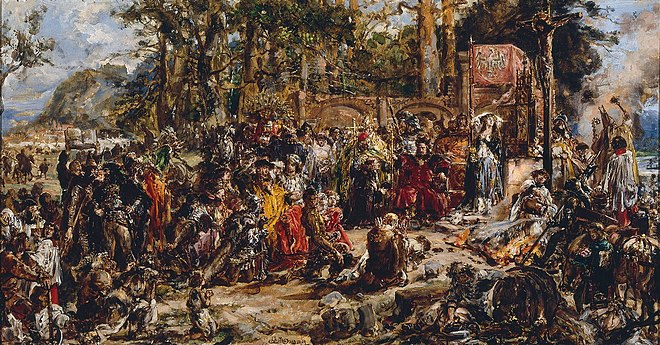
On 15 February 1386, Jogaila married Jadwiga (aka Hedwig), the "King" (Queen) of Poland. This created the opportunity for him to be crowned King of Poland as well as Grand Duke of Lithuania, a prospect that was so tempting that converting to his bride's Christian faith was no problem for him. He took the Christian name Władysław II Jagiełło. The baptism of his court and family followed, and Jogaila/Władysław sent to Pope Urban VI with a request to create an episcopal see at Vilnius, the capital. Vilnius got its cathedral in 1387.

Urban recognized Lithuania officially as a Roman Catholic state on 19 April 1389, although parts of Lithuania held out into the 15th century. (The illustration is called "The Baptism of Lithuania" by 19th century Polish painter Jan Matejko.)

So about Jadwiga: who was she, and was she King of Poland or Queen? That's a good story...for next time.

12 January 2024

The Last Holdout

As the western world was turned to Christianity from paganism, there was one area that did not rush to baptism.

In 1009CE, there is a reference to Lietuva Land in the Annals of Quedlinburg. Lietuva Land was the first reference to what we know as Lithuania. They had exposure to Eastern Orthodox Christianity because of contact with the Kievan Rus. In the 11th and 12th centuries, more personal names crop up that are East Slavic language versions of Christian names, showing that there was more contact and influence from Christian nations around them.

There was actually a Lithuanian Crusade attempted by the Teutonic Order against polytheistic pagan Lithuania from 1238 to 1422. Their plan was to incorporate Lithuania into a Teutonic State along the southeastern shore of the Baltic Sea; they had done this with Prussia. (The religious motivation may have been a cover for simply wanting to expand their state.) Lithuanian rulers were opposed to the concept of Christian baptism and fought back.

Well, not all Lithuanian rulers. Mindaugas (c.1203 - 1263) founded Lithuania as a duchy and was its first duke. He had opposition to his power, most notably his nephew Tautvilas, who in 1250 accepted Christian baptism from the Archbishop of Riga, which made neighboring Christian forces into willing allies against Mindaugas.

The politically savvy Mindaugas knew exactly how to counter this ploy, however, and himself accepted baptism (the illustration is a 17th century portrayal of this event) in exchange for Pope Innocent IV acknowledging Mindaugas as King of Lithuania. Innocent signed two papal bulls related to this. One directed the Bishop of Chełmno (Poland) to crown Mindaugas King of Lithuania, appoint a bishop for Lithuania, and build a cathedral. The second declared that the new bishopric would be accountable to the pope, not the Archbishop of Riga.

Mindaugas successors did not necessarily follow in his footsteps and accept Christianity, however. I'll go into that more tomorrow.