12 March 2025

The Politics of Saints

After Edith of Wilton died (c.984), her canonization was a slow process, taking 13 years (slow for the time; canonization these days in the Roman Catholic Church has more stringent requirements). One of the issues may have been that, although she chose to remain in Wilton Abbey her whole life, and at the age of two chose religious objects over fine clothing and jewelry, her life was not the same as a humble servant of God.

She wore clothing befitting a princess, had a special metal container for heating bath water, and a collection of exotic animals provided by her father, King Edgar, and others. She also kept contact with her father that enabled her to use his influence in various ways. Goscelin of Canterbury wrote that her influence with her father was so profound that people from other countries and Rome would visit her, bringing her gifts for her growing zoo and asking for help with the king.

Christianity and politics were deeply entwined: kings were believed to rule by divine right, and Christian counsel was sought by rulers. Having a saint in the family was a good sign, so it makes sense that, 13 years after her death, her half-brother Æthelred pushed her canonization with the support of St. Dunstan.

Even King Cnut, who conquered half of England from Æthelred's son, Edmund II, supported her sainthood, perhaps as a way to ingratiate himself to the Wessex royalty, although marrying Æthelred's widow might have been sufficient. Cnut claimed that Edith appeared and saved him from a storm at sea.

Edith's "miracles" were mostly not of helping people with curing illness, but of appearances in visions, and often, shall we say, self-serving. Prior to canonization, she appeared to people urging them to support her elevation to sainthood. Afterward, when a Wilton nun tried to take one of her relics, a headband, Edith's head appeared to warn her off.

Of course, all of this comes from Goscelin of Canterbury, writing several decades after her death. We should take a closer look at him, next time.

11 March 2025

Saint Edith

Imagine being a toddler, being raised by your mother in a convent, and then discovering that you are a royal princess. I cannot imagine how that must have affected Edith of Wilton (c.961 - c.984) growing up.

Her mother was Wulfthryth, who was taken from the nunnery at Wilton Abbey by King Edgar the Peaceable, who initially wanted Wulfthryth's sister, Wulfhild. After bearing him a daughter, Wulfthryth decided to return to the nunnery, taking her daughter and leaving Edgar to find another wife (which he did in Ælfthryth).

There is a later story that, when Edith was two, her father came to Wilton and laid before her royal clothing and jewelry, while her mother presented her with religious objects. Edith supposedly reached for the religious objects, displaying her devotion to religion. This story is likely apocryphal, but Edith did, in fact, devote her life to religion. It is also said that, when she was 15, Edgar offered to make her an abbess and gave her a choice of three convents, but she chose to remain at Wilton for the rest of her life.

A saint's life written a century later by Goscelin of Canterbury suggests that Edgar was a supporter of his daughter, his former wife, and the Abbey. Goscelin describes her as wearing very grand clothing at the Abbey, annoying the other residents. Her choice of these royal garments was tested when a candle fell on the chest containing them; the chest burned, but the clothing inside was unharmed.

Edith may have remained a secular member of Wilton and not become a nun. She seems to have lived a grand life. Edgar sent her two foreign tutors, gave her clothing, financed the re-building of the convent with a chapel designed by Edith, and Edith occasionally visited her father's court. Edith also had a private zoo of exotic animals at the convent.

In 984, she built a chapel dedicated to the 3rd-century Saint Denis. The dedication ceremony was performed by St. Dunstan, who predicted that Edith would die in three weeks. She did. At the moment of her death, a nun at Wilton saw ranks of angels singing in the abbey church.

After her death, there were only a few miracles attributed to her, so the progress to canonize her was slow, but she was eventually named a saint by her brother King Æthelred II 13 years after her death.

Of course the stories, especially written long after her death and relying on legends told by the abbey, cannot be taken at face value. There was a great deal of politics to be found in acknowledging certain saints. Tomorrow I want to talk about Edith's sainthood and what it meant to the king.

10 March 2025

Wulfthryth and Edith of Wilton

King Edgar (c.944 - 975) had a few children by a few women. One of the women was Wulfthryth of Wilton, an English noblewoman born c.937 who was being educated at the nunnery at Wilton Abbey when Edgar came along. His goal was to marry her cousin, Wulfhild, who was also at the abbey. Wulfhild resisted his amorous advances—her goal was to be a nun, and she eventually became the abbess—and he chose to marry Wulfthryth instead.

With Wulfthryth he had a child, Edith, born c.961. The relationship did not last long, however: in a year or two Wulfthryth chose to return to Wilton Abbey, and took Edith with her. Although Wulfthryth had born a daughter, that did not disqualify her from becoming Wilton's abbess later.

St. Dunstan (supposedly) did not approve of Edgar's actions, taking Wulfthryth away, impregnating her, and then whatever action caused her to leave. He described penance for Edgar, who did not wear his crown for seven years. Edgar also gave Wulfthryth six estates—although that may have been out of actual care for her, not as penance—which later she gave to Wilton Abbey. When bailiffs wanted to arrest a thief who had requested sanctuary at Wilton, she was able to prevent it by her connection to the king. Likewise she secured the release of two priests who had been imprisoned.

Like Wulfthryth, Edith was raised and educated at Wilton Abbey, and chose to enter the religious life. There is a story that, when she was two years old, King Edgar visited her and placed before her a set of clothing and jewelry suitable for a royal princess. At the same time, her mother placed before her religious objects. Edith reached for the religious objects. This story is likely apocryphal, and existed to emphasize her piety by turning away from riches to religion.

At the age of 15, Edgar offered her the chance to be abbess of one of three different convents, but she chose to remain at Wilton. Edgar continued to be supportive of his only daughter, and the balance between her identity as a royal personage and her status as a nun at Wilton remained an issue. I'll talk about her progress to become a saint tomorrow.

09 March 2025

After Killing a King

After the startling murder of Edward the Martyr, Ælfthryth's role in the incident came under scrutiny. Was she simply greeting her stepson the king and offering him refreshment after his journey to Corfe Castle to visit her and her son? Or was she deliberately distracting him with a drink so that he could be unsuspecting and unprepared while he was dragged from his horse and stabbed by her (or Æthelred's) retainers?

Or was it possibly a Becket situation, with the retainers acting on their own to remove an obstacle to Æthelred's accession to the throne, knowing this was what he or his mother wanted?

Whatever the case, the murder of a king was shocking. Kings were considered to hold their position by divine right, and killing one was an egregious sin. The hasty burial at Wareham was "unceremonious," to say the least. A year later, the body was removed to Shaftesbury Abbey. When they dug him up, he was deemed "uncorrupted," a sign of saintliness.

Contemporary chroniclers telling the tale of the murder do not name the murderer(s), which is unusual since they would be known, and presumably punished. This reticence could be explained by the writers avoiding naming publicly the person they deemed the real culprit, Ælfthryth. Naming the woman who had been crowned a queen as a plotter of assassination was a bold move.

Chroniclers might also have avoided naming the murderer(s) because they were retainers of Æthelred, and since he was by default the next king, any suggestion that he might have instigated or planned the murder was a chancy idea to put into writing.

In any case, the young Æthelred became king. I've written about him several times, so I want to fulfill a promise I made two days ago, when I said here that I would have more to say on Edgar's "middle" family, his second consort and her daughter. See you tomorrow for the story of Saint Edith.

08 March 2025

Ælfthryth's Plans

Ælfthryth was the first wife of a king of England (Edgar the Peaceable) to be crowned queen herself. She was the third woman (that we know of) with whom Edgar had children. She had two with Edgar: Edmund, who died young, and Æthelred, born c.966.

Edgar had an older son, Edward, born c.962 by his first wife, Æthelflæd. Upon Edgar's death in July 975, the question of succession came down to Edward and Æthelred. Ælfthryth tried to cast doubt on the legitimacy of the marriage to Æthelflæd, trying to convince the nobles and populace that Æthelred was the only legitimate son and therefore should take the throne.

There is some additional evidence supporting Ælfthryth's claim. A charter of 966 lists Ælfthryth  as the "legitimate wife" and Edmund as the "legitimate son," whereas Edward is mentioned as "begotten by the same king."

Neither of the boys had reached his majority—and the evidence suggests that Edward may, indeed, have been born out of wedlock, but by the backing of the Archbishop of Canterbury, Dunstan, and the powerful Ealdorman of East Anglia, Æthelwine, Edward was chosen over Æthelred. An account written many decades later claims that Dunstan, seeing the opposition to Edward, pushed forward with declaring Edward king in a drastically abbreviated ceremony. In compensation, Æthelred was given the lands traditionally granted to the king's eldest son. He and his mother retired to Corfe Castle.

After Edgar's support of monastic reform—replacing secular clergy in monasteries with monks following the Rule of St. Benedict—Edward's was a very different reign. One almost-contemporary priest, Byrhtferth, described it thus:

the commonwealth of the entire realm was shaken; bishops were perplexed, ealdormen were angry, monks were struck with fear, the people were terrified, and the secular clerics were made happy, because their time had come. Abbots are now expelled, together with their monks; clerics are brought in together with their wives; and 'the last error was worse than the first'

In light of this, Ælfthryth may have been the savior of the people. In March 978 the king decided to visit his brother at Corfe Castle. When he arrived, he was met at the gate by Ælfthryth and some retainers. Some sources say he was offered a cup by his step-mother to quench his thirst after the ride. He was then pulled from the horse and stabbed by her retainers. It is said his foot was caught in the stirrup, and that his horse bolted and he wa dragged for some distance.

He was 16 years old. The body was buried quickly somewhere nearby. We'll talk about the immediate aftermath tomorrow.

07 March 2025

Edgar's Families

King Edgar the Peaceable was known to have three consorts, one or two of whom he might even have married. Two of his sons went on to become kings of England themselves.

The first woman with whom he "consorted" and married was Æthelflæd Eneda ("The White Duck"). An 11th-century scholar named Eadmer wrote a Life of St. Dunstan in which he relates that she was the legitimate wife of Edgar by 957-959, and that she died "a few years later." The two had a son, Edward, born c.962.  Edgar was known to have relations with two others not long after 962, so Æthelflæd may have died not long after Edward's birth.

Edgar next (or concurrently) consorted with Wulfthryth of Wilton in the early 960s, but by 964 was married to Ælfthryth. By Wulfthryth he had a daughter, Edith of Wilton, who was born c.961 (yes, before the birth of the son, Edward). The story goes that Edgar took Wulfthryth out of the nunnery at Wilton Abbey and to Kent, where Edith was born. William of Malmesbury wrote that they were married, but that she renounced the marriage after Edith's birth, leaving Edgar and taking Edith with her back to Wilton Abbey, where Wulfthryth remained for the rest of her life (more on them later).

The third consort—whom he married—was Ælfthryth. This was her second marriage; her first was to Æthelwald, son of Æthelstan Half-King (mentioned in Edgar's link above), and there is an interesting story about that marriage.

Ælfthryth was considered exceptionally beautiful, and Edgar sent his trusted lieutenant Æthelwald to see if the rumors of her beauty were true and to propose that she marry Edgar. It turns out the rumors were true, and the proposal was from Æthelwald himself, who married her and told Edgar that she was not beautiful at all. Hints of this betrayal got back to Edgar, who said he would visit the poor woman, whereupon Æthelwald told her to make herself as unattractive as possible. Instead, she set her eyes on being a queen and made herself as beautiful as possible. Edgar fell for her, and either killed Æthelwald during a hunt or simply posted him to Northumbria. In either case, he got Æthelwald out of the way and married Ælfthryth in 964/65.

Ælfthryth was from the Wessex royal line, and was the first wife of a king of England to be crowned herself as queen, a ceremony which took place on 11 May 973. Queen Ælfthryth was very involved in the administration of the realm, being an advocate in at least six legal cases. She was also interested in the dynastic succession, and looked carefully at Edgar's children from his previous women. Ælfthryth had her own children with Edgar, and wanted them to succeed Edgar. I'll tell you tomorrow what steps she took to ensure that outcome. Yes, it is what you think.

06 March 2025

Edgar the Peaceable

Edgar (c.944 - 8 July 975) was king of England, a son of Edmund I, gaining the throne after the death of his older brother Eadwig. His immediate predecessors had dealt with Viking invasions of England, especially in the north, but Edgar's reign (959 - 975) was blessed in that there were no invasions to deal with, allowing him to focus on local matters.

His mother Ælfgifu seems to have died shortly after childbirth, so he was raised by Ælfwynn, the wife of Æthelstan Half-King, an ealdorman of East Anglia, whose nickname is recorded in a Life of St. Oswald and explained as the result of the authority he wielded in East Anglia and the value of his advice to the five kings of England he served. Ælfwynn was very religious, and Edgar's upbringing was exposed to the idea of monastic reform.

His teacher in this was Æthelwold of Winchester, the abbot of Abingdon Abbey.

As king, therefore, he supported English Benedictine Reform, the late 10th-century religious and intellectual movement to replace monasteries (which at the time were largely staffed by often-married secular clergy) with celibate and contemplative monks who would follow the Rule of St. Benedict. Edgar's influence in this matter was more prominent in southern England; as yet his sway over practices in the north was tentative, a holdover from the previous decades of their independence under Viking rule.

In fact, most of the contemporary or near-contemporary sources we have on Edgar come from accounts of the Benedictine Reform movement—logical, since literate clergy were the likeliest sources of writing and recording at the time. The Anglo-Saxon Chronicle only has ten entries that mention him.

Later historians have a lot to say about Edgar, his three consorts—one or two of which he might have actually married—and the children he fathered with them. They make for interesting reading, and we'll start those stories tomorrow.

05 March 2025

Oslac and Eadwulf Evil-Child

It would appear, after the death of Oswulf I of Bamburgh, that Northumbria was divided between two earls, Oslac of York and Eadwulf Evil-Child of Bamburgh. Oslac apparently managed the southern part of Northumbria, while Eadwulf held the north. Their origins are similarly obscure, but circumstantial evidence suggests a connection to Oswulf: the "Os-" element in Oslac's and Oswulf's names and the fact that "Eadwulf" was also the name of a previous ruler of Bamburgh who may have been Oswulf's father.

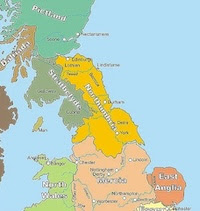
On the map shown, Jorvik (its original name) refers to the kingdom of York. The area north would have been Eadwulf's.

Their names appear in official documents. Oslac appears as witness to three charters in 963 as a thegn, not quite the earl status that later histories gave him. Eadwulf likewise appears as witness to royal charters between 968 and 970. Still, those charters—assuming the names on the charters are the same persons as the men administering the north—show that each of them was a trusted member of the court and traveled to meet with the king, who at the time was Edgar the Peaceable (who succeeded Eadwig who succeeded Eadred, who had worked diligently to re-unite Northumbria with southern England).

By 994, a charter is attested by Waltheof, Eadwulf's successor, suggesting that Eadwulf was either deceased or simply no longer in charge for some reason that no histories mention. Oslac was banished from England not long after the death of King Edgar. Edgar's death had led to a conflict over the succession, and some suggest that both Oslac and Eadwulf backed the unsuccessful Æthelred the Unready instead of Edward the Martyr, and lost their positions because of that misplaced loyalty (Æthelred was not even a teenager yet; Edward was older, but illegitimate; hence the debate over the succession.)

Whatever the case, Oslac and Eadwulf have their footnote in history. Oh, and why the nickname "evil child"? Who knows? His given name means "happy wolf"; perhaps it was simply a joke: "happy wolf, evil boy." Or he was truly considered to be less than a good person. Anyone who knows the reason for the name is long dead.

As is King Edgar the Peaceable, but at least we know more about him, and I'll share some of the with you next time.

04 March 2025

Oswulf I of Bamburgh

Oswulf had (according to Roger of Wendover's account) betrayed Eric Bloodaxe to help get rid of him. Once Northumbria was finally rid of Viking rulers, King Eadred made Oswulf commander of Northumbria. He had been the ruler of Bamburgh, a village on the coast, and was likely a son of Eadwulf I of Bamburgh, who had been the ruler there until his death in 913

Bamburgh was very small—still is, but it has a castle (see illustration)—and the tradition that Oswulf became commander of all Northumbria seems a bit of a stretch, but a history written a little later, the De primo Saxonum adventu ("On the first arrival of the Saxons") supports this:

Primus comitum post Eiricum, quem ultimum regem habuerunt Northymbrenses, Oswulf provincias omnes Northanhymbrorum sub Edrido rege procuravit.
First of the earls after Erik, the last king whom the Northumbrians had, Oswulf administered under King Eadred all the provinces of the Northumbrians.

The Historia Regum ("History of Kings") by Symeon of Durham also says "Here the kings of Northumbrians came to an end and henceforth the province was administered by earls." So it looks legitimate (or at least was thoroughly believed) that the Anglo-Saxon king in the south managed Northumbria through subordinates, rather than allowing them their own king.

Northumbria might not have been "intact" under a single earl for long, however: the De primo Saxonum adventu claims that it was divided into two parts after Oswald's death, between Oslac of York and Eadwulf Evil-child. Let's talk about those two tomorrow.

03 March 2025

Trouble in Northumbria

In 947/948, the folk of Northumbria decided to oust Amlaib Cuarán, the Viking ruler who came from Dublin with his cousin, Olaf Guthfrithson, and took over when Olaf died. They invited Eric (later called "Bloodaxe") from Norway to take his place. This request for another Scandinavian ruler seems to be a response to the Anglo-Saxon family of Æthelstan continually subduing the north to keep England united.

Archbishop of York Wulfstan supported Eric, but the current Anglo-Saxon king, Eadred, came north in 948 and destroyed part of Northumbria as punishment, even burning several buildings at Ripon (a significant place, it was founded by St. Wilfrid and housed the remains of St. Cuthbert at one time). When he departed the north, Eadred advised that he would return with greater devastation if they did not get rid of Eric.

That did not resolve the "northern trouble," however, because shortly after, King Malcolm I of Scotland raided Northumbria and took captives and stole cattle. Moreover, with Eric gone and Eadred back south, Amlaib returned in 949, so one record claims. That only lasted until 952 when, once again, the Northumbrians expelled him, whereupon Eric returned to reign from 952 - 954.

Eric might have stayed longer except for a betrayal. A history written a century later by Roger of Wendover says:

King Eric was treacherously killed by Earl Maccus in a certain lonely place which is called Stainmore, with his son Haeric and his brother Ragnald, betrayed by Earl Oswulf; and then afterwards King Eadred ruled in these districts.

After this, Oswulf administered Northumbria and was loyal to Eadred and the following English kings. Northern control by Vikings was a thing of the past. The identity of Maccus is unknown. It is assumed that Roger of Wendover had access to a text with details of the death that is no longer available to modern scholars.

Tradition tells that Oswulf ruled all of Northumbria for about the next decade, so I think he's worth talking about, although we know very little about him. See you tomorrow.

02 March 2025

Eric Bloodaxe

I mentioned yesterday that the control of northern England passed in and out of Anglo-Saxon and Viking hands until finally the inhabitants themselves drove out the last Viking ruler in 954. That ruler was Eric Bloodaxe.

Details of Eric's life are few, and this has caused the sometime King of Northumbria in the 940s and 950s with an Eric of Norway mentioned in Norse sagas who ruled the Norwegian Westlands in the 930s. This possibly erroneous conflation of the two gives us a richer history, but cannot be proven. If true, however, then Bloodaxe is the son of Harald Fairhair and half-brother of Haakon the Good, and left the kingship of Norway to rule over northern England.

At least we have evidence of his status in England from the existence of coins minted during his reign. Shown are coins minted at York with "ERIC REX" on them, accompanied by a sword.

The epithet "Bloodaxe" comes from mentions by a Norse poet writing in the 900s, and is given to him because he supposedly slew his half-brothers to ensure his rule over Norway. Other poets and historians refer to him as a "brother killer" or simply the he was vicious as a Viking raider. The Anglo-Saxon Chronicle omits "Bloodaxe" and refers to him simply as "Harald's son."

Let's talk about northern England. When Æthelstan died in 939, he was succeeded by his teenage brother Edmund. It seems that Olaf Guthfrithson almost immediately left Dublin to reclaim what he once claimed. He was joined by his cousin, Olaf Sihtricsson (known in Ireland and usually referred to in chronicles as Amlaib Cuarán). When Guthfrithson died in 941 or 942, Amlaib succeeded him. He had (for a time, at least) the support of Archbishop Wulfstan of York. Edmund then marched north and subdued Amlaib (and Wulfstan), and negotiated a treaty: Amlaib would be an ally and could hold onto Northumbria.

This second Olaf, however, was supposedly not as acceptable as the first, so Wulfstan and others helped drive him out in 952 and invited Eric from Norway to come and rule them. This is where he starts minting his own coins. Tomorrow we'll continue the back-and-forth possession of Northern England from Viking to Anglo-Saxon hands.

01 March 2025

Æthelstan's Reign, Part 3

King Æthelstan (c.890s - 27 October 939) united England under a single ruler, prevented invasion, reformed the law, and donated to the Church. He did all the things you would want a leader to do, but of course, nothing lasts forever.

Æthelstan died almost exactly 40 years after the death of his grandfather, Alfred the Great. There is no particular reason given for his death. It is likely that, as a man in his 40s who had led armies through some fierce battles and pushed his body to its limits as the leader of a country, he was simply aged to the point where his body had enough. The fact that so many king's deaths raise the specter of poison, but not here, is telling that it seemed a natural death.

He was buried at Malmesbury Abbey. The 12th-century chronicler William of Malmesbury stated that the king had devotion to the memory of the 7th-century St. Aldhelm, but there may have been another reason. When Æthelstan first was crowned, he had an older sibling, Ælfweard, with a claim to the throne. Winchester—where Æthelstan's grandfather, father, and Ælfweard were buried—seems to have preferred Ælfweard over Æthelstan. Æthelstan might have avoided Winchester as part of a grudge.

With the king's death, the Viking king of Dublin, Olaf Guthfrithson, was chosen by York to rule them. The unification of northern England to the rest of the island was broken. It got worse: Olaf conquered the East Midlands as well. Upon Olaf's death in 941, Æthelstan's half-brother Edmund managed to regain control of the midlands in 942 and York in 944, but that victory was short-lived. Edmund died in May 946, and the Vikings once again took control of York.

I once wrote of Æthelstan as the Forgotten King. The truth is that we have little source material about his life. William of Malmesbury wrote about him long after his death, and his account is considered unreliable, but some historians argue that William must have had access to some lost biography. Still, the charters and coins give evidence of a very active king. Also, the illustration in yesterday's post was made in Æthelstan's lifetime, making his likeness one of the earliest contemporary portraits of an English king in existence.

Speaking of York: northern England swayed back and forth from Anglo-Saxon to Viking hands. Anglo-Saxon rule did not become permanent until the northerners decided to drive out their Viking rule themselves. Tomorrow we'll start the story of that Viking ruler, Eric Bloodaxe.

28 February 2025

Æthelstan's Reign, Part 2

Like his grandfather Alfred the Great (and to a lesser extent his father, Edward the Elder), Æthelstan had close ties to the Church.

He not only made bishops out of some of his close friends, but also made friends out of bishops and priests who were welcome at royal feasts and who were invited into the assemblies where he heard disputes and made decrees.

Æthelstan was a great collector of holy relics, and showed great respect to shrines. When he invaded Scotland in 934, he took along 18 bishops. When he reached the market town of Chester-le-Street, he paid his respects to the shrine of St. Cuthbert, presenting gifts including a stole and maniple for use of the priests who maintained the shrine. (This was before Cuthbert's final resting place at Durham Cathedral.)

His interest in relics was described as þæt he mid þam gewytendlicum madmum, þa unateoridenlican madmas begitan sceolde, Old English for "that he should use his ‘transitory treasures’ to obtain ‘everlasting ones'." The idea was that venerating and preserving these holy relics would help him get into Heaven, so he sent men out to find them. Keepers of shrines also sent him some.

He donated to churches, but did not found as many as the later legends suggest. His reputation in this area seems to have exceeded the evidence that some churches were founded during his reign as they believe in their local histories. Æthelstan also made donations to churches outside of England. When a delegation went to the court of Holy Roman Emperor Otto I with two of Æthelstan's half-sisters, so that Otto could pick one as a wife (he chose the 19-year-old Eadgyth over the older Eadgifu), the priest accompanying the delegation continued throughout Germany, visiting monasteries and presenting gifts from Æthelstan. In exchange they were asked to pray for the king.

Unfortunately, Æthelstan's kingship did not last very long after he united England, and I'll go into his final days tomorrow.

27 February 2025

Æthelstan's Reign, Part 1

Because of the Battle of Brunanburh, historians hale King Æthelstan as first of the true kings of the English in that the country was united under one ruler. Part of that status is due to bringing northern England under his rule, despite the fact that it was claimed by Olaf Guthfrithson, King of Dublin. (Olaf was defeated at Brunanburh.) Æthelstan even purchased the Amounderness Hundred, one of the six subdivisions of Lancashire in northern England, and gave it as a gift to the Archbishop of York, who managed the region for the king. Let's talk more about the man I once labeled the "Forgotten King."

Needing to manage a much larger realm than his predecessors meant creating an organized central government. Charters of grants of land could formerly be made by those overseeing their corner of the kingdom, but from 928 to 935, all charters came from a single royal scribe referred to as "Æthelstan A." These charters provide more detail as to dates, previous ownership, and lists of witnesses.

Rather than traveling around his kingdom constantly and meeting with officials, Æthelstan instead summoned them to him in Wessex. A large number of lords, bishops, and other officials attended his meetings, which some see as the rudimentary beginning of a Parliament.

He also reformed the law. After focusing on clerical matters, he turned to citizen safety. He decreed the death penalty for anyone over the age of 12 who was caught stealing goods worth more than eight pence. Enforcement was sketchy, and later he observed

I, King Æthelstan, declare that I have learned that the public peace has not been kept to the extent, either of my wishes, or of the provisions laid down at Grateley, and my councillors say that I have suffered this too long.

He changed tactics, declaring amnesty for robbers if they paid back their victims. This produced no results, so he went back to harsh penalties, raising the age to 15 to avoid killing too many young people. He also instituted the idea of "tithing," not the paying of a tenth of one's goods to a church or lord, but a group of ten men who voluntarily swore to keep each other honest and keep the law. This was later called the frankpledge, which you can read about here and see the words of the oath here.

Tomorrow we'll look at his relationship with the Church, with whom he kept very close connections.

26 February 2025

The Battle of Brunanburh

We saw yesterday how in 937 an alliance of former enemies came together to attack King Æthelstan, who had in the past proven superior in battle to some of them individually. The final battle of that conflict was decisive, but not in the way the attackers expected.

The antagonists were Olaf Guthfrithson, King of Dublin, Constantine II, King of Scotland, and Owain, King of Strathclyde. Olaf sailed from Dublin in August, and the battle must have taken place before winter, but we don't know exactly when. Nor do we know exactly where Brunanburh was. We know the name "Brunanburh" from the Old English poem about the battle that is found in four of the nine surviving copies of the Anglo-Saxon Chronicle.

The poem, our source of information about the battle, begins by praising Æthelstan and his brother, Edmund:

King Athelstan, the lord of warriors,
Patron of heroes, and his brother too,
Prince Edmund, won themselves eternal glory
In battle with the edges of their swords
Round Brunanburh; they broke the wall of shields,
The sons of Edward with their well-forged swords
Slashed at the linden-shields; such was their nature
From boyhood that in battle they had often
Fought for their land, its treasures and its homes,
Against all enemies. Their foes fell dead,
The Scottish soldiers and the pirate host
Were doomed to perish; and with blood of men
The field was darkened from the time the sun
Rose at the break of day, the glorious star,
God the Eternal Lord's bright candle passed 
Across the land, until this noble creature
Sank to its resting-place. [source]

As the poem says, the battle lasted all day. The invaders broke ranks and fled, and Æthelstan's men pursued them. Olaf sailed back to Dublin and Constantine fled northward to Scotland, but the fate of Owen of Strathclyde is not mentioned.

The battle is corroborated in the Annals of Ulster, recording that several thousands of Norsemen were killed, including five kings and seven earls who accompanied Olaf. Constantine's son was killed. English losses were not zero: the Annals of Clonmacnoise list Æthelstan's cousins among the deceased. Over three dozen medieval texts— Anglo-Saxon, Irish, Welsh, Scottish, Norman, and Norse—mention the battle. The Annales Cambriae simply lists "war at Brune" as its sole 937 entry, but others offer detail that coincides with the Anglo-Saxon poem.

Historians refer to the Battle of Brunanburh and its decisive victory over invaders as the moment when all of the smaller kingdoms in England came together and established their unity as "England." Æthelstan is considered by some to be the first king of a united England. Unfortunately, he did not have long to enjoy this status. I'll explain tomorrow.