11 May 2025

Loch Lomond

There is more to Loch Lomond than just being jealous of the notoriety of Loch Ness. In an 11th-century version of the Historia Brittonum, it is listed as the first of several marvels of Britain:

The first wonder is the lake Lumonoy. In there are sixty islands, and men dwell there, and sixty rocks encircle it, with an eagle's nest on each rock. There are also sixty rivers flowing into that place, and nothing goes out of there to the sea except one river, which is called Lenin.

Loch Lomond, which drains south via the River Leven, has more than 30 islands of various sizes, and they are not surrounded by 60 rocks.

Some of those islands were artificial. People arrived in the area 5000 years ago, during the Neolithic Era, and built up "islands" over the water for safer living. These are called crannogs, and could be a structure on stone pillars or built on wooden stakes (see illustration). A crannog in Lomon called "The Kitchen" was a meeting place for Clan Buchanan from 1225 onwards.

Defense was also the reason why the Romans in the 1st century CE built forts near and around Loch Lomond against the Highland tribes. The need for defense never faded: early Medieval Viking raids dragged their boats overland to put them in the Loch and attack and sack several of its islands.

The loch and its neighboring mountain, Ben Lomond, are part of an area called the Trossachs. The Trossachs were home to Robert the Bruce and William Wallace. The signet ring of Rob Roy Macgregor was a bloodstone from Loch Lomond.

A later legend of the area was that of Reverend Robert Kirk, who researched myths and legends and then wrote a book called The Secret Commonwealth of elves, fauns & fairies. He died before it was published, and sparked his very own legend that the fairies, angry that he revealed their secrets, whisked him away.

The Clan Buchanan, mentioned above, was one of the oldest Highland clans, and we're going to look at their origin tomorrow.

10 May 2025

The Marvels of England, Part Two

In Part One we read about items in the Historia Brittonum that concerned King Arthur and the city of Bath. The first one listed of the Mirabilia ("Marvels") seems to have taken a standard British geographical feature and exaggerated it:

The first wonder is the lake Lumonoy. In there are sixty islands, and men dwell there, and sixty rocks encircle it, with an eagle's nest on each rock. There are also sixty rivers flowing into that place, and nothing goes out of there to the sea except one river, which is called Lenin.

Yes, parts of Britain had a lot of lakes and isles, although much of what was wetland has been drained for farmland and development. This might refer to Loch Lomond, which drains south via the River Leven. Loch Lomond was said to contain 60 islands, but it's closer to 30, and as for the rocks and eagles and 60 rivers...

The final wonder listed is that of the Cruc Mawr Tomb:

There is another wonder in the region which is called Cereticiaun. There is there a mountain, which is given the name Cruc Maur, and there is a grave on the summit of it, and every man whosoever that will come to the grave and stretch himself out next to it, however short they will be, the grave and the man have been found within one length, and, if it will be that the man is short and small, similarly also it is found the length of the grave is like the height of the man, and, if he will be long and tall, even if he might be of length four cubits near the height of every man so the tumulus is discovered. And every wanderer who's up to weariness, the man will bow three bows near that, he will not be beyond himself up to his day of death, and he will not be weighted down again by any weariness, even if he will go alone to the boundaries of the cosmos.

Cruc Mawr has been identified as likely a hill near Cardigan; the name of that hill is remembered in the name of a farm on the hillside: Crugmore. This size-changing grave reminds us of yesterday's Tomb of Amr, Arthur's son, which changes in length each time someone tries to measure it. There is no simple explanation for the belief in this, especially the last part about bowing and being free from weariness for the rest of one's life. Gerald of Wales also mentions this marvel, although he probably got it from the Historia itself, not by independent research.

I've rarely written about geographical features, but next time, how about we look at Loch Lomond and some of the legends and characters connected to its area?

09 May 2025

The Marvels of England, Part One

Two later versions of the 9th century Historia Brittonum contained a section that is referred to as Mirabilia, "marvels" or "miracles." These legends were repeated by others who borrowed from the Historia and became part of the fabric of the "Matter of Britain" in people's minds. A couple of them are legends of King Arthur, of whom the Historia had a lot to say.

The 12th of the Mirabilia listed is about the Cairn of Cabal, Arthur's dog:

There is another wonderful thing in the region which is called Bucit. There is there a mound of stones and one stone placed on top has a footprint of a dog on it. When hunting the porker Troynt, stamped Cabal (who was the dog of the soldier Arthur) the step in the stone, and afterward Arthur gathered together stones under the stone on which was the track of his dog, and it is called Carn Cabal. And men come, and they take the stone in their hands through the space of the day and night, even so, in the daylight of the following day it is come upon on top of his collection.

There was a medieval cantrev (a Welsh unit of land similar to the English Hundred) named Builth, within which is a hill called Carn Gafallt. There are three Bronze Age burial mounds at the top, constructed of stones loosely held together. Depressions made by small stones falling out of place could be taken to resemble a canine paw.

The marvel that follows this is about the Tomb of Amr, Arthur's son:

There is another miracle in the region which is called Ercing. A sepulcra is shown near a spring which is given the name Licat Amr, and the name of the hero who's grave is in the tumulus, it follows, was called Amr. He was the son of Arthur the soldier, and he himself has killed him in that very place and done the burying. And men come to measure the tumulus in length: sometimes it is six feet; sometimes nine; sometimes twelve; sometimes fifteen. For whatever the measurement you will measure it in such a succession, again you will not find it with the same measurement; and even I have made confirmation on my own.

Later stories of Arthur refer to the Wicked Day of Destiny when Arthur defeats his son, Medraut or Mordred, at the Battle of Camlann. Those are later versions of the son's name than what is found in the Historia. A mound south of Hereford, England, called Wormelow Tump, is sometimes pointed out as the burial place of Amr.

Another marvel (number three in the list) is the Hot Pool:

Wonder three - the hot pool, which is in the region of the Huich and encircled by a wall made of brick and stone and to that place men go during all seasons to be washed and to each, as it may have pleased them, the bath thus may be made according to his own will: if he may have willed, the bath will be cold, if warm, it will be warm.

This one is a little easier to explain. The "region of the Huich" refers to the Hwicce, Saxons who lived in the area that includes Bath, a place then and now known for its hot springs.

I'll share a few more of the Mirabilia tomorrow. See you then.

08 May 2025

The Historia Brittonum

In a previous post I mentioned the old idea that Britain was founded by people who fled the Fall of Troy. This idea came from the Historia Brittonum, "The History of the Britons," which was produced c.828/9CE. It explains that the name "Britain" comes from Brutus, descendant of Aeneas. As fanciful as the Historia was, it influenced chroniclers and writers for centuries afterward.

It is the earliest source to describe Arthur not as a king but as a military leader, a dux bellorum, "leader/duke of wars":

Then it was, that the magnanimous Arthur, with all the kings and military force of Britain, fought against the Saxons. And though there were many more noble than himself, yet he was twelve times chosen their commander, and was as often conqueror. The first battle in which he was engaged, was at the mouth of the river Gleni.‎

A legend that Arthur carried the image of Mary into battle comes from this as well. Geoffrey of Monmouth's Historia Regum Britanniae ("History of the Kings of Britain") drew heavily on the Historia.

This is also the source of the Vortigern story, who allowed the Saxons to settle in Britain and married Hengist's daughter. Vortigern's failed attempt to build a fortress led to his priests advising to sprinkle the foundation with the blood of a boy who never had a father. Vortigern finds Ambrosius, who instead prophesies that the foundations are falling due to two dragons fighting underground.

Unsurprisingly, the work blends historical facts with legends. A copyist's note added to the manuscript claims it was written "no earlier than the fourth year of the reign of King Mermenus," who can be identified as Merfyn Frych ap Gwriad, king of Gwynedd (reigned 825 - 844). A line in chapter four also dates it as "from the Passion of Christ 796 years have passed. But from his Incarnation are 831 years."

The illustration above shows "of Nennius" in Latin, and that authorship has been disputed. The name Nennius does appear on some copies of the manuscript, but the consensus is that it was added in the 11th century, and that the original author/compiler of the Historia is unknown. Still, Nennius' name is usually attached to the work when it is discussed.

One of the sections is called the Mirabilia, the "Wonders"; I'm going to share some of the lesser-known legends of Britain starting tomorrow.

07 May 2025

The Poetry of Taliesin

Taliesin (6th century) came a legendary figure of whom many stories are told and to whom many poems are ascribed—(almost) all of it fiction. It is believed by some scholars, however, that some of the poetry that mentions 6th century events or figures are likely the work of a real figure of that name who existed.

Rheged was a kingdom in the north of Great Britain, a Brittonic-speaking region in terms of post-Roman and Early Medieval Eras. One of its kings was Urien, mentioned in the Historia Brittonum and in several poems praising him. (Urien's grandson was St. Mungo.) A poem by Taliesin praising Urien at the Battle of Catraeth—and believed to be original—is offered here.

It is called "The Battle of Gwenystrad" [source].

The men of Catraeth arose with the dawn,
About the Guledig, of work a profitable merchant.
This Urien, without mockery is his regret.
He sustains the sovereignty and its demands.
Warlike, the grandeur of a perfect prince of baptism.
The men of Prydain hurtful in battle array,
At Gwenystrad, continuously offerers of battle.
Protected neither the field nor woods
The people with shelter when tribulation comes.
Like the wave loud roaring over the beach,
I saw valiant men in battle array,
And after the morning, battle-mangled flesh.
I saw a tumult of three limits slain,
A shout active in front was heard.
In defending Gwenystrad was seen
A mound and slanting ground obstructing.
In the pass of the ford I saw men gory-tinted,
Dropping their arms before the pallid miserable ones.
They join in peace as they were losers.
Hand on the cross they wail on the gravel bank of Garanwynyon.
The tribes revel over the rising wave.
The billows protect the hair of their captures.
I saw men of splendid progress
With blood that clotted on the garments,
Toiling energetically and incessantly in battle.
The covering battle, where there was no flight, when contrived.
The ruler of Reged, I am astonished at what was dared.
I saw a brow covered with rage on Urien,
When he furiously attacked his foes at the white stone
Of Galystem. His rage was a blade;
The bucklered men were sustained in need.
May a desire of battle come on Eurwyn.

And until I fail in old age,
In the sore necessity of death,
May I not be smiling,
If I praise not Urien.

This page tries to locate the battle geographically. 

Taliesin's existence is mentioned as one of five chief British poets in the Hitoria Brittonum. Although I've referenced the Historia several times, I haven't spent time explaining the pros and cons of this early source. Let's start talking about that tomorrow.

06 May 2025

Chief of Bards

The 9th-century Historia Brittonum mentions five especially renowned British poets, one of whom is Taliesin. In the 12th century he was considered the author of a great number of romantic legends. The Middle Welsh manuscript called the Book of Taliesin from the 14th century has 56 poems. Scholars think 11 of them may date back to the 6th century, and may actually have been written by the figure known to history as Taliesin.

We know little of his life (of course), but the odes to King Urien Rheged, who died c.550, give us a time frame for an early bard. There are poems to other rulers of that era, suggesting that Taliesin may have performed for at least three kings. His life, however, contains (again, of course) many stories that cross over into fantasy and legend. His double-birth is the most profound of these.

According to a 16th-century account, the Hanes Taliesin (Welsh: "Tale of Taliesin"), his given name was Gwion Bach, and he was a servant to Ceridwen, an enchantress married to a noble in the time of King Arthur. She wanted her ugly son to gain respect, and so created a potion of inspiration so that he would become a famous bard. The potion needed stirring for a year and a day, and that task was given to Gwion Bach. At the completion of the stirring, three drops from the cauldron landed on Gwion's thumb.

Because it was hot, Gwion immediately put his thumb in his mouth, and received the inspiration and wisdom intended for Ceridwen's son. Knowing Ceridwen would be furious, he fled. She pursued, so he turned himself into a hare. Ceridwen turned herself into a greyhound to catch him, so he became a fish and leapt into the river. She became an otter, so he turned himself into a bird to fly away. She turned herself into a hawk, so he fled into a barn and turned himself into a single grain to hide. She became a hen and ate the grain.

The result was that she became pregnant. Realizing that she would give birth to Gwion, she resolved to kill the child, but he was so beautiful at birth that she could not bring herself to do it. She instead put him in a basket and threw him into the river.

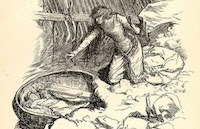
The baby and basket got caught in a weir set up to catch salmon by Elffin, son of a lord, who raised the child and named him Taliesin. (The illustration above is an 1897 work by F.H.Townsend.) Taliesin grew up possessing the wisdom and talent derived from the potion ingested by his previous self.

That is the origin story of the legendary Taliesin. Tomorrow we'll look at the poetry that might actually be ascribed to the real Taliesin.

05 May 2025

Druid Culture

The Classical Era sources we have for druid culture agree that druids were important in Celtic society. Julius Caesar wrote that the druids had an elected leader who ruled until death, referred to in later literature often as an "arch-druid."

Druids were highly respected for the learning and wisdom. Caesar said that they studied "the stars and their movements, the size of the cosmos and the earth, the nature of the world, and the powers of immortal deities." (Despite this sophistication that mirrored the Roman world, Caesar also described the frequency of human sacrifice, likely in order to paint them as inferior to the civilized Romans, and therefore worthy of conquest.)

Other classical writers, Diodorus Siculus and Strabo, claimed the druids were so revered that they could stop an impending battle between armies simply by intervening. They were philosophers and knowledgeable about religion. Another Roman, Pomponius Mela, writing around the same time as Julius Caesar, made the first remarks about how their learning was conducted in secret, taking place in caves or hidden in forests.

Caesar claimed it could take 20 years for a druid to properly learn the required lore, because nothing was committed to writing, but needed to be thoroughly memorized. Yes, there was a written language in Gaul, but there exists today no single written line of "druidic lore" that can be verified as authentic. The forgeries of Edward Williams/Iolo Morganwg do not count.

In the centuries after the conquest of Gaul, the Romans took measures to wipe out the druids. Pliny the Elder wrote that Emperor Tiberius (14-37CE) banned druidic practices (and soothsayers) in order to stop human sacrifice.

Druids seem to have survived in the British Isles a little longer, until Christianization spread. Their role as carriers of oral tradition and law did not disappear, however: it survived with a different name for the purveyors. That name was "bard." Tomorrow we'll look at one of the early and most famous bards, of whom some say it can be argued that he was one of the last druids: Taliesin. See you then.

04 May 2025

About Druids

One of the earliest recorded descriptions of druids comes from Julius Caesar, who encountered them in the conquest of Gaul in the 1st century BCE. In Book 6 of his Commentarii de Bello Gallico ("Commentaries on the Gallic War"), he has a few chapters on the social structure of Gaul. He lists two groups that were prominent in Gallic society, druids and nobles. Unfortunately, we should be careful what we take as fact, since a lot of what he wrote was hearsay, and some comes from an account a century earlier by another politician, Posidonius.

Posidonius decided in the 90s BCE to travel the world. He studied the Celts in Gaul, describing customs like nailing skulls to doorways as trophies. The Celts told him that they honored druids, whose descriptions caused Posidonius to describe druids as philosophers. Posidonius' writing on the lands of the Celts is lost, but was quoted by others, such as Caesar.

Julius Caesar commented on the role of human sacrifice, including of innocent people, and the option of burning alive hundreds of people to protect the larger population from famine or plague. The legend of the "wicker man" (seen above), entrapping several people in the wicker-made construct and burning the whole, comes from one line of Caesar's, which is believed to have been inspired by the stories of Posidonius:

They have images of immense size, the limbs of which are framed with twisted twigs and filled with living persons. These being set on fire, those within are encompassed by the flames.

The 1st-century Greek geographer Strabo also mentions this practice, saying that innocent people would be sacrificed inside if there were no criminals handy to use.

Caesar also discusses the divinities to whom the druids sacrificed, mentioning Dis (the Roman god of the underworld), from whom Caesar says the Celts believe they were descended. Another was the goddess Brigid, associated with healing and smithcraft and nature (among other things), who may have been Christianized centuries later as St. Brigid.

We'll go into more of the civil culture of druids tomorrow.

03 May 2025

Faking Medieval Literature

During the Celtic Revival, a Welsh stonemason named Edward Williams (1747 - 1826) took an interest in collecting old manuscripts and began writing his own poetry. After moving to London, he joined a Welsh literary society, but later returned to Wales and farming (at which he was unsuccessful). In the 1780s, he decided to help "revive" early Welsh literature by forging it, and he adopted the name Iolo Morganwg. His collection was later published in 26 volumes as the Iolo Manuscripts by his son, Taliesin, whom he named after an early medieval bard.

To be fair, not everything in the Iolo Manuscipts was a forgery. He wanted to prove, however, that a lot of Welsh culture—particularly druidism—survived the Roman Conquest of Britain, and his evidence was manuscripts that he claimed to have uncovered himself. His first foray into re-educating a modern world on his finds was by publishing a collection of poetry by a known 14th-century creator of love poetry and erotica, Dafydd ap Gwilym (c.1315 - c.1350). He included hitherto unknown poems of Dafydd which were Edward's first published forgeries.

This collection was very successful, and Edward moved back to London in 1791 where he founded Gorsedd (Welsh for "throne"), a community of Welsh writers and poets. (The site of its founding is commemorated by the plaque shown above.) This society had ranks:

  • Ovates, who wear green robes (novices)
  • Bards, who wear blue robes (seasoned members)
  • Druids, who wear white robes (the highest rank)

Wales has an annual music and poetry competition, the Eisteddfod. In 1884, the Transactions of the Royal National Eisteddfod of Wales made remarks on Edward's published work:

The records thus furnished, take us back to a time of Prydain ab Aedd Mawr, who is said to have lived about a thousand years before the Christian era, and who established the Gorsedd as an institution to perpetuate the works of the poets and musicians.

Of course, Edward's records were made up, but they supported the idea of a Celtic Revival and mis-educated people for generations. Gorsedd also made much of Stonehenge and other circles of standing stones. Occurrences of Eisteddfods often created circles of standing stones to mark the event, but these days a set of artificial stones is used and set up wherever the Eisteddfod takes place, only to be put away until the following year.

But what of the druids? Do we really know anything about them, especially since they left no written records? Let's delve into them next time.

02 May 2025

The Celtic Revival

Folk often look to the past as a "Golden Age," or even just as having facets that fascinate the current era. There was a "Celtic Revival" that started in the 19th century that became enamored of a highly polished view of the stories and artifacts of the distant past. (There was a similar Gothic Revival that started in the 18th century, extended into the next century by Pugin.)

A large part of this was "insular art"; that is, arts and crafts of Early Medieval Ireland, Britain, and Wales. Archaeology was becoming a popular pastime—alas, without the rigor of modern scholars: sites were frequently simply "bulldozed" to reveal treasure, and careful mapping and cataloguing was unknown—and the artifacts discovered were sought after and duplicated, as mentioned in yesterday's post on Irish Treasures.

One lasting effect of this is the ubiquity of the High/Celtic/Irish cross (pictured), with knotwork inscribed in the verticals and horizontals. That knotwork found its way into some Art Nouveau designs by Irish-American designers, such as are found in Old Saint Patrick's Church in Chicago, and the designs of Chicago Architect Louis Sullivan [link], whose father was a traditional Irish musician.

Another lasting effect was created by Welsh antiquarian and author Iolo Morganwg (Edward Williams, 1747 - 1826), a collector of Welsh literature who portrayed himself as an expert on Welsh culture and a reviver of druidism, although after his death it was discovered that he had forged many documents he passed off as historical.  The idea of druidism, however, is still with us, and we should talk about that a little more.

01 May 2025

Irish Treasures

In yesterday's post about the Ardagh Hoard it was compared to the Book of Kells as prime examples of early Irish art, but then mentioned the Derrynaflan Chalice  and the Tara Brooch.

The Derrynaflan Chalice was discovered rather recently, in 1980, as part of a hoard of five liturgical vessels found in County Tipperary on the site of an early Irish abbey. Unlike the accidental discovery at Ardagh when the boys were digging for potatoes, the Derrynaflan discoverers were exploring the abbey site with a metal detector. Similar to the Ardagh situation, ownership of the find was disputed. The discoverers,  father and son, were given permission to wander the land, but the ruins were protected under the National Monuments Act of 1930, and digging up anything on the site was not permitted. They kept their find secret for weeks before revealing it and trying to claim ownership and trying to sell it for £5,000,000. They were unsuccessful, and the find went to the National Museum of Ireland.

The Derrynaflan Hoard is of the same vintage (8th - 9th centuries) as the Ardagh Hoard, displaying the same intricate detail. It included a silver paten, a hoop that may have been intended to support the paten, and a strainer. A bronze basin was inverted on top of the four items, suggesting it was deliberately buried that way to keep the items preserved.

The Tara Brooch was a little earlier (late-7th - early-8th centuries). It is so finely detailed that a magnifying glass is needed to appreciate parts of the design. It was found c.1850 on a beach on the east coast of Ireland, 25 miles from Tara, and despite its name has no real connection to the Hill of Tara. It was given that name by a Dublin jeweler named George Waterhouse who wanted to make and sell copies during the Celtic Revival and thought the name would add mystique and grandeur and create more customers.

Although it is impossible to know the origin of these items, there are occasional random hints about them in history. As I mentioned in the post on St. Brigid, Gerald of Wales makes a reference to a book at Kildare that might just be the Book of Kells. The Book of Leinster (12th century) mentions an elaborate brooch buried after a defeat. Historians wonder if the burial of the Tara Brooch was deliberate to commemorate a tragedy, and not an accidental loss.

What was the Celtic Revival? Although it was well past the Middle Ages, let's talk about it tomorrow.

30 April 2025

The Ardagh Hoard

In 1868, two boys were digging in a potato field west of Ardagh in County Limerick when they struck something solid that was definitely not a potato. Clearing some earth and reaching his hand down, he discovered the long pin of a broach. Realizing that there might be more buried there, he dug down three feet and found a space shaped with round stones, inside of which was a large cup which contained a smaller cup and some brooches. A flat stone that had shifted sideways suggested that the items were deliberately buried in a stone-lined chamber with a flagstone on top.

The boys had unwittingly uncovered what became known as the Ardagh Hoard. It included four broaches, a plain chalice, and an elaborate chalice called the Ardagh Chalice. The Chalice is a two-handed size made of beaten silver and decorated with gold, bronze, brass, and pewter, with enamel designs. Around the bowl it is inscribed with the names of the apostles. It is clearly a Christian chalice, but the fine brooches suggest use by wealthy people, and are reminiscent of later Viking designs, suggesting that the hoard was not buried until about 900CE.

The land was rented by the mother of one of the boys, who sold the items to the Bishop of Limerick, George Butler. Butler had the items cleaned up by a jeweler. Because the objects seemed to have been hidden away carefully, as if the owner were protecting them and intended to retrieve them, they would qualify as a "treasure trove" and by law become the property of the Crown. Bishop Butler denied that they were a treasure trove, but did eventually hand them over to the National Museum of Ireland in Dublin.

The Ardagh Chalice is considered one of the finest examples of early Irish craftsmanship, rivaling the Book of Kells. Tomorrow we'll look at a couple of comparable examples of Early Irish art, the Tara Brooch and the Derrynaflan Chalice.

29 April 2025

Ardagh History

Legend says that St. Patrick arrived in Ardagh c.434 and created a Christian settlement over which he put his nephew, Mel of Ardagh, in charge as bishop. The village is beside Ardagh Mountain (Irish Árd Archadh means "high field"), a hill 650 feet high.

The mountain was originally known as Brí Leith. One of the High King's rights was bilberries from Brí Leith for his traditional harvest meal. (Bilberries look like blueberries of North America but are not the same species. In Ireland they are gathered on the last Sunday of July, and at Lughnasadh.) Brí Leith was the legendary home of Midir, a king and son of Dagda of the Tuatha Dé Danann.

After Patrick, it became an important part of Ireland's early Christian history, but there are no records of Mél's successors as bishop of Ardagh until the reign of Henry II and the arrival in Ireland of the English. Brigid of Kildare was said to have spent her earliest years as a nun in the Ardagh monastery, under the mentorship of Mél.

The English attempt to take over Ireland (one of many) caused the burning of the original church and town. In 1230, after being restored, there was further trouble over choosing a bishop. The disagreement turned to violence, and part of the cathedral was once again destroyed. Another dispute over episcopal control in 1496 again destroyed the entire church, leaving only an altar standing. The illustration above shows what little remains of the Church of Mél behind some gravestones.

There was more than one location in Ireland named Ardagh. We've been talking about Ardagh in County Longford, but there was another in County Limerick, in which a treasure hoard was discovered in 1868 in a potato field. Tomorrow we'll show off the Ardagh Hoard.

28 April 2025

Mél of Ardagh

St. Patrick had sisters. One of them was discussed yesterday, Derarca, called the "mother of saints" because she had so many children who became saints and or bishops. Four of her sons were named Mél, Melchu, Munis, and Rioch. (Some historians think Mél and Melcghu ere the same person.) They went with their uncle Patrick to Ireland tp help with his mission.

Patrick established a church at Ardagh and made Mél its bishop. (The illustration is of Patrick consecrating Mél.) Mél was a "traveling bishop," supposedly never staying in one place long but always moving to spread his missionary message. He performed manual labor to earn his living as he went. He spent part of his time living on the farm of his aunt Lupait, during which rumors spread to discredit him that he and she were living an inappropriate and scandalous life together. Patrick himself went to investigate, but Lupait and Mél proved their innocence by performing miracles. Lupait survived a Trial by Ordeal by carrying hot coals without harm. Mél produced a live fish by ploughing it up in a field.

In contrast to this reported wandering life, he also is said to have built a monastery at Ardagh, and was its abbot as well as a bishop (difficult to do if you aren't around much). Brigid of Kildare visited Ardagh for a time, and Mél was her mentor there. He granted her the authority of an abbess, which was a benefit when she established her own monastery.

Mél is remembered these days in a cathedral at Longford dedicated to St. Mél, as well as a college. His feast day is 7 February, and has taken on an unusual observance. It is seen as a holiday for single people (perhaps as a rebellion against all the fuss of St. Valentine's Day a week later). On 7 February in Longford, single people celebrate the benefits of being single, and even send cards and host parties for singles.

Ardagh was important as an early Christian diocese in Ireland, but its history traces back longer than that. Let's talk about its folkloric traditions tomorrow.

27 April 2025

St. Patrick's Family

Whether Brigid of Kildare was an early Irish saint or a pre-Christian goddess, her legend says that her mother was a slave baptized by St. Patrick, and that she was mentored by Patrick's nephew, Mél of Ardagh. As it turns out, Patrick had more than a few nephews who followed in his footsteps.

Patrick had a sister, Derarca, known as St. Derarca and the "mother of saints" because of her children's careers. Our first indication of her comes from the Vita tripartita Sancti Patricii (Tripartite Life of Saint Patrick), which is believed to have been written within a century of Patrick's death. It mentions that Patrick had two sisters, and when he came to County Derry for an ordination he found three deacons there who were his nephews. (To be honest, Patrick's own very brief account of his life mentions no sisters.)

Legend says that Derarca married twice. Her first husband was purported to be Conan Meriadoc; she bore him Gradlon Mawr, later King of Brittany. (Another legend says that her first husband was Restitutus the Lombard.) Her second husband was Conis the Briton. If you add up all the children attributed to her, you have 17 sons—all of whom became bishops and/or saints—and at least two daughters. (The illustration shows where her house is said to have stood, on Valentia Island in Kerry, of which she is the patron.)

Her daughters were Saint Eiche of Kilglass and Saint Lalloc of Senlis. Her other children included Saint Sechnall of Dunshaughlin; Saint Nectan of Killunche; Saint Auxilius of Killossey; Saint Diarmaid of Druim-corcortri; Dabonna, Mogornon, Drioc, Luguat, and Coemed Maccu Baird.

The three deacons Patrick encountered in Derry, however, were Saint Reat, Saint Nenn, and Saint Aedh. They are commemorated on 3 March, 25 April, and 31 August. Some records say Patrick had several sisters, and I am not certain of the mother of these three. 

There was one child in particular, son of Derarca and Conis, of whom we do hear more, and that is the Mél of Ardagh mentioned above. I'll tell you about him tomorrow.