18 November 2022

Vision of Tnugdalus

The 12th century saw a burgeoning of literature by figures whose names we actually know, like Marie de France and Chrétien de Troyes (mentioned here), Thomas of Britain and Hue de Rotelande. Then there were less clearly known names like Marcus, supposedly an itinerant Irish monk in the Regensburg, Germany, monastery called the Scots Monastery. The only item written by Marcus is the Visio Tnugdali, the "Vision of Tnugdalus," found in five 15th century copies, one of which is Cotton Caligula A.ii, found in the famous Cotton Library, that includes several other romances.

Written shortly after 1149, it is an account told to Marcus by a knight, Tnugdalus, called Tundale in English manuscripts. Marcus claims also to have translated the story from an Irish version. We are told that the story took place in Cork in 1148.

The story is of the wealthy Tnugdalus, who loved stealing, sex, and food and drink. He fought and gossiped and never did any good works. One day he goes to collect a debt owed to him. The borrower is unable to pay, and Tnugdalus flies into a rage. The borrower remains calm and talks Tnugdalus down, and invites him to a meal. While eating and drinking, however, Tnugdalus starts to feel ill, starting with his arm becoming paralyzed. When he tries to rise from the table, he collapses; he becomes cold as the proverbial stone, except for some slight warmth on his left side (where the heart is)?

This was on a Wednesday. The slight warmth leads those around him to keep him above ground. He regains consciousness on Saturday afternoon, upon which he has a story to tell.

He says his soul awakened in a dark place, and he wept, sure that his sins had caught up with him in the afterlife. A horde of foul and noisy creatures come rushing toward him, claiming that his sins confirmed his status as one of them! While he cowers before them, a point of light appears and grows closer, ultimately arriving and turning out to be his guardian angel, who asks him "What are you doing here?"

The angel tells him that he still has a chance to be saved. The horde freaks out about this, but the angel turns to Tnugdalus and says "Quick! Follow me!" The angel leads him through a dark tunnel, where the angel's light reveals the souls being tormented for different sins. This Dante-esque journey reveals more and more types of torment for different sins, some of which Tnugdalus experiences for a time, until the angel takes him on to the next experience. Ultimately, nearing the gates of hell, he sees Satan himself, a 150-foot tall human-shaped and thousand-armed creature chewing souls in his sharp teeth a thousand at a time.

Purgatory is also on the itinerary's. great relief to Tnugdalus, who wants to stay there, but the angel assures him that even better awaits, and takes him to Heaven. They stand on a wall in Heaven—seen in the illustration above—and Tnugdalus now grasps knowledge of everything, and can see anything, no matter how far away. Suddenly,

... Saint Ruadan approached them. He welcomed Tundale happily, took him into his arms and hugged him.

‘My son, your arrival here is blessed indeed,’ he said, and they stood together. ‘From now onwards, while you live in the world you can look forward to a good end to your life. I was once your patron saint and in your worldly life you should be willing to show me some generosity and to kneel, as you well know, in my presence.’

St. Patrick is also seen, as well, as several historical deceased Irish bishops. Tnugdalus asks to stay, but is told that is not possible unless someone has led a good life. Tnugdalus must return to his body and change his ways if he wants to see this place again. Tnugdalus re-awakens in his body, astonishes all the people surrounding him by that and by the promise to amend his life.

The story is reminiscent of the Irish immram (Irish "voyage"), a hero's journey, usually by sea, through fantastical and legendary places. Marcus wrote in Latin, although he says he translated an Irish-language account. The story was translated into several languages, at least into French, German, and Norse. The Cotton version is Middle English. You can read a Modern English version here.

I'm curious about the place where Marcus wrote. What was a Scots Monastery doing in Germany? Tomorrow I'll tell you about the Schottenkirche.

17 November 2022

St. Ruadán

St. Ruadán was one of the Twelve Apostles of Ireland. Born in Tara and educated at Clonard by Finnian, he later founded his own monastery of about 150 at Lorrha, the remains of which are pictured here.

Ruadán was known for his prophecies. His prophecy that Diarmait mac Cerbaill would die from the roof beam of his house came true, even though Diarmait had it removed and cast into the sea: it was found and innocently used as a roof beam in another house, in which Diarmait was trapped when it was burned down. The roof beam—his own—fell on him.

Ruadán was not just objectively prophesying Diarmait's death: he actively disapproved of Diarmait. Diarmait had imprisoned a kinsman of Ruadán who had violated the king's law. Ruadán came to Tara to curse Diarmait for violating he sanctity of the church; he cursed the hearth, proclaiming that never again would smoke rise from a building on the Hill of Tara. Diarmait then glanced up at the ceiling, at which Ruadán made his famous prediction about the roof beam.

The Curse of Tara and the "decommissioning" of the royal hill site would therefore have started as of Ruadán's visit in 556. Diarmait survived until 565, however, and Adomnán of Iona held a synod at Tara in 697.

Ruadán died in 584; his feast day is 15 April. There is not a lot of detail about his life, but his reputation lived on: he "appeared" in the 12th century to an Irish knight named Tnugdalus (alternately, Tundalus or Tundale). The popular Visio Tnugdali ("Vision of Tnugdalus") was recorded about 1149 by a Brother Marcus who claimed to have heard it from the knight himself. 

But that's a story for tomorrow.

16 November 2022

Prophetic Death

Prophetic death is a staple of mythology and legend. One classic trope is the "threefold death" in which a prophecy claims three different manners of a person's death, all of which somehow come true.

One example is a Welsh legend of Merlin, who is asked to prophesy a boy's death; he says the boy will fall from a rock. The boy is then dressed in different clothing and brought before Merlin and asked about the manner of his death; Merlin says he will hang. The boy is then disguised as a girl and brought again; Merlin prophesies drowning. Later, while on a hunt, the boy slips from a rock, is caught on a tree and suspended upside-down, with his head in a lake, where he drowns.

Diarmait Mac Cerbaill was a real historical figure, and yet we are told he suffered the threefold death of legends. According to the Life of Columba by Adomnán of Iona, he is told by an Irish seer that his foster-son, Áed Dub ("Black Áed"), will kill him; Diarmait banishes Áed Dub. Then, St. Ruadán prophesies that he would be killed by the roof beam of his hall at Tara; Diarmait has the roof beam removed and thrown into the sea.

With those dangers removed, Diarmait continues his quest to avoid death by asking druids how he will die. They predict a threefold death, "by iron, water, and fire." This would mean slain with a weapon, drowning, and burning. Further, they are him that there will be signs of his impending death: a shirt grown from a flax seed, a woolen mantle made from a single sheep, ale brewed from a single grain of corn, bacon from a sow that has never farrowed.

Diarmait, satisfied that his death by anything other than old age is unlikely, visits the hall of Banbán, where he is shown a shirt, a mantle, and bacon that satisfy the conditions of his imminent death. He decides to immediately leave the hall, but Áed Dub is waiting at the door, stabs him and sets fire to the hall. Prevented from leaving the burning hall, Diarmait climbs into a vat of ale to survive the heat. The burning hall collapses, and the roof beam, which Banbán had found in the sea and used to build his hall, falls and crushes Diarmait.

It is curious to have a prophetic and threefold death attributed to an actual person. The Annals of Tigernach, in the entry for 563, merely states "Diarmaid son of Cearbhall was killed in Ráth Bec in Magh Line by Aodh Dubh son of Suibne Araidhe, king of Ulster, and his head was taken to Cluain and his body was buried in Connere."

Adomnán, for his own reasons, was clearly embellishing. Perhaps his knowledge that Diarmait was dabbling in Christianity was the emphasis, since legend says that Áed Dub suffered a similar threefold death, which Adomnán attributes to divine justice after killing Diarmait. Adomnán would have been drawing from several sources for his Life of St. Columba, including the saga Aided Diarmata ("Death of Diarmait").

One more look at Diarmait, the king who bridged the pagan and Christian eras in Irish kingship, before we move on to something else. This next look will be from the angle of St. Ruadán.

15 November 2022

Diarmait mac Cerbaill

There were two significant designations for kings in Ireland. Of the several different kingdoms on the Emerald Isle, only one of them had possession of the sacred site the Hilo Tara, on which stood the Lia Fáil, the "Stone of Destiny," brought to Ireland by the Tuatha dé Danann, that would cry out when the true king stepped on it. Whether the Stone ever was heard to cry out is moot: possessing the Hill let you declare yourself King of Tara after engaging in a sacred pagan initiation rite.

The other designation was High King of Ireland, or King of All Ireland. This designation was not rooted in Irish mythology: it denoted someone powerful enough that other kingdoms recognized his political and military superiority. There was no spiritual or religious aspect to this title.

Diarmait Mac Cerbaill was the last known king in Ireland to go through the pagan ritual of marriage to the goddess of the land, and so was King of Tara. Annals declare him a great-grandson of the semi-historical Niall of the Nine Hostages. His father's name was Fergus, but rather than be named "Ferguson," his surname is given as Cerbaill from his father's nickname Cerrbél, "crooked mouth."

During his lifetime, he was also declared High King of Ireland, from 544 to 565. His reign was not stellar. In a dispute between St. Columba and Finnian of Movilla, he took the wrong side and was defeated at the Battle of Cúl Dreimhne, the famous "Battle of the Books" over the copyright of the Cathach. It was not the only battle he lost.

Despite his initiation as King of Tara, and references to "druid fences" being used during the Battle of Cúl Dreimhne, he was the first High King in Ireland to embrace (or at least dabble in) Christianity. Adomnán of Iona wrote that Diarmait was "ordained by God's will as king of all Ireland." Adomnán was writing 150 years later, but it is not the only evidence that Diarmait might have begun forging a healthy relationship with Christianity. He supported St. Finnian of Movilla. The stone pictured above is believed to be Diarmait and St. Ciaran, carved into the Cross of the Scriptures at Clonmacnoise, planting a stake together. There is a quotation attributed to him that suggests respect for the power of Christianity: "Woe to him that contends with the clergy of the churches." Also, curiously, two of his sons are called Colmán, a specifically Christian name based on the 6th century Irish missionary, St. Columbanus. (Irish royals were known to give the same name to more than one son—relying on nicknames later to distinguish them?—until the 16th century.)

The end of his life, however, was decidedly non-Christian; rather, it involves a mythical "threefold death" based in prophecy that seems impossible at first but comes true in a logical manner. It's complicated enough that I think I'll save it until tomorrow. See you then.


14 November 2022

High King of Ireland

There are two titles given to kings of Ireland: King of Tara, and High King of Ireland. These are not the same thing. "High King" was first used in the 9th century, although it was sometimes applied retroactively and anachronistically to figures of legend; "King of Tara" was first used in the 6th century, although retroactively applied to previous kings as well as legendary figures.

The Kingship of Tara is by far the older of the two, and does not necessarily denote ruling all of Ireland. It is associated with the Hill of Tara, a site that has been important since Neolithic times, with several Neolithic features including a passage tomb dated to 3200BCE, and a standing stone called the "Stone of Destiny" (brought to Ireland by the Tuatha dé Danann).

Possessing the Hill of Tara by conquering whichever tribe held it was a necessary step to claim this special kingship. In the 3rd century, the Laigin seized it from the Érainn; Niall of the Nine Hostages took it from the Laigin in the 5th century, after which it was possessed by the Ui Néill clan. 

The Hill of Tara is also associated with the title "High King." It is considered the place from which the High King rules, thanks to its legendary status. The High King of Ireland was also known as the "King of all Ireland," because unlike the King of Tara, the High King was one who united all the various kingdoms under one rule. Actually, "united" is probably too strong a word. The High King received tribute from the smaller kings, but did not directly rule their kingdoms. (With the rise of political and financial power in cities such as Dublin, Limerick, and Waterford, possessing those became more important after the 11th century.)

The King of Tara was a sacred title, and he "married the land" by having a marriage or a sexual relationship with a "sovereignty goddess" (a term found only in Celtic studies), Maeve. Gerald of Wales wrote that the would-be king sexually embraced a white mare, which was then slaughtered for a feast. Which brings us to Diarmait mac Cerbaill.

Diarmait mac Cerbaill is considered the last King of Tara to be part of the pagan ritual. Diarmait, however, also turned towards Christianity during his reign. I'll go into this dichotomy next time.

13 November 2022

Adomnán of Iona

Adomnán of Iona (also known as Eunan) was born about 627 CE in what is now County Donegal. We do not know a lot of details of his life before he became the ninth abbot of Iona in 679. At some point he tried to get the monks of Northern Ireland to adopt the Roman dating of Easter, decided at the Synod of Whitby in 664. Irish monasteries were still opposed to this, and modern scholars think his authority was probably weakened by his attempts to get Iona to change, and by his absences from Iona as he traveled to other monasteries to try to persuade them to follow the Roman method of calculation.

His greatest legacy may be the Vita Columbae, the "Life of Columba." He was related on his father's side to St. Columba, and used an earlier source to write the definitive biography. The Life of Columba is a valuable resource for information about groups like the Picts, the practices of monasteries, and the politics of the time.

He also wrote De Locis Sanctis, "On Holy Places." He got the information second-hand by a Bishop named Arculf who visited Iona after being to the Holy Land, Egypt, Constantinople, and Rome.

He is also known for the Cáin Adomnán (Gaelic: "Canons of Adomnán"). Presented and agreed to in 697 at the Synod of Birr—a meeting of Irish nobles and churchmen believed to have been convened by Adomnán himself—it established the safety and immunity of non-combatants during war. It is also referred to in Latin as the Lex Innocentium, the "Law of Innocents."

As mentioned in the previous post, he makes one of the earliest references to the divine right of kings. Diarmait Mac Cerbaill was High King of Ireland; he died about 565. Adomnán said he was "ordained by God's will as king of all Ireland," and that his assassin was visited by divine punishment. 

Adomnán died in 704, possibly on 23 September, which is celebrated as his feast day. Although the name Adomnán and its variants are rarely found today, his alternate name of Eunan is found on the Cathedral of Eunan and St. Columba in Letterkenny, County Donegal, as well as on other churches and schools.

I came to talk about Adomnán because of the link to the divine right of kings I wrote about yesterday, but the more I read, the more puzzling his example became. A monk declaring Diarmait Mac Cerbaill "ordained by God's will" looks more and more odd when you look at the king's actions: was he a Christian High King of Ireland, or was he a King of Tara, or both? We'll go into this tomorrow.

12 November 2022

Divine Right of Kings

The Protestant Reformation in the 1500s undermined the authority of and people's faith in the pope and the Catholic Church. This was a boon to temporal authorities, as people increasingly looked to kings for guidance. The king was considered to be answerable for his decisions and behavior to no one but God. (Eventually, of course, the lack of limits in a ruler came under question, since it removes any power from the people, and the revolutions of the late 1700s dealt with this.)

While it lasted, however, the notion of the divine right of kings was beneficial to the tiny percentage of the human population that could take advantage of it.

For Christians and Jews, a passage in Deuteronomy was crucial:

When you come to the land that the Lord your God is giving you, and you possess it and dwell in it and then say, 'I will set a king over me, like all the nations that are around me,' 15 you may indeed set a king over you whom the Lord your God will choose. One from among your brothers you shall set as king over you. You may not put a foreigner over you, who is not your brother." (Deuteronomy, 17:14-15)

Debates took place over whether this meant the people choose a king, or whether their choice is an example of God's will being made manifest. In fact, Jewish law requires a blessing upon seeing a monarch: "Blessed are You, Lord our God, King of the universe, Who has given from His glory to flesh and blood." This suggests that the monarch has God's support.

Medieval Europe was willing to accept that God gave the ruler complete temporal authority, just as the Pope had complete spiritual authority. Richard I of England declared in 1193 "I am born in a rank which recognizes no superior but God, to whom alone I am responsible for my actions," and first used the phrase (still the motto of the monarch of the United Kingdom) Dieu et mon droit (French: "God and my right"). This is the origin of the pluralis majestatis, the "royal we" used by potentates, to indicate that they and God are speaking. Richard's Chancellor, William Longchamp, introduced the use of the plural into documents he produced during Richard's reign.

Henry VIII took this one step further (too far?) when he declared himself head of the Church in England. James VI /I of Scotland/England heavily promoted the divine right theory—although Scotland had always seen the king as simply "first among equals"—as did Louis XIV of France. James used a passage from Romans 13 about "God's ministers" to support his idea of divine right.

The earliest reference to divine rulership takes place long before James, or even Richard. Tomorrow we'll talk about Adomnán of Iona.

11 November 2022

Reviving the Justinian Code

The Byzantine Emperor Justinian I had many accomplishments, but establishing the Corpus Juris Civilis ("Body of Civil Law"), often referred to as the Code of Justinian, was one of the most lasting. The first main codification of Roman law, it influenced many modern legal systems. It was given the force of law as the sole source of legal interpretation, which made the application of law across the Empire consistent.

Although established in the 6th century, copies were extensive for the centuries that followed (no originals from the 6th century remain). City-states in northern Italy adopted the Justinian Code as they grew and needed more formal systems of law to guide them internally and in their relationships with each other. By the time Frederick I Barbarossa came to the throne it was also being used in his territories north of the Alps.

Frederick began to use the Justinian Code which not only made application of the law consistent over a large area, it also bolstered Frederick's grander claims. Based on a Roman Imperial foundation, the Code embraced the idea of the "divine right of rulership." Frederick, like many worldly rulers in the Middle Ages, was in conflict with the Church over ultimate authority. The Justinian Code gave him a reason to push forward the idea that he had divine authority to do as he liked, such as taking over northern Italy as well as Germany, and clashing with Archbishops.

The Justinian Code was also adopted as the foundation of the Napoleonic Code, which abolished feudalism.

The "divine right of kings" was a common concept in the Middle Ages. One of the earliest examples was offered in the 7th century by Adomnán of Iona; I'll tell you about him next time.

10 November 2022

The End of Barbarossa

You are Frederick I, offspring of two of Germany's most powerful families. As a young man, you went on Crusade and distinguished yourself in battle. You become King of Germany and King of Italy. As Holy Roman Emperor, you attempt to re-establish the extent of the Roman Empire. Your help is requested for a Third Crusade, "the most meticulously planned and organized" of any Crusade up until then. The approach of your army so unnerves Saladin that he divides his forces, currently trying to lift the Siege of Acre imposed by Richard Lionheart of England.

Meanwhile, your forces proceed through the Armenian Kingdom of Cilicia, reaching the Saleph River (now called the Göksu in Turkey on a plateau in the Taurus Mountains). The army is sent along a mountain path, while you decide on a shortcut advised by the locals: simply cross the river on your horse.

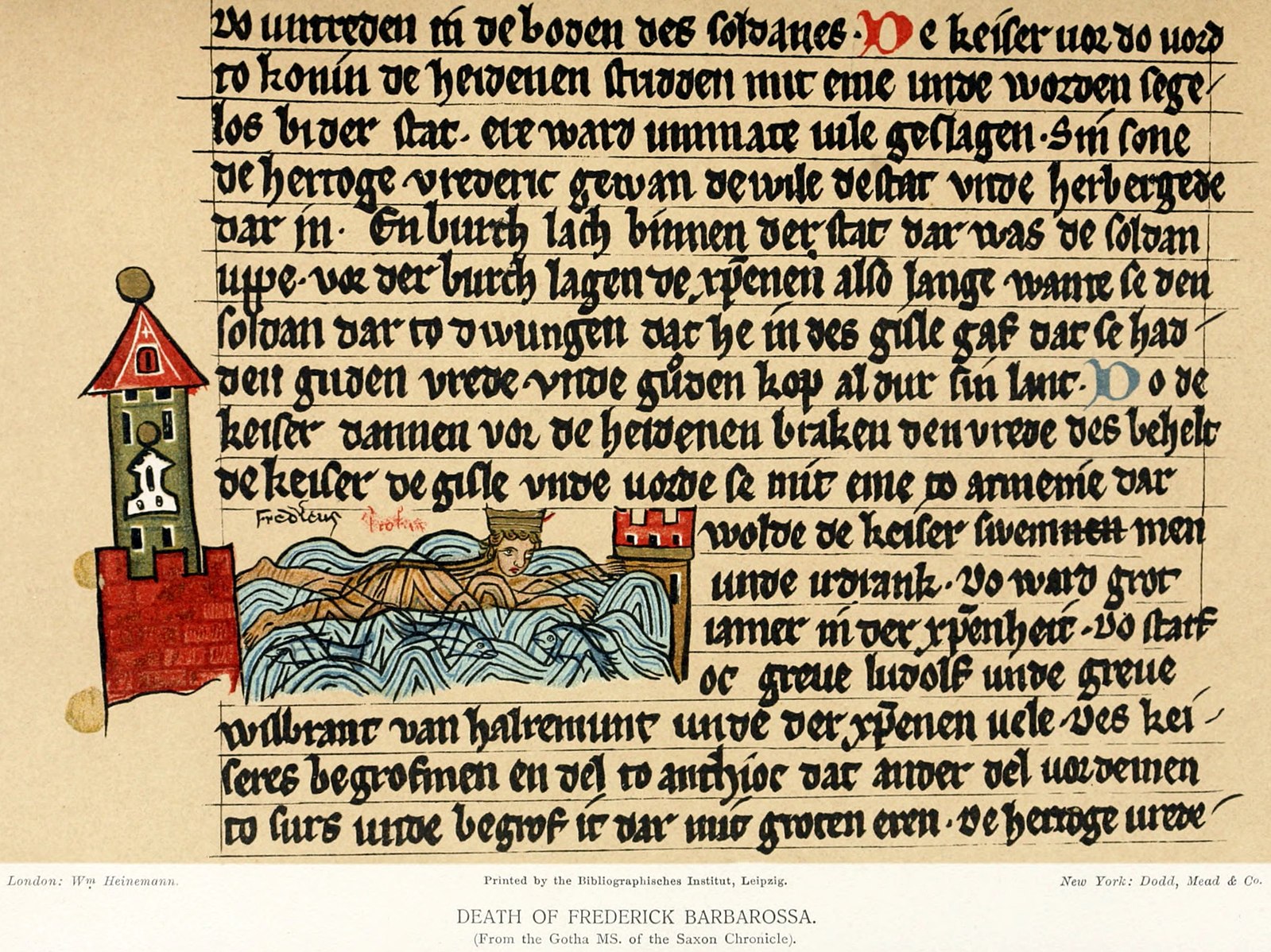
Holy Roman Emperor Frederick I, called Barbarossa, drowned in the Saleph on 10 June 1190.

Accounts vary. A biography written within a few years of Frederick's death says he chose to swim the river—possible, but he was 68 years old at the time—and was swept away. A churchman who was with the Crusade says it was a simple swim to refresh himself, but the old man encountered an unexpected current (illustrated in a manuscript of the Saxon Chronicle above). Another says he was thrown from his horse and weighed down by his armor. A contemporary chronicler claims God saved them from an evil man by drowning him in shallow water while the emperor was washing himself.

Whatever the case, the body was subjected to mos Teutonicus, thousands of German soldiers abandoned the Crusade and went home, and Philip of France took the rest to the Holy land where he shared command of the Crusade with Richard I of England, with whom he was not on friendly terms.

Frederick's reputation was such that he is one of those characters who passed into legend, specifically that he is not dead but lies sleeping (like Arthur, with attendants) until such time as his country needs him, either in the Kyffhäuser Mountains in Thuringia or Untersberg. The signal for his revival will be the disappearance of ravens flying around the mountain. His red beard continues to grow, his eyes are only half-shut, and occasionally his hand raises, signaling a boy to go outside and see if the ravens are still flying.

Germany never lost its interest in Barbarossa. The Kyffhäuser Monument (also called Barbarossa Monument) was erected on the anniversary of Frederick's coronation in 1896 to commemorate him and Kaiser Wilhelm I, who was declared the reincarnation of Barbarossa. Hitler named his invasion of the Soviet Union "Operation Barbarossa," although originally called "Operation Otto" after Otto the Great.

These recent posts have, of course, told barely one percent of the extensive accomplishments of Barbarossa. Tomorrow I want to dip into one of his other actions: the revival of the Roman Justinian Code.

09 November 2022

Starting the Third Crusade

Personalities and politics prevent progress. When Barbarossa received letters from the Holy Land asking for help in fighting Muslims, he refused because of a dispute he was having with the Archbishop Philip of Cologne.

The conflict was not unique to them. We saw it when Charlemagne was first crowned on Christmas Day 800, during the Investiture Controversy, and with Becket, to name just a few turbulent times in European history. Who had ultimate authority, pope or emperor? Philip of Cologne had plenty of authority as archbishop, with money flowing to him through the feudal system.

He wanted more, however, and started buying up the lands of his vassals and selling them to others for profit. His fiefdom was held from the emperor, Frederick I Barbarossa; in fact, his was the largest feudal territory under Frederick. Philip never openly challenged Frederick, but his growing economic power and control over land was a cause for concern. Frederick also annoyed Philip by giving market privileges to the cities of Aachen and Duisburg that would have cut into the economic power of Cologne. This "Cold War" made Frederick reluctant to leave for the Middle East for the length of time a Crusade would take.

Fortunately, the two made peace with each other on 27 March 1188 after a council in Mainz. Philip pledged his support of Frederick, and Frederick "took up the Cross." But that led to another issue for Frederick: in 1175, Frederick had made an alliance with Saladin. Now Frederick had to send a message to Saladin, informing him that their alliance was over.

There was another problem, faced by all Crusades: how to finance it? As have many European rulers over centuries, Frederick turned to the Jews. "Crusade fever" more often than not led to persecution of any non-Christian, and the Jews had suffered massacres connected to the First and Second Crusades. On the eve of Frederick's reconciliation with Philip, the Jews of Mainz were being threatened by a mob. Frederick sent Marshal Henry of Malden to disperse the mob, after which the chief rabbi met with Frederick. An imperial edict followed, threatening equal punishment for anyone who maimed or killed a Jew. Frederick also partially financed the Crusade by a tax on the Jews of Germany.

Sadly for Frederick, he would not survive the Crusade. We will see his end tomorrow.

08 November 2022

Barbarossa!

Born about 1122-23, Frederick (Friedrich) was born in France to the Duke of Swabia. He grew up learning the noble arts of hunting and riding and martial activity, but not the less-necessary arts of reading and writing.

In 1147, as his father lay dying, Frederick decided to accompany his uncle, Conrad III (who was King of Germany) on the Second Crusade. Frederick's father was angry at his brother for taking Frederick away when soon the Duke's widow would need support. The Duke died in the first week of April, and (now Duke) Frederick departed on Crusade at the end of May.

A few months later, Frederick was "tested" by his uncle. A Crusader was robbed and killed in a monastery outside Adrianople in Turkey, and Conrad ordered Frederick to avenge the death. Frederick destroyed the monastery and killed the perpetrators. His military training served him well on Crusade, and he was noted for being victorious "before all others," even though the Crusade itself failed.

In 1152, Conrad died, and the only two people at his deathbed—Frederick and the bishop of Bamberg—agreed that he wished Frederick to be named king, rather than Conrad's own son (who was only six years old at the time). A few days after being crowned King of the Germans, Frederick was crowned "King of the Romans," a title used to by kings of Germany from 1002CE onward to denote they considered themselves Holy Roman Emperor. 

He made it his goal to truly restore the wide-reaching boundaries enjoyed by Charlemagne, and the first step was to unite all the various princes of territories in German lands, and then to extend his authority to Italy. After making concessions in Germany to get everyone on his side, he began a total of six expeditions to Italy, beginning with Sicily, under Norman control by King William I of Sicily. From 1154 until the 1170s, he managed to conquer parts of Italy, but stirred up a great deal of anti-German sentiment and rebellion. An alliance with Constantinople helped the Italian city-states in northern Italy to defeat Frederick, a shock to Europe. It was his time in Italy that gave him the nickname Barbarossa, which means "red beard" in Italian. This nickname became so entwined with his career that it was carried back to Germany, where he was referred to some times as Kaiser Rotbart, "Emperor Red Beard."

In 1187, the aging emperor received letters from the European rulers in some Crusader states in the East to come to their aid. Frederick declined to join this Third Crusade, and urged Philip II of France to go, but later changed his mind and chose to "take up the cross."

This change of heart regarding the Third Crusade involved the Archbishop of Cologne and the Jews of Strasbourg, which I will explain next time.