27 May 2022

The Abbot of Battle

Yesterday I presented a series of facts (as we know them) about the founding of Battle Abbey. Today we take a look at a story of the founding.

A manuscript called The Chronicle of Battle Abbey tells this story that took place during :

When William, duke of Normandy, looked from the high ground of Telham Hill upon the forces of King Harold, he vowed that if God gave him the victory he would found a monastery upon the place of battle. Amongst those who heard this vow was a monk of Marmoutier, William called 'the smith,' who when William had obtained the crown of England urged him to fulfil his promise; the king willingly agreed and entrusted William with the execution of his design. 

The monk, therefore, brought over from Marmoutier four of his brethren, but as the actual site of the battle seemed to them unsuitable for a great monastery, they began to build on the lower ground to the west. When the Conqueror heard of this he angrily insisted that the foundations should rest upon the very spot where he had achieved his victory, and upon the monks pleading a scarcity of water he replied, 'If God spare my life I will so amply provide for this place that wine shall be more abundant here than water is in any other great abbey.' 

 ...  For various reasons, however, building progressed slowly, and it was not until 1076 that things were sufficiently advanced for an abbot to be appointed. Robert Blancard, one of the four monks who had first come over, was elected, but on his way back from Marmoutier he was drowned. Accordingly William 'the smith' was sent to Marmoutier to fetch Gausbert, who came with four of his brethren and was consecrated abbot of St. Martin's of the place of Battle.

In Heads of Religious Houses: England and Wales 940–1216, the authors compile lists of abbots, etc., that include Battle Abbey. From their research, Robert Blanchard was the first abbot, starting in 1067. He had previously been a monk at Marmoutier Abbey. Marmoutier Abbey was founded in 327 CE by St. Martin of Tours, which explains why Battle Abbey was dedicated to Martin.

Pope Alexander II telling William to do penance for all the souls killed in the battle is true. Battle Abbey being built "on the lower ground to the west" away from Senlac Hill where the fighting actually took place  is accurate. A conversation in the middle of a huge battle between the leader of one side and a monk hanging out is ... less likely. Making sure there is a compelling story behind the founding of the abbey to enhance your reputation ... priceless.

Under the third abbot of Battle Abbey, Henry of Bec (appointed 1096, died 1102), Marmoutier tried to claim control over Battle Abbey. It didn't happen, but let's learn more about Marmoutier next.

26 May 2022

Battle Abbey

You would think that the name "Battle" for a religious house must be an abbreviation of some more appropriate term, and you would be wrong. It is named for one of the most pivotal moments in the history of England, the Battle of Hastings and the death of King Harold.

Once William the Conqueror won, he began a building campaign of massive churches whose size completely dwarfed the smaller Anglo-Saxon buildings they were meant to replace. This had the effect not only of impressing upon the natives how different everything would be, but was also likely a way to atone for the bloodshed he had caused. This second reason was important, since Pope Alexander II in 1070 ordered him to do penance for the deaths he caused.

To that end, he ordered the construction of an abbey whose high altar should stand on the exact spot where Harold's standard fell, marking victory for the Normans. The abbey was dedicated to St. Martin of Tours (4th century), who had been a soldier before becoming third bishop of Tours and one of the most popular French saints. Despite that dedication, however, the place was referred to as Battle (or "Battel") Abbey, and the town of Battle developed next to it.

We don't know when exactly it was started, but in 1070 William invited 60 Benedictines to establish a monastery. His intent was that it would eventually house 140 monks. Enough was built for it to be habitable by 1076; it was finished in 1094. by William's . He endowed it with many estates, so that it became one of the richest monasteries in England.

When Henry VIII dissolved the monasteries, Battle Abbey was given to one of the king's friends, who demolished most of it and turned the remainder into a large manor house. Little of the original remains, but visitors are welcome, historical reenactments take place on the grounds, and a plaque and stone stand where (we suppose) the high altar once stood.

There is a slightly different story about the founding of Battle Abbey that also establishes a closer link to St. Martin of Tours. I'll tell you about it tomorrow.

25 May 2022

The Seat of Wisdom

The special nature of the Virgin Mary—having been born without sin so that she could bear the Savior—made her the focus of attention as Christianity evolved. We've looked at the end of her life on earth and what happened afterward. In the Middle Ages, she took on a new title: the Seat of Wisdom.

The connection between Mary and Wisdom can be found starting in the 8th century. Masses focused on Mary used particular texts:

Wisdom sings her own praises, before her own people she proclaims her glory; In the assembly of the Most High she opens her mouth, in the presence of his hosts she declares her worth. [Sirach 24:1-2]

In the 11th century we first hear the phrase "Seat of Wisdom" to refer to Mary, in a litany at the Shrine of Our Lady of Loreto in Italy. A 12th century Benedictine, Odo of Canterbury, Abbot of Battle Abbey, offers an explanation for the title:

Philosophy is called the pursuit or love of wisdom. Mary is, therefore, the philosophy of Christians for whoever desires to find true Wisdom must direct his/her love and endeavor to Mary.

This could be interpreted to mean that Mary=Wisdom, but most theologians in the Middle Ages say Wisdom as a synonym for "The Word," Logos, from the Gospel of John. Since Mary, one of whose other titles is Theotokos [Greek: "god bearer"] brought God/Logos/Wisdom into the world, she is the seat (or throne) of Wisdom. Depictions of this in art, either two-dimensional or three-dimensional, show her sitting, with Christ as a child on her lap or knee.

Next let's take a sharp turn to something completely different: the above mentioned Battle Abbey.

24 May 2022

Where did Jesus' Mom Go?

On 1 November 1950, Pope Pius XII declared as dogma the Assumption of the Blessed Virgin Mary, that her body was taken up into heaven because of her sanctity. The Assumption had been a common theme in Christian art since the Middle Ages, but the event appears nowhere in the New Testament. How did this idea come about?

Mary was obviously a significant figure in the life of Jesus, but the Gospels give us no information about her after Pentecost. A Byzantine author of the late 7th-early 8th century, Hippolytus of Thebes, wrote that she lived another 11 years after her son, dying in AD 41 [sic; I would have suspected AD 44, if Jesus lived 33 years]. Tradition had her supporting the early Church, living with the Apostle John, and being visited by the angel Gabriel who told her she would die in three days. The apostles, scattered around the world, were magically transported to her side (except for Thomas in India). Thomas arrived three days after her death, and asked to be taken to her grave in Gethsemane. When they got there, the body was gone but a sweet fragrance remained.

In the East was a tradition called the "Dormition of the Mother of God": the idea that she died peacefully in her sleep with no suffering. A sarcophagus in Zaragoza in Spain dated c.330 is carved with a scene of the Dormition. This idea of the Dormition was acceptable to the Western Church, although not initially celebrated as a holy day. The Eastern Roman Emperor Maurice (582 - 602) set the date of the celebration of the Dormition as 15 August, after which its celebration spread.

A bishop in Cyprus, Epiphanius of Salamis, living near the end of the 4th century, was concerned that he could find no authorized tradition about the end of her life, and he identified three beliefs surrounding the end of her life: that she died peacefully, that she died a martyr, that she did not die. Eventually he wrote a text claiming that, like Elijah, she did not die but was taken into Heaven.

The desire to have Mary continue to be special after bearing the savior teased theologians. Pope Leo IV (847 - 855) gave the Dormition (being called the Assumption in the West) a vigil and an octave to further its importance. Elisabeth of Schonau, a German nun, experienced visions of Mary and Christ in Heaven; as word spread, this promoted the belief that she was assumed into Heaven.

There is still no official dogma on whether Mary died and was then taken into Heaven, or was taken into Heaven without dying. To some this is a distinction without a difference, but it shows the uncertainty out of which this important Holy Day has sprung.

Some centuries after we've been discussing, Mary takes on an even grander role in Christian art, as the Seat of Wisdom. We'll explore that next.

23 May 2022

John of Damascus

John of Damascus was born into a well-to-do Arab-Christian family in Damascus around 675 CE. His father was an official serving the Umayyad Caliphate. He was a priest, a composer of hymns (some of which are still used in Eastern Orthodox liturgy), and a defender of Christianity. He was interested in law, theology, music, and philosophy.

He lived near the end of patristic development of church dogma, and is considered the last of the Eastern Orthodox Doctors of the Church, being referred sometimes specifically as the Doctor of the Assumption because of his writing on the Assumption of Mary.

He spoke out in contrast to the Eastern tradition of iconoclasm. He wrote three (that we know of) works defending icons:

You see that He forbids image-making on account of idolatry, and that it is impossible to make an image of the immeasurable, uncircumscribed, invisible God. You have not seen the likeness of Him, the Scripture says, and this was St Paul’s testimony as he stood in the midst of the Areopagus: ‘Being, therefore, the offspring of God, we must not suppose the divinity to be like unto gold, or silver, or stone, the graving of art, and device of man.’

These injunctions were given to the Jews on account of their proneness to idolatry. Now we, on the contrary, are no longer in leading strings. Speaking theologically, it is given to us to avoid superstitious error, to be with God in the knowledge of the truth, to worship God alone, to enjoy the fulness of His knowledge. We have passed the stage of infancy, and reached the perfection of manhood. We receive our habit of mind from God, and know what may be imaged and what may not. [link]

The anti-Semitism is not unique. Other works of his show strong hostility to other groups: Against the Jacobites; Against the Nestorians; Dialogue against the Manichees; On the Faith, Against the Nestorians; On the Two Wills of Christ (Against the Monothelites); as well as the straightforward On Right Thinking.

He was also, unsurprisingly, opposed to Islam; one of the first known Christian writers to attack it. In Concerning Heresy he claims Muslims first worshipped Aphrodite, and that Mohammad learned Christianity from an Arian monk instead of true Christianity. Also, he criticizes the claim that Mohammad received the Koran from God in his sleep, because there were no witnesses. Moses received the Torah in front of the Israelites, Jesus was foretold by the Old Testament, but no witnesses exist to support Mohammad's claims, and no prophecies in the Bible foretold Mohammad.

John was also a promoter of perichoresis, the idea that the members of the Trinity are constantly "going around" each other, endlessly interacting and being intertwined. This sounds obvious (maybe) to anyone raised in a Christian environment, but pre-Nicene Councils, focus on the Trinity was often on distinguishing between the three to explain why three were needed. Perichoresis ties their being/existence closer together.

John of Damascus died 4 December 749. He is considered a saint in the Catholic Church, as well as Eastern and Ethiopian Orthodox Churches, the Anglican Communion, and Lutheranism. His feast day is 4 December and 27 March. He is there patron of pharmacists, theology students, and icon painters!

As mentioned above, John's writings helped define the dogma of the early Church. Next I want to go a little deeper into his unofficial title "Doctor of the Assumption."

22 May 2022

Buddhism in the West

Buddhism started seeping westward during the time of Alexander the Great, and many Greek colonists adopted Buddhism or parts of it. Commerce between Europe and Asia would have exposed Europeans to Buddhism. Some exposure to Buddhism may have been coerced, such as when Tëmur, a grandson of Kublai Khan, became Khan after Kublai's death.

The story of Shakyamuni Buddha would have been spread about: that his royal father wished his son to succeed him, but a prophesy that he would become a religious figure made the father anxious. The father surrounded his son with all manner of sinful items and behavior and isolated him from any evils of the world that might provoke sympathy and caring. Despite these precautions, the son turned to religion and eventually became the Buddha.

This story would have been appealing and familiar to Christians: turning away from the pleasures and riches of a material life and embracing religion is the origin story of several saints. In fact, many details of the Buddha's origin (I have severely streamlined it) match uncannily to the life of a particular Christian saint, St. Josaphat.

I wrote a skeptical post years ago about St. Josaphat and the supposed connection to Buddha. Around the same time, a book was published that tracks the story of the Buddha as it raveled westward and was translated into different languages, with each new translation adding culturally significant details, until it reaches the Latin west adapted as the story of St. Josaphat. And that is how Buddha became a Christian medieval saint. The illustration shows Buddha on the left and St. Josaphat on the right.

Some think the Greek version was first created by John of Damascus, one of the Doctors of the Church such as Augustine of Hippo. I'll tell you more about him tomorrow.

21 May 2022

The Cloud of Unknowing

Many works of Christian mysticism in the Middle Ages are biographies or autobiographies of mystics, sharing their revelations, their visions, and their interpretations of such. In the 2nd half of the 14th century, an anonymous author wrote a manuscript called "The Cloud of Unknowing" which was a guide aimed at a student on approaching God through mysticism.

The author shared three forms of prayer: reading, ordinary prayer, and contemplative prayer. Reading referred to contemplative or pious reading (in Latin, lectio pia). Ordinary prayer would be praying out loud or silently.

The last, contemplative prayer, inspired what is now called Centering Prayer, a form of Christian meditation with a strong emphasis on internal silence. The idea is to be more "present" and open to God.

Indeed, the point of the "Cloud" seems to be to avoid specific images and works and thoughts of God's attributes, and realize that God is not really knowable, that there is a vast "cloud of unknowing" between you and God. One must surrender all thought of specific aspects of God and open oneself to allow a glimpse of the true indescribable nature of God. This abandonment of trying to know God by specifics is the apophatic method, mentioned when discussing Maimonides' explanation of what God is by discussing what God is not.

The author felt that his approach was not for just anyone. At the start of the prologue, he says:

I charge thee and I beseche thee, with as moche power and vertewe as the bonde of charité is sufficient to suffre, [...] neither thou rede it, [nor] write it, [nor] speke it, [nor] [yet] suffre it be red, wretyn, or spokyn, of any or to any, bot yif it be of soche one or to soche one that hath (bi thi supposing) in a trewe wille [...] to be a [perfect] folower of Criste,

There are a few other works that are possibly written by the same author. One of them seems certain: "The Book of Privy Counseling" is only half the length of his most famous work, and explains further the concepts in "Cloud." The "Cloud" has 17 known manuscripts, and was clearly not as popular as the works of Richard Rolle, but interest grew in the 20th century.

One paragraph stands out for some thinkers:

If you want to gather all your desire into one simple word that the mind can easily retain, choose a short word rather than a long one. A one-syllable word such as "God" or "love" is best. But choose one that is meaningful to you. Then fix it in your mind so that it will remain there come what may. This word will be your defence in conflict and in peace. Use it to beat upon the cloud of darkness above you and to subdue all distractions, consigning them to the cloud of forgetting beneath you. [Chapter 7]

Some see in this a strong similarity to Buddhist meditation and modern transcendental meditation, which got me thinking: was Buddhism known in medieval Western Europe? Let's find out tomorrow.

20 May 2022

Heat, Sweetness, Sound

Richard Rolle's career as a hermit left him plenty of time for writing. He chose a wide variety of topics—although Psalms figured heavily—and wrote in Latin early on; after 1340 he mostly wrote in English, perhaps trying to aim his words of wisdom at a wider audience.

Incendium Amoris ["The Fires of Love"] was one of his most popular in later years. We still have 44 copies, one-third of them from outside England. In it he describes the stages of mystical experience that he perceived, the first of which was the purgative stage he called "open door." In it one has to purge oneself of all worldly thoughts that would stand between yourself and the divine. Then came the stages of calor, canor, and dulcor.

Calor was the first experience of mystic contemplation, what they called illumination; it is a glimpse of heavenly glory felt as heat:

I call it fervour when the mind is truly ablaze with eternal love, and the heart similarly feels itself burning with a love that is not imaginary but real. For a heart set on fire produces a feeling of fiery love. [Penguin Classics, translator Clifton Wolters]

Canor, or song, became the most constant and important to him. As he first described it in "The Fires of Love":

I call it song when there is in the soul, overflowing and ardent, a sweet feeling of heavenly praise; when thought turns into song; when the mind is in thrall to sweetest harmony. [Ibid.]

Last was dulcor, always a part of the other two:

This twofold awareness is not achieved by doing nothing, but through the utmost devotion; and from these two there springs the third, for unspeakable sweetness is present too. Fervour and song bring marvellous delight to a soul, just as they themselves can be the product of very great sweetness. [Ibid.]

Some of his other works:

Readings in the Office of the Dead taken from the Book of Job. It was popular enough to be printed in 1483 in Oxford and was used by clergy in York in the 15th century. It survives in 42 manuscripts.

*Commentary on the first 2.5 verses of the Song of Songs, of which we still have 30 manuscripts.

*Twenty manuscripts exist of Commentaries on the Psalter, in both Latin and English. The English version was for Margaret Kirkby, and was the only English translation of (part of) the Bible for 200 years.

*The Form of Living, written as a guide for Margaret Kirkby, exists in 30 manuscripts. 

His writing was enormously popular, copied and shared for several generations.

Not all authors of mystic writing are known to us; some maintained anonymity, whether through humility or simple obscurity. One such author, writing shortly after Rolle, produced a work of Christian mysticism with the evocative title, The Cloud of Unknowing. That will be next.

19 May 2022

Richard Rolle

Richard Rolle (c.1300 - 30 September 1349) was born to a North Yorkshire farming family. He showed promise as a young man and was sponsored by the Archdeacon of Durham to attend Oxford to study philosophy. He gravitated more toward theology and biblical studies, but left Oxford while still in his teens to become a hermit.

At first he tried to live simply near his family's home, but became worried that they would disapprove and try to "reclaim" him. One day he encountered a former fellow Oxford student, John Dalton, who was willing to set him up in a cell with the necessary provisions.

A few years after leaving Oxford, while living an ascetic life on Dalton's property, he had his first mystical experience. He expressed the feeling of mystical experience as calor, canor, and dulcor. Calor was a feeling of heat. Canor was an experience of sound. Dulcor was a sweetness that accompanied both the feelings of calor and canor. A combination of these feelings was with him always after that, about which he says "I did not think anything like it or anything so holy could be received in this life."

Having attained this level of mystic expression, he left Dalton's cell and started to travel. We know he spent time in Hampole, sharing his experience with a Cistercian convent. He also visited Margaret Kirkby, whom he had set on the path to the anchorite life. He was able to cure her seizures by his presence.

He stayed near the Hampole convent for the rest of his life. He died there in 1349, possibly having succumbed to the Black Death, although by fall of that year the worst of the plague was over. He was originally buried in the convent cemetery, but later moved to his own chapel space because of the attention his grave drew: visitors and supplicants came to pray and make offerings; miracles were claimed to result.

In the 1380s, canonization proceedings were begun; many of the details of his life (other than details he included in his many writings) came from recording the anecdotes from people who knew him or had heard of him during the process of preparing a biography as part of the canonization process. The process was never completed, however, so he never became Saint Richard Rolle, although the Church of England commemmorates him on 20 January. In the Episcopal Church in the USA, he is commemorated on 28 September along with the mystics Margery Kempe and Walter Hilton.

His writings were so popular that over 450 manuscripts survive that were produced between 1390 and 1500. His writings were more popular than Chaucer. We can look at some of them next.

18 May 2022

Margaret Kirkby

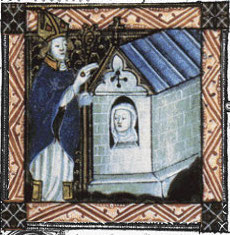
Margaret Kirkby (c.1322 - 1391/4 CE) was an anchoress in a couple locations in England. Although she withdrew from public life to devote herself to a contemplative life worshipping God (in a cell like the illustration to the left), we  actually know quite a bit about her.

Growing up in a landowning family in Ravensworth, North Yorkshire, she made the acquaintance of Richard Rolle, the spiritual director of the Cistercian convent at Hampole. He wrote for her an English translation of the Psalms, with commentary relating the Psalms (which are, technically, songs) with his concept of canor, the idea that sound—specifically through singing things like the Psalms—can link the devout to God.

Rolle wrote his own version of the Ancrene Wisse, called The Form of Living, in which he warned her of the difficulties she would face as an anchoress cut off from his guidance. He also sent her copies of other of his writings.

Margaret Kirkby and Richard Rolle had an interesting relationship. She suffered from seizures while in her cell, and Rolle would sit at the window to her cell and comfort her with her head on his shoulder.

Margaret's career as an anchoress took an unusual turn in 1357 when she was allowed to leave her cell in Hampole and enter a cell at a church in Ainderby that would allow her to observe Mass. Remarkably, she reversed this in the early 1380s, returning to the Hampole convent for her remaining years.

Anchorites were not too numerous, and having an extremely devout person sealed away in the church (or some other building's) wall was rare enough that the spectacle drew visitors and donors. A silver ewer was bequeathed to her by one of her patrons, Sir Bryan Stapleton, in 1394. She did not get to enjoy its use for long, however, since she died in 1394.

The man who guided her to and through the religious life, Richard Rolle, became one of the most widely read authors in the hundred years after he died. We will meet Richard Rolle next time.

17 May 2022

A Manual for Nuns

Sometimes, devoting yourself to a religious life meant a life of service: going out into the world to help others. Sometimes, pursuing a religious calling meant withdrawing from the world as a hermit, living simply on your own in order to contemplate God. Sometimes, the withdrawal was more severe, and your desire to withdraw from the world meant enclosing yourself in a small space and avoiding contact with the world. The men and women who took this path were called anchorites and anchoresses.

Many anchoritic cells still exist—called anchorholds—small cells built into the walls of local village churches. They might have three windows: one facing the altar for observing Mass, one for food and drink to be passed into the anchoress, one for light from the outside.

The Ancrene Wisse (Old English: "Rule of Anchoresses) was written in the early 13th century as a guide for young women wishing to live the anchoress life. The context tells us it was written for three young women known to the author. We can also guess approximately where it was written—or at least where the author grew up—because of the West Midlands dialect used.

Because medieval manuscripts were copied by hand, mistakes could be made. There are nine copies of the Ancrene Wisse in various British libraries with tiny alterations, but the main message is the same. One of the pieces of advice is: 

No anchorite, by my advice, shall make profession, that is, vow to keep any thing as commanded, except three things, that is, obedience, chastity, and constancy as to her abode; that she shall never more change her convent, except only by necessity, as compulsion and fear of death, obedience to her bishop or superior;

 and when you wake in the morning:

When you are quite dressed, sprinkle yourselves with holy water, which you should have always with you, and think upon God’s flesh, and on his blood, which is over the high altar, and fall on your knees toward it, with this salutation, “Hail, thou author of our creation! Hail, thou price of our redemption! Hail, thou who art our support during our pilgrimage! Hail, O reward of our expectation!”

Although anchoresses by definition withdrew from the world, presumably avoiding fame and attention, at least one was well-known. Tomorrow we'll meet her.

16 May 2022

Leprosy

Hospitals in the Middle Ages could be designed for different clientele. Some (like the Jerusalem Hospital) were specifically for pilgrims/crusaders who needed help in the Holy Land. Some were for the poor and infirm/elderly. Then there were hospitals specifically designed for those whom you wanted to keep distant from everyone else: lepers.

The word "leprosy" comes from Greek Λέπρα, literally "a disease that makes the skin scaly" (yep, they had a word for it!). The earliest English language use is in the Ancrene Wisse, a 13th century handbook for nuns. The word "leprosy" is falling out of use since the disease is less common. It is more commonly referred to as Hansen's disease, after the Norwegian physician who identified Mycobacterium leprae in 1873. Four strains have been identified, largely confined to geographical area.

Symptoms described in literature that could be leprosy have been recorded as early as 700 BCE in Sri Lanka and by Hippocrates (who was aware of a lot) in 460 BCE.

Lepers were not welcome in town or village, and leprosaria, a hospital for lepers, were few and far between. Covering the open sores with bandages was one way of dealing with it. 

Sometimes it could be treated with blood—a physician might think the leper had too much blood, and would make an incision near a sore to drain some blood. Because some thought leprosy was the result of sin, attempts to restore the victim to pre-sinful innocence involved a bath that was "medicated" by adding  some blood from an innocent infant or pure virgin. Supposedly, the corrupt blood would leave the body, to be replaced by the innocent blood. Another method to restore purity was an alchemist's concoction that contain the "purest" of elements, gold. Pliny and others thought snake venom was a potential cure; as recent as 1913 doses of bee stings were considered as a cure by someone named Boinet.

These days Hansen's can be controlled by bactericides and by the patient developing good habits: frequent VSE (Visual Surveillance of Extremities), cleaning any scratch/wound immediately, good hygiene.

Now to "turn on a dime," let's look at that manual for nuns next.

15 May 2022

Of Hospitals and Treatments

Much of the medieval "medical" care happened in the home—herbal remedies and such—but hospitals did exist, run by religious groups such as the Order of the Hospital of St. John. This Order founded and managed the Jerusalem Hospital to support crusaders and pilgrims to the Holy Land. In the case of this Order, they were so committed to care that, in the words of an anonymous cleric who visited the Jerusalem Hospital:

It has happened on a number of occasions that when the space … proves insufficient for the multitude of the suffering, the dormitory of the brethren is taken over by the sick and the brethren themselves sleep on the floor.

Their charity did not know boundaries. Jerusalem had thousands of Muslims and Jews living there who were also in need of care. Therefore,

the sick are gathered together in this House out of every nation, every social condition, and both sexes, so that by the mercy of the Lord the number of lords increase in proportion to the multitude of languages. Indeed, knowing well that the Lord invites all to salvation and wishes none to perish [Ezek.18:32], men of pagan religion find mercy within this holy House if they flock thither, and even Jews.

Of course daily "treatment" would have included Christian instruction and daily prayer as well as food and medicine and ointments. Since sickness was often considered the result of sin, this made sense at the time.

The hospital and the care offered even tempted wealthy citizens to act poor so they could get treatment. 

There was only one type of person was outright refused entry to the Jerusalem (and other) Hospital.

Next? Lepers.

14 May 2022

Ergot Poisoning

When the relics of St. Geneviève were paraded through there streets of Paris in 1129 during an outbreak of St. Anthony's fire, they seemed to work. The truth is, however, that St. Anthony's fire could abate as suddenly as it arrived, so coincidence might have figured in the miraculous cure. But what was (is) St. Anthony's Fire? Modern researchers put their money on ergotism, or ergot poisoning.

Ergot is a fungus— Claviceps purpurea—that grows on certain grains, especially rye. The early symptoms may not cause too much alarm: fatigue, nausea, diarrhea. Later, it can lead to convulsions. It becomes St. Anthony's Fire when the fungus causes the blood vessels in the outer extremities to constrict. The arms and legs do not get blood and oxygen and therefore develop gangrene. At that stage, amputation (or a miracle) is the only recourse. While the limbs were dying, the sensation of burning was intense, hence the reference to "fire." So why "St. Anthony"?

The Order of Hospitallers of St. Anthony founded hospitals to treat the disease. There was plenty of work to do. St. Anthony's Fire was a problem waiting to happen as soon as stored grain started getting moldy.

Ergot was known at some point: the black growth on the rye was studied. In 1582, a German doctor used small doses to produce contractions in pregnant women. In the 20th century, ergotamine was developed to help with migraines and cluster headaches.

Tomorrow I'll talk a little more about medieval hospitals and cures.

13 May 2022

St. Geneviève

St. Geneviève was born a peasant in Nanterre around 419/22 CE. One day, while St. Germanus was passing through Nanterre, she told him she wanted to devote herself to God. He told her she should live a life espoused to Christ. At the age of 15, she decided to devote herself to the Christian life and move to Lutetia.

She spent 30 years mortifying her flesh through extensive fasting and abstaining from meat. Her austerity was considered excessive by her ecclesiastical superiors, who urged her to deprive herself less. She drew many visitors due to her piety, even divine visitors: she reported so many visions of angels that those jealous of her threatened to drown her in a lake. A visit by St. Germanus convinced her detractors to trust her.

Her piety was so strong that, when Attila was approaching Paris in 451, she convinced the people to pray instead of fleeing; the strength of her prayers turned the Huns instead to attack Orléans instead (I guess they did not have a saint to pray for them). In 464, Clovis and his father Childeric were besieging Paris (Gallo-Roman clergy were very resistant to the Frankish attempt to bring all of Gaul under its banner), Geneviève crossed their lines to bring grain to the city, and persuaded them to be merciful to the citizens.

Clotilde, the wife of King Clovis, was a patron and supporter of Geneviève, and may have commissioned her biography. Clotilde—a Catholic whom Clovis married partially to placate the clergy, whose cooperation he eventually realized he would need—was known for religious patronage; you can read about an example here.

Clovis (no doubt at Clotilde's urging) built an abbey where Geneviève could live. After her death, her tomb at the abbey saw many visitors and many miracles. In 1129, an epidemic of ergot poisoning was ravaging the city; it subsided after her relics were paraded through town.

Louis XV ordered a new church for the "patron saint of Paris." Before it was finished, her relics were destroyed in 1793 during the French Revolution, but some were recovered, and the church was finished and reconsecrated in 1885.

I was going to talk next about why she moved to "Lutetia" (see the first paragraph) and yet was called the "patron saint of Paris," but right now I really want to talk about ergot poisoning, so that's next.