20 May 2023

The Troubadour Styles

Troubadours originally referred to their songs as vers, but over time developed a set of several different specific types of composition. The vers was a love song that later took on the term canso. The newer identifiable genres include:

Alba (called an aube in German love songs or Aubade in French): a "dawn song"; the lament that dawn approaches and the man must depart before the lady's husband discovers them).

Comiat: a song renouncing the lover.

Canso de crozada: a song encouraging the Crusades.

Desdansa: a dance for sad occasions.

Devinalh: a riddle or cryptogram.

Gap: a boasting song.

Maldit: a complaint of a lady's behavior.

Planh: a lament on the death of an important figure (evolved from the Latin planctus, a lament).

Serena: a song expressing impatience, waiting for night to fall so one could join their lover.

Tenso: a debate between two poets.

Viadeira: a traveller's complaint.

Let's look at the man thought of as the original troubadour next time.

19 May 2023

The Female Troubadour

The word "troubadour" was masculine, and the feminine form was "trobairitz" (both singular and plural). The term was rarely used, and was first seen in a 13th century Occitan romance, Flamenca. Trobairitz wrote and performed for Occitan noble courts from 1170 to about 1260—significant because up until then known female composers only produced sacred music.

Almost all information we have about them comes from their own biographical lyrics. We know of only 20 or so female poets. They were outnumbered by troubadours by 20 to 1, and their surviving works are about 1% of the total musical works from the 12th and 13th centuries. In fact, of the works of trobairitz that have survived, we have perhaps only a single work from each, except for two women.

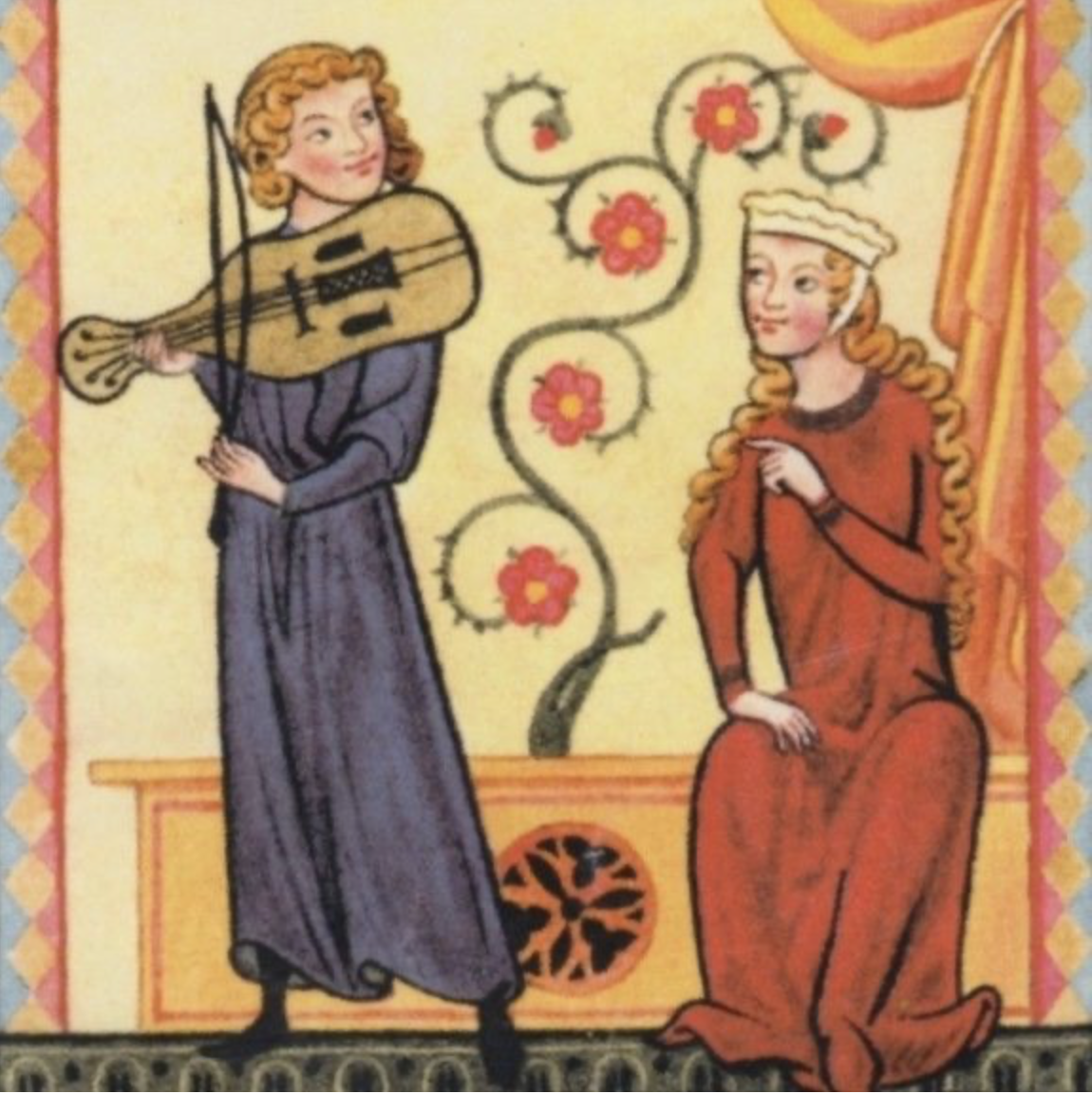
The Comtessa Beatriz de Dia (pictured here from a 13th century codex; Dia was a town in southern France) was born c.1140 and died c.1212. She left us 5 works—four cansos and one tenson—one of which is the only trobairitz work with musical notation. (In the case of troubadours, about 10% have musical notation intact.)

The other trobairitz who left us more than one composition was Castelloza, the wife of Lord Turc of Meyronne (in southwestern France). She wrote several cansos about Arman de Brion, whose status was higher than hers. She describes the pain of betrayal:

My handsome noble-natured dear,
I’ve loved you since the day you pleased me.
How great a fool I am is clear.
For you held back, while such love seized me
That I not once have turned away.
Though you repay my good with ill
I’ll stand my ground and love you still,
For love so has me in its sway
That I now doubt my life can offer. [source]

Cansos and tenson were only a few of the types of songs composed by the troubadours and trobairitz. There were also alba, devinalh, gap, planh, ensenhamen, and many others. I'll give you a list next time, in case you want to try your hand at some different styles of song.

18 May 2023

What Makes a Troubadour?

In the years 1100 - 1350, a type of musical performer arose called a troubadour. They did not call themselves troubadours; that term was first used in 1575 to refer to court poets of the 12th and 13th centuries. They almost always referred to themselves as chantaire, "singer." The term "troubadour" is assumed to come from Occitan trobador, from trobaire, "composer," which may be from Late Latin tropare, "to compose, to invent a poem."

The earliest known troubadour whose work has survived was Duke William IX of Aquitaine (grandfather of Eleanor of Aquitaine). He may not have been the first troubadour: it is possible that his political prominence helped him appear to be the start of a tradition, but he may instead have been just one example of an already thriving cultural event. The chronicler Orderic Vitalis records that William composed songs about his experience on the First Crusade. Order also gives us a first-hand account of William performing "many times ... with rhythmic verses and witty measures."

The troubadour phenomenon rose and fell. The 12th century began with few examples of activity, but the final decades saw a burst of output: almost half of the almost 2500 pieces (from a total of about 450 known names) that have survived come from the years 1180 - 1220. Beginning in western Aquitaine, it spread to eastern Aquitaine, then down to Toulouse and Provence. In the early 1200s it reached Italy and Spain.

Duke William was probably the highest-ranking member of society who could be designated a troubadour. Most described themselves as "poor knights," although there was Jaufre Rudel, prince of Blaye in southwestern France.

The troubadours had an "enemy" in the jongleur. The jongleur was not the juggler that the word has become, but was actually a minstrel. The difference is that the minstrel plays songs he has heard from others, although there may be an element of dancing and acrobatics. The troubadour is a poet-composer, a much higher calling requiring skill. Troubadours often wrote attacks on jongleurs. There were, however, many troubadours who also entertained in the manner of the jongleur.

The word troubadour is masculine; a female troubadour is a trobairitz. It would make sense to look at the phenomenon of the female composer in the troubadour tradition next.

17 May 2023

Peire d'Alvernhe, Poet and satirist

I mentioned that, for all our talk of courtly love in the Middle Ages, the only use of the actual phrase was in a single Provençal poem. The author of that poem was Peire d'Alvernhe, a troubadour born about 1130. He produced 21-24 poems (authorship can be difficult to determine) by 1170. He was known well-enough that Dante names him in the Divine Comedy.

An anonymous biographer tells us he was handsome and charming and wise, and that he spent time in Spain at the court of Alfonso VII of Castile and his son Sancho III. The biographer calls his poems the greatest poems ever except for the slightly later Giraut de Borneill. A contemporary of Peire's, Bernart Marti, wrote a poem in which he accuses Peire of entering a religious life but abandoning Holy Orders.

Not only did he abandon the religious life, he also abandoned the concept that brought us to this blog entry. The reference to courtly love is in a poem in which he praises love of the Holy Ghost over that of cortez amors de bon aire, "well-spirited courtly love." In this preference of spiritual over carnal love he (and others) followed the influence of one of the earliest troubadours whose name we can put to his poetry, Marcabru (active 1130 - 1150).

Of all Peire's poems, modern scholars have spent the most time and effort discussing a particular one: Chantarai d'aquest trobadors ("Song of wandering troubadours"), a sirventes or "service song" used by troubadours to address a particular subject for educational purposes. In this poem he describes a dozen known troubadours, criticizing their looks and their poetry before proclaiming himself their superior. Although critical, it is seen as a good-natured parody, and he ends by telling the listener that it was composed "while laughing and playing."

On the other hand, if the twelve other troubadours were not present to laugh along with their descriptions, would an audience be familiar enough with the others to understand that it was all in fun? On the other other hand, it does give us (as few pieces of medieval literature do) give us information about specific poets we might not otherwise have, allowing us opportunities to identify authorship for some of the troubadours' works.

Peire d'Alvernhe, Bernart Marti, Marcabru, Giraut de Borneill—we have many names of troubadours, but what did they have in common? What made a "troubadour" rather than just a poet? Let's talk about the troubadour life tomorrow.

16 May 2023

Courtly Love

"Courtly love" is the phrase used to describe a set of "rules" expressed in medieval literature about the relationship of a man (usually a knight) with a woman (usually a noblewoman). First appearing in continental French stories, it became (for some) a way to conduct oneself in a relationship, especially one outside of marriage.

First, a few facts. The phrase "courtly love," the English translation of the French amour courtois, was not routinely used until the late 19th century (introduced by a French philologist). (To be fair, the phrase cortez amors appears in a single Provençal poem in the 12th century.) C.S.Lewis in The Allegory of Love defined it as "love of a highly specialized sort, whose characteristics may be enumerated as Humility, Courtesy, Adultery, and the Religion of Love."

Also, the focus of the practice was not so much about the behavior of the knight as the privilege of the woman. Eleanor of Aquitaine is credited with bringing the courtly love ideals from her home to England when she married Henry II. Eleanor's daughter Marie, Countess of Champagne (by Eleanor's first husband, Louis VII), spread it to the court of Champagne. Troubadours popularized the ideas in their poems and songs.

Courtly love was expressed as a form of feudalism, where the man acts as a vassal of the lady. Addressing her in poetry as his "lord" served two purposes: it showed his willingness to serve, and it hid the lady's name. Courtly love was often a secret love, because it was adulterous: the lover pined for the love of a highborn lady who was often married to his real feudal lord. This "forbidden love" did not stop him from expressing g the utmost courtesy and humility toward her.

Many noble marriages were political arrangements rather than loving unions, and given the daily lives of many noble couples, who hardly spent time together, there were opportunities to see the lady without her husband present, although the presence of ladies-in-waiting precluded consummating physical love.

Andreas Capellanus in the late 12th century wrote De amore ("Concerning Love"), also known as De arte honeste amandi ("The Art of Loving Virtuously"). In it he lists several rules that became entwined with the courtly love idea:

1. Marriage is no real excuse for not loving.
6. Boys do not love until they arrive at the age of maturity.
8. No one should be deprived of love without the very best of reasons.
13. When made public love rarely endures.
14. The easy attainment of love makes it of little value; difficulty of attainment makes it prized.
20. A man in love is always apprehensive.
30. A true lover is constantly and without intermission possessed by the thought of his beloved.

Was this a real practice in anyone's life? Did real people engage in these "poetic" affairs (sexuality rarely comes into the subject of courtly love)? Hard to say, although it seems entwined with some of the very real chivalric ideals that were expected behavior on the part of the knight.

That single instance of cortez amors I mentioned was by a poet named Peire d'Alvernhe, who was prolific enough in his time and obscure enough in ours that he is a perfect subject for this blog...next time.

15 May 2023

The Matter of Rome

The man who first came up with the concepts of the Matter of Rome, the Matter of Britain, and the Matter of France, was Jean Bodel (c.1165 - c.1210).

For Bodel, the Matter of Rome was the collected literature of the Greeks as well as the Romans, and included historical figures such as Alexander the Great and Julius Caesar, and especially the Trojan War. The Iliad and the Odyssey were important inspirations for later works. 

Curiously, the Iliad and the Odyssey were not known to the Middle Ages. Although the two epic poems were known and studied in the Byzantine Empire, Western Europe only knew about them through a couple short prose narratives. This was enough, however, to spark the imagination. A 12th-century French poet, Benoît de Sainte-Maure, wrote a 40,000-line version of the story of Troy that was a major source of inspiration for medieval poets. The Iliad and the Odyssey themselves were not made available in print in Western Europe until almost 1490.

Another significant source from the Matter of Rome that informed medieval knowledge was Virgil's Aeneid. After leaving Troy, Aeneas travels the Mediterranean (not unlike Odysseus) and finally founds Rome. A grandson or great-grandson of Aeneas, Brutus/Brute/Brut, later founds Britain and becomes its first king. The story of Aeneas got retold as the Roman d'Enéas ("Romance of Aeneas"), c.1160 in a poem of a little over 10,000 lines.

Troy continued to captivate European audiences. Geoffrey Chaucer's Troilus and Criseyde is a love story that takes place in Troy during the war, introducing the medieval notion of courtly love to Ancient Greece. Anachronism did not bother medieval writers, however: even if they understood the possible cultural differences that would have existed, they would not let historical accuracy get in the way of telling the story they thought people wanted to hear.

Courtly love, for instance, was a popular central theme of much literature, and I find I've mentioned it briefly only once without going into detail. I'll rectify that oversight tomorrow.

14 May 2023

The Matter of Britain

Just like the Matter of France, the Matter of Britain is a collection of legends and literature involving kings and heroes.

King Arthur was central to many of these legends, but not the only figure. The Knights of the Round Table was fodder for many stories that promoted chivalrous behavior and Christian values wrapped in mysterious powers and fantastical antagonists.

The 12th century poet Chrétien de Troyes, though French, contributes to the Matter of Britain with stories of Perceval, Lancelot, Yvain, and the Story of the Grail. Thomas Malory's 15th century Le Morte d'Arthur was the ultimate expression of the Arthurian Cycle.

The 12th century Historia Regum Britanniae ("History of the Kings of Britain") by Geoffrey of Monmouth collects many earlier texts and provides us with the stories of King Coel, making him the father of Helena. This is also the source of Shakespeare's King Lear.

One of the earliest works in the Matter of Britain is the 9th century Historia Brittonum by Nennius (to be fair: Nennius was likely a later contributor to the work; the original author is unknown). One of Nennius' singular contributions to the Matter of Britain is the idea that Britain was found and founded by Brutus or Brute of Troy, Britain's first king  and a descendant of Aeneas. Using the legend of the diaspora of heroes after the Trojan War, this created a desirable link to Rome through its Virgilian founder, Aeneas.

And that was important because Rome and its Empire was the "Golden Age" that Western Europe looked back at and longed to recreate, hence the Holy Roman Empire. As it happens, the third and final of the Matters was the Matter of Rome. I'll tell you more next time.

13 May 2023

The Matter of France

This post referred to the Song of Roland as foundational to of the Matter of France. The Matter of France, also known as "The Carolingian Cycle," is a collection of legends and literary works about the origins of the French nation.

It is not unusual to look back in history and perceive a "Golden Age" when life was better and people were more heroic. Charlemagne, because he united much of Western Europe, promoted a rebirth of learning and arts, and spread Christianity, is seen as the cornerstone on which the nation of France was built.

The Matter of France is written about in chansons de geste, or "song(s) of heroic deeds."

A French poet from the Champagne region, Bertrand de Bar-sur-Aube (late 12th - early 13th centuries) divided the matter of France into three cycles of chansons de geste  at the start of a poem about a Count of Paris who was one of Charlemagne's grandsons:

At Saint-Denis, in the great abbey, we find it written (I don't doubt) in a book of noble lineage that there have been only three gestes in well-defended France (I think no-one will argue with me now). [...]

The lordliest is that of the kings of France. [...]

The next, it is right to say, was of Doon of the white beard, he of Mainz who had many lands. [...]

The third geste, which was much to be praised, was that of Garin de Monglane of the fierce countenance. [...]

Doon and Garin are not well-known to modern audiences, but Charlemagne turns up in every European history book. Their stories are different, but the heart of the Matter of France is Christianity (especially against Muslims, who are erroneously perceived as polytheistic) and feudal loyalty. The chansons were largely seen by the Middle Ages as reliable historical retellings.

The Matter of France evolved and spread to other countries. The Song of Roland became Orlando Furioso ("The Frenzy of Orlando") and Orlando Innamorato ("Roland in Love") in Italy in the early 1500s and late 1400s respectively. These works in turn influenced Edmund Spenser's Faerie Queene in England.

More to the point for England and Spenser was the Matter of Britain, which I'll talk about next time.

12 May 2023

The Song of Roland

In 778, Basques ambushed the rearguard of Charlemagne's army as it was going northward through the Ronceveaux Pass in the Pyrenees. They had good reason, and they destroyed the rearguard and the baggage train. In the process, according to Charlemagne's biographer Einhard, they killed the "prefect of the borders of Brittany," Hruodlandus. Hruodlandus is translated as the name "Roland."

In the 11th century, a poet writing in Old French produced a 4000-word epic poem, La Chanson de Roland ("The Song of Roland") that turned the incident mentioned briefly by Einhard into the foundation of a literary cycle called the Matter of France. It tells a very different story from Einhard's brief description.

Instead of being pursued by Basques whose chief city of Pamplona had its walls torn down by Charlemagne's army on his way home, the poem has Charlemagne's army fighting Muslims in Spain for seven years. The last holdout is the city of Saragossa, ruled by Marsile. Marsile promises treasures to Charlemagne and that he will become a Christian if Charlemagne will leave and go home.

Charlemagne is satisfied with this. His nephew, Roland, selects Roland's stepfather Ganelon to carry the message of acceptance to Marsile. Ganelon, afraid that Roland wishes him ill by sending him to where Muslims might kill him, betrays them all by telling the Muslims how to ambush Charlemagne's army as they pass through Roncesvalles. The rearguard, led by Roland with comrades Oliver and Archbishop Turpin, finds themselves overwhelmed.

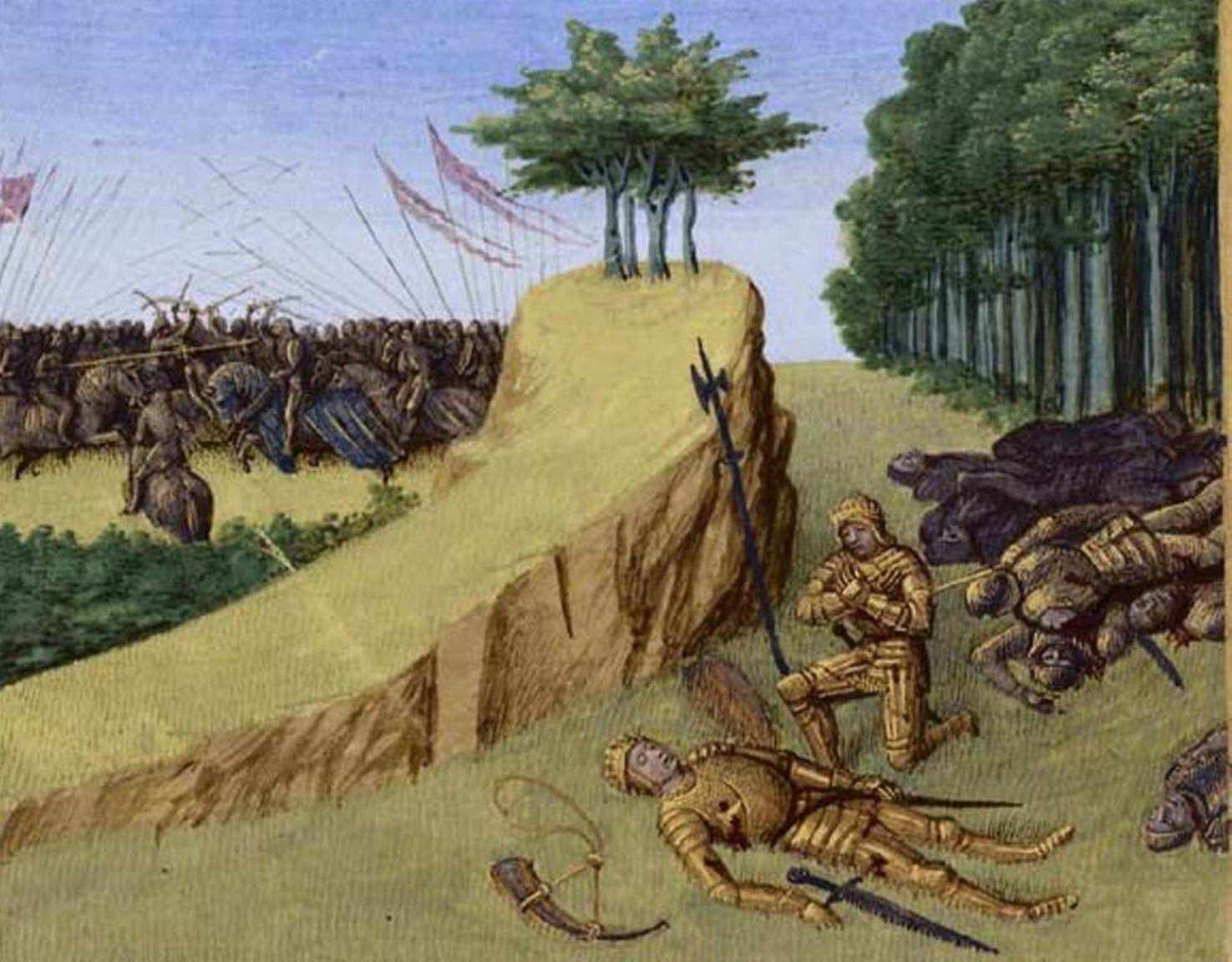
Oliver tells Roland to blow his horn and summon reinforcements. Roland believes that would be an act of cowardice. Roland, however, loves Oliver's sister, so Oliver tells him that Roland will not be allowed to see his sister again if he does not summon help. It is Turpin who ultimately convinced Roland to blow his horn (in the illustration above). Emperor Charlemagne hears the horn and starts back, but takes too long because Ganelon delays him. With Roland's men dead or dying, he blows the horn one more time so powerfully that his temples burst. He is taken to Heaven by angels.

Charlemagne finally arrives, finds Roland and all his men dead, and pursues the Muslims into the River Ebro where they drown. While burying their dead, the Franks are attacked by Baligant, emir of Babylon, who has come to support Marsile. The armies fight, Charlemagne kills Baligant, the Muslims flee, and Charlemagne now conquers Saragossa, returning home with Marsile's queen.

Ganelon's betrayal is discovered, and he is imprisoned; he argues that he acted out of legitimate revenge against his stepson, not treason against the emperor. Although Ganelon's friend, Pinabel, will fight anyone who claims Ganelon is guilty of treason, Thierry convinces the council of Barons that it was treason, since Roland was serving Charlemagne at the time of the betrayal. Pinabel challenges Thierry to trial by combat, Thierry kills Pinabel, Ganelon is executed by having four horses tied to him, one to each limb, and set to gallop.

There are many improbabilities and impossibilities here, not least of which Charlemagne did not become an emperor until many years later, and an "emir of Babylon" is unlikely to appear in northern Spain, thousands of miles west of Babylon. The poem became an important literary and cultural touchstone for medieval France, however. I referred above to the "Matter of France." There were three great "Matters" in the Middle Ages, and I'll tell you more about them tomorrow.

11 May 2023

Battle of Ronceveaux

Charlemagne thought trying to retake parts of the Iberian Peninsula back from the Moors was a good idea, so he accepted an invitation from Sulayman al-Arabi to join him in opposing the Umayyad Caliphate (Suleyman was a supporter of the Abbasid family tree, which eventually did succeed the Umayyads). The affair did not go smoothly, and before too long Charlemagne headed home. Along the way, however, he decided to harass the Basques of Pamplona and surrounding lands.

This was not entirely arbitrary on Charlemagne's part. His father, Pepin the Short, had trouble with Basques, who were a significant part of the Aquitainian army that Pepin fought and defeated. The Basques had submitted to him in the late 760s. Charlemagne perhaps wanted to express his frustration at accomplishing nothing from the agreement with al-Arabi, and used his army to "blow off some steam" by tearing down the city walls of Pamplona.

What Charlemagne should have realized was that the Basques would not just sit back and lick their wounds. As he headed north, the Basque army followed him. To get through the Pyrenees, the Christian army chose the Ronceveaux Pass. The rearguard was led by Roland, warden of the Breton March.

Curious point about Roland: in all recorded history, he is mentioned only once. Einhard in his "Life of Charlemagne" tells the story of what happened when the Basques caught up with the tail end of the army at Ronceveaux on the evening of 15 August 778:

That place is so thoroughly covered with thick forest that it is the perfect spot for an ambush. [Charles's] army was forced by the narrow terrain to proceed in a long line and [it was at that spot], high on the mountain, that the Basques set their ambush. [...] The Basques had the advantage in this skirmish because of the lightness of their weapons and the nature of the terrain, whereas the Franks were disadvantaged by the heaviness of their arms and the unevenness of the land. Eggihard, the overseer of the king's table, Anselm, the count of the palace, and Roland, the lord of the Breton March, along with many others died in that skirmish. But this deed could not be avenged at that time, because the enemy had so dispersed after the attack that there was no indication as to where they could be found. [source]

The attack was completely unexpected, and the Frankish forces were in disarray. The lightly armored Basques had the high ground, and were successful at cutting off the rear guard from the main part of the army. The Franks fought as well as they could, and arguably succeeded in keeping the Basques focused on them, allowing the main part of the army to survive, but Roland and his part of the army was slaughtered by the Basques. In the 8th century, that was the end of the story.

In the 11th century, however, a French poet would compose an epic poem that would turn this once-mentioned Roland into a national hero in a highly fictionalized re-telling of the Battle of Ronceveaux. Tomorrow we will have "story time." See you then.

10 May 2023

The Reconquista—Abbasid Alliance

I have mentioned before the disagreements, after the death of Muhammad, over which direction the faith should go. The Rashidun Caliphate was the successor to the Prophet, followed by the Umayyads. Not everyone approved of the Umayyads, however, and there was a third caliphate ready to be "born": the Abbasid, descended from Muhammad's uncle. As it happens, in the second half of the 9th century, there were Abbasid-leaning Muslims in the northern part of the Iberian Peninsula who were willing to ally themselves with Christian kingdoms if it meant getting rid of Umayyad rule.

Sulayman al-Arabi, the Abbasid-preferring governor of Barcelona, sent a message to Charlemagne in 777, offering his submission to Charlemagne's rule if he could get military aid against the Umayyad emir of Córdoba, Abd ar-Rahman I. Sulayman had allies: Husayn of Zaragoza and Abu Taur of Huesca. Charlemagne was all too happy to bring an army south to reconquer territory from Muslims.

Reaching Barcelona, Sulayman welcomed him, and their two armies marched next to Zaragoza to add Hosayn's military forces. Reaching Zaragoza, however, they found that Husayn would not allow them into the walled city. He had just recently defeated Abd ar-Rahman's general and taken him prisoner. Husayn was willing to rely on his own power to deal with further Umayyad threats, and no longer was willing to risk his autonomy being usurped by a Christian ruler.

Charlemagne settled into a siege of Zaragoza. After more than a month, however, an agreement was made: Husayn would pay Charlemagne some gold to go away. This he did, but on his way back north Charlemagne decided to make an example of the Basques, whom he suspected of being allied with the Moors. He spent some time destroying villages, tearing down the walls of Pamplona, and setting up his own garrisons. Satisfied, he set off for home through the Pyrenees.

Unknown to him, the angry Basque forces organized and pursued. Not only had this attempt at Reconquista come to naught, but Charlemagne was about to be handed a terrible defeat that would be immortalized in literature. Details tomorrow.

09 May 2023

The Reconquista—Covadonga

Long before the Crusades in the late 11th century decided to take control of the Holy Land, Christians and Muslims were clashing in the western end of the Mediterranean, in the Iberian Peninsula. The Umayyad Caliphate in Iberia had largely been a positive force in uniting the territories under organized rule, but the attempt in 721 to expand northward across the Pyrenees into Gaul led to the 721CE Battle of Toulouse, considered by many to be the first major clash between Muslims and Christians. A decade later, the Battle of Tours, fought by Charles Martel (see parts one and two), stopped the Muslim northward advance. Further attempts were thwarted by Charlemagne's establishing of the Marca Hispanica, the "Spanish March" ("march" in its political/military meaning of a "border").

The Reconquista—Spanish for "reconquest" and the term given by historians in the 19th century to the Christian attempts to reclaim lands from Muslim rulers—actually started a few years before the better-known Toulouse, with the Battle of Covadonga in 718. Covadonga is in northwestern Spain, and it is the site where the Umayyad Caliphate encountered the Visigothic prince Pelagius. Pelagius incited a rebellion against the Umayyads.

His army was filled with Visigothic and Hispano-Roman "refugees" migrating northward to get away from Umayyad rule. Finding themselves of common mind, they began their rebellion by refusing to pay the jizya, the tax on dhimmi (non-Muslims), required by Sharia Law. They also began harassing the smaller Muslim garrisons, eventually ousting a provincial governor, Munuza. Pelagius founded the Kingdom of Asturias, on the northwest coast. Occasional inroads made by Muslim forces were either repelled, or their control was thrown off again once they left the area to go back south. The capital in Cordoba was more focused on forcing its way into Gaul; Asturias was not at first a significant point of trouble.

Eventually, however, Asturias had to be dealt with. Munuza and a General Alqama took an army to Asturias. Pelagius' army retreated to a narrow mountain pass, where they were able to throw stones and rain arrows down on the Muslim army. The narrow pass and poor tactics led to great loss of life among the Muslims. Munuza retreated, and tried again with a larger army, but was once again defeated.

This was the first time a Muslim-controlled territory had been reclaimed by Christians. The Umayyads had a presence in southern Gaul, however, and leaders in Europe decided that had to change, leading to a large battle and the oldest surviving work of French literature. I'll explain tomorrow.

08 May 2023

The Family of Saints: Fulgentius

Severianus and Theodora were members of well-to-do Hispano-Roman families in the 6th century who bore four children, all of whom became saints. The family lived in Cartagena, or Carthago Nova ("New Carthage"), on the southeast coast of Spain. The family moved to Seville about 554 CE, but their parents died before the children were all grown up.

The second-born was Fulgentius; the few personal details we know about him come from the writing on religious life that his brother Leander wrote for their sister, Florentina. Leander mentions that he (probably in his role as Bishop of Seville) sent Fulgentius to Cartagena, and asks Florentina to pray for his safety.

It was probably through Leander's support that Fulgentius (sometime between 590, when we have records of a Bishop Pegasius presiding there, and 600, when Leander died) became Bishop of Astigi (now Ecija), in the province of Seville.

The Second Council of Seville in 619, presided over by Fulgentius' brother Isidore, by then Archbishop of Seville, dealt with diocesan rights, non-canonical ordinations, and territorial disputes. Fulgentius, as Bishop of Astigi, claimed a certain church was in his territory, but it was also claimed to be in a parish belonging to the diocese of the Bishop of Córdoba. Roman common law was applied. It turned out that the church had been following the dictates of the diocese of Astigi for 30 years, and this was considered sufficient to declare it part of the Astigi diocese.

Because we know there was a Bishop Marcianus of Astigi in 633, Fulgentius must have died by then. In the 14th century, his remains were found (along with those of his sister) in the village of Berzocana in the Sierra de Guadalupe, where they had been carried for some reason (perhaps out of concerns about the non-Christian occupation of Iberia?). Some of the remains are still in Berzocana, but the majority of bones are interred in the Cathedral of Murcia in Cartagena. Fulgentius is venerated as a patron saint of that diocese.

Was there concern about Muslim-Christian relations? Here I mentioned their tolerant co-existence, but obviously the Crusades at the far end of the Mediterranean were creating a very different relationship. There is a phenomenon historians call the Reconquista that refers to attempts by Christian rulers to retake Iberian territories. We'll start down that road tomorrow.

07 May 2023

The Family of Saints: Florentina

Severianus and Theodora were members of well-to-do Hispano-Roman families in the 6th century who bore four children, all of whom became saints. The family lived in Cartagena, or Carthago Nova ("New Carthage"), on the southeast coast of Spain. The family moved to Seville about 554 CE, but their parents died before the children were all grown up.

Younger than Leander but older than Isidore, Florentina was being raised by Leander. His embracing of the monastic life probably influenced her to do the same, so she and a number of virgins banded together to form a religious community. Leander wrote for her a guide to living an ascetic life away from the world; since he died in 600 or 601, she must have chosen the cloistered life prior to that year.

Among his "rules" were to avoid interactions with men, especially young men; and to avoid interactions with women who were still living in the world. The women should be temperate in their eating and drinking. They should read Holy Scripture and meditate on it. Those living in the community should hold each other in equal love and friendship.

She died about 612, and her feast day is 20 June. She is considered the patroness of the diocese of Plasencia. The statue above is from the Cathedral in Seville. Her bones are interred in two places in Spain: a few are in the cathedral of Murcia, but most of her remains are in Berzocana, along with those of her brother Fulgentius, of whom I will have more to say next time.

06 May 2023

The Family of Saints: Leander

Severianus and Theodora were members of well-to-do Hispano-Roman families in the 6th century who bore four children, all of whom became saints. The family lived in Cartagena, or Carthago Nova ("New Carthage"), on the southeast coast of Spain. The family moved to Seville about 554 CE, but their parents died before the children were all grown up.

Leander (shown), the eldest, became a Benedictine monk about 576, and a few years later was appointed Bishop of Seville. The co-ruler of the Visigoths in Spain, Liuvigild, had arranged for his son Hermenegild to marry the 12-year-old Ingund, sister of the Merovingian Childebert II, who became King of Austrasia. While Ingund traveled through Gaul to Iberia, she met a Catholic bishop who warned her not to accept Arianism, the heresy still practiced by many Visigoths, such as her new husband and his family. Hermenegild's mother, Queen Goiswintha, tried to baptize Ingund into Arianism, but the girl refused. Gregory of Tours tells us what Goiswintha did next:

the Queen lost her temper completely ... seized the girl by her hair and threw her to the ground: then she kicked her until she was covered with blood, had her stripped naked and ordered her to be thrown into the baptismal pool.

Liuvigild sent the two to rule in Seville and get them away from his wife. In Seville, however, Ingund encountered Leander. Leander, like his parents and his siblings, was a powerful voice against Arianism. Seville had a strong catholic population. No doubt from the influence of his wife (no doubt "transitively" from Leander, although from 580-582 Leander was traveling to Constantinople and back), Hermenegild converted to Catholicism in 582.

Hermenegild's father was not pleased: he saw Catholicism as "Roman" and Arianism as part of the Visigothic identity. Liuvigild besieged Seville, capturing it in 584, along with his rebellious and (to Liuvigild) heretical son. Leander fled eastward to Constantinople. Hermenegild was imprisoned and urged to renounce Catholicism, which he steadfastly would not do, refusing the Eucharist from an Arian bishop at Easter. His father had him beheaded on 13 April, 585, making Hermenegild a martyr in the Catholic Church.

Depending on the chronicle, Ingund had one of two different fates. One story from Gregory of Tours is that she fled to Constantinople with their son, Athanagild. She did not survive—at this time, plague was going around the Mediterranean—and was buried in Carthage, but Athanagild was delivered to Constantinople where he was raised by Emperor Maurice II. The other version is that she returned to her family in Gaul where Athanagild was raised by her and her mother, Brunhilda.

Leander remained in the East, preaching and writing against Arianism. After the death of Liuvigild in 589, Leander returned to Seville, where he remained bishop until his death in 600 or 601. In 589 he held the Third Council of Toledo, in which Visigothic Spain (or at least its representatives at the Council) renounced Arianism for good.

His younger brother Isidore said of him "This man of suave eloquence and eminent talent shone as brightly by his virtues as by his doctrine. By his faith and zeal the Gothic people have been converted from Arianism to the Catholic faith."

Two of his writings survive: one is an essay about his triumph of the church on the conversion of the Goths. The other is a monastic rule composed for his sister, Florentina, whom I shall talk about next.