07 September 2024

Medieval Surgical Procedures

Yesterday's post took a turn toward a particular surgical procedure, so I thought we'd talk a little more about that topic. What procedures were known and practiced with evidence of patient survival, back when doctors believed in the Four Humors of Hippocrates? I have talked about medicine numerous times, so here I want to focus on actual invasive practices with instruments.

Purging was one of the most common forms of surgery, piercing a vein to let out blood because a person's fever or angry nature indicated an excess of blood.

Amputation was another fairly common practice when a limb was so damaged by accident or warfare that there was no chance of it healing. Unfortunately, surviving an amputation was not always assured. An interesting article by the National Library of Medicine points out early art of people with crutches that supports their educated medical opinion that a leg amputation was only likely to survive if it were below the knee. Above the knee amputation led to too much bleeding. [link] Presumably amputations of smaller parts—toes, fingers, arms up to elbows—were less of a problem.

Related to amputation was cautery/cauterization, sealing off blood vessels by heating iron and pressing it to the wound. In an ideal situation, the wound was sealed, bleeding was stopped, infection did not occur, and the patient would survive. Even in this situation, however, the process caused intense pain, especially if you accepted the treatment for hemorrhoids that involved inserting a hot poker. This did not work, nor did the non-surgical suggestion of going to sit on the rock where St. Fiacre was cured of hemorrhoids. [link] (Maimonides finally wrote a seven-chapter treatise on the subject ultimately suggesting a good soak in a bath.)

Dental surgery was not unknown. Toothache was a major problem in the Middle Ages, and extractions were common. Situations arose, however, whose descriptions suggested the client had oral cancer. Roger Frugard (pre-1140 - c.1195), a surgeon in Salerno, wrote a Practica Chirurgia ("Practice of Surgery") in which he describes cancer in the jaw:

"if the flesh is hard, perforated and blackened' ('Si la char est dure, perse e anercie') cancer ('cancre') of the mouth was difficult to cure."

He describes cutting into the healthy flesh around the hard cancer, cauterizing the wound, and sealing it with muel de oef ("egg yolk"!).

Trepanning—boring a hole in the head to relieve pressure—is the oldest surgical procedure for which we find evidence: Skulls—many hundreds of them—that were trepanned have been found dating back 7000 years ago and more, with evidence of healed bone around the edges showing that the patient lived. The circumstances under which it was decided to drill a hole in the cranium are unknown.

Cataracts were originally dealt with by using a thick needle to push the cornea back. Islamic medicine came up with a better solution: a thin hypodermic needle inserted through the white part of the eye to extract the obstructing cataract material.

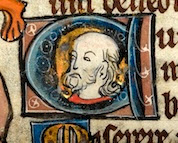
The illustration above is from a later manuscript copy in the Trinity College Library of Roger Frugard's Practica Chirugia that has many illustrations that help explain his techniques. Let's learn a little more about him and them tomorrow.

06 September 2024

About Preventing Children

Folk in Classical and Medieval times developed many methods for avoiding getting pregnant, but sometimes the inevitable happened. The Bible's statement to "be fruitful and multiply" made the Church's stance on aborting a pregnancy clear, but the rest of the culture did not always see it that way.

Avicenna (c.980 - 1037) offered this reasoning:

At times it may be necessary to induce abortion; that is, when the pregnant woman is young and small and it is feared that childbirth would cause her death, or when she suffers from a disease of the uterus or when a fleshy growth in the uterus makes it very difficult for the fetus to emerge. Also when the fetus dies in the womb of the woman. Know that when labour continues for four days it means that the fetus is already dead.

Methods of abortion could be dangerous to the women as well. Hippocrates had refused to use abortifacients because of the danger they posed to the mother. The early Church stated that women who abort a child should be exiled from the church. A synod in 314 modified that to 10 years of exile. The Church Father Basil the Great later softened that, saying it should be less if the woman shows repentance.

In another case, a woman was sentenced to death for aborting her child precisely because she did it with malicious intent to prevent her husband (whom she had come to hate) from having an heir. Roman law allowed that, if a woman were to do the same thing for the same reason but it post-divorce, then she should only be exiled.

The Church Father St. John Chrysostom criticized abortions, but gave the example of a sex worker who needed to abort a pregnancy or else she would lose her livelihood. He goes so far as to blame her male client, who was responsible for getting her pregnant, as the real murderer.

A 9th century Byzantine author of a biography of a Greek Patriarch Ignatios tells the story of a woman with a breech birth who is in intense pain. The doctors prepare for an embryotomy (removing the baby by cutting it into parts and removing them). The 6th-century Bishop Paul of Mérida, who trained as a doctor in his youth, doesn't scruple to perform an embryotomy to save a woman's life.

That late-term abortions can find their way into accounts of religious lives and can be justified by Christian saints suggests a very different attitude toward the health and safety of the mother than is sometimes taken these days.

Embrotomies would have been difficult for the surgeon and the patient. Let's talk next about some of the other surgical practices that were employed in the Middle Ages. 

05 September 2024

Avoiding Pregnancy

Yesterday we talked about medieval parents having large families. Today we're going to talk about preventing large families. Although Canon Law insisted that sex was solely to be engaged in for procreation, in the "real world" that was not a feasible attitude. (Pope Gregory IX even stated that marriages entered into intending not to have children were ipso facto null.) There were, therefore, plenty of instances where becoming pregnant was not a desirable outcome of sex. Therefore, methods were devised for avoiding pregnancy.

The simplest one was for the woman to track her menstruation. Lack of menstruation could lead to pregnancy, so either knowing reliably when menstruation would occur or inducing it was one method. Herbal remedies were often readily available around the house as prophylactics against pregnancy. Parsley, Queen Anne's Lace,* and Pennyroyal were considered effective in inhibiting fertility.

Another way to prevent pregnancy was by inserting something into the cervix. Lacking modern IUDs, Avicenna's Canon of Medicine suggests mint "in there" would prevent conception. Aristotle taught that rubbing the womb with cedar oil, lead ointment or incense, mixed with olive oil, would prevent the sperm from coming in contact with the woman. (The lead ointment had other damaging effects.) Also, wooden blocks were not uncommon, and very uncomfortable.

One could try to prevent the sperm from reaching its goal through a barrier, or one could try to kill the sperm. Medieval and Classical spermicides included inserting a cloth after the act that was soaked in vinegar, or honey, or grated acacia leaves soaked in honey (the sap in acacia is spermicidal).

Another way to "avoid pregnancy" is to pretend one is not pregnant. I grew up understanding the meaning of the phrase "she's gone to her sister's" to explain a long absence.

A French novel (only a little later than the Middle Ages) has advice to a teenage girl about sex, and assures the girl that getting pregnant unexpectedly is easily managed, but not by abortion:

...moreover, to remove any worry, there is one more thing to consider, it is that this mishap is not so extraordinary that one should fear it so much. There are so many pregnant girls who never attract notice, thanks to certain corsets and dresses made to order, which they use, and which do not prevent them from having a good time with those who made them pregnant.

...and during that interval, you can simulate illness, trips, pilgrimages. When the time comes, you will identify a midwife who is obliged in conscience to keep the fact hidden. [L'Escole des Filles]

If the calendar was off, if contraception didn't work, then eliminating the fetus was the next step, but we'll look at that grisly topic tomorrow

*The name is for Anne, Queen of Great Britain (1665 - 1714); earlier names would have been "bishop's lace" or "bird's nest" or simply "wild carrot."

04 September 2024

Were There Children in the Middle Ages?

Until fairly recently there was an idea that "childhood" as we think of it today did not exist in the Middle Ages. You can see this in a recent online essay:

Regardless of social class, childhood in the late Middle Ages was markedly different from what we know today. Children were viewed as miniature adults, expected to contribute to the family’s livelihood from an early age. [link]

One of the reasons behind this theory is pictures from the era that show little distinction in clothing worn by children and adults. That essay goes on to say:

Playtime was limited, and the concept of a carefree, innocent childhood was virtually nonexistent. Instead, children were taught the skills necessary for survival.

One of the first serious explorations of daily life in the Middle Ages found evidence against this theory. The Ties That Bound: Peasant Families in Medieval England, by Barbara Hanawalt, looked at coroners' reports in England that explored deaths. Interrogation of witnesses regarding "what you were doing when..." turn up a wide variety of daily activity that otherwise would never have been recorded. Those reports tell us that young children (with ages in the single digits) are playing at home or outside with friends, and not dragged into slavish agricultural labor or being drilled in the "skills necessary for survival." In fact, children are out playing and falling into ditches or dying in other accidents totally unsupervised by adults. They kicked balls around, or played catch, or were playing with toys or dolls by the hearth when disaster struck.

There is another notion that parents did not love their children the same way modern parents do. Because families were larger than they often are now, and because a child might be given the same name as a child born previous to the same parents that had died early on, the feeling is that parents considered babies interchangeable, or merely as a way to produce "more laborers" for the family business. There are plenty of recorded examples of parents grieving for dead children, lullabies that were sung to babies, and toys and games that were made for them. More affluent families had advice books written for raising children well and making sure they are moral.

The Church supported the difference between children and adults:

It came to regard children under the age of puberty as too immature to commit sins or to understand adult concepts and duties. [link]

Puberty was 12 for girls and 14 for boys, and that is when they generally began to be educated in ways that would lead to economic success in the future, either in their parents' trade or as an apprentice to some other person with a desirable career.

Since a large part of the population—perhaps up to a third—at any time was under the age of puberty, there was no getting around the idea that children were different and needed to be nurtured and cared for, not treated as tiny adults. That's a lot of babies being produced at any time, and a lot of mouths to feed. Was there a way around that? Did the Middle Ages have methods of contraception available to them? Let's take a look at that topic tomorrow.

03 September 2024

The Man Who Invented the Future

Imagine a world with no clocks or calendars in the homes. You lived by the cycle of the seasons and the annual religious festivals and holy days. Life is cyclical. After all, "If winter comes, can spring be far behind?" as Shelley wrote centuries later. No need to look ahead, unless the pope called a synod or Crusade that took years of preparation. No one imagines this changing. Into this world comes Joachim de Fiore (c.1135 - 1202), who begins to study the Bible, looking for hidden meanings. He especially focuses on John's book of Revelation that describes a very different world.

We've talked about medieval attitudes to the end times before (here and here, for example). Clearly the world did not end or change radically at the millennium, and Joachim was trying to figure out what biblical references to upcoming events meant. What he proposed was a theory of the ages of the world that was very appealing to his co-religionists, and saw what lay ahead in very attractive terms.

He tied the history of the world—both past and future—into the concept of the Trinity. The first age of the world was represented by God the Father and aligned with the Old Testament. The second age was the age of Jesus Christ, and aligned with the New Testament. A third age was coming, however, and this is why Joachim's thought was such a pivotal moment in theology and culture. Each age was better than the previous, and the best was yet to come.

Of course people had a concept of the future, in that they knew they would wake up tomorrow and different events might happen during their day. They knew they would eventually die, but their children would age, have children of their own, and the cycle would continue. Joachim envisioned a future in which the entire world evolved into something new.

The third age was the age of the Holy Spirit. It was supposed to arrive at or by 1260, and would be the age of universal love, the Kingdom of the Holy Spirit, and the ecclesiastical structure of the Roman Catholic Church would be replaced—an enormous change in society!—by the "Order of the Just," people whose level of Christian enlightenment would mean no rules were needed: people would simply care for each other.

Those who felt the church was too worldly were attracted to Joachim's theory. One of Joachim's followers, Gerardo, would later declare the "Order of the Just" was the Franciscan Order, that had developed an ascetic branch called the Spirituals. Ubertino de Casale adopted Joachim's ideas. Joachim's notion of the third age also inspired the Cult of the Holy Spirit centuries later.

One of the problems with the reception of his writing was, of course, that he foresaw the end of the current ecclesiastical system. He had no problem declaring the end of the papacy because Rome was Babylon and the pope was the Antichrist. As the year 1260 approached, however, his writing was widely circulated. Thomas Aquinas (writing just after 1260) opposed Joachim's theory, but Dante (c.1265 - 1321) placed Joachim in Paradiso. Some Franciscan Joachimite Spirituals decided that the Antichrist was Holy Roman Emperor Frederick II (died 1250).

The Fourth Lateran declared some of his ideas heretical. Worthy of note, however, was that Joachim himself was still respected and never declared a heretic.

Joachim has been referenced by poets and authors, including Umberto Eco, James Joyce, Yeats, the modern Illuminatus trilogy. Some think that Hegel's theory that each age of history gets better than the last came from Joachim's theory.  There was even a 2023 movie called Joachim and the Apocalypse.

I want to get away from "heavier" topics for a bit and build on what I said in the fourth paragraph above. Tomorrow we'll look at the question "Did children exist in the Middle Ages?"

02 September 2024

Joachim de Fiore

In a message for the World Day of Creation (27 June, 2024), Pope Francis said of Joachim de Fiore that he  "was able to propose the ideal of a new spirit" and that this was a turning point in history. And Rick Searle, author of the Utopia or Dystopia blog, called him "The Man Who Invented the Future" in a 2015 post. These are extraordinary 21st century statements about a little-known 12th century monk. So who was Joachim de Fiore?

He was born in Calabria c.1135 to a good family who made sure he was educated to become a clerk of the courts and then follow his father's footsteps and become a notary.

On a pilgrimage to the Holy Land c.1159 he experienced a spiritual conversion that made him turn away from a worldly life. On his return to Calabria, he became a hermit, wandering and preaching for several years although he did not join an order. Lay preaching was not always an acceptable practice to church authorities, who pressured him to "form Alize" his actions by joining the monks of the Abbey of Corazzo, where he was ordained c.1168. He began studying Scripture intently, certain that there was meaning hidden there that had not yet been revealed or understood. He was especially concerned with the apostle John's book of Revelation.

Around this time he had become a counselor to Margaret of Navarre, mother and regent for the underage William II of Sicily, where he probably met Peter of Blois.

About 1177 the monks of Corazzo, impressed by his scholarship and piety, made him their abbot, a responsibility and authority which he did not crave. In 1182, after trying and failing to join Corazzo to the Cistercian Order because of Corazzo's poverty, and convincing William II of Sicily to grant Corazzo some lands, he got permission from Pope Lucius III to step down as abbot and find another home. Joachim went to the Abbey of Casamari, which had recently changed from Benedictine to the more strict Cistercian Order. There he wrote three books: The Harmony of the New and Old Testaments, Exposition of Apocalypse, and the Psaltery of Ten Strings.

He was one of those rare people in this era who was writing things people had not said before, but did not get declared heretical. Lucius III and succeeding popes approved of what he was saying, and his fame spread. Constance the Empress of Sicily invited him to hear her confession, and left her raised chair to sit on the ground when he pointed out the need to humble herself. Richard the Lionheart met with him prior to the Third Crusade to get advice. The Spirituals of the Franciscans declared him a prophet (which Joachim denied).

In 1200 he submitted all of his writing to Pope Innocent III for examination and approval. Sadly, he died in 1202 before the results and before he could finish his final book, Tract on the Four Gospels, but his works were copied and distributed widely.

What was it that he wrote that created such an impact that, 800 years later, a pope would call his work a turning point and a scholar would call him the man who invented the future? I'll go. explain that tomorrow, but leave you with this teaser: by "future" Searle did not mean he predicted what things would be like in the future. Searle meant that Joachim invented the concept of the future. Stay tuned.

01 September 2024

Ubertino the Heretic

Ubertino de Casale felt so strongly that the proper spiritual life for a Franciscan and other prelates required a life of strict poverty that he strongly denounced those who thought and lived otherwise. Franciscans who felt the same were called the Spirituals.

The Spirituals publicly declared the leaders of the Franciscans as heretics, along with Popes Gregory IX, Nicholas III, and Innocent III. Innocent had spoken against the teachings of Joachim of Fiore, a brilliant theologian whose ideas supported the Spirituals. Another pope, Benedict XI, forbade Ubertino from preaching and banished him to Monte Alverna, a remote convent in the center of the Tuscan Apennines that was associated with St. Francis (he supposedly received the stigmata there).

Rather than be penitent and alter his views, Ubertino used his time to write a book, Arbor Vitae Crucifixae Jesu Christi ("The Tree of the Crucified Life of Jesus"), in which he promoted his views on the poverty of Christ and Christians. The book became popular reading, which brought it to the attention of the church authorities.

In the book, Ubertino had identified Pope Boniface VIII and Benedict XI as the first and second beats of the Apocalypse. This was not received well by the papacy, and Ubertino was summoned to Avignon with other leaders of the Spirituals to debate his ideas. Ubertino's demand that the Spirituals of the Franciscans have separate monasteries was denied. Pope Clement V issued a bull in 1312, Exivi de Paradiso, in which he declared the Franciscans able to accept and use money for necessities despite the strict rule of St. Francis.

In 1317, Ubertino was allowed to lave the Franciscans and make his home with the Benedictines, but he did not stop commenting loudly on the Franciscans, for which he was excommunicated in 1318. In 1322, the Dominicans and the Franciscans were arguing about the poverty of Jesus Christ, and Ubertino was summoned once again to Avignon to offer his opinions. Ubertino's opinion mirrored the papal bull of 1312: although Christ and the Apostles rejected personal possessions, they used alms and goods for necessities and to help others.

Pope John XXII liked this answer. Ubertino stayed in Avignon, but in 1325 he was accused of heresy again by speaking out in support of Peter Olivi, a French Franciscan who had been Ubertino's teacher in Florence who also promoted strict poverty and probably influenced Ubertino in that direction. Pope John XXII ordered him arrested, but Ubertino fled and disappeared from the historical record.

I mentioned Joachim de Fiore above. His ideas still resonate today among theologians. Our current Pope quoted him just a few months ago, so I think he's worth discussing. See  you next time.

31 August 2024

Ubertino of Casale

St. Francis of Assisi insisted on personal poverty for members of the order he founded, the idea that one should have no possessions and live with as little as possible. Over time, some members of the Franciscans felt that this restriction was not being observed the way it should, and they started practicing the extreme poverty exemplified by Francis himself.

To be fair, the Franciscans began caring for the poor and the sick, and that was not something you could do unless you had possessions: a roof and paraphernalia for helping sick and hurt people. So the Franciscans evolved into two groups: The Zelanti (from the word "zeal"), also called the Spirituals, and the Relaxati, later called the Conventuals.

The Spirituals' extreme views caused them to criticize the growing wealth of the Church and the lavish lifestyle of its top prelates. This put the Fraticelli on a collision course with the papacy, fictionalized by Umberto Eco in the book The Name of the Rose. In the book (and movie), we meet one of the Spirituals, Ubertino de Casale (seen above worshipping Christ).

Ubertino joined the Franciscans in 1273 as a 14-year-old. After a few years he was sent to Paris to study, but returned to Italy when he was done. He traveled to Rome, visiting Christian sanctuaries and sites, then settled in Tuscany. Considered very smart though eccentric, he soon became leader of the Tuscany Spirituals.

The Tuscany Spirituals were so extreme that they started to publicly claim that Popes Gregory IX and Nicholas III (who had been a friend of Francis) were heretics for not interpreting the Franciscan rule of poverty properly, and allowing moderation. Gregory had stated that gifts given to the Franciscans were in fact gifts to the pope, and the Franciscans were just using them temporarily. Pope Innocent IV allowed the Franciscans to appoint an outsider who would be in charge of buying, selling, and managing goods, like a quartermaster. The Spirituals did not approve of this way of trying to weasel out of Francis' original rule.

Of course, Ubertino was one of the loudest critics of the papacy and his fellow Franciscans, and the authorities decided he needed to be dealt with. We'll talk about that tomorrow.

30 August 2024

The Council of Vienne

The Council of Vienne (1311-1312; seen here in a painting in 1880 by Paul Lacroix) has been mentioned before, and produced some positive decisions, but its goal of church reform led to the condemnation of certain groups who did not seem to deserve condemnation.

One of its condemnations was of the Beguines and Beghards. These were groups of (respectively) laywomen and laymen who created communities of folk who wanted to live simple lives devoted to prayer and good works. Their lifestyle mirrored that of monks, but they took no formal vows. The difficulty for the Council was that these groups were accused of believing that they could achieve their own salvation independent of the guidance of religion (or the authority of the Church) by living their lives simply. Pope Clement V produced an encyclical from the Council condemning the groups as heretical. In some areas, Beguines and Beghards were actually burned.

Another conflict between formal and informal spirituality was sparked by Ubertino de Casale (a significant figure in the book and movie The Name of the Rose). He complained that a stricter adherence to the Rule of St. Francis was necessary, especially regarding the vow of poverty. Those following this stricter rule were called Spirituals, and they were opposed by the leaders of the Franciscans, who were straying away from the vow of strict poverty. The outcome of the Council was a bull from Clement left decisions of behavior up to the individual abbots.

The Council embedded in canon law that priests must not marry, and laid out punishments for adultery, concubinage, fornication, incest, and rape.

A crusade was discussed, because the King of Aragon wanted to attack the Muslim city of Granada. Philip IV of France on 3 April 1312 (the Council ended the following May) vowed to go on Crusade within the next six years, but Clement said he had to start within the next year and Philip must lead it. A tithe was begun to raise funds for the Crusade, but Phillip died in November 1314.

One of the biggest decisions to come out of the Council was regarding the Knights Templar. When Clement called the Council by a bull in August 1308, saying the Templars would have to answer for their actions in a new ecumenical council in 1310 (it was obviously delayed). This bull created papal commissions to investigate the Templars and take depositions that would be brought to the pope.

The fate of the Templars has been discussed many time in this blog, but Ubertino de Casale has not, so tomorrow we'll look at his life and impact on the Franciscans.

29 August 2024

Who Were the Beghards?

After the successful spread in the Low Countries of the simplified Christian lifestyle of laywomen called Beguines, a similar trend appeared for laymen. Groups like these did not take any formal vows or join monasteries. Rather, they chose to live simply and do good works, often in communities. One of the laymen groups was called the Beghards.

Beghards were often older, working men who were not wealthy to begin with, or who found themselves in a situation in life where they might have difficulty supporting themselves. They owned no property and agreed that the money in the community would be kept together for community needs. Members shared a living space. (The illustration is of a former beguinage in a borough of Stuttgart.) They chose leaders to guide them.

The origin of the terms "Beguine" and "Beghard" are unknown. They likely have nothing to do with begging, and are supposed to come from the Flemish beghen, "to pray."

Synods in 1259, in 1261, and in 1282 produced laws limiting their growth. They were condemned strongly by the Council of Vienne in 1312, but Pope John XXII overrode the Council. What was so bad about Beguines and Beghards? Because they were not educated as clergy, their practices and beliefs could develop into ideas opposed to official doctrine. Also, formal religious groups that took vows were offended by the idea that a random group could attain "religious status" without committing themselves by taking vows. In fact, Beghards and Beguines could leave their community at any time.

Beguines and Beghards started to wane before the Middle Ages were over, but some communities lingered; there were still 34 communities in 1734 in Flanders. Pope Gregory XVI referred to them in a 1832 encyclical. The world's "last Beguine" died in 2013.

The Council of Vienne tackled church reform, and attacked another religious group, which I'll tell you about next time.

28 August 2024

Marie of Oignies

The Beguines were a 12th century movement in which ordinary Christian women decided to live a more simple and pious life, rather than formally join a monastery or abbey or the priesthood. The Cardinal Jacques de Vitry was intrigued by this group, and wrote a biography of one of them, to whom he was her confessor. His fascination with her life and belief in her piety motivated him to try to persuade the pope to formally approve their movement.

That woman was Marie of Oignies. She was born to a wealthy Belgian family in 1176. While still young, she saw the contrast between the fine clothes provided by her parents and the New Testament comments against excess, in 1 Timothy 2:9, for example:

Likewise also that women should adorn themselves in respectable apparel, with modesty and self-control, not with braided hair and gold or pearls or costly attire,

Her parents were not happy with her attitude, but she chose solitude and prayer over playing with other children. She was attracted to the life of the Cistercians she saw. When she was married at the age of 14, the independence from her parents allowed her to make more choices of her own concerning how she conducted her life. She started to mortify herself with denying herself sleep, sleeping on wooden planks, and wearing a tight rope around her waist.

She convinced her husband, Jean de Neville, to take a vow of chastity so that she could preserve her body as God's handmaiden. She claimed to have a vision in which promised her spiritual compensation for a childless marriage. She also convinced him to do good works along with her, and they began to care for lepers.

Their example caused others to live near them and start conducting their lives according to rules established by St. Francis. Jacques de Vitry came in 1208 to investigate the growing reputation of her community. His hagiography of her tells us that she was constantly praying, no matter what she was engaged in.

Miracles were attributed to her. She offered a hair from her head to an ill man, who was cured. She predicted de Vitry would receive a summons to cross the sea, which happened. While traveling with companions, a severe storm approached. Marie prayed to John the Evangelist, and the storm raged around them but they remained dry.

As another sign of her holiness, she claimed she could detect whether a Host was consecrated, and she claimed the unconsecrated Host made her ill. She swore to only consume consecrated Hosts. When she died, her body was found to be severely emaciated.

She died on 23 June 1213, and is venerated in the Catholic Church as protection for women in labor.

The Beguines were a female movement. Was there a corresponding male movement? There was, and tomorrow we'll talk about the Beghards.

27 August 2024

Hair and Religion, Part 3

I wrote two parts about this topic previously (Part 1 and Part 2), but the research for yesterday's post on just plain hair led me to believe it is time for a follow-up, especially since it will include some of the people we have previously discussed.

Hair (as opposed to flesh) did not decay, and on the occasion when a saint was exhumed for the sake of retrieving relics (or simply proving sainthood by the belief that incorruptibility of the corpse was a divine sign) finding a good head of hair was proof and a relief. Locks of hair counted as relics.* The earliest reference to this was in the 4th century, when an early martyr named Nazarius was disinterred and discovered to have a full head of hair. 

The first Christian king of Norway, Olaf Tryggvason, was a cruel man to those who would not accept forced conversion, but a year after he died he was exhumed and found to have hair and nails that had continued growing "as much as when he had been alive." (Presumably, this means twice as long as when he died.)** His beard and hair were trimmed and put into a fire to see if they were suitable as relics. When the hair did not burn, the presiding bishop declared Olaf a saint.

Hildegarde of Bingen was a cloistered nun who was recognized in her life as very wise and holy. A single hair of hers was preserved in a silk container the altar at her abbey. A fire that swept through the church left her relic unharmed. This hair had other powers: when a woman who was possessed by a demon had the hair brought before her, the demon fled.

Jacques de Vitry wrote a biography of a Beguine, Marie d'Oignies. During her life, a man whose illness could not be diagnised after seeing many doctors was cured by the touch of Marie's hair.

The illustration is of the Talisman of Charlemagne, an amulet carried by him that supposedly carried a hair of the Virgin Mary.

Jacques de Vitry left behind several writings, but only the one biography. What was it about Marie d'Oignies that made her a special interest? He was fascinated by the "holy power" of the Beguines, and Marie was a singular member. We'll take a look at what made her special next time.

*Teeth and fingernails were also desirable, since they could be taken without desecrating the body; in later centuries, of course, the entire skeleton became fair game.

**And you know that hair and nails do not continue to grow after death: the skin shrinks and pulls back, revealing more hair/nail from under the surface.

26 August 2024

Hair & Baldness

Let's talk about hair in the Middle Ages; not hairstyles, but hair itself.

Hairstyles were important, of course, because there was cultural significance to them. A tonsure shaved the head of a monk to resemble the Crown of Thorns pressed onto Jesus prior to the Crucifixion. (Although we believe some tonsure patterns were different.) "Hair and Religion" was a topic that produced a Part 1 and Part 2. A lock of hair from a saint was just as good a relic as a bone, and for a long time was the only thing allowed to be taken from the body. And it was felt that a shaved head disqualified a man to be king. Charles the Bald was probably not bald since he was qualified to be emperor, and the nickname was likely a reference to something else.

But what did the Middle Ages feel about hair itself? Well, they liked it, and if you were a man who didn't have it on the top of your head, you'd probably want to find a way to get it back. They therefore looked for remedies for baldness. One Irish manuscript authored by Connla Mac an Leagha assembled 920 remedies arranged from the head to the feet. Several are remedies for hair-related conditions (I'll skip over the lice and mites solutions).

Connla said hair could be encouraged to grow with a poultice of crushed chickweed and goat's dung. No details are included regarding proper preparation—which suggests that the readers would be familiar with it and did not need instructions—just that it needs to be applied and then held in place with a cloth. (My personal assumption is that no one in his right mind would smear goat dung on his head, and therefore the uselessness of Connla's remedy would never be discovered.)

Another slightly more elaborate hair-loss cure also included dung (I see a pattern forming). Meadowsweet, plantain, sheep's fat, and fresh butter were mixed with sheep's dung. (Must have fresh; wouldn't want it to spoil and stink up the sheep's dung.) These were to be cooked together and then strained (and presumably cooled) and applied to the scalp. It probably became a semi-solid thanks to the butter, so it would stay on the head when applied.

Another way to make a vile cure for baldness was to fill a clay vessel with mice, seal it with a lid, and bury it for a year. When the year was up, dig it up and open it, and smear the results not the scalp. This was considered so powerful a remedy that it was advised to wear gloves when handling it, lest you grow hair on your fingertips.

It wasn't all about baldness: one might also lament the graying of the hair. We know oak galls were used in making dark ink. Hot water, powdered oak galls, and the juice of white cabbage were mixed together, (presumably) cooled, and then applied to the graying hair and a cabbage leaf put on top of the process. This was supposed to reverse graying.

An old friend, Hildegarde of Bingen, wrote about medicine as well as music. She had ideas about hair and its lack:

A person with a big, wide bald spot has strong warmth inside himself. This warmth and the sweat from his head push out the hair. The moisture of his breath is fertile and moistens the flesh where the beard grows so that much hair can grow there. But a person who does not have much hair in his beard, though hair in abundance on his head, is cold and quite infertile. When his breath touches the flesh around his mouth this flesh becomes infertile.

And she also had a solution for hair loss:

When a young person begins to lose his hair, take bear fat, a small quantity of ashes from wheat straw or from winter wheat straw, mix this together and anoint the entire head with it, especially those areas on the head where the hair is beginning to fall out. Afterwards, he should not wash this ointment off for a long while.

Researching for this post led me to information that prompts me to write a "Hair and Religion, Part 3"; I'll get right on that for next time.

25 August 2024

Charles the Bald

Charlemagne's son and successor as emperor, Louis the Pious, had several children. Several of them were with his first wife, Ermengarde of Hesbaye. After her death in 818, Louis married Judith of Bavaria and had one son, Charles, born 13 June 823. Charles was much younger than his brothers, who all had been granted sub-kingdoms of their own by the time of his birth. The presence of another son and possible successor to Louis raised concerns among the older children.

Louis tried to give Charles his own sub-kingdom, but Louis' older sons rebelled against these attempts. You can read more about that here. In 837, Louis called his nobles together in Aachen and asked them to recognize Charles as heir to the entirety of Gaul. When Louis died in 840, Charles' allied himself with his older brother Louis the German to defeat their other brother, Lothair I. The Treaty of Verdun in 843 gave Charles all of the kingdom of the West Franks, an area which essentially encompasses modern day France. Louis the German held the eastern area that corresponds to Germany. Lothair kept the title King of Italy.

Life was relatively peaceful after Verdun. The brothers would meet every few years to discuss matters of mutual concern. In 858, however, Louis was persuaded by his nobles to try to take land from Charles. Charles was not very well-liked by his people, who did not respond to his call to raise an army, so he fled to Burgundy. Louis the German's bid failed, because the bishops refused to crown him king of the West Franks.

He eventually became emperor when Lothair's son died, and traveled to Rome where Pope John VIII. When John asked him for help against the Saracens in Italy, he crossed the Alps to help, but the nobles of Lombardy were not interested in supporting him. Charles, feeling ill, started back home, but died on 6 October 877, in the mountains. The body had to be brought home for proper burial, but carrying a body across the Alps was not easy or swift. The stench from the decaying corpse prompted them to bury him as soon as possible, at an abbey in Burgundy. A few years later the body as disinterred and taken for burial to the Abbey of Saint-Denis

Regarding his nickname: A Genealogy of Frankish Kings that was started during his reign lists him as Karolus Calvus, "Charles the Bald." There are no contemporary records that suggest he had little or no hair. Some scholars suggest that it was an ironic nickname because he was very hairy. Others point out that "bald" could simply be a reference to his lack of land at first. The illustration above is of Charles in the Vivian Bible, made in 845, and shows him with plenty of hair.

The Middle Ages cared about hair and its upkeep, and baldness was not seen as desirable. There were cures for baldness. If you're interested in them, come back tomorrow.

24 August 2024

Pope John VIII

John VIII was a Roman who, as a young man, witnessed the 846 CE raid against Rome by Muslims. According to the Liber Pontificalis ("Book of the Popes"), the raiders were Saracens from Africa, although other records offer other origins. These would have been Aghlabids from Ifriqiya, who started with the conquest of Sicily a couple decades earlier. They plundered the suburbs of Rome but were prevented from entering the city thanks to the walls, which were damaged but not breached.

When he became pope on 14 December 872 (after the death of Adrian II), John commenced to push back on the presence of Muslims in and around Italy. He considered the Muslim successes the result of bad Christians. He requested aid from Charles the Bald and others, but aid was not forthcoming, not even from local Christian leaders.

The incoming Muslims had, in some cases, settled in and made arrangements with local Christians to live peaceably near each other. He decided to declare a ban on forming alliances, but no one was buying it. This was seen simply as a ploy to increase the reach and power of the Papal States.

In 876 he himself traveled to the cities of Salerno, Capua, Naples, Gaeta, and Amalfi to form an alliance against the Saracens. He reinforced the walls of the city. The 846 raid had plundered the Basilica of Saint Paul Outside the Walls (which was its name, not just a description of its location). He fortified the basilica, the connected monastery, and even the nearby houses. He also formed a papal fleet.

John's predecessor, Adrian, had condemned Photios I, the patriarch of Constantinople. John reinstated him, hoping to appease the Byzantines and gain their support.

Unfortunately for John, his attempts to strengthen Rome drained the papal treasury. This is assumed to be the reason that, almost exactly one decade after the start of his pontificate, he was poisoned and then clubbed to death by his own clergy, on 16 December 882.

"Taking out the boss" was not the usual way to end the pontificate of a pope, but it was effectively employed more than once in the history of the Liber Pontificalis, especially in the 10th century starting with John. There were another half-dozen "eliminations" that are certain, and then maybe a further half-dozen papal deaths that were, let's say, a little bit suspicious.

But as tempting a topic that is, I've realized that Charles the Bald keeps getting mentioned, going back 12 years, and hasn't really been given his own entry, despite being the descendant and ancestor of those who have been highlighted. Time to put Charles in the spotlight and find out if he really was bald, or if that was a reference to some other characteristic. See you tomorrow.