28 June 2022

Other French Currency

The franc was coined by King John the Good in 1360 to help stabilize the currency in France and try to generate the millions he needed to pay off Edward III of England for his ransom (he had been captured during the Battle of Poitiers). It was used for almost 300 years, then reintroduced post-Revolution (in 1795) in decimal form, remaining popular up to (and including) the introduction of the euro. In 1960, the unit of currency was re-named "new franc" and declared worth 100x the "old" franc. Eventually "new" was dropped and it was simply "franc" again.

Prior to the franc, there were many currencies used in France, many of them based on the livre tournois (the "Tours pound"). There was no livre tournois coin, because it was the equivalent of one pound of silver; it was used as a unit of measurement for accounting purposes. Pepin the Short, father of Charlemagne, created a long-standing system of currency for the French (and English) when he made the livre (pound) equivalent to 20 sous or sols (shillings), each of which was divided into 12 denier (pennies, seen in the illustration). The only coin minted in this system was the denier; the other two "coins" were simply used for convenience to describe larger numbers of denier.

Around 1000 CE the Capetians introduced the French Mark as a unit equivalent to 16 sols or 192 denier. Kings tried to establish a fixed standard for the livre and the Paris pound or livre Parisi was born, but the livre tournois became the standard for accounting during the reign of Louis IX in 1266.

The Hundred Years War saw the livre depreciating, and King John tried to correct this with the franc. It was called that as the short form of the inscription Johannes Dei Gratia Francorum Rex (Latin: "John by the grace of God king of the French"). The franc was now worth an entire livre tournois.

For most of the history of French currency, silver was used, while gold was more common in Byzantine currency. Did Western Europe have less accessibility to gold than other parts of the world? Let's talk about getting gold next time.

27 June 2022

King John the Hostage

King John the Good of France was captured during the Battle of Poitiers in 1356 and taken to England as a hostage, hosted by King Edward. He was given grand lodgings along with his son Philip, where he could have horses and pets, travel the country, dine in grand style, and have a court astrologer and musicians. As a king and peer of Edward, he was going to be treated royally.

The Treaty of Brétigny in 1360 exchanged John for 83 other hostages while waiting for cash payments totaling three million écus. Edward would renounce his claim to the French throne, and France would allow him to hold several areas without owing allegiance to the French throne. John also gave over to England two of his sons: Louis I the Duke of Anjou, and John, Duke of Berry; they were held in Calais, under English control.

In 1362, Louis of Anjou decided he had enough and escaped captivity, against the terms of the treaty. King John was appalled, and felt honor-bound to return to captivity in England. He ultimately was hosted at the Tower of London, where he died in 1364.

Every account of John's captivity and freedom and return mentions that he minted the franc when he first was released in order to stabilize the French economy. Since I've been talking about currency recently, I suppose it's fair to give the franc its moment in the spotlight. See you next time.

26 June 2022

The Give and Take of Hostages

Probably the easiest way to sum up the medieval view of hostages is a line from Adam Costa's Hostages in the Middle Ages:

In medieval Europe, hostages were given, not taken. They were a means of guarantee used to secure transactions ranging from treaties to wartime commitments to financial transactions.

The word itself has caused debate among etymologists. Some sources think it is related to the Latin hostis, "stranger." It seems more likely it is from Old French ostage, which was used for both pledge or bail and kindness or hospitality. In turn this was from Latin obsidanus, meaning literally "to sit before" and meaning people who were hostages.

A hostage was a pledge of financial payment or cooperation. One example was Philip of Courtenay. Another was William Marshal. William served five English kings, starting with Henry II. When he was a boy, his father, John, opposed King Stephen in favor of the Empress Matilda (this was during "The Anarchy"). Stephen was besieging John's Newbury Castle, and John promised he would eventually surrender the castle and offered William as hostage/surety for his promise.

John used the time it bought him, however, to reinforce the castle and send word to Matilda's forces of what was happening. Stephen found out, and ordered John to surrender immediately, or else William would be hanged. John called Stephen's bluff, saying "I still have the hammer and the anvil with which to forge still more and better sons!" Stephen started to arrange to have William catapulted at the castle, but could not do it. Harming a hostage and harming a child were not easily done.William was released only after several months went by and a peace treaty was signed to end the war.

Another famous hostage was King John of France (26 April 1319 – 8 April 1364) during the Hundred Years War. The English under Edward, the Black Prince, dominated at the Battle of Poitiers, although the French army was probably twice the size. John was captured by a French exile who had sided with the English, Denis de Morbecque, who promised to lead John to the Prince of Wales. John surrendered by handing over his glove.

John was taken to England, where he lived in high style for years. He was allowed to travel the country, and had a budget that included buying pets and clothing and having his own court astrologer and a court band. He would be a hostage while a treaty (including ransom) favorable to the English would be negotiated.

His son, the Dauphin, had great difficulty arranging things back in France. The Estates General, a consulting and legislative body of the various estates in France, were angry over the mismanagement of resources (taxes and men) in a disastrous military engagement. They demanded political concessions in exchange for money, which the Dauphin refused. King John would remain a hostage, hosted by King Edward, for a total of four years. How he was able to go home, and why he then went back to England to place himself in captivity, will be explained tomorrow.


25 June 2022

Mortgaging Children

This is the story of Philip of Courtenay (1243 - 15 December 1283). He was one of the Latin Emperors of Constantinople—the empire was established after the disastrous and mis-guided (literally) Fourth Crusade—even though the Byzantine Empire had re-established control in 1261. Technically he was an "Emperor in Exile."

He was born in Constantinople, the child of Baldwin II and Marie of Brienne. Baldwin was the last of the Latin Emperors who actually ruled from Constantinople. The difficulty with the "Latin Emperors of Constantinople" was that they didn't have the resources they would have enjoyed at home. They weren't landowners living off rents. Baldwin's "territory" was essentially the city itself, and he did not have the resources to control the country around him, where life just went on.

Baldwin went westward to beg for money, asking Rome and France to help support him financially. One plan was to supplant the Marchioness Margaret of Namur (a sometimes independent state, now basically a city in Belgium) to have the Namur revenues. It didn't matter to him that Margaret was his sister. Baldwin didn't stay to manage Namur, however, and after it was invaded by the Count of Luxembourg, Baldwin sold the rights to his cousin, Count Guy of Flanders.

Baldwin left Marie and a regency council behind while he traveled Europe begging. In 1238 they sold the Crown of Thorns to Venice for 13,134 hyperpyrons. Around that time Baldwin got money from Louis IX of France in exchange for some other relics, of which Constantinople had many.

But this is about his son, Philip, and you can guess where this is going. Baldwin and Marie borrowed 24,000 hyperpyrons from Venetian merchants. The mortgage, the surety for this loan, was their son, Philip of Courtenay. Philip was five years old at the time. He was sent to Venice to live in the household of two merchant brothers. He was there from 1248 until he was 17, in 1260, when the mortgage was paid with the help of Alfonso X of Castile.

Mortgaging your child seems like a cruel act by a desperate parent. As difficult as it is to argue with that, as usual, medieval sensibilities were different from ours, and never more so than in the idea of a hostage. In fact, the meaning and practice of "hostage" is my next topic.

24 June 2022

The Mortgage

"Mortgage" is a Late Middle English word from Old French, and literally means "dead pledge"; folk etymology will say the name signifies the debt dying when it is repaid. The use of "mort" originally had a different meaning.

When the Normans invaded the British Isles, they introduced an item of Norman law called a "gage of land." Say I was a landowner in need of money; for a sum from a lender, I (the gagor) would give possession but not ownership to the lender (the gagee) until I paid off the loan.

There were two types of gages: living and dead. In the living gage (Norman vifgage) and the dead gage (mortgage). With the living gage, any profit made by the lender while in possession of the land—such as selling the produce from it—went toward reduction of the debt. The dead gage did not reduce the debt, however much the land might have produced for the lender.

During Henry II's reign (1154-1189), he tried to right some wrongs that occurred under his predecessor King Stephen (1135-1154), during which many properties had been improperly seized. In the Assize of Clarendon, Henry created the right of novel disseisin ("new/recent dispossession"), by which the gage could go to the royal court and claim improper dispossession. The cases were dealt with swiftly, which was a plus, but they did not actually determine proper ownership: they merely judged whether the land should go back into the original landowner's possession, and the question of ownership was left for later. Yes, it could get messy.

Novel disseisin made the lender's life difficult, since the gage could at any time make a claim to repossess the land. The practice could easily be abused by a gage.

A frequent use of mortgage after 1095 was for the money needed to afford to go on Crusade. But who had the money to lend? Surprisingly, because of generous gifts, monasteries often had the cash to offer—interest feee, of course. Because so many Crusaders came back with less money than they started with, or no money at all, or never came back because they died on Crusade, monasteries gained lots of land for grazing their sheep or planting vines.

Keep in mind, however, that mortgages were not as common as they are today when everyone wants to own a house. Things were different when generations of families stayed in one building, and cottages could be built by one's own labor, or with the help of friends and family.

Speaking of mortgages and family, however, have you ever heard of mortgaging your children? You will, if you come back tomorrow.

23 June 2022

A Living Wage

I've talked about different jobs here and here. What could you earn in different professions?

First, we need to know the currency:

1 pound (£) = 20 shillings (s)
1 shilling = 12 pence (d)
1 pence (penny) = 4 farthings
Additionally, 1 crown was only 5 shillings, and 1 mark = 13 shillings and 4 pence
The £, s, d symbols are from French Livre, sou, and denier, which are in turn from Latin liber, solidus, and denarius.

Lists of wages are not readily available; the information must be gleaned from various sources found in various time periods. For comparison's sake, I will keep to wages in the 1300s.

An unskilled laborer in 1300 could make £2/year, or 40s; by 1390 that had doubled to £4.

A manservant in 1390 could make 20s/year; a maidservant half that, 10s.

A swineherd made as much as the maidservant.

In 1351, as the Black Death was reducing the labor pool, a mason could earn 107s/year; by 1390, that had risen to £8, or 160s!

A carpenter in 1300 could make 53s/year. By 1351 (Black Death killing off workers!), that had risen to 80s/year, and a master carpenter could earn 107s. A little later, in 1400, the carpenter's apprentice would be worth 40s/year.

While the carpenter might be hired to help build a house, the thatcher might be needed for the roof. Collecting sufficient reeds, binding them, making them secure so that the roof is thick enough to keep out inclement weather and secure enough that high winds don't destroy it—these arduous and skilled tasks probably explain why the thatcher in 1390 could make £6/year, or 113s!

Of course, building a house took a lot more than one's savings. A two-story cottage in the early 1300s could cost £2, four times what the swineherd makes. A house with several rooms could cost £10-15! So what did the typical person/family do to afford it? Why, get a mortgage, of course. Did mortgages work the same way they do now? Let's find out tomorrow.

The Medieval Sourcebook has a lot of pricing information ranging from the 11th to 15th centuries, if you'd like to explore further.


22 June 2022

The Cost of Things

When I taught high school English Literature, students were aghast at the small sums (a few hundred pounds) that a successful poet might have to live on. They had a difficult time grasping not only that prices were much lower, but also that the Age of Reason household did not use expensive machines for washing, cooking, preserving foods, calling friends, watching or hearing entertainment, etc.

I've tackled this topic at least once before, but mostly focused on food prices. Let us look at some other economic data. First, however, we have to know the currency:

1 pound (L) = 20 shillings (s)
1 shilling = 12 pence (d)
1 pence (penny) = 4 farthings
Additionally, 1 crown was only 5 shillings, and 1 mark = 13 shillings and 4 pence

The L, s, d symbols are from French Livre, sou, and denier, which are in turn from Latin liber, solidus, and denarius.

Now let's get dressed in the 1300s:

A fashionable gown (for upper class) could cost as much as 10 pounds.
A simple tunic for a working class man could cost 3-4 shillings
A landless serf's tunic anywhere from 1-6 pence
Highest quality wool for making clothes was 5 shillings/yard in 1380
If you wanted silk, it was 10-12 shillings/yard (but more easily available a century later)
(A loose-fitting tunic required 2.5 yards; a doublet (a lined tunic, so "doubled" fabric) needed 4 yards
Shoes and boots could be 4 to 6 pence
Accessorize with a hat (10 pence to 14 pence) and a purse (1.5 pence), and you were ready to hit the town

How affordable were these? Tomorrow we will look at what people earned in different professions.

21 June 2022

The Golden Coin

Let us talk about coinage, specifically the solidus. Its plural was solidi; also known as the bezant (named for Byzantium, the earlier name of Constantinople, now Istanbul), and sometimes simply as nomisma, Greek for "coin."

It was introduced by our old friend Emperor Constantine the Great. He designed a gold coin weighing 4.45 grams. (As of this writing, gold is worth US$59.54/gram.) That weight stayed consistent from Constantine's time (early 300s) right up to the 1030s, after which Byzantine emperors started to make it with less gold because of a suffering economy due to military and civil problems. By the time of Alexios I it was being made with very little gold. Alexios eliminated the solidus in 1092, replacing it with the hyperpyron nomisma ("super-refined coin").

This hyperpyron was the same weight, though of slightly less purity because the debased solidi were recalled and melted down with gold to make the new coin. This coin was the standard until the mid-14th century, although it also suffered from succeeding emperors using less and less gold in it.

What was it "worth" in terms of buying power? Well, prices fluctuate over time and place, of course, and the day-to-day need for and value of goods is very different from how we live today. In Constantine's time, for instance, the average Roman would consume two pounds of wheat bread daily. In 320 CE a loaf of wheat bread could sell for two nummi (a silver coin, later made of copper or bronze). An early (pure gold) solidus at one time was worth 7200 nummi. A Roman cavalryman made 180 nummi per day. A solidus would be worth a month and a half salary for him. There's also a little more insight from this old post.

Next time, let's look at some prices closer to our time.

20 June 2022

Deeds of the Franks

Gesta Francorum et aliorum Hierosolimitanorum (Latin: "Deeds of the Franks and the other pilgrims to Jerusalem"), also known simply as Gesta Francorum (you can figure it out), is an account of the First Crusade, from the viewpoint of an anonymous member of the group following Bohemund of Taranto who later joined Raymond of Toulouse. This account gives us many details not always available elsewhere.

As well as accounts of some specific sieges and battles, there are details of some of the more mundane trials and tribulations. One anecdote is about the arrival of the "People's Crusade" led by Peter the Hermit, who departed early with a band of common people and families:

The Emperor had ordered such a market as was in the city to be given to these people. And he said to them, "Do not cross the Strait until the chief host of the Chritians has come, for you are not so strong that you can do battle with the Turks." The Christians conducted themselves badly, inasmuch as they tore down and burned buildings of the city and carried off the lead with which the churches were constructed sold it to the Greeks. The Emperor was enraged thereat and ordered them to cross the Strait. After they bad crossed, they did not cease doing all manner of evil, burning and plundering houses and churches.

Ultimately, these pre-crusaders were destroyed by the Turks. Part of their problem was not being wealthy enough to provision themselves, and winding up in a land where they had no access to resources. Locals, knowing their great need, were quick to take economic advantage:

When the Armenians and Syrians, however, saw that our men were returning utterly empty-handed, they counselled together and went away through the mountains and places of which they had previous knowledge, making subtle inquiry and buying grain and other bodily sustenance. This they brought to the camp, in which hunger was great beyond measure, and they sold a single assload for eight perpre, which is worth one hundred and twenty solidi of denarii. There, indeed, many of our men died because they did not have the means wherewith to buy at such a dear price.

Crusading was not an easy undertaking. Strange lands, no support,y chain, constantly being attacked (or attacking); it is astounding that they managed to accomplish any of their goals.

It occurs to me that readers of this blog will have no modern point of reference for a solidi, so I think it's time to talk about money next.

19 June 2022

Guibert of Nogent

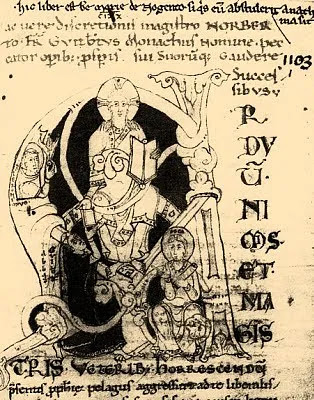
Guibert of Nogent, a Benedictine  was not remarkable in his time, but his extensive writings and autobiography have more recently provided insight into daily life in the Middle Ages.

Born c.1055 to minor nobility, his was a breech birth. His family made an offering to the Virgin Mary the he would be dedicated to a religious life if he survived. Guibert's father (according to his autobiography) was violent man who died while Guibert was still young. Guibert believed his father would have broken the vow and would have tried to get Guibert to become a knight.

At the age of 12, after six years of a strict tutor for the boy, his mother retired to an abbey near saint-Germer-de-Fly. Soon after, Guibert entered the Order of Saint-Germer, studying classical works. The influence of Anselm of Bec inspired him to change his focus to theology.

The first major literary work of his was the Dei gesta per Francos ("God's deeds through the Franks"). It is a more polished version of the anonymous Gesta Francorum. His additions give us more information about the reaction to the Crusade in France.

His autobiography is also patterned after another work, the Confessions of St. Augustine. It is a lengthy work dealing with his youth and upbringing and his life in a monastery. There are references that give us insight into daily life, such as when he denigrates someone for their manner of dress:

But because there are no good things, that do not at times give occasion to some wickedness, when he was one day in a village engaged on some business or other, behold there stood before him a man in a scarlet cloak and silken hose that had the soles cut away in a damnable fashion, with hair effeminately parted in front and sweeping the tops of his shoulders looking more like a lover than a traveller.

Guibert's criticisms tell us something about attitude toward certain fashions. 

He had a skeptical view on saints:

I have indeed seen, and blush to relate, how a common boy, nearly related to a certain most renowned abbot, and squire (it was said) to some knight, died in a village hard by Beauvais .on Good Friday, two days before Easter. Then, for the sake of that sacred day whereon he had died, men began to impute a gratuitous sanctity to the dead boy. When this had been rumoured among the country-folk, all agape for something new, then forthwith oblations and waxen tapers were brought to his tomb by the villagers of all that country round. What need of more words? A monument was built over him, the pot was hedged in with a stone building, and from the very confines of Brittany there came great companies of country-folk, though without admixture of the higher sort. That most wise abbot with his religious monks, seeing this, and being enticed by the multitude of gifts that were brought, suffered the fabrication of false miracles. [Treatise on Relics]

...and on saints' relics:

Odo, Bishop of Bayeux, eagerly desired the body of St Exuperius, his predecessor, who was honoured with special worship in the town of Corbeil. He paid, therefore, the sum of one hundred pounds to the sacristan of the church which possessed these relics that he might take them for himself. But the sacristan cunningly dug up the bones of a peasant named Exuperius and brought them to the Bishop. The Bishop, not content with assertion, exacted from him an oath that these bones brought were those of Saint Exuperius. "I swear," replied the man, "that these are the bones of Exuperius: as to his sanctity I cannot swear, since many earn the title of saints are far indeed from holiness." [Treatise on Relics]

He died in 1124.

Speaking of deeds of the Franks, there should be some interesting items to glean from the aforementioned Gesta Francorum. Stay tuned.

18 June 2022

Other Accounts of Clermont

How do we know what happened hundreds of years ago? Sometimes we have an archaeological finds that are subject to interpretation. Sometimes we have direct records, like coroner reports or exchequer accounts that we assume are straightforward. Sometimes we have histories written by contemporaries, or eyewitnesses, but even those we have to look at with a critical eye. Did the author have an agenda? Did the author have an accurate memory of the event? Did the author know how to interpret events?

For example: what did Urban actually say at Clermont on 27 November 1095 to announce the (First) Crusade? Six accounts have survived.

First, we have a letter Urban himself sent to Flanders. He says "a barbaric fury has deplorably afflicted and laid waste the churches of God in the regions of the Orient" (because he has had a request from the emperor in Constantinople for help with the Turks) and makes a passing reference to Jerusalem by saying the barbarism has "even grasped in intolerable servitude its churches and the Holy City of Christ, glorified by His passion and resurrection." Interestingly, there is no indication that this Crusade has as its main purpose taking over Jerusalem from non-Christians.

There is also the Gesta Francorum ("Deeds of the Franks"), an anonymous history written only a few years after 1095, that simply says Urban called upon people to "take up the way of the Lord" and be prepared to suffer in the undertaking. This account suggests that Urban was calling on the Franks specifically for this task, and caused the Franks to sew crosses onto the right shoulders of their garments to indicate their willingness.

Two eyewitness accounts exist. Fulcher of Chartres was a chaplain whose detailed account of the Council of Clermont (in the week preceding the announcement) gives an account in which he claims to record only things that he saw with his own eyes. He is the best (we think) account of what Urban actually said.

Robert the Monk is the other account. Robert says he was an eyewitness to Urban's speech, and he may have been: Robert has been identified as a former abbot of Saint-Remi who lived from c.1055 - 1122. Writing more than ten years after the speech, he embellishes it (compared to Fulcher's version) and makes it more dramatic. It is Robert who claims that the crowds as one shouted Deus vult ("God wills it!") at the conclusion of the announcement.

Two more accounts that do not claim to have been present exist. Guibert, the abbot of Nogent, adds his own emphasis on returning Jerusalem to Christian possession to fulfill prophecies about the Apocalypse. Baldric, the archbishop of Dol, seems to re-write the account from the Gesta Francorum and emphasize the Crusade as an appeal to chivalry. Part of Urban's focus during the Council was to reign in violence caused by Christian knights in the West.

We take what we can get from the historical record and hope we can assemble the jigsaw puzzle of historical events.

Tomorrow I'll tell you a little more about Guibert of Nogent and his very "modern" skepticism about something that scholarship definitely agrees with, no matter what people in the Middle Ages believed.