25 January 2022

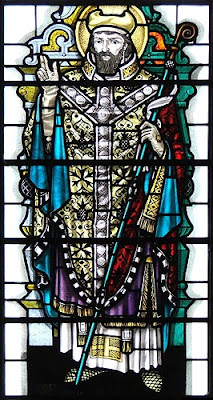
St. Æthelwold

Æthelwold was born about 910CE to a wealthy Winchester family. He served at the court of King Æthelstan (reigned 924-939), learning as much as he can and yearning toward a religious life. He and his friend Dunstan were ordained about 939 by the Bishop of Winchester, St. Alphege. Æthelwold and Dunstan went to the monastery in Glastonbury in Somerset about 940, where Dunstan was made abbot

At this time, Danish incursions into England had sacked and destroyed many monasteries. Monastic life in England was at a low point. Dunstan, who like Æthelwold was later made a saint, adopted the Rule of St. Benedict (mentioned a few times) for the Glastonbury monastery, and led the revival of monasticism in England. Dunstan, Æthelwold, and Oswald of Worcester and York would be called the "Three English Holy Hierarchs" for their work in reviving English Orthodox monasticism.

Æthelwold wanted to go to Cluny in France to experience their version of monasticism, but Dunstan and then-King Edred did not want to lose him, and they sent him to Abingdon-on-Thames to run the derelict monastery there. The patron saint of the place was St. Helena, because legend had it that she built a church there.

Abingdon became a strong monastic community. Æthelwold brought singers from Corbie in France to teach Gregorian chant, which was not common at the time in England.

When Æthelwold became Bishop of Winchester in 963, the priests were illiterate, lazy, guilty of drunkenness and gluttony; they were not good at the services, and most were married men. Æthelwold expelled the married men, tightened up discipline, and brought in monks from Abingdon as the nucleus of a new "monastery/cathedral" institution.

I'll say a little more about him tomorrow, including about the miracles attributed to him.

24 January 2022

Wulfstan the Cantor

Of the countless people who lived in the Middle Ages and accomplished things—writing, building, etc.—a very few are remembered by name. One of them is Wulfstan, known as Wulfstan of Winchester or Wulfstan the Cantor.

A cantor sings liturgical music. The monk Wulfstan was a cantor of the Old Minster in Winchester, who became a precentor. A precentor is responsible for composing liturgical music himself, training the choir, and leading the choir or congregation in the music, singing solo lines to which they respond. He was a poet as well as a musician, and wrote a biography of St. Æthelwold, who was probably his mentor. He wrote several works, making him one of the most prolific Latin authors pre-Norman Conquest.

A 15th century commentary refers four times to a "Wulstan" and his work on musical theory, De tonorum harmonia ("On the harmony of tones"). It is likely that this reference is to Wulfstan; unfortunately, this work of Wulfstan's no longer exists. It would be the only known work on music written by an Anglo-Saxon. He is also responsible for the longest (3386 lines) Anglo-Latin poem extant, the Narratio metrica de S. Swithuno (A metrical narrative of St. Swithin).

The work for which he is best know, however, is the Vita S. Æthelwoldi (The life of St. Æthelwold), the principal source of information on St. Æthelwold, about whom I think we should talk next.

23 January 2022

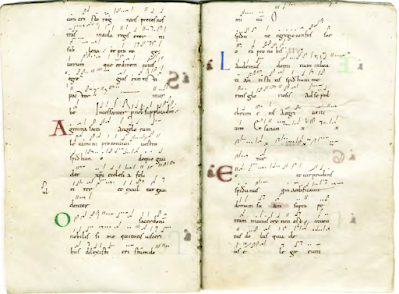
The Winchester Troper

When priests and monks prayed the Canonical Hours, praising God through hymns was considered an important part of the experience. We are fortunate to have a thousand-year-old manuscript that holds many examples of the music used at such times.

trope is a theme or motif, and the Winchester Troper was named that because it includes different musical styles or motifs. The Winchester Trooper actually refers to two manuscripts of liturgical plainchant and polyphony, although the two manuscripts are not exactly connected; that is, they are not two parts of the same collection, just two manuscripts of the same type of music.

The music is in two forms: liturgical plainchant and two-voice polyphony. Plainchant (or plainsong) is simply a collection of chants used in the Western European Catholic Church, in which all singers follow the same tune. It was the primary type of Christian liturgical music until the development of polyphony in the 9th century, when two or more singers would harmonize. The Winchester Troper's examples of polyphony are for two voices.

As usual with many early manuscripts, authorship is unknown. A person once connected with scribing the Troper, but now determined to have been dead by the time the Troper was put together, was a character called Wulfstan the Cantor. I'll tell you more about him tomorrow.

If you would like to hear a sample of music from the Winchester Troper, click here.

22 January 2022

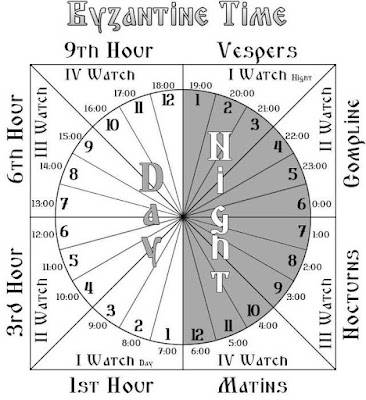
Canonical Hours

Canonical Hours were fixed times during the day for prayers. The Bible was the source for planning multiple times during the day for prayer. In Exodus, God required sacrifice of animals in the morning and the evening; these sacrifices evolved into set times for prayer. Psalm 119 states (line 164) "Seven times a day I praise you for your righteous laws" and line 62 says "At midnight I rise to praise you."

The prayers for the Canonical Hours were mostly from Psalms, but there were also humans and other Bible verses. Over time, the specific passages became more regulated, requiring a system for keeping them straight and making sure that everyone was following the same script.

Saint Benedict of Nursia founded communities of monks, and produced the Rule of St. Benedict for them to follow. By that time (the Rule was written in 516), the Hours consisted of seven daytime prayers and one nighttime prayer. (Very few people outside of monasteries were determined to get out of bed to pray.) The Breviary (from Latin breviarium, "summary") was created to combine Psalms, the schedule for each day, the hymns needed, etc. Breviaries were copied and shared with other monastic communities.

When Pope Innocent III learned of breviaries, he adopted them for non-monastic priests as well. They and the daily prayers are still adhered to today, although there are now various forms.

I mentioned hymns, and I think it would be interesting to discuss (and listen to) some of the music used as part of the Canonical Hours.

21 January 2022

Tide Dials

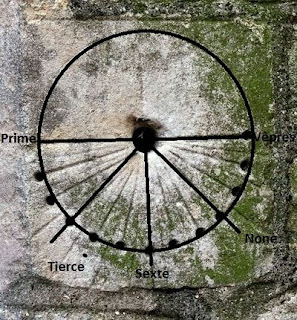
The Bewcastle Cross has what is considered the earliest surviving English sundial. It is actually a "tide dial." The "tide" part of the name comes from the Old English tīd, used to refer to hours, specifically canonical hours. The canonical hours are the specific times of day that require prayer. These times of prayer are also called "offices" or "divine offices," because they are an official set of prayers. The shift from "tide" to "hours" came after the Norman Conquest in 1066, when the Norman French hour replaced the Old English term.

So the tide dial shows the specific times when prayers are encouraged (but may also display hours of the day).

This is not to say that they did not recognize additional segments of the day. If you look at the illustration, you will see the words Prime, Tierce, Sexte, Nones. These refer to the First, Third, Sixth, and Ninth hours of the day. Prime was the first hour of daylight, so sunrise, and the time for the first set of prayers. The next set of prayers did not have to take place until the Third hour after that; three hours later, Sexte prayers took place, followed by Nones and finally Vespers, or evening prayers.

Because the length of time between sunrise and sunset varies throughout the year, the time between prayers was not precisely 180 minutes. With more regular timekeeping, fixed hours were designed for these times. Tomorrow I'll show you the canonical hours that are still used today.


https://en.wikipedia.org/wiki/Tide_dial#Bewcastle_Cross

20 January 2022

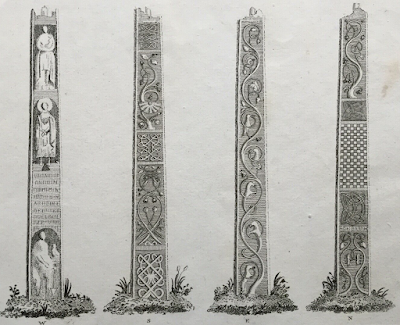
The Bewcastle Cross

The Bewcastle Cross is one of two stone monuments from the same era with similar iconography. Standing 14.5 feet high (it would be higher, but the actual cross top has broken off), it dates from the 7th or early 8th century, like the Ruthwell Cross (see the previous post).

Also like the Ruthwell Cross, it is covered with fine carving, Christian symbols, and runic inscriptions.

Images include John the Baptist holding a lamb, and Christ with a halo being held up by two beasts, similar to Christ being recognized as dominant over beasts on the Ruthwell Cross.

One difference from Ruthwell is that we have some idea of who made the Bewcastle Cross. A heavily weathered inscription has been interpreted by some to say "This slender pillar Hwætred, Wæthgar, and Alwfwold set up in memory of Alcfrith, a king and son of Oswiu. Pray for their sins, their souls". This may refer to Egfrid, who was king of Northumbria from 670 until 685. Presumably this dates the pillar to after 685.

One feature of the Cross that distinguishes it from Ruthwell is the earliest known English sundial. We will delve into that tomorrow.

19 January 2022

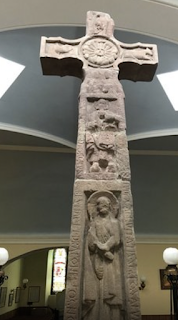
The Ruthwell Cross

In a part of southwest Scotland that used to be in Northumberland stands a stone cross 18 feet high, the Ruthwell Cross, carved with runic inscriptions and Christian imagery. Anglo-Saxon runes on a work of Christian art are highly unusual, but these runic inscriptions are also significant for their link to poetry.

Some of the runes are lines from the Anglo-Saxon poem The Dream of the Rood, giving us an opportunity to date the poem. The cross dates from the 8th century, which lets us know that the poem must have been well-known enough by then to be considered appropriate for carving.

Sadly, it was smashed in 1642 by Presbyterian iconoclasts. Fortunately, after smashing it, the destroyers left the pieces lying there, enabling a Scottish minister to re-assemble it 1818. Weathering and the destruction has obscured the carvings a little.

Besides traditional vine-scroll designs of leaves and birds, scenes show Mary Magdalene washing Christ's feet, Christ having dominion over the animals, Saints Paul and Anthony breaking bread in the desert (that one has a carved inscription that makes it clear), the healing of a blind man from the Gospels, and more.

The Ruthwell Cross is not completely unique, in the sense that there is another "cross" of similar vintage and style. We will talk about that next.


https://en.wikipedia.org/wiki/Ruthwell_Cross#Runic_inscription

https://www.bl.uk/collection-items/ruthwell-cross

18 January 2022

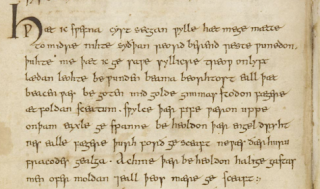
The Dream of the Rood

The imagery of the cross on which Jesus was crucified is common in religious writings. It even made its way into an Old English poem.

The Dream of the Rood, like many Anglo-Saxon poems, is unsigned, and exists in a single copy, found in the Vercelli Book. The Vercelli Book is one of only four known collections of Old English poetry, most of whose entries are anonymous. It was discovered in 1822 in the city of Vercelli Library in Italy.

In the poem, the poet dreams in vivid imagery of a tree and the rood/cross. ("Rood" is from the Old English rōd meaning "pole" and is usually used to mean the crucifix.) He imagines a bejeweled cross that transforms into the plain wooden crucifix representing Christ's suffering. The cutting down and cutting up of the tree to make a rood is compared to the suffering of Christ. The rood itself speaks in the dream, telling how it received the body of Christ, saw his suffering, then was cut down and buried, only to be dug up and adorned with gems.

This story seems to be tied to the idea that Helena dug up the True Cross. Coincidentally, the Vercelli Book includes a poem, Elene, which tells the same story.

The date of them poem isn't certain, but there is a carved stone cross, the Ruthwell Cross, on which are inscribed lines reminiscent of several lines from the poem. The Ruthwell Cross was erected in the 8th century. If the lines were not carved at a later date than the creation of the Cross, then we know the poem was around prior to that, and known to people.

We should probably take a closer look at the Ruthwell Cross next. In the meantime, if you wish to read the poem (in Modern English, that is), here's a link.

17 January 2022

The True Cross—Found!

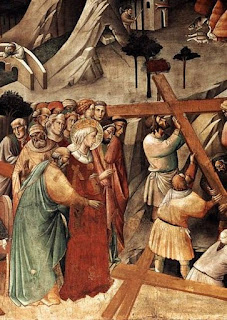
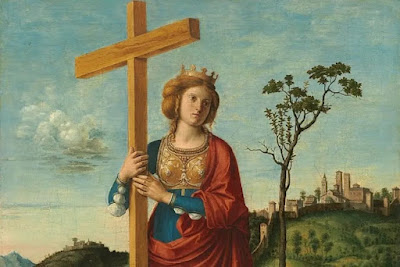
Empress Helena of Constantinople went to Palestine from 326-328CE to find Christian relics, consistent with her recent conversion to Christianity. Among other acts, she tore down a temple built by Emperor Hadrian in the 130s. Excavating under it, she found three wooden crosses.

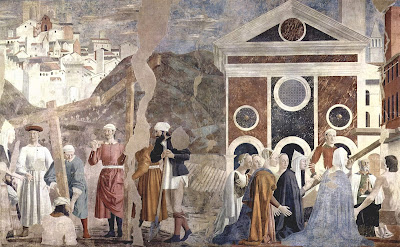
As excited as she may have been to find three crosses, Helena wanted absolute proof of their authenticity. She tested the crosses by having a dying woman brought to the site, having her touch the crosses. Touching the first two produced no change in her condition, but touching the third cross resulted in a sudden recovery. This provided Helena the proof she wanted, and she declared the third cross the True Cross, used to crucify Jesus Christ.

On the site was built the Church of the Holy Sepulchre, a version of which exists today.

This story of the dying woman comes down to us from a monk Rufinus (344-411CE), who was a translator of Greek Christian writings into Latin. He tacks this story onto his translation of an Ecclesiastical History by Eusebius. Strictly speaking, there is no contemporary account of this. Eusebius, who died in 339CE and was therefore a contemporary of Helena, wrote a Life of Constantine (Helena's emperor son) in which he mentions the destruction of Hadrian's temple and the construction of the church on the site, but does not mention anything about the finding of the True Cross.

Nevertheless, many later records purporting to be accurate histories of the finding tell variations of the above story. Relics of the True Cross were spread all over Christendom, and even inspired a well-known Old English poem. I'll tell you about it tomorrow.

16 January 2022

Empress Helena of Constantinople

 Helena was a common name for Greek females all over the Mediterranean. One Helena, born to a lower-class family c.246CE, became anything but common in her lifetime. We know hardly anything of her origins and early life. Geoffrey of Monmouth's tale that she was a British princess and the daughter of "Old King Cole" is one of the more colorful theories.

Her lowly origins, even if they were known at the time, were glossed over after she became linked to Emperor Constantius Chlorus, either as his wife or concubine. Their son, Constantine I, was the first emperor to stop the harassment of Christians. His Edict of Milan in 313 stated that Christians—and, in fact, all religions—should be allowed to practice their faith openly. Constantine later in life declared himself a Christian, although he did not get baptized until he was on his deathbed.

Helena converted to Christianity after her son became emperor in 306. Constantine gave Helena the title of Augusta Imperatrix, a very high honor, and with it gave her an unlimited budget to find and retrieve Christian relics. She undertook a pilgrimage to Palestine where she built churches.

Various sites in the area had been identified as being significant to Christians. Supposedly, Helena built the Church of the Nativity in Bethlehem at the site of Christ's birth, and the Church of Eleona on the Mount of Olives, from which Christ ascended to Heaven. There was already a temple on the site of Jesus' tomb, built after 130 by the Emperor Hadrian dedicated to Venus (or Jupiter).

Helena had this temple torn down, and began excavating. What happened next is a story for tomorrow.

15 January 2022

The True Cross


 The "True Cross" refers to the cross upon which Jesus of Nazareth was crucified. Although it would have been of ordinary wood, Classical and Medieval and Renaissance legends decided it had to be something more than that.

The Golden Legend by Jacob de Voragine has several different origin stories for the wood of the Cross. In one, the Cross was made from the wood of three trees which grew from three seeds that had been planted by Seth in the mouth of his father's, Adam's, corpse. Seth had taken the seeds from the "Tree of Mercy" (which is not part of the Biblical story).

Another version related by Voragine explains that the wood came from a cutting from the Tree of Knowledge of Good and Evil, also planted by Seth on Adam's grave.

From either of these origins, an elaborate provenance was created to get the wood from Eden to Golgotha. The wood was made into the rod of Moses, which was planted by King David in Jerusalem, from which grew a tree that enabled Solomon to carve a beam for his temple. Eventually, the tree was cut down for wood that was used to build a bridge used by the Queen of Sheba to visit Solomon. The Queen had a vision that a piece of wood from the bridge would lead to the replacing of God's covenant with the Jews (this would be Jesus and his message). Solomon, thinking this a tragedy, had the wood buried. It was exhumed years later and some was used to make the True Cross.

How did it come to be discovered after the crucifixion? For that, we must talk about a remarkable woman, the Empress Helena of Constantinople, which we will do next.

14 January 2022

The Battle of Hattin

 The Horns of Hattin is an extinct volcano whose twin peaks overlook Hattin in the Lower Galilee. In 1187, a battle took place between the forces of Saladin and Crusaders that was devastating for the Crusaders.

At the time, there were many Western European forces in the Middle East, due to the Second Crusade, and Jerusalem was in Christian hands, with Guy of Lusignan currently the King of Jerusalem. Still, the desire was to have the entirety of the Holy land under Christian control, which meant further conflict. Likewise, Muslim forces wanted the Christians to withdraw.

Saladin controlled much of the territory surrounding the Crusader forces and promised his people that he would drive the Christians from Jerusalem. Saladin had made a private treaty with the Franks in 1185 to give them Jerusalem if the Crusaders would stop waging further battles. There was peace until 1187 when a Muslim caravan was raided by Raynald of Châtillon. Saladin swore he would kill Raynald and sent a force to raid an area held by the Franks. The Templars lost about 150 knights and 300 foot soldiers in this battle (the Battle of Cresson), which was a severe blow to Frankish morale.

Guy was advised to move against Saladin, and on 3 July 1187, his forces started marching towards the Sea of Galilee (known at the time as Lake Tiberias). They were harried constantly nay Muslim archers, and along the way found little fresh water to replenish their supplies. The Muslim forces prevented them from reaching Lake Tiberias and fresh water, and set fires to the dry grass to annoy the Franks further with smoke and heat.

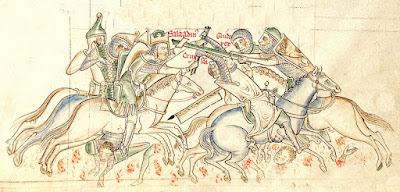
Three times the Frankish forces charged Saladin's, and three times they were beaten back, the third time being definitive. Many European nobles were taken captive that day. Guy of Lusignan and Raynauld of Châtillon were taken to Saladin. Saladin offered water to Guy, a sign that Guy would be treated well; Guy offered the water to Raynauld, but Saladin slapped it from his hand, charging Raynauld with breaking the truce. Raynauld was executed.

Guy of Lusignan was taken to Damascus as a prisoner (released in 1188). Two-hundred Templars and Hospitallers were beheaded, as were many others. A piece of the True Cross was taken from the Crusaders and sent to Damascus, about which I will have more to say next time.

13 January 2022

Pelagio Galvani

 Cardinal Pelagio Galvani (c.1165 - 30 January 1230) was the papal legate leading the Fifth Crusade. He hailed from the Kingdom of León, and became a canon lawyer. Pelagio was not a tolerant man: on a two-year mission to Constantinople, he tried to close Greek Orthodox churches and imprison their priests, and action that created so much chaos that the Martin Emperor of Constantinople, Henry of Flanders, reversed Pelagio's acts.

Crusades needed religious leaders as well as military ones, and Pelagio was sent to lead the Fifth Crusade by Pope Honorius III (Pope Innocent II, who had called for the Crusade, had died July 1216, before the Crusade had started out).

During the Siege of Damietta, while the Crusading army made some inroads in to Egypt, intending to use it as a staging area from which to conquer Jerusalem (see yesterday's post), the sultan al-Kamil made a peace offering: he would ensure the handover of the Kingdom of Jerusalem to the Crusaders, if they would depart completely from Egypt.

Given the main goal of the Crusades—to control Jerusalem—this would seem to be a win-win, and the secular leaders wanted to accept it. Pelagio, however, along with the Templars, the Hospitallers, and the Venetians, wanted to keep what they had taken. The Templars and Hospitallers would have shared Pelagio's religious reasons for converting the whole world to Christianity. In the case of the Venetians, I suspect they were more interested in the value of Damietta and the Nile as trade routes for their merchant fleets.

The Siege continued to attack Damietta under Pelagio's orders, and a further deal was offered by al-Kamil: this time he included to release any prisoners they had taken and to return the piece of the True Cross that had come into Muslim hands. Pelagio turned this and subsequent offers. Despite arrivals of more Crusader forces, the western army never gained a permanent foothold in Egypt. Finally, on 28 August, even Pelagio realized the Egyptian route was a lost cause. A nighttime attempt to use a canal to make further progress into Egypt on 26 August 1221 resulted in disaster for the Crusaders when the Egyptians detected them and attacked. The defeat was so demoralizing that even Pelagio decided to admit defeat. Two days later, he sent an envoy to al-Kamil. On 8 September 1221, the Crusading army left Egypt, abandoning the Fifth Crusade, having never come close to Jerusalem.

But how is it that sultan al-Kamil had a piece of the True Cross to offer? He got it at the Battle of Hattin, which I'll tell you about tomorrow.

12 January 2022

The Fifth Crusade

Were the Crusades successful? If the objective as stated was to put Jerusalem under Christian rule and maintain that rule, then the Crusades were a failure. Some of them never even made it to Jerusalem.

The Fifth Crusade was called by Pope Innocent III during the Fourth Lateran Council of 1215, intending it to start in 1217. It lasted until 1221, but although it was carefully organized and well-staffed, its strategy was flawed.

To be fair, the strategy seemed like a good idea at the time: sail to Egypt and attack, conquering what they believed to be an easier Muslim-controlled target. The Crusaders could then use Egypt as a staging area to attack the Holy Land. To make a long story short, the first of the Crusading fleet reached the Nile harbor town of Damietta on 27 May, 1218, and waited a few days for others to catch up. (It was not unusual that storms separated the ships, and so they did not all arrive simultaneously.) The most dynamic defender of that part of the world, Saladin, had died in 1193; his brother al-Adil took up the role of defender. al-Adil preferred to manage non-Muslims with treaties rather than jihad, and was disappointed in the Crusaders' next action.

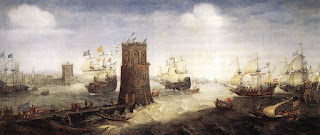
The Siege of Damietta began on 23 June, but the town of Damietta had strong stone walls and a large stone tower that secured a chain across the mouth of the harbor to defend against ships. The first assault failed when scaling ladders collapsed and the town defended itself with a barrage of stones. The next day, however, the main tower was breached, the chain was cut, and ships could enter the Nile. al-Adil's son, al-Kamil, scuttled several ships upriver from the mouth of the Nile, preventing the Crusader ships from sailing further.

The Crusaders then built a floating fortress to use on the river, but a storm on 9 November blew it toward the Egyptian camp, whereupon the Egyptians overtook it and slaughtered all but two Crusaders. The two survivors were executed by the Crusade leaders for cowardice, having managed to escape the assault.

At this point, al-Adil's sons, al-Kamil and al-Mu'azzam, made an offer: we will give up Jerusalem to you (with two small exceptions) if you evacuate Egypt. You would think this was a direct route to their goal, but something—or rather someone—stood in the way. I will address that next.

11 January 2022

The Holy Land Decrees

Desiring with an ardent desire to liberate the Holy Land from the hands of the ungodly, we decree with the advice of prudent men who are fully familiar with the circumstances of the times, and with the approval of the council, that all who have taken the cross and have decided to cross the sea, hold themselves so prepared that they may, on June 1 of the year after next (1217), come together in the Kingdom of Sicily, some at Brundusium and others at Messana, where, God willing, we (the Pope) will be present personally to order and to bestow on the Christian army the divine and Apostolic blessing. [link, bottom of the page]


Thus begins the Holy Land Decrees at the end of the Canons of the Fourth Lateran Council of 1215. Pope Innocent was extremely motivated to call for a Crusade, not only because he was the pope, and restoring Jerusalem to Christian rule was important to him, but also because of the disaster that was the Fourth Crusade that got sidetracked and ransacked Constantinople in 1204. The Crusade effort needed to be carefully organized to avoid that outcome. The Decree continues:

Moreover, that nothing connected with the affairs of our Lord Jesus Christ be omitted, we wish and command that patriarchs, archbishops, bishops, abbots, and others who have the care of souls, diligently explain the meaning of the crusade to those committed to them...

The Council wanted to make sure the Crusaders were absolutely committed to the goal, in order to prevent being sidetracked. The Decree went a little further, and you have to give them credit for thinking ahead. Getting to the Holy Land from Europe meant going by water (an overland march would take many months), and travel by water had its own dangers:

Since the corsairs and pirates too vehemently impede assistance to the Holy Land by capturing and robbing those who go there and those returning, we excommunicate them and their principal abetters and protectors, 

...and because no one wants any global distractions:

But, since for the success of this undertaking it is above all else necessary that princes and Christian people maintain peace among themselves, we decree with the advice of the holy council that for four years peace be observed in the whole Christian world,

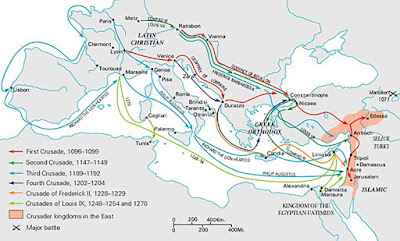
So...with all this preparation, why does the graphic above show no Crusade taking place in 1217? What happened to the Fifth Crusade? See you tomorrow.