12 May 2022

Germanus of Auxerre, Part 2

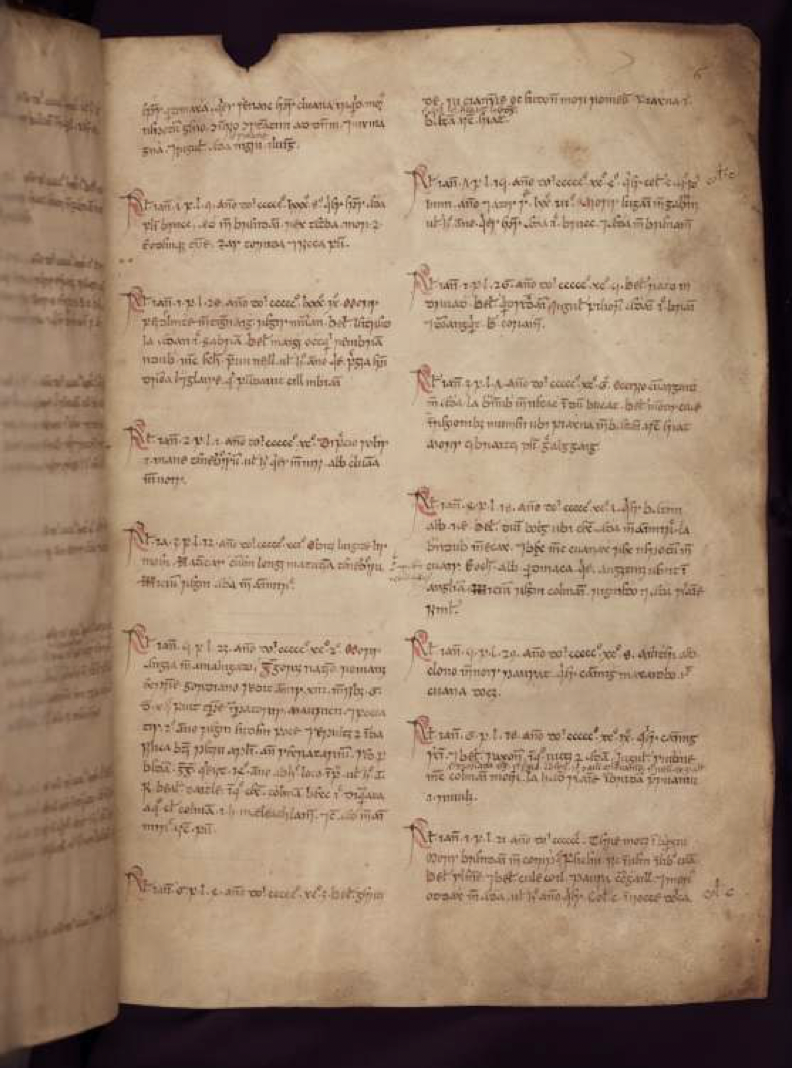
After Germanus defeated the Pelagians in Briton (through sheer force of his rhetorical skills, apparently, having studied eloquence and having argued the law), Germanus celebrated at the shrine of St. Alban (the first British Christian martyr). That night, St. Alban appeared to Germanus in a dream, telling the details of his martyrdom. Germanus had the story written down next morning. Our only record of St. Alban is the Passio Albani, ("Passion of [St.] Alban"), written in either the 5th or 6th century. Some scholars feel it is likely that we only have any information regarding St. Alban because Germanus had it written down.

Another anecdote about him in the Historia Brittonum ("History of the Britons," mentioned once before here) has him traveling to Britain a second time in the mid 430s or 440s, at which time he condemned for incest Guorthigern, the Vortigern of Welsh tales who figures into stories of Arthur. Vortigern tried to humiliate Germanus by having his daughter declare the bishop as the father of her child. In retaliation, Germanus cursed Vortigern, who fled into Wales pursued by Germanus and others. Vortigern holed up in a castle; Germanus and his group fasted and prayed for three days; fire from heaven fell on the castle, destroying it and all within. No historian gives any value to this story, but it is an example of Germanus' reputation.

He died in Ravenna; his feast day is 31 July.

His name lives on, at the Abbey of Saint-Germain d'Auxerre, at the church Saint-Germain l'Auxerrois which stands across from the Louvre, and several St. Germanus churches in England. He also makes appearances in literature and other media; his 2nd mission to Britain is included in the 2004 movie King Arthur, opposite Clive Owen as Arthur; in 2007, his character appears in The Last Legion where he leads the Romans and Britons against the Picts.

But back to that little girl he saw in Nanterre (see the illustration); what he told her more specifically was that she should live her life as if she were espoused to Christ. Apparently, that's exactly what she did. Tomorrow I'll introduce you to St. Geneviève of Paris.

11 May 2022

Germanus of Auxerre, Part 1

There are some stories about Germanus (c.378 - c.445 CE) that are difficult to believe and hard to substantiate. The Vita Germani ("Life of Germanus") written c.480 CE by Constantius of Lyon, no doubt intended to inflate Germanus' reputation, gives us most of our information on him.

We are told, for instance, that he was from one of the noblest families of Gaul, receiving the best education in eloquence and civil law in Rome, where he practiced law before the Tribune. He married s noble lady, Eustachia, before being sent back to Gaul as one of six dukes.

Unfortunately, he made an enemy of the local bishop, Saint Amator. Germanus would hang the carcasses of his hunting expeditions on a certain large tree with many branches to age. This tree had been used as a site of pagan rituals. Amator was angered that Germanus was drawing attention to it, so while the duke was away, he had the tree cut down and burned, along with the carcasses. Amator feared the duke's reaction, fled to the prefect Julius, and requested permission to tonsure Germanus.

When Germanus came to the church to find Amator, Amator gave him the tonsure against his will, telling Germanus that he needed to amend his ways to be prepared to replace Amator when the bishop died, and ordained him a deacon. Surprisingly (for real life; not surprisingly for a saint's story), when Amator died, Germanus was unanimously chosen to replace him as bishop. Germanus was made bishop on 7 July 418.

"Spontaneous religiosity" was a theme in anecdotes about Germanus. When he was sent from Rome to go to Britain to fight Pelagianism, he passed through Nanterre in Gaul. Walking through a crowd, he spotted a young girl and told her she should devote her life to Christ, and she did.

Germanus—who, remember, was a duke and soldier before he became a bishop—also helped the Britons against Pictish and Saxon raiders. Leading his army into a vale in North Wales, he told them to shout at his signal. Once the raiders approached, he shouted "Alleluia!" three times. The Christian army repeated his call, and the sound echoed so much between the mountains that the raiders fled, thinking themselves vastly outnumbered.

There are more stories, including one that tangentially connects him with the Arthurian legends. I'll share those next. (And eventually I'll get back to that little girl in Nanterre; we're not done with her.)

10 May 2022

Pre-Patrick Palladius

Although St. Patrick gets credit for spreading Christianity widely in Ireland, he was not the first Christian sent there for that purpose. He was preceded by Palladius (fl.408 - 431; died c. 450 CE), the first bishop of Ireland.

Some of what we know from him comes from accounts of St. Patrick, who was his contemporary, along with St. Prosper of Aquitaine. Palladius came from a noble family in Gaul, and had a wife and daughter. We don't know what happened to the wife, but at one point, after becoming an ascetic, he placed his daughter in a convent in Sicily and in 415 was ordained a priest. He seems to have lived in Rome from 418 - 429; we assume he is the Deacon Palladius who convinced Pope Celestine I to send a bishop named Germanus to Britain to fight growing Pelagianism.

Celestine also sent Palladius with relics of saints Peter and Paul to be the first bishop of Ireland. According to a later account, the Book of Armagh, Palladius had a difficult time in Ireland: the natives did not want his preaching, and he did not want to live in a strange land.

After 431, he went to Britain and served among the Scots for 20 years. Scottish historians acknowledge that Palladius was the first bishop and "first apostle" of Scotland. There are several dedications in the village of Auchenblae suggesting he spent most of his time there, and perhaps died there in 450.

We know more about the Germanus sent to Britain; he's next.

09 May 2022

The Annals of Ulster

History is written by the victors, or so it is said, and I was warned in graduate school always to question an author's intent. Everyone who write something down has an agenda, a point they intend to get across. That point might not be completely objective.

The Annals of Ulster might be in the same category, but their entries are usually simple lists of events without editorializing. This give the historian a separate check on other more detailed accounts, just in case the longer account is presenting a skewed version to get across the author's political point.

Another benefit of the Annals is that they cover more than ten centuries, from 431 CE until 1540, and so reach back further than many historical records. The first entry for 431 is:

Kalends of January
The year 431 from the Incarnation of the Lord.

Palladius, having been consecrated by Celestine, bishop of the city of Rome, is sent to Ireland in the consulship of Aetius and Valerius as first bishop to the Irish so that they might believe in Christ—in the eighth year of Theodosius.

The first several decades are compiled from other accounts, before the contemporary writers take over.  For the next year, for instance, we see:

432
Kalends of January sixth feria, fifth of the moon, [AM]4636. AD 432 according to Dyonisius.

Patrick arrived in Ireland in the ninth year of the reign of Theodosius the Less and in the first year of the episcopate of Xistus, 42nd bishop of the Roman Church. So Bede, Maxcellinus and Isidore compute in their chronicles.

The contributors to the Annals seemed to like following kings and their events and battles, as well as the activity of the viking invaders of Ireland. Another benefit to historians is that the Annals are written mostly in the Irish language, with only a few entries in Latin. Linguists have used the Annals to study the evolution of the Irish language.

But here's a question: if you're writing a history of Ireland, and obviously St. Patrick is an important part of that, it might make sense to use that as your starting point. They started, however, with Palladius. So ... who was he?


08 May 2022

The Battle of Clontarf

The Battle of Clontarf took place on 23 April 1014. It turned Brian Boru into a national hero, although that may have had more to do with public sentiment and creative re-telling than factual outcome, since Boru did not survive.

Boru (c.941 - 23 April 1014) had grown in power until his kingdom of Munster was unparalleled in Irish history. The king of Leinster, Máel Mórda, challenged Boru at the Battle of Glenmama on 30 December 999, lost and had to submit. A few years after, in 1002, Brian Boru's political and military authority caused him to be recognized as "High King" of Ireland.

Meanwhile, Viking raids on Ireland the previous few centuries had resulted in settlements on the coast, including one that grew into the Kingdom of Dublin. At the time of Clontarf, the king of Dublin, Sitric Silkenbeard, was nephew to the king of Leinster.

They all should have been on good terms. Brian's ex-wife Gormlaith was Máel Mórda's sister, and Sitric was her son by a previous husband. One of Brian's daughters from a previous marriage, Sláine, was Sitric's wife! Unfortunately, the lust for power does not take a backseat just because of familial ties.

In 1013, Máel Mórda and Sitric Silkenbeard rebelled against Boru's authority. Boru decided he needed to make a strong statement, so he sent his son Murchad into Leinster who "plundered the land ..., burned the whole country, and took great spoils and countless captives." [Annals of Ulster]

Other skirmishes led Brian Boru to bring his army to Leinster in September 1013, where he positioned them outside Dublin. Sitric sailed east to find Viking support. According to Njal's Saga, he approached both the Earl of Orkney and a warrior from the Isle of Man and offered each to be the king of Ireland if they would aid him against Boru. (Njal's Saga is a later work of poetry and cannot always be relied on for factual details. See what it says about valkyries.)

Sitric's viking allies sailed to Dublin the week before Easter. (Easter in 1014 was 25 April, about as late as it can get, so the weather was amenable to sailing and fighting.) The armies met at Clontarf (the name means "meadow of the bull"), an area north of Dublin, on Good Friday. A blow-by-blow of the Battle of Clontarf does not exist in the contemporary Annals of Ulster or the Annals of Inisfallen, nor in the poetic Njal's Saga. The dead included Brian Boru, his son Murchad, his grandson Toirdelbach, his nephew Conaing.

On the other side, Sitric survived, because he stayed in Dublin to protect it; he could see the fighting from the city walls. His brother Amlaíb led the Leinster forces, and died because of it. Máel Mórda was killed, as were the two leaders from Orkney and the Isle of Man.

In all, estimates are that 7,000 - 10,000 were killed in the battle, but not all by bloodshed. The battle started at dawn and continued all day. The tide was in near the end of the day, preventing the retreating vikings from reaching their ships, and many drowned while trying to retreat. The viking and Dublin influence on Ireland was severely diminished.

After Boru's death, his remaining forces were led by Máel Sechnaill Mac Domnaill. He had been High King before Brian Boru, and was restored to that position after Clontarf, since Boru's male issue had been killed.

It was not called the Battle of Clontarf at the time: the 12th-century Book of Leinster has a list of kings where it states that Brian Boru died in the "Battle of Clontarf Weir." The date of the battle itself may be false, Good Friday being first mentioned in later medieval sources. There is a theory that Good Friday was chosen symbolically to link Brian Boru's death with that of Christ's sacrifice. Boru was hailed ever after as a national hero, although his victory was a pyrrhic one.

I'll talk a little more about the value of the Annals of Ulster next time.

07 May 2022

Valkyries

Everyone is probably familiar with the valkyries, the "choosers of the slain" in Norse legend. They didn't just carry the dead to Valhalla, however. Norse soldiers who died in battle had two possibilities: Valhalla or Fólkvangr.

Fólkvangr (Old Norse "folk field") was the domain of Freyja, Odin's wife and goddess of love, beauty, fertility, sex, war, gold, and seiðr. (Going forward, when you see the character ð, pronounce it as a voiced th, as in these.) There she sits in her hall Sessrúmnir (Old Norse "seating room"). Besides warriors, Egil's Saga (composed in the 13th century) has a non-warrior woman remarking that she will not taste food again until she dines with Freyja.

The other half of slain soldiers are carried by valkyries to Valhalla. There they are called the einherjar (Old Norse "once fighters") who prepare for the final battle at Ragnarök. Valkyries in Valhalla serve mead to the einherjar.

Visual depictions of valkyries are ... vague? We have Viking Age art with women in it that could be valkyries, but we just don't know. Silver amulets with women holding drinking horns are numerous, especially in graves. A silver-gilt figurine found in Denmark and dated to 800 CE shows a female with bare arms holding a shield and sword. When you look for females carrying drinking horns, you will find them all over Northern Europe, in metal and carved on rune stones.

Outside of Scandinavia, the Anglo-Saxons also had a similar concept. The Old English word wælcyrge might have been a loan-word from Old Norse or an independent idea. The charm "For a Swarm of Bees" seems to compare a swarm of bees to a ride of the valkyries.

How did the idea of female choosers of the slain arise? We'll never know for certain, but some scholars think they were originally demonic entities who swarmed over the dead in battlefields. As concepts shifted and battle became more glorified, warriors were honored with an afterlife. Getting to that afterlife required a mechanism, and the demonic entities connected with death became noble entities carrying fallen soldiers to their reward. They go from Furies to Norns, involved in the fate of warriors.

It is likely that poetry helped re-shape the idea and function of the valkyries. Njal's Saga is an Icelandic saga that describes events between 960 and 1220. It describes an incident in which a man secretly observes valkyries at a loom, weaving and singing about who will die at the Battle of Clontarf (Dublin, 1014 CE). They then ride off, singing "start we swiftly with steeds unsaddled—hence to battle with brandished swords!"

If you were to search, say, Facebook for the name "Valkyrie," you would find several. Whether that is a given name or a nickname the person has chosen for herself isn't clear. I personally know an actual "Valkyrie" who reads this blog. Hi, Kyrie!

And now for something completely different: the Battle of Clontarf. See you tomorrow.

06 May 2022

Bee poetry?

I remember the character Queenie in the TV show "Lark Rise to Candleford" (based on the partially autobiographical books by Flora Thompson) speaking to several hives of bees, saying "Bees, bees, your master's dead; I must be your mistress now." The need was to explain to the bees that the person maintaining the hive was gone so that they could mourn properly and then attach to a new owner, not just fly away to seek a new home. The illustration here is "The bee friend" by Hans Thoma (1839-1924). He is speaking to his bees, because tradition holds that the bees must be informed of important events.

Bees were important for wax and honey, and a hive/colony could be kept going for years, with a strong bond developing between the family and the bees. You would not want the bees to have a reason to "swarm" and leave, so keeping them "in the loop" was important. Besides just "telling the bees," you could use a spoken charm to try to keep them.

One such charm was the Lorsch Bee Blessing, written down (we think) in the 9th century in Old High German and used to keep the bees from leaving. Translated, it says:

Christ, the bee swarm is out here!
Now fly, you my animal, come.
In the Lord's peace, in God's protection,
come home in good health.

Sit, sit bee.
The command to you from the Holy Mary.
You have no vacation;
Don't fly into the woods;

Neither should you slip away from me.
Nor escape from me.
Sit completely still.
Do God's will.

There also exists "For a Swarm of Bees," an Anglo-Saxon charm intended to prevent the bees from swarming and going to a new location.

Settle down, victory-women, sink to earth,
never be wild and fly to the woods.
Be as mindful of my welfare,
as is each man of border and of home.

Clearly each poem/charm indicates how important a thriving hive was for the person needing the wax and honey.

The "victory-women" of the first line of "For a Swarm of Bees" is curious. The Anglo-Saxon word is sigewif  and Jacob Grimm (of Grimm's Fairy Tales) and other scholars think it may be drawing a poetic comparison to the valkyries of Norse myth. Perhaps the bees are compared to valkyries because of their weapon (sting) and the way they ride to battle (swarm)?

Speaking of Valkyries, I mentioned one once when discussing the real historical figure portrayed in the 2013 TV show The Vikings. I think the valkyries need a little more explanation.

05 May 2022

Honey

Sugar cane was cultivated thousands of years ago—in Southeast Asia; mass cultivation and importation to Europe was not available in the Middle Ages. But Europe had honey.

Honey can sweeten food.

Honey is a preservative.

Honey can be used in medicine.

But there were also more...creative uses.

For instance, a peasant working on a manor could pay his rent in beeswax and honey.

At least one late medieval manual tells us Jewish children would learn their letters by, once having written the letters on a slate, covering the slate with honey. "The child then licked them so that the words of the Torah might be 'as sweet as honey'." (No reports exist on the efficacy of this pedagogical method.)

Manuals had differing recipes for mead, but one suggests to crush the honeycombs by hand or pestle (and mortar), strain the honey, mix it with water in a ratio of 1:4, let it sit for three days, then boil until it is at the concentration you prefer. It was then strained through linen and allowed to ferment. Mead was very popular, and so common that in 1015 in the city of Meissen, Germany, mead was used to put out a fire because the town had more mead at hand than water. This would have required a lot of honey available for the brewing.

Regarding its medicinal use: the Romans used it in medicinal concoctions, mostly for flavoring, but after the fall of the Roman Empire very little is written about honey's uses in medicine. Its antibacterial effects were not demonstrated until 1892 by a Dutch scientist.

I've got a few more things to say regarding bees themselves next time, and then we'll turn to something else.

04 May 2022

Bee-keeping

The value of honey was no doubt discovered long before human beings started keeping written records. The Egyptians were maintaining bees as far back as 2450 BCE. In the Middle Ages, bees were seen as a source of not only honey, but also wax for candles wanted by the church and the aristocracy. They had other methods of lighting, such as tallow and rushlights, but wax candles were the best. 

Many people kept bees for these purposes, but the practice was so common that there was no need to explain it, and so the "rules" of beekeeping are scarce. The Geoponika, a 20-volume Byzantine collection of agricultural knowledge from the 900s includes "of the management of bees" in book 15.

The bee is the wisest and cleverest of all animals and the closest to man in intelligence; its works is truly divine and of the greatest use to mankind. Its social life resembles that of the best regulated cities. In their excursions bees follow a leader and obey instructions. They bring back sticky secretions from flowers and trees and spread them like ointment on their floors and doorways. Some are employed in making honey and some in other tasks. The bee is extremely clean, settling on nothing that is bad-smelling or impure;

Initial beekeeping was finding the trees the bees themselves had used and watching them. Holes would be bored, or even small wooden doors installed, to give access to the honey inside and to be able to seal up the hive against inclement weather. Once humans decided to keep the bees closer, they built hives of any material available: clay, wicker, straw, wood. Some documents warn against stone and clay, because the summer heat would make them unbearable. Pliny the Elder mentions hives made from horn and translucent stone, but there is no evidence that any hives made like that ever existed.

Skeps—domes of straw with a small hole—became common in the 14th century. They were easy to make, but to get at the wax and honey you needed to disturb the bees. Another problem with skeps was that they were small and easily stolen. Wax and honey were that important. We know the wax was for candles, but honey had lots of uses.

We will go into that next.

03 May 2022

Childeric I

Childeric I was presumably a child of Merovech, and the first king of the dynasty called Merovingians. He lived from about 437 until 481 CE. Records are sketchy, but if we are to believe Gregory of Tours, Childeric in his youth was a "wild child" who was exiled to Thuringia (now central Germany) for eight years on account of debauchery and his tendency to seduce the daughters of his subjects.

While in exile, the Gallo-Roman Ægidius, who was briefly ruler of the short-lived kingdom of Soissons, started calling himself "King of the Franks." Meanwhile, in Thuringia, the Queen Basina left her husband to marry Childeric, claiming "I want to have the most powerful man in the world, even if I have to cross the ocean for him."

Later, in 463, Childeric and Ægidius fought together to repel Theodoric II and the Visigoths from Orléans. He is also reported to have fought with "Odovacrius" (Odoacer of Italy?) against the Alemanni (but not the people we usually call Alemanni).

With Basina he had all least four children. One of them, Clovis I, because king after Childeric. His other children were Audofleda, who married Theodoric the Great of the Ostrogoths; Lanthechild, who was an Arian Christian but converted when Clovis did; Albofleda, who died soon after converting with Clovis to Christianity.

In 1653, Childeric's tomb was discovered. A ring was found with the inscription CHILDIRICI REGIS (Latin: "Childeric King"), the first hard evidence that he was considered a king. The tomb included gems, gold coins, and 300 golden bees (they could have been some other insect, like cicadas, but in general they are called bees). Napoleon liked Childeric's bees as a symbol of the French empire in 1804.

Unfortunately, in November 1831, Childeric's treasures were stolen from the Bibliothèque National de France along with several kilograms of other gold treasures and melted down. Childeric's treasure is gone, except for two bees.

...which is as good a transition as any to talk about medieval beekeeping next time.

02 May 2022

Merovech

The Merovingians were the predecessors of the Carolingians (Charlemagne's family) and can be considered the founders of France. I've mentioned the Merovingians a few times (check the list to the right), but hardly spoken about their eponymous founder, Merovech.

Merovech (aka Mérovée, Merowig, and in Latin Meroveus) was on the scene from about 411 until 458 CE. He was king of the Salian Franks, the tribe that became the primary tribe in France. Details are hazy, but his father may have been Chlodio, also king of the Salian Franks.

The Roman historian Priscus, writing about the conflicts between Attila the Hun and Rome, mentions a beardless youth with long hair adopted by Roman general Aetius. This turns out to be Merovech, looking for Roman support in his bid to succeed Chlodio. His rival was his elder brother who aligned with Attila the Hun. The Romans fought the Huns in Gaul, and Merovech became king.

At some point, it apparently became necessary to enhance Merovech's origin. The Chronicle of Fredegar states that Chlodio and his queen were at the sea shore when she went bathing. She was attacked by a sea creature and became pregnant with Merovech. Adding a veneer of divinity wasn't unusual in the Classical and Medieval periods to elevate a ruler's reputation. This origin was adopted and exaggerated by writers in the 20th century to link Merovech to the bloodline of Jesus, to the Illuminati, to Masonic lore, and to horror fiction.

But all this is largely...legendary. The Merovingian dynasty—although named for Merovech—starts officially with Childeric I. He is next up.

01 May 2022

The Dove of St. Nivard

St. Nivard was one of those early medieval saints of whom we know next to nothing. He was archbishop of Reims from before 657 CE until 673. He was the brother-in-law of Childeric II (King of Austrasia). The best info Catholic.org has to offer is the his feast day, 1 September

Charles Forbes, the Count de Montalembert, a member of the French Royal Academy, published in 1861 The Monks of the West, from St. Benedict to St. Bernard. In a chapter called "The Monks under the First Merovingians" he writes:

In the following century, St. Nivard, Archbishop of Reims, visiting his diocese on foot, arrived in the fine country which overlooks the course of the Marne, opposite Epernay; and, finding himself fatigued, slept under the shed of a great beech, on the knees of his companion, Berchaire. During his sleep he saw a dove descend from heaven upon the tree, and, after marking the same circuit three times by flying round it, reascend to the skies. Berchaire, who had not slept, saw the same saw the same vision. They agreed to build an abbey there, which was called Hautvillers. Berchaire was its first abbot; and the high altar rose upon the same spot where the tree had stood when the dove alighted, a sweet symbol of the tranquil innocence which was to reign there.

From there he discusses the many legends of holy men encountered tearing animals and taming them.

Where Forbes found the original story is still a mystery to me, but at least one faithful reader of this blog "need[ed] a few more details about this dove." I had been less than thorough in my origin story of Hautvillers, so I hope this helps.

Next time, I'll talk about who these "First Merovingians" of the chapter title were.

30 April 2022

The Utrecht Psalter

Vellum—fine parchment made from the skin of a calf—is more durable than paper. Even so, manuscripts that survived for centuries are precious, and sometimes we have them only due to extraordinary measures taken by individuals.

One such individual was Sir Robert Cotton, whose hobby was collecting old manuscripts of all kinds in his personal library. Despite a fire that destroyed some, there are countless things we know about the Middle Ages that we would not know except for his collection, including poems such as Beowulf. One unique manuscript that he collected was the Utrecht Psalter. (I should say "near-unique" for reasons explained a little later.)

A psalter is the Book of Psalms from the Bible. The word psalter is Old English (p)saltere from Latin psalterium from Greek psaltērion and means a stringed instrument. (Remember that the Psalms are songs.) This particular psalter came to the Cotton Library from Canterbury Cathedral some time after the Dissolution of the Monasteries (in the 1530s when Henry VII changed things). Robert had the pages bound, and then lent the manuscript to the Earl of Arundel, who took it into exile in the Netherlands (during the English Civil War in the 1640s); upon his death it was sold, and somehow wound up in the library of Utrecht University by 1716.

One of its distinguishing features is the style of art. Each vellum page contains a psalm, and the background of each page illustrates every image from each line of the psalm in understated color called bistro, a shade of brown or grayish brown. The pages are 10x13 inches—an unusually large size choice, unless it were intended to be used by several people reading/singing at once. It might have been a monks choir book rather than intended for personal instruction, as the mnemonic device of the illustrations would suggest.

Created in the 800s during the Carolingian period, it influenced a style that is called the "Utrecht style." There are at least three copies that were made of it prior to its acquisition by Cotton: the Harley Psalter (in the British Library), the Edwin Psalter (at Trinity College, Cambridge), and the full-color-with-gold-backgrounds Anglo-Catalan Psalter (so-called because it was half-illustrated by an English artist in 1180-1200 and finished in Catalan in 1340-50 in a different style), in the Bibliothèque nationale de France.

But whence came the original? An argument is made for it originating near Reims, because the style is similar to the Ebbo Gospels, suggesting that, like them, the psalter was sponsored by Archbishop Ebbo of Reims. Also, some believe the illustrations draw from details that would have been gleaned from the travels of none other than or recent predestination heretic, Gottschalk of Orbais. Besides psalms, it includes the Athanasian Creed, to which Ebbo's successor Archbishop Hincmar of Reims was partial.

This puts it in the vicinity of Hautvillers, which gives me a reason to re-visit Hautvillers and clear up a few details about which I was terribly neglectful yesterday. Tomorrow I answer the question: what about that dove?

29 April 2022

Hautvillers

Hautvillers is a commune in northeastern France. In 650 the Benedictine Abbey of St. Peter (in French it was the Abbaye Saint-Pierre d'Hautvillers) was established; it remained active until the French Revolution in 1789.

It was founded by St. Nivard, the Bishop of Reims, when a dove indicated where it was to be established. The abbey was devoted to the Rule of St. Benedict and of St. Columbanus, whose monastery practices in Ireland were in some cases even more strict than Benedict's.

The Abbey was known for its illuminated manuscripts. The very vibrantly illustrated Ebbo Gospels came from this Abbey. A well-known book of psalms known as the Utrecht Psalter (discovered in the Netherlands in the Utrecht University Library in 1858) is illustrated in a similar style to the Ebbo Gospels, and so might have come from here as well.

In 841, a priest from Reims stole from Rome the bodily relics of St. Helena, mother of the Emperor Constantine and finder of the True Cross. Pilgrimages to see the relics helped bring donations to the Abbey, allowing it to purchase more property. (After the French Revolution, the relics were transported to Paris; they went to the Knights of the Holy Sepulchre in 1819.)

One of the uses of more land was, of course, to provide the Abbey with its own food and drink. Vineyards were always a good idea. One of the monks at Hautviller disliked using white grapes, because of their tendency to enter "refermentation." Refermentation happened after the wine was bottled: in the warmer weather, remaining yeast would "wake up" and start producing carbon dioxide again. Enough and you have sparkling wine; too much and you have exploding bottles. This monk laid down some rules for the best wines and best sparkling wines, such as blends of grapes from multiple vineyards (before pressing, not after they were already wine). His name was Dom Perignon. He did not develop the brand now known as "Dom Perignon," but it was named for him. The myth that Perignon invented champagne was created by a later monk, Dom Groussard, who made up many stories about the Abbey to garner fame.

Next: whether it came from Hautvillers or not, the Utrecht Psalter is worth a look.

28 April 2022

Gottschalk of Orbais

I believe and confess that omnipotent and unchangeable God foreknew and predestined saint angels and elect men to eternal life gratis and that He equally predestined devil, head of all demons, with all of his apostates, and also reprobate men, namely his members, on account of their own most certainly foreknown evil merits, through the most right judgment to deserved eternal death; for thus says the Lord himself in His Gospel: “The prince of this world is already judged”

So wrote Gottschalk of Orbais (c.808 - 30 October 868 CE). He studied at Fulda Monastery in Germany where he became friends with Strabo and studied under Hrabanus Maurus. His first act of "rebellion" was being ordained in France (where he joined the Abbey at Corbie) not by his bishop, but by the local choriepiscopus of Rheims, a lesser functionary in the bishop's. By 840 he had left France for Italy where he preached his views on predestination, before being driven out by Hrabanus Maurus who at that time had become Archbishop of Mainz.

He preached and gained followers in Germany until the Synod of Mainz in 848. It was presided over by Hrabanus Maurus with King Louis the German present. Gottschalk was declared heretical, beaten, and for hidden to return to the Kingdom of Francia under Louis the German. He was sent to Archbishop Hincmar of Rheims to be kept under confinement, but he continued to preach his double predestination.

Six months after the Synod of Mainz was the Council of Quierzy—with Archbishop Hincmar and King Charles the Bald—at which Gottschalk's preachings were questioned again; this time, however, there was no calm theological debate. When Gottschalk refused to accept that is interpretation of Augustine was wrong, he turned to verbal abuse of his opponents. He was defrocked (both in the sacerdotal and sartorial sense), beaten, and imprisoned in a monastery at Hautvillers for the next 20 years, until his death.

Hautvillers; now there's a place worth talking about. Next time.