07 October 2022

Adeliza of Louvain

After the death of his first wife, Matilda of Scotland, King Henry I of England needed a second wife. Well, mostly he needed an heir, because the sinking of the White Ship killed his only male heir, William of Adelin. He had plenty of surviving children, but he had not been married to their mother(s), so that presented a legitimacy problem. He found what he needed in Adeliza of Louvain. 

Adeliza (c.1103 - 1151) was 17 or 18 when she wed Henry in 1121, who was about 35 years older than she. She was even younger when negotiations started; Henry had already been looking for a second wife, but the process accelerated after the White Ship. Sometimes called "the fair maid of Brabant," she was known for her beauty. The historian Henry of Huntingdon (once mentioned here) raved that her beauty was completely natural, needing no adornment.

One of her attractive features (aside from her physical features) was her ancestry: as a descendant of Charlemagne, marriage to her would link their children to an age still looked upon as glorious and foundational to contemporary Europe. The two were wed in Windsor Castle on 24 January 1121. They were married for 15 years, during which time she seemed to have always been near him as he traveled his kingdom. She took little interest in administrative duties, however, unlike many queens.

She did, however, turn out to be a patron of the arts, sponsoring French poets. An Anglo-Norman poet, Philippe de Thaon, dedicated a Bestiary in Latin to:

 ...an outstandingly beautiful woman.
And she is courtly and wise, Of good customs and generous:
She is called 'Aaliz', Queen is she crowned,
She is the queen of England; May her soul never know trouble!

She also commissioned a biography of her husband, which no longer exists.

After Henry died on 1 December 1135, she first retired to Wilton Abbey, a Benedictine convent, and shortly after founded a leper hospital. She had several properties that Henry had given her, and when she re-married in 1138, she and William d'Aubigny lived at her castle of Arundel.

Adeliza's relationship to her step-daughter, Matilda, was cordial. They were approximately the same age, and Henry had named Matilda his heir-presumptive until he had an heir with Adeliza. Unfortunately, he and Adeliza did not produce an heir, so technically, Matilda would inherit the throne and country.

...and that's when the trouble started. Tomorrow we re-visit The Anarchy.

06 October 2022

Henry I of England

The first royal wedding too take place at Windsor Castle was that of King Henry I and Adeliza of Louvain.  Henry (c.1068 - 1135) was a younger son of William the Conqueror who was initially cut out of inheriting anything substantial. Upon William's death, William Rufus became king of England (brother Robert Curthose got Normandy), and Henry got nothing.

He was granted the County of Cotentin—the peninsula that extends into the English Channel and contains Cherbourg and Bayeaux—for £3000 from Robert, slowly establishing power and some authority. Robert had hoped to be given England as well as Normandy, and wanted Henry on his side. Since Henry was otherwise landless—which at the time meant having no power whatsoever—he allied himself with Robert. Robert's intention to take England from William never turned to action, however.

In 1088, Bishop Odo of Bayeaux convinced Robert that Henry could not be trusted. Odo seized Henry, who was captive for the winter; Robert took back the Cotentin. In spring of 1089, nobles in Normandy persuaded Robert that Henry should be released.

In 1091, William invaded Normandy, defeating Robert and signing a treaty with him making each the other's heir and completely leaving Henry out of the negotiations. Henry decided to fight his brothers, but wound up being besieged in MontSaint-Michel for a time. Rumor has it that, when Henry ran out of fresh water, Robert allowed supplies to be taken in, upsetting William Rufus. The back-and-forth between siblings in that family would surprise no one who had seen a certain movie based on their descendants, The Lion in Winter.

Time passed, and once again William and Henry were on amiable terms. When William Rufus died on 2 August 1100, Henry "happened" to be present (click the link to understand the quotation marks). Henry wasted no time in getting himself crowned. Although rightly the throne should have gone to Robert, England accepted Henry with alacrity because of the Charter of Liberties, in which Henry made promises that undid some of William's unpopular practices. The nobility might have been fed up with the constant fighting between Robert and William and embraced Henry as a sort of "compromise candidate." After some debate over the rightful heir, Henry was crowned 5 August in Westminster Abbey.

Three months later, Henry married Matilda, the daughter of Malcolm III of Scotland, also known as Malcolm Canmore, in a shrewd political move. That Matilda might have been a nun did not deter the marriage. They had two children: Matilda and William Adelin, who died in the White Ship tragedy.

Marriage did not mean fidelity: kings were understood to exert their sexual prowess and desires in many directions. Henry had at least ten acknowledged extra-marital children who lived long enough to have titles and careers. Matilda of Scotland died in 1118, and when the White Ship sank in 1120 taking his legitimate son with it, Henry collapsed with grief. Now with no legitimate son, and seeing the prospect of numerous less-legitimate heirs and various nephews who could tear the country apart fighting for the throne, he decided to marry again.

So finally we come to the first royal wedding to take place in Windsor Castle, to Adeliza of Louvain. See you tomorrow.

05 October 2022

Windsor Castle

"High above the river Thames and on the edge of a Saxon hunting ground" William of Normandy built a motte-and-bailey structure from 1070 to 1086. It was made of timber, and exists today, but William wouldn't recognize it. Today it is known as Windsor Castle. William's son Henry I was married there, after which he took up residence there; Every king and queen of England since then has used it as their royal residence.

The change began in the reign of King Henry II (1154 - 1189). Archaeological evidence shows the south timber wall was subsiding by as much as 6 feet. Henry replaced the timber with stone walls and decided to create apartments for himself and his royal family, transforming it from a purely defensive structure into a palace. (You can still see the original mound with the Round Tower re0built by Henry II in the illustration above.) King Edward III (1327 - 1377) decided it would be his most important palace, and spent an unheard-of £50,000 to expand and renovate it, starting its evolution to become the largest occupied castle in the world.

Windsor's importance to William was due to its position on the Thames. (Well, also its nearness to Windsor forest, a royal hunting preserve established by the Saxon kings.) The whole point of numerous motte-and-bailey castles was that they were within a day's march from others, making it easy to get reinforcements when needed.

The name "Windsor," which is used for the castle and the family name of the current English royals, is mentioned in the Anglo-Saxon Chronicle and comes from Old English Windles-ore, or "winch by the riverside," suggesting that this was a place where goods were loaded to and from boats.

Because there is often great public interest in royal weddings, let's talk about the first royal wedding at Windsor, of Henry I to Adeliza, the "fair maiden of Brabant."

04 October 2022

Motte-and-bailey in England

After William of Normandy took over England in 1066, one way to establish his authority and help maintain it was to build a series of fortifications. Eighty percent of these were in the motte-and-bailey style that the Normans had been using all over France and later over much of Northern Europe.

It would have taken longer and been less efficient to build from scratch, and so in many cases he chose to build on existing fortifications. After all, you don't build a castle just anywhere: you need it to have resources, such as fresh water. Towns were established the same way; no one built them in a desert or on an inaccessible peak (unless you built them for other reasons than comfortable living). So 

Since many towns already had defensive walls and the resources needed for living, many of the new structures were set up there. The castle would take up space, however, and the town was already being used. The solution was to demolish local houses and buildings.

Records of castle-building hint that, for instance, 166 houses in Lincoln were destroyed to build its castle. In Norwich, 113 families had to be displaced. Cambridge got lucky: only 27 houses were destroyed to make way for the new castle.

More motte-and-bailey defenses were set up in the west than the east, likely because the east was relatively settled, but in the west there were likely problems coming with Wales (and they would be coming for a long time). In all, at least 741 motte-and-bailey castles were built in England and Wales over the next few generations. When the Bayeaux Tapestry was made, it even included a fighting scene taking place at such a structure; in the photo above you can see a wooden palisade on a hill with soldiers fighting at the base.

I know that motte-and-bailey sounds like a primitive style of castle,—it is certainly no Neuschwanstein—but it was just the first stage for greater things. Next we'll look at a motte-and-bailey that everyone's heard of: Windsor Castle.

03 October 2022

Motte-and-bailey

Norman cathedral design wasn't the only architectural style introduced into England after 1066. The fortification style called motte-and-bailey came along with the new ruling class.

The Normans were building these around Northern Europe at least a generation prior to 1066, and some archaeological evidence in Vincy, in northern France, suggests the first motte-and-bailey existed there as early as 979CE.

So what exactly is a motte and what is a bailey? The motte was a mound topped with a structure for defense. A bailey comes from the Norman-French baille and simply means a low yard. In Castles: Their Construction and History, Sidney Toy quotes a description by a Frenchman around 1130 on construction:

[they would make] a mound of earth as high as they can and dig a ditch about it as wide and deep as possible. The space on top of the mound is enclosed by a palisade of very strong hewn logs, strengthened at intervals by as many towers as their means can provide. Inside the enclosure is a citadel, or keep, which commands the whole circuit of the defences. The entrance to the fortress is by means of a bridge, which, rising from the outer side of the moat and supported on posts as it ascends, reaches to the top of the mound. [p.53]

There was tremendous variation in mottes. Anywhere from three to 30 meters high can be found—but 30 was far from the average. Two-thirds of those built in England and Wales were under 5 meters tall, and only 7% were more than 10 meters. Compared to the soaring heights of the cathedral-building program, the military structures put up by the Normans were significantly less visually impressive.

Making an aesthetic or religious impact was not the point, however. Showing "who's the boss" and preparing for possible uprisings and defensive needs were more important. Tomorrow I'll talk more specifically about how William's castle-building affected English towns and countryside.

02 October 2022

Anglo-Norman Culture

We have looked at the influence on the language in England when it suffered an influx of Norman-French population and administration. This was inevitable, but was not what you would call deliberate. William of Normandy (more commonly known to modern readers as William the Conqueror) did not decree as the new king "Now we start changing the language!"

There were, however, more overt actions taken that demonstrated to the Anglo-Saxons how different things would be from now on. I am going to give you an example using two pictures.

St. John's Church in Escombe is one of four existing Anglo-Saxon churches in England. Built about 670CE with roughly dressed stones, the nave is 43 feet long and 14 feet wide. Contrast that with the New Romney Church tower of the Church of St. Nicholas. Built mid-12th century, it is a typical Norman church, and towers over any buildings nearby, including any Anglo-Saxon structures. Below you'll see a second photo that gives you a better idea of its size.

During William's reign (1066-1087), in a single generation, at least 15 cathedrals were begun, 13 of which stand today. Imagine the culture shock as the newcomers saw these mammoth structures going up and up, dwarfing their own architectural accomplishments.

Deliberate actions, as I said, but was the reason for the building fervor to intimidate the locals? There are other ways to say "We are in charge" than showing off fine Caen marble from your homeland and saying "We worship God better than you." Why giant cathedrals?

Turns out, William probably had a personal rather than a public reason to make attempts to please God. William was illegitimate (one of his epithets is William the Bastard). That's probably not why he built churches, but it was one reason given initially by Matilda of Flanders for refusing his offer of marriage.  She had a better reason for turning him down: their union would violate current laws of consanguinity.

The laws of consanguinity established by the church at that time forbade unions of people within seven generations of relatedness. William was Matilda's third cousin (once removed). We don't know what arguments he used to overcome her objections, but they did marry about 1051, and the flagship he sailed in to England, the Mora, was a gift from Matilda. Some scholars think his building campaign was motivated by appeasing God for all the death caused in the battle for England, for marrying someone to whom he was closely related, and because of a little guilt over taking the throne of England when there was a person who might have had a better claim.

Was everything the Normans built on such a large scale? No. Many defensive structures were not as grand as the churches. Tomorrow let's look at motte-and-bailey.

01 October 2022

How the Normans Changed Our Language

Many of you already know about the Norman Invasion of 1066 when William the Conqueror became ruler of England and the Anglo-Saxons within. The intersection of two cultures will always cause linguistic borrowing, no matter how protective one of them may be (even the French say "hot-dog"). When major changes in society take place, we can expect major changes in language.

In truth, the injection of Norman French vocabulary probably amounted to fewer than 1000 words. They were not random words, however, but words whose presence "reflect[s] the ‘superiority’ of the French culture" to use the words of one scholar. Words like noble, dame, servant, minstrel come from French, as do estate, government, duke, madam, sir.

Even outside of the upper classes, the Norman French words introduced in England are still with us in all walks of life and careers.

Thanks to the Norman influence, we gave ecclesiastical terms clergy, friar, prayer, and the word religion itself! In the legal profession, court, crime, judge and justice are used daily. The military still uses general, sergeant, army, regiment, and siege. A pupil can go to an art lesson and sit in a chair to learn about color or ornament. 

True, some of the words came through French ultimately from Latin, but we cannot know that English would have ultimately gained them otherwise. Or would they? There were two major French dialects that influenced English at different times; there was a second influx of Central French vocabulary in the 13th century, further adding to—and maybe confusing?— the English language.

For instance, Latin caballus (horse), led to Norman French cavalier, but Central French chevalier, which is why in Modern English we have not only cavalier and chevalier, but also cavalry and chivalry. Latin canalis (channel) turned into Norman French canal and Central French chanel, so now we have both canal and channel.

Another telling set of Anglo-Saxon vs. Norman French terms comes when we look at livestock. Anglo-Saxon peasants (peasant is French, but from the 15th century) raised cattle and pigs, but when those animals become food and are served at a table, they are dined on by Norman masters as beef and pork.

But these were more subtle changes than some deliberate actions taken by the Normans to show superiority. I'll talk about Norman culture tomorrow, and what they did to "show off."

30 September 2022

Modern Old English

There's an episode of The West Wing in which Bartlett asks a retired English teacher if she made her students "read Chaucer in the original Old English."

Sigh.

Paralleling the theme of yesterday's post, Chaucer's Middle English is practically "Early Modern English." Middle English on the page would be recognizable to many, although if they hear it pronounced it would probably be difficult to discern, and Chaucer gave us many familiar words.

Old English presents more difficulty, but our connection to it is very strong. Also known as Anglo-Saxon , it can be called Old English because it is recognizable, if you look carefully. In the opening lines of Beowulf, for instance, you can discern that:

Dena = Danes
dagum = days
cyning = king
threatum = threat
thas/that = that
him = him
gōd = good

The Lord's Prayer begins:

Fæder ūre þū þe eart on heofonum
Father our you who art in Heaven

Obviously there has been evolution, but there are many nouns that have changed little in 1000+ years:

God, mann, heaofon, eorðe, weorold, lif, lufu, word, weorc, dæg, hand, cynn
God, man, heaven, earth, world, life, love, word, work, day, hand, kin

There are also many everyday verbs that have changed little in 1000+ years:

sittan, secan, healdan, beran, giefan, cuman
sit, seek, hold/held, bear, give, come

Of the 1000 most commonly used words in day-to-day Modern English, 83% come to use from Old English. Much of the rest of our vocabulary is also from Old English. In the historical development of the English language, Old English is con sided to be used from about 500CE to about 1100, and Middle English from 1100 to about 1500. Instead of a slow evolution from Old to Middle, however, there was one linguistically catastrophic event that pushed Anglo-Saxon "over the edge" and forced it to change. That's a story for next time.

29 September 2022

The Early Modern Period

I've offered my own idea of when the Middle Ages ended, but of course there are other ways to look at it. I suggested specific events taking place in or around 1453, but we can look at the Middle Ages not just about specific events so much as it was about cultural norms.

At the foundation of this question—and all discussions about periods in history—is whether you can accurately establish periodization at all. One of the first to "break up" the flow of events was Leonardo Bruni, mentioned as a tutor of Lorenzo Valla. Bruni has been called the first modern historian, and was the first to define human history as three periods: Antiquity, Middle Ages, and Modern. He was influenced by Petrarch, who described the glorious Classical Roman period versus the post-Classical tenebrae or "darkness." (This may have been the origin of the popular modern term "The Dark Ages.")

For Bruni to describe "Modern" as his lifetime (c.1370 - 1444) may cause us to smile, but of course it was modern to him...and may in fact still be considered the start of the Modern Era. Was there a shift in something in the 1400s that allows us to think of it as the start of our own era?

What trends or cultural shifts were significant enough—and continuous enough—to motivate modern historians to say that the Modern Era started in the 1400s? What was so different? We talk about the Renaissance as a rebirth of art and culture, but there was more:

•Globalization, with the expansion of mercantilism and sophisticated international economics
•The Age of Exploration/Discovery, with increased travel and improved methods of transport
•Religious dissent, and the development of secular policy
•The decline of feudalism, and the development of civic politics

The point is not just that these were different from what came before, but that these changes are still in place. Many of the changes that started in the 1400s are still with us, making the argument that what makes us "modern" and not "medieval" has in fact been going on for about six centuries, not just two or three.

A modern medievalist named Nancy Partner once said that if Medieval Studies wanted more respect from historians in general, they should start calling the Middle Ages the "Really Early Modern Era." Well, that may be stretching it, or maybe not, at least when it comes to the English language. Of the 1000 words most commonly used in Modern English, 83% come from Old English. Tomorrow I'll give you one idea of how much Old English you are speaking on a daily basis.

28 September 2022

Lorenzo Valla--Early Modern Scholar

Lorenzo Valla was born about 1407 in Rome. His father was a lawyer for the pope. Lorenzo studied under Leonardo Bruni (sometimes called the first modern historian) and Giovanni Aurispa (who is credited with the revival of Greek in Italy).

Lorenzo entered the priesthood in 1431, seeking a position as a secretary in the Vatican's diplomatic office. Failing to secure that position, he went to Pavia to lecture, but he got himself in trouble there by offending the greatest jurist and expert on Roman law, Bartolus de Saxoferrato, by criticizing his Latin style. He had to leave Pavia, and became essentially an itinerant lecturer, traveling from city to city seeking opportunities at universities, until he was invited to Rome by Pope Nicholas V to work in Nicholas' new Vatican Library.

With steady employment, he could devote his spare time to writing. He had published in 1433 his first literary work, De Voluptate ("On Pleasure"), in which he argued for the benefit of Epicurus' embracing of natural appetites over the principles of the Stoics. He now produced a text on logic, Repastinatio dialectice et philosophie ("Re-digging dialectic and philosophy"). There are more: Notes on the New Testament, De Elegantis which examined Latin grammar and style, a work on Free Will that argued against Boethius' Consolation of Philosophy.

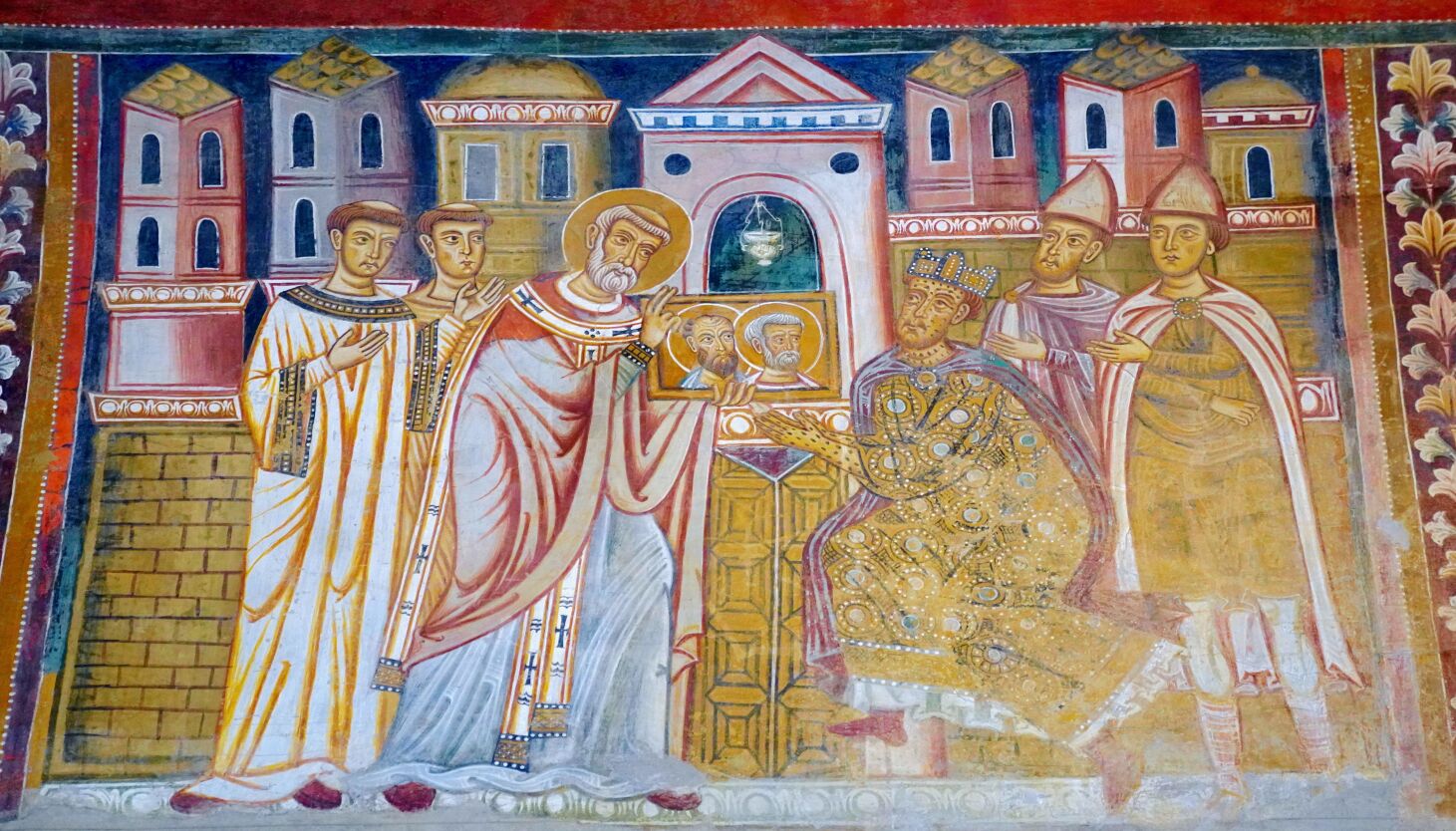
The truly ground-breaking work, however, was De falso credita et ementita Constantini Donatione declamatio, ("Declamation of the falsely believed and falsified Donation of Constantine") in 1440. The Donation of Constantine was largely believed (argued against, but still believed) as the foundation for papal authority over temporal lords.

Lorenzo took a close look at the text of the document that purported to be a formal imperial decree from the 4th century. His extensive familiarity with the development of Latin over the centuries helped him realize it was written in a style more appropriate to a less-educated writer from the 8th century.

Not only was the language wrong for the premise, he argued three other points:

1. There was no legal authority by which Emperor Constantine could have given Pope Sylvester I the powers claimed in the document.

2. There was no historical evidence in any records that there were administrative changes in the Western Roman Empire.

3. His own doubt that Constantine cared enough about the pope to give him anything.

The Church, understandably, rejected this theory. 

Lorenzo was put on trial by the Inquisition in 1444, ostensibly for supporting Alfonso V of Aragon in a territorial dispute over the Papal States.

Lorenzo Valla died 1 August 1457. It did not get formally published until 1517 and became popular among Protestants. Thomas Cromwell had it translated into English in 1534. The Donation eventually became recognized by all as a fake.

So why did I title this with the phrase "Early Modern Scholar"? Shouldn't he be labeled "Renaissance Scholar"? Many historians refer to the Renaissance as "Early Modern" now; the reasons why I look forward to explaining tomorrow.

27 September 2022

The Donation Hoax

The Donatio Constantini (Latin: "Donation of Constantine") was a document in which the converted Emperor Constantine, whose Edict of Milan ended Christian persecution, gave the popes authority over the western part of the Roman Empire.

The 5th-century "Legend of St. Sylvester" tells about the relationship between Constantine and Pope Sylvester I. In it, Sylvester cures Constantine of leprosy, who then converts to Christianity. Following this, Constantine grants to Sylvester authority over Rome, Antioch, Alexandria, Constantinople, Jerusalem, and all churches, as well as any estates that are attached to churches. The oldest manuscript of the story is from the 9th century, but it is not until Pope Leo IX (pope from 1049 - 1054) that it gets used to affirm the supremacy of the papacy over temporal lords. It became a valuable tool in the argument, especially with the Holy Roman Emperors, that the pope's decisions and decrees superseded anyone else's. There was plenty of legal opposition to the idea, especially starting with Otto III, but no one denied its authenticity.

Then, in 1440, a Catholic priest named Lorenzo Valla took a close look at the document. He was a specialist in Latin translation, and something about the document did not look right. His familiarity with numerous Latin documents of all types and all times led him to the conclusion that, rather than an official document from the 4th century, it was a poorly written forgery from the 8th century, and therefore a hoax. 

Why was he motivated to chop down the chief pillar of papal authority over secular powers, when he himself as a priest could benefit? He might have had a personal reason, which I will look into and share next time.

26 September 2022

The Donation of Pepin

The idea of actual Papal States giving the pope serious temporal power really took off in 756 when Pepin the Short, king of the Franks, gave to Pope Stephen II several territories and towns in the Italian peninsula.

To be fair, the territories were not Pepin's to give, not originally anyway. They were under control of Aistulf, king of the Lombards. A few years earlier, in 751, Aistulf conquered the exarchate of Ravenna. The exarchate of Ravenna was the last piece of Italy considered to be part of the Roman Empire, having been established by Byzantine Emperor Justinian as part of his plan to administer the western part of the fading empire.

Aistulf decided that his conquest of Ravenna and killing of the last ruler of it, the exarch Eutychius, meant he was now the nearest thing to a Roman Emperor. He therefore demanded that Rome itself submit to him and send him a tribute of one gold solidus per person.

Pope Stephen II could not negotiate with Aistulf to back down, so he sent a request to Pepin to come to his aid. The Franks and Lombards were on friendly terms, so Stephen thought Pepin would have better luck. Pepin promised the pope he would arrange the return of the Exarchate of Ravenna. The pope in return anointed Pepin and his sons Charles (Charlemagne) and Carloman as kings of the Franks (they did not need this to be kings, but it was a nice piece of recognition from a figure who was seen as the head of the Christian faith). He also named them patricians of the Romans, an honorary title suggesting they were Roman elite. The pope also pronounced a blessing on Pepin's wife, Bertrada.

So Pepin took his army to Lombardy, surrounded Aistulf's forces, defeated any military opposition, and made Aistulf promise to return Ravenna. A treaty was signed, Pepin turned around to go home, and once he had left Lombardy, Aistulf ignored the treaty. Aistulf besieged Rome. Word went to Pepin. The Frankish army came and forced Aistulf to abandon the siege.

So more than Ravenna became part of the Papal states, because Pepin turned over Lombardy as well and several other cities. Emissaries of the Roman Empire entreated Pepin to give the land to the political empire, not the spiritual papacy, but Pepin would not. The pope would now be a temporal ruler for centuries to come.

You may have heard that there was an earlier gift of land to the pope, called the Donation of Constantine. We will talk about this hoax tomorrow.

25 September 2022

The Papal States

Although the early popes had no temporal power or property, as the Roman Catholic Church grew in popularity and influence, they accrued territory. It started simply, when Constantine gave the Lateran Palace for the pope's use, but the Renaissance saw a significant expansion and increase in the papacy's temporal and political influence.

As the Church grew post-Edict of Milan, donations of and (or buildings to be used as churches) followed from well-to-do Christins. These were all initially treated as property privately held, not as property of a political entity. This may have helped when the Roman Empire crumbled under attacks: Odoacer's overthrow of Romulus Augustus in 476, and the later rule by the Ostrogoths, would have made the Church's position more precarious if it were seen as a political rival. At this time, however, it was just a private "corporation," so to speak. The pope could be a dutiful subject under the new (and potentially hostile) administrations, while still professing spiritual authority.

When the Eastern Roman (Byzantine) Empire, headquartered in Constantinople, decided to reconquer the Western Roman Empire from the Goths, it set in motion a chain that would pass more temporal power to the popes. True, the East managed to regain much territory in Italy between 535 and 554, but the fighting left the economy in disarray. This made it easier for the Lombards to enter from the north and proceed to conquer most—not all—of the territory held by Constantinople.

The remaining strip of land stretching diagonally from coast to coast and including Rome. As the Eastern Empire's ability to manage these lands from far away waned, they increasingly left the popes in charge, since by this time the popes were the single largest landowner. At some point, these lands and others became known s the Duchy of Rome.

As their temporal power grew, of course, it led to severe clashes with other rulers. But then, it was other rulers' generosity that contributed to the papal increase in power. One such example was the Donation of Pepin, which I'll tell you about next time.

24 September 2022

Pope Innocent IV

Innocent IV (born Sinibaldo Fieschi) had a busy decade. He lived longer than that, of course, and was consequential, but there is a lot of uncertainty about him pre-elevation to the throne of Peter. He was born in Genoa, but some sources say it was further south in Manarola. There is a belief that he taught canon law in Bologna, but there is no record of it. Some biographies say he was the Bishop of Albenga in 1235, but from 1230 until 1255 Albania's bishop was named Simon.

One of his first problems as pope was dealing with conflicts between Gregory IX And Holy Roman Emperor Frederick II. One was that Frederick had been supportive of a Sixth Crusade, but then was lax about taking part. Another was that Frederick had captured some territories in Lombardy belonging to the Papal States. Gregory called a general council to vote to depose Frederick, but Frederick captured two cardinals who were on their way. This intimidated the remaining cardinals, who were reluctant to oppose the emperor afterward. Gregory had denounced Frederick as a heretic (he was such a religious skeptic that Dante placed him in the circle for heretics).

Innocent, in his earlier role as Cardinal Fieschi, was on good terms with Frederick, but as pope he had to continue the policies of his predecessors, demanding the return of lands in Lombardy. Frederick refused, of course, and his continued political attacks on papal rule created enough of a hostile environment in Rome that Innocent became concerned for his freedom. He snuck out of Rome in disguise in 1244, making his way ultimately to Genoa. A few months later he went to France, winding up in Lyon where he was warmly welcomed.

In December of 1244 he summoned his bishops to the First Council of Lyon; the goal was to minimize Frederick's authority. It was the smallest general council ever: many members feared Frederick's wrath and did not attend, and bishops from the Middle East and Far East were hampered in travel by (respectively) Muslim and Mongol hostilities (see here and here). (Innocent's attempts at dealing with Mongols shortly after would fail.) The council excommunicated Frederick, throwing Europe into turmoil until Frederick's death in 1250.

With Frderick's death, Innocent felt safe in returning to Italy. He also doubled down on the idea that he hd the right to interfere with secular politics. He appointed Afonso III in Portugal. He helped Henry III of England buy a title in Italy, even though Henry had been giving trouble to Archbishop Edmund Rich.

In other news, Innocent formally approved the Order of the Poor Clares, named for Francis of Assisi's friend. (In the picture above, he is granting charters to Franciscans and Dominicans.) He reversed earlier popes' orders to round up and burn copies of the Talmud, being convinced by a team of rabbis that the Talmud was a foundation for them to be able to understand the New Testament.

His time as pope has been woven through this blog for years, and it was high time he got his own titled post to bring some of these references together in one place.

Speaking of things that get mentions and might deserve a fuller explanation, the Papal States have been mentioned above, as well as here and here. Let's explain what they were and how they got started.

23 September 2022

Who's the Pope?

With the recent posts on rival popes and antipopes, it may be worthwhile to examine the title "pope" a little.

From the start, St. Peter was recognized as the bishop of Rome, and his position was considered a sort of "first among equals." His successor (so far as we know; we cannot always be certain of such early records) was Pope Clement I, who may be the Clement mentioned by Paul in his first letter to the Corinthians. Pope Clement wrote his own letter to the Corinthians, in which he tells them to be unified and heal a schism that was dividing them. It is considered the earliest example of the bishop of Rome acting authoritatively over far-flung Christians. There is no evidence that his right to instruct them was questioned. In fact, the Ethiopian Orthodox Church considers Clement's letter part of the New Testament.

We refer to him as "Pope Clement," but there is no evidence that he used that title himself. The first bishop of Rome to be referred to as pope (from Latin meaning "papa," but you knew that) was Damasus I (c.305 - 384), who grew up benefitting from Constantine's Edict of Milan granting protection to Christians. In fact, since "pope" meant "father," it could be and was used for bishops. Pope Leo I (called "the Great"; 440 - 461) called himself Pope, and from his time forward that title was reserved for the exclusive use of the bishop of Rome.

Rome became a suitable resting place for the bishops of Rome when Constantine granted them the use of the Lateran Palace (see photo), but sometimes the politics in Rome became unstable and prompted the pope to re-locate, not always by choice. In the 1200s the papal court could sometimes be found in Viterbo, or Orvieto or Perugia. When a pope died, the College of Cardinals would meet in his location to hold the Conclave to elect a successor.

Then there was the pope who fled Rome in disguise because of the Holy Roman Emperor. He just happens to be a pope whose time in office—ten and a half years—includes numerous references to items mentioned throughout this blog. I can't wait to tell you more.