14 February 2024

Anselm versus Rufus

The professional relationship between Anselm of Canterbury and King William II of England was as rocky as any similar pairing through England's Middle Ages. The ongoing debate over lay investiture—secular lords appointing priests and bishops—was ripping apart the continent as well, leading to rival popes. Anselm, like those before and after in his position as Archbishop of Canterbury, wanted the clergy to be independent.

Even as Anselm was being invested as archbishop and it seemed he and William had reconciled their differences, William made a move that caused the first big clash. William's father, William the Conqueror, had left him England, but William Senior's original possession of Normandy on the continent went to his elder son, Robert Curthose. William Junior wanted to rule Normandy as well, so planned a takeover. Plans like this required soldiers and supplies, and those required money. The quickest way to raise cash was to tell everyone to give you some.

So William sent to Anselm, asking for £1000. Anselm offered £500. William felt he was owed money for Anselm's new position (something called annates, which maybe we'll go into someday). Anselm decided to pursue his own agenda. He asked William to fill all the vacant church positions and allow Anselm to enforce canon law. William refused. Anselm withdrew any offer of funds, saying "that he [Anselm] disdained to purchase his master's favor as he would a horse or ass." William was said to reply that he didn't want Anselm's money or blessing for the endeavor, because "I hated him before, I hate him now, and shall hate him still more hereafter."

Anselm really wanted to make his appointment official by receiving a pallium from the pope; William had refused Anselm's travel for this purpose earlier. A meeting of nobles and bishops gathered to discuss this. William ordered the bishops not to treat Anselm as their archbishop, and they caved to the king. The nobles, however (many of whom did not approve of William's rule) supported Anselm. Secretly, Anselm asked two men to travel to Pope Urban II and request the pallium. They were Bishop of Exeter William of Warelwast (uncle of Bishop of Exeter Robert Warelwast mentioned here) and Archbishop Gerard of York.

They persuaded Urban to send a papal legate with the pallium. The legate met with the Bishop of Durham, who represented the king (and had argued against allowing Anselm to go get the pallium himself). William agreed that he would support Urban (over Antipope Clement III), in exchange for the right to block papal legates and intercept any papal letters to clerics. This was unacceptable, so William tried to sell the pallium to anyone who would take it and replace Anselm. No one would take it (or the price was too high). He tried to get money from Anselm for the allium; Anselm refused. William then wanted to personally put the pallium on Anselm, but Anselm refused again: this act would suggest that the king had the authority of a pope over the archbishop.

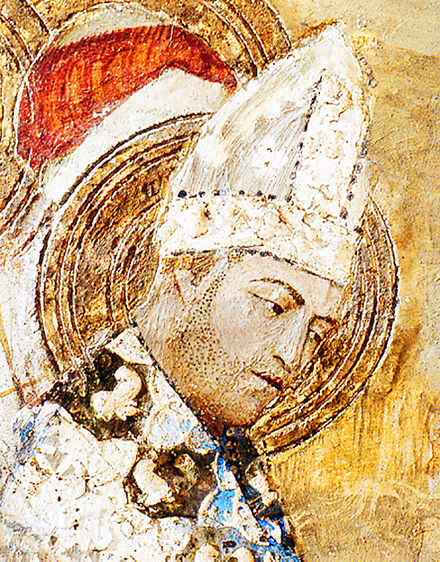
Finally, the pallium was placed on the altar at Canterbury Cathedral, and on 10 June 1095 Anselm placed it on himself (seen above in a 20th century representation by E.M.Wilmot-Buxton).

A few months later, Urban would declare the First Crusade. William continued to deny Anselm's attempts at reform and church independence, and Anselm even had to go into exile. But it was around this time that he wrote the most consequential piece of Christian theology in the Middle Ages, an essay titled Cur Deus Homo. It's time to talk about that.

13 February 2024

Anselm Becomes Archbishop

Anselm of Bec was the natural successor to Lanfranc as Archbishop of Canterbury, but King William II "Rufus" left the see vacant so he could appropriate the revenues of its estates to himself. At Christmas 1092, William swore that no one would take the position at Canterbury while he was alive. Anselm decided it was not a good idea to pursue the position in opposition to the king, so he stayed away from England.

A few months later, William fell ill—so seriously ill that he feared that this was a punishment from God for his sinful ways. In order to atone, he summoned Anselm to hear his confession and administer last rites. Anselm was actually back in England, having been begged by the Earl of Chester to help establish a new monastery. (This was a Benedictine monastery dedicated to St. Werburgh; the abbey church is now Chester Cathedral.) William undid some of his horrible acts by releasing captives and promising to rule according to the law. He also nominated Anselm to take the position at Canterbury.

The monks at Canterbury were all for it—they carried him to the church and pushed the crozier into his hands (see the 19th-century illustration of the event)—but Anselm himself claimed advanced age (he was 60) as a reason to deny the position. Also, he was still officially abbot at Bec, and Bec refused to allow him to abandon that position. Negotiators were chosen to arrange the matter. Anselm in August gave William his conditions for assuming the archbishopric.

  • William had to return the church lands he had seized
  • William needed to accept the Gregorian Reforms
  • William needed to listen to Anselm in spiritual matters
  • William had to reject Antipope Clement III and support Urban II (William had not yet chosen sides)
William accepted these terms, but a few days later changed his mind and blocked Anselm's appointment. Public pressure made him relent, and he returned all the lands of Canterbury on the day Anselm was invested, 25 September 1093.

Traditionally, to become archbishop meant being given the pallium by the pope, and Anselm wanted to travel to Rome for that purpose to make it official. The Investiture Controversy (see several recent posts) made this dangerous. The Holy Roman Emperor and the pope in Rome had been at odds and were constantly each declaring the other deposed. This also led to the antipope situation mentioned above. William had not yet decided which pope he would support, so was not going to send Anselm to either one. Anselm was invested without a pallium.

So, let's sum up: Anselm was now Archbishop of Canterbury, Canterbury's lands were returned to it, William Rufus had repented and chosen to become a better king, and Rufus and Anselm were now on the same page. One of those statements is inaccurate, and we will be looking at the continued conflicts between Archbishop and King (and whether anyone was the winner) tomorrow.

12 February 2024

Anselm of Canterbury

Anselm of Canterbury has been referred to in this blog a few times by one of his other names, Anselm of Bec. He was born 1033/34 in the Upper Burgundy (Italy) region. His parents were both from noble families. His father was a Lombard noble, Gundulph; his mother, Ermenberge, was the granddaughter of Conrad the Peaceful, one-time King of Burgundy. Unfortunately, wars in Burgundy caused partitioning and transferring of territory, and Anselm's parents lost many of their estates.

The loss of political power in the family did not matter to Anselm, who at the age of 15 decided to pursue a religious life. His father opposed this, and Anselm fell ill for a time, perhaps psychosomatically, after which he gave up on education and acted the carefree youth. When Ermenberge passed away, possibly when giving birth to Anselm's sister, Gundulph became obsessively religious himself and entered a monastery when Anselm was 23. Anselm left home with a single attendant and spent the next three years wandering through Burgundy and France.

His wandering drew him to the Benedictine Abbey of Bec, whose abbot was the renowned and learned Lanfranc. When Anselm's father died, the young man asked Lanfranc's advice: return home and use the wealth of the family's remaining estates to provide alms for the poor, or give them up altogether and become a monk? Lanfranc, feeling his advice would be a conflict of interest, sent Anselm to Archbishop Maurilius of Rouen. Maurilius told Anselm to become a novice at Bec. Anselm was 27.

Anselm threw himself into his studies at Bec, and in his first year produced his first of many writings, a fictional discussion of grammar that resolves some of the inconsistencies and paradoxes that arise from Latin nouns and adjectives. It begins:

Student. Concerning (an) expert-in-grammar I ask that you make me certain whether it is a substance or a quality, so that once I know this I will know what I ought to think about other things which in a similar way are spoken of paronymously.
Teacher. First tell me why you are in doubt.
S. Because, apparently, both alternatives—viz., that it is and is not [the one or the other]—can be proved by compelling reasons.
T. Prove them, then.
S. Do not be quick to contradict what I am going to say; but allow me to bring my speech to its conclusion, and then either approve it or improve it.
T. As you wish.
S. The premises
(i) Every/Everything expert-in-grammar is a man,
(ii) Every man is a substance,
[link]

It is heavily influenced by Boethius and his writings on Aristotle.  It is not casual reading for anyone today.

In 1063, when Anselm was 30, William the Conqueror asked Lanfranc to become abbot of a new abbey William built at Caen in Normandy. The monks at Bec elected Anselm to become prior, a lesser role but the person in charge in the absence of an abbot. He maintained a strict Benedictine Rule; after 15 years he was finally named abbot.

Bec attracted students from all over due to its reputation for learning during Anselm's time in charge. He continued to write, and he fought for the abbey's independence from secular influence, as well as from religious influence from people such as the archbishop of Rouen. Bec was enhanced by being granted lands in England after 1066. Anselm would sometimes visit England to check on the abbey's estates, to appear before his secular lord, William, and to visit Lanfranc, who by now was Archbishop of Canterbury. Anselm impressed William, and he was probably by then on a "short list" of candidates for Archbishop of Canterbury to succeed Lanfranc.

When Lanfranc died in 1089, however, William was gone and the throne was held by his son, William II "Rufus." Rufus had other plans. I'll tell you about Anselm's rocky path to archbishop next time.

11 February 2024

Matilda's End

Matilda of Tuscany had become a powerful woman with a great deal of influence in northern Italy. She had a big concern, however: she was the last of the House of Canossa, and there was no one to whom to leave her position and possessions. She needed an heir. A daughter born of her first marriage to Godfrey the Hunchback, Beatrice, died within a few weeks. She also wanted allies in her ongoing hostility with Hole Roman Emperor Henry IV, and political marriages were a traditional way to make allies.

In 1089, she married Welf (the illustration is their marriage from a 14th century history by Giovanni Villani), who in 1101 would become Duke of Bavaria. Matilda was in her 40s by now, and Welf was a teenager. Cosmas of Prague in his Chronicle of Bohemians records a letter from Matilda to Welf:

Not for feminine lightness or recklessness, but for the good of all my kingdom, I send you this letter: agreeing to it, you take with it myself and the rule over the whole of Lombardy. I'll give you so many cities, so many castles and noble palaces, so much gold and silver, that you will have a famous name, if you endear yourself to me; do not reproof me for boldness because I first address you with the proposal. It's reason for both male and female to desire a legitimate union, and it makes no difference whether the man or the woman broaches the first line of love, sofar as an indissoluble marriage is sought. Goodbye.

This "letter" is now considered fictional, but it is a clue from a contemporary historian regarding what he thought the motivations would be for the teen to marry Matilda. There were 120 days of wedding festivities. Cosmas also suggests that Welf was reluctant to act the proper husband; whatever the reason, the two separated by the spring of 1095. There was no annulment or divorce, but the two were no longer together. Matilda had another idea for an heir, however.

Around 1099, she turned to her allies in Florence, the Guidi Family, adopting one member of the family, Guido Guerra. He appears in records as adoptivus filius domine comitisse Matilde ("her adoptive son accompanied count Matilda"). Unfortunately for Guido, she donated all her possessions to the Apostolic See at Canossa in 1102. Guido, realizing he had nothing to inherit, left her side. If she had not adopted Guido or made the donation, Welf would have inherited, since there is no record of the marriage being dissolved. She cut them both out of the picture with what is called the Matildine Donation.

That seems to be another story, however. Scholars now believe the Matildine Donation is a faked document from the 1130s, long after her death. The pope did not want Canossa's ownership to go outside of Italy to Bavaria, which it would have done because of the marriage to Welf. So the Church faked the Donation.

In reality, references to the Matildine Donation are only found in religious documents, not in any other secular collection of records. In her later years, Matilda had better relations with Henry IV's heir, Henry V. In May of 1111, Henry V visited her, and from that visit apparently came an inheritance agreement that Henry V would be her heir and all hostilities and penalties that had been imposed upon her by her opposition to Henry IV would be dropped.

Matilda's life became quieter in her final years. Donizo of Canossa, a monk, wrote a history of the House of Canossa, part of it especially focusing on Matilda. She continued to promote the arts and literature, especially religious literature. One work dedicated to her was the Orationes sive meditationes ("Prayers and Meditations") by Anselm of Canterbury.

She died on 24 July 1115, but her prominence in life led to legendary status in death. She became known (erroneously) as the sole benefactor of several churches and monasteries in northern Italy. She can be seen at night at the Savignano Castle, riding a white horse during the full moon. A fountain she asked the pope to bless can get a woman pregnant with a single drink from it. Scholars looking at the Investiture Controversy give her plenty of attention.

Anselm of Canterbury (also known as Anselm of Bec), who dedicated a work to her, was not an ordinary figure. Despite being Italian by birth, he rose to the highest clerical position in England, Archbishop of Canterbury. He also wrote what was probably the most significant work of theology in the history of Roman Catholicism. Let's look at him tomorrow.

10 February 2024

La Gran Contessa

After Matilda of Tuscany's mother and husband died (from old age and assassination, respectively), Matilda became the sole Margravaine of Tuscany. There was suspicion about the "convenient" death of her husband and whether she had somehow engineered the assassination. There was also a rumor that she had been having an affair with an "old family friend," Pope Gregory VII.

She increased the animosity against herself by going to Lorraine to claim her dead husband's lands in Verdun. Godfrey the Hunchback, however, had willed it to his nephew, Godfrey of Bouillon. Godfrey was understandably opposed to this, and also argued that she should not have the estates that had been given by Godfrey's father when he married Matilda's mother. The debate went before Bishop Theodoric of Verdun, who pleased himself and the pope by ruling in Matilda's favor. (Godfrey went on to became historically famous in other ways.)

Her first large-scale political event was providing military protection for Pope Gregory when he traveled north to meet with Holy Roman Emperor Henry IV during their conflict—as Margravaine of Tuscany and heir to Canossa she technically controlled all the passes across the Apennines. Henry decided to travel south, however, and meet Gregory on Henry's terms. Gregory had excommunicated Henry and placed Germany under Interdict (so no one in Germany could receive any Sacraments). German nobles had told Henry he had to submit to the pope within a year or be deposed.

Learning of Henry's approach, Matilda told Gregory to come to Castle Canossa for safety. There was no danger, however: it turns out that Henry was coming to do penance. At the end of January 1077, Henry stood outside the gates of Canossa, barefoot in the snow, for a few days to show his sincerity. He had his wife and son and some others with him. The pope finally forgave him.

Matilda likely had a significant role in the negotiations that followed, given her political position as well as her role as host at Canossa. She continued to make waves, fighting later with Henry. Her court became a center of art and culture in northern Italy, and she became known as la Gran Contessa. She encouraged scholars to publish their works. We have a psalter written at her request by Bishop Anselm of Lucca. Johannes of Mantua made a commentary in the Song of Songs. Several works were also dedicated to her, which she had copied and distributed.

As the years went by, she became mindful of the fact that she was the last heir to the House of Canossa. Her search for an heir led to a second marriage to a man 20 years younger. That didn't work out, but she thought of another option. I'll tell you about those tomorrow.

09 February 2024

Matilda of Tuscany

Matilda of Tuscany (c.1046 - 1115) was one of the most important figures in Italy in the second half of the 11th century. After the deaths of her father and brother, she ruled from the Castle of Canossa in northern Italy. She was said to be literate in Latin, French, and German; some believe she was taught military strategy as well, along with riding and weaponry.

As a strong female, she had a role model in her mother, Beatrice of Lorraine, who managed the regency of Matilda's brother Frederick and made alliances with other important political and religious figures. Beatrice was supportive of church and papal reforms, such as those proposed by Pope Gregory VII. Beatrice re-married; her choice of second husband was Godfrey the Bearded, Duke of Upper Lorraine, who had openly rebelled against Holy Roman Emperor Henry III. Henry, angered by her choice of his enemy as her husband, had Beatrice and Matilda arrested in 1055 and taken to Germany (Godfrey evaded capture). Henry died a year later, and the regency of his successor, the very young Henry IV, saw Godfrey reconciled with Henry's family and the women released. Upon their return to Italy, the pope (now Victor II) made clear that he valued the House of Canossa.

Matilda was understandably not inclined to look kindly on the family of her German captors. She supported Pope Gregory and his reform movement over Henry IV's choice of the Antipope Clement III. This led at a later date to Henry's forces ravaging parts of Tuscany.

Matilda was betrothed to Godfrey the Bearded's son from an earlier marriage, Godfrey the Hunchback. The elder Godfrey died on 30 December 1069 in Verdun, and records of the event tell us that Matilda was present and describe her as the wife of Godfrey the Hunchback.

The marriage was a way to consolidate Tuscany and Lorraine, but it was otherwise not typical. The two had a daughter, Beatrice, who died within a year, and the couple lived apart. Godfrey, perhaps because he learned from family history the dangers of crossing the Holy Roman Emperor, chose to support Henry IV in the Investiture Controversy, despite his wife's feelings and public stand on the matter.

By this time Beatrice—still co-regent with her daughter—was preparing her daughter for sole rule, encouraging her to be in charge of decisions and charters. When Beatrice died in 1076, Matilda became sole ruler of her parents' real estate possessions. Life was not simple, however. Godfrey had been assassinated (while relieving himself) two months earlier; if Beatrice had died first, Matilda's husband would have taken possession of her estates. As it happens, the deaths happened within a couple months in just the right order to make Matilda more powerful.

Suspicion fell on her for their deaths, as well as another accusation regarding her relationship to the pope. Let's dig into that, and into her career as ruler, next time.

08 February 2024

War in Rome

After King Henry IV of Germany and Pope Gregory VII clashed over several issues, Henry decided to depose Gregory and put Guibert of Ravenna on the Throne of Peter as (antipope) Clement III. Henry promised to bring his army to Rome to accomplish this, but failed in his first attempt in 1081. A later attempt succeeded, however.

Henry marched into Rome on 21 March 1084. Pope Gregory barricaded himself in the Castle Sant'Angelo, which meant abandoning the papal complex. Three days later, Clement III took possession of the papacy. In return, he crowned Henry as Holy Roman Emperor.

Gregory had allies, however, one of whom was the powerful King of Sicily, Robert Guiscard. Robert brought his Norman army to Gregory's aid, prompting Henry and Guibert to abandon Rome. On their way north, Henry ravaged parts of Tuscany which were possessions of Matilda of Tuscany, who had supported Gregory. Guibert went to Ravenna, where he had been archbishop, and wielded limited power.

Although Gregory was free to resume his job as pope, Romans were upset at damage done by his Norman allies. Opposition to Gregory grew great enough that he decided to live at Monte Cassino. He died a year later, on 25 May 1085. His immediate successor (Victor III) did not relish the public life of the papacy, and did not last long before he retired. His successor was Urban II, who also had problems because of German support (and some in Rome) for Clement. Clement returned to Rome in 1089, taking up residence at the Vatican and forcing Urban to stay away from Rome.

The King of France's brother, Hugh of Vermandois, marched on Rome to deal with the antipope, prompting Clement this time to flee to Monte Cassino. Hugh captured Monte Cassino as well, however, and Clement fled to Albano, a day's journey from Rome. By this time, however, Urban had died, and Paschal II was the pope of the anti-Germany faction.

Guibert/Clement died on 8 September 1100, having outlived two popes who were his opposition and who failed to depose him. His supporters elected another antipope, Theodoric, who never wielded any real authority and lasted a year.

Who was this Matilda of Tuscany, who supported Gregory and suffered because of Henry IV? Let me tell you about la Gran Contessa tomorrow.

07 February 2024

Antipope Clement III

The awkwardness about antipopes is that they take names that are later taken by official popes. One has to keep them straight in the historical record, because antipopes often rule for a time because they have a faction of cardinals (and rulers) and the general populace that supports them and carries out their rulings and policies. Today I want to take a look at Antipope Clement III (seen here supporting the election of Holy Roman Emperor Henry IV, from a chronicle by Otto of Freising).

He was born Guibert of Ravenna in the 1020s. Family connections helped get him appointed to the Imperial chancellorship of Italy in 1058. The appointment came from Holy Roman Empress Agnes, mother and regent for the young Henry IV. In 1061, he supported Honorius II as pope instead of Alexander II. When Germany and Empress Agnes decided to support Alexander II as the one true pope, Guibert's support of Honorius was condemned and he was dismissed from the chancellorship.

Guibert was not completely out of favor: he kept contact with the German court, and when Henry IV became Holy Roman Emperor, he made Guibert Archbishop of Ravenna. Pope Alexander II was a little reluctant to confirm to a high position in the church a man who had opposed his papacy, but to keep peace with Germany he confirmed Guibert in 1073.

In that same year, Alexander died and Gregory VII became pope. Gregory tried instituting several reforms, among which were eliminating simony (purchasing appointments), making the clergy independent of secular courts and influence, and denying secular authorities the right to appoint clergy. Archbishop Guibert spoke out against these reforms, no doubt endearing him to Henry IV. Guibert refused to attend Gregory's Synod on these matters in 1075, so Gregory suspended him.

Emperor Henry IV was opposed to Gregory's reforms; his Synod of Worms in 1076 resolved that Gregory was deposed; several Transalpine bishops agreed. Gregory excommunicated them, including Guibert. The Transalpine bishops and prelates gathered in April 1076 with Guibert presiding and declared pope Gregory himself excommunicated.

In 1080, at a further synod in June, Henry declared Gregory deposed (again) and Guibert elected as Pope Clement III. Henry promised his new pope that he would march with his army to Rome and make the papal election official. He failed at first, but ... well, let's continue this tomorrow.

06 February 2024

Pope Urban II

The reign of Pope Urban II was barely more than a decade, but he made some decisions with profound effects for centuries. He was born Odo of Chatillon c.1035, and began studies at the Cathedral school of Reims in 1050. He progressed rapidly and became the grand prior at Cluny. Pope Gregory VII named him the Bishop of Ostia (a suburb of Rome) about 1080. He was a champion of the Gregorian reforms involving moral integrity of clerics and their independence from secular courts.

Pope Gregory VII died in 1085, having named three potential successors. The first, Desiderius, was a pious man who had devoted his life to not being in the public eye, and remained in the office as Victor III for a mere 130 days, after which Odo of Chatillon was made pope by acclamation, taking the name Urban II.

Urban's first challenge was the antipope Clement III, who had been installed by Holy Roman Emperor Henry IV in 1085 after Henry's clash with Gregory over the Investiture Controversy (see Gregory's link above). Urban had to avoid Rome because of Clement, but he traveled around northern Italy and France, holding synods to promote reforms against simony, clerical marriages, and issues of the Holy Roman Emperor and the antipope. (Clerical marriages—rather, the practice of keeping mistresses—were dealt with in England and France simply by instituting a heavy tax on mistresses.)

He became involved in political issues when he supported the rebellion of Prince Conrad against his father, Henry IV. He helped arrange the marriage of Conrad to Maximilian, the daughter of Count Roger I of Sicily (she brought a large dowry that helped Conrad in the fight against Henry).

He also negotiated a compromise between Anselm of Bec and William II of England, which brought him England's support against the antipope.

Urban's most profound undertaking was to preach the Crusade in 1095 (see illustration), starting a papal policy of trying to assert control over the Holy Land that lasted for centuries. He was motivated by a request from the Byzantine Emperor Alexios I Comnenos, asking for help against the Turks. Urban offered remission of all sins for those who "took up the Cross."

He also gave Roger of Sicily the authority to appoint bishops, to forward the church revenues to Urban, and to sit in judgment over ecclesiastical issues—the exact opposite of what the Investiture Controversy with Henry IV was supposed to resolve! Other secular rulers did not get these privileges, which led to problems later with Roger's heirs.

Urban died in 1099, in Rome. Had he, then, eliminated the antipope Clement? Not really. Clement outlived and (in some sense) out-reigned Urban. Let's look at the anti-papacy of Clement II tomorrow.

05 February 2024

The Hospital Brothers of Saint Anthony

In 1095 CE, Gaston of Valloire (or of Dauphiné) founded a religious order, sanctioned by Pope Urban II (who also called for the First Crusade that same year). It was named for St. Anthony the Great, by whose intercession Gaston believed his son had been cured of the disease that then came to be known as St. Anthony's fire.

Gaston and his son built a hospital near the Church of St. Anthony at Saint-Didier de la Mothe, which was administered by the new order, the Hospital Brothers of St. Anthony. It was dedicated to caring for victims of St. Anthony's fire, which was the cause of frequent epidemics.*

The Hospital Brothers were laymen, and though they cared for the poor and sick who came to visit the shrine with relics of St. Anthony at the nearby church, they did not always get along with the community of Benedictines who tended the church and shrine.

The Hospital Brothers wore black with a a blue Tau ("T") cross. The Tau cross was affiliated with St. Anthony, but we are not sure why. He was not executed on one, as some suggest (he died in his bed). One theory is that he had a T-shaped staff on which he would rest. The laymen eventually evolved into a monastic order with the blessing of Pope Honorius III (who also sanctioned the Dominicans) in 1218; 30 years later they adopted the Rule of St. Augustine and were declared canons regular by Pope Boniface VIII.

Now the "Antonines" were a fully-fledged "rival order" to the nearby Benedictines; each group felt they had primary responsibility for the relics of Anthony. Hostilities arose until the pope gave custody of the shrine to the Antonines and sent the Benedictines to Montmajour Abbey, 130 miles away.

The success of the hospital motivated them to expand. By the 15th century there were 370 hospitals in France, Spain, Italy, and Germany run by the Order of St. Anthony. They were caring for many illnesses, including the Black Death. Their popularity declined after the Reformation, especially when the link was discovered between St. Anthony's fire and ergot, after which incidents of the disease fell sharply. Their donations and influence dwindled, and in 1777 they were subsumed into the Knights of Malta. The last hospital, in Hochst, Germany (see illustration), was closed in 1803. In Memmingen, Germany, you can see a museum to the Order, on the site of one of their hospitals that was opened in 1214.

The man who first sanctioned the Order and called for the First Crusade, Urban II, did a lot more in his decade as pope. Let's dig into his career tomorrow.


*For those who don't like to click links, St. Anthony's fire was caused by ergotism, although some of the symptoms could also be the result of erysipelas.

04 February 2024

Ergot Poisoning

The term "ergot" refers to a group of fungi that grow on rye and other grains. The illustration shows a stalk of wheat with a growth that is part of the life cycle of the fungus Claviceps purpurea, the chief source of ergot. The fungus produces alkaloids that, when consumed by mammals, produces ergotism, or ergot poisoning.

There are two main symptoms of ergotism. There are convulsive symptoms that range from mild such as headaches, nausea, diarrhea, and vomiting, to severe: spasms, mania, and psychosis. There is also a set of gangrenous symptoms because of the vasoconstrictive nature of ergot: loss of circulation in the fingers and toes that can lead to loss of the fingers and toes themselves.

Ergot could also affect the nervous system and make the sufferer feel sensations on the skin without any external source. In the Middle Ages this was called St. Anthony's Fire.

Although ergot could infect other grains, rye was the likeliest source in the Middle Ages. Rye was considered a less desirable grain for bread than wheat, and was therefore the grain of the poor—which covered most of the agricultural population. Grains infected with ergot are darkened. Ergot-infected grains in a bushel of wheat would stand out from their color and could easily be picked out. The darker rye would more easily hide the infected grains, especially once it was ground into flour.

Medieval doctors had no cure, and so people turned to divine intervention. The 12th-century chronicler Geoffroy du Breuil recorded outbreaks in the Limousin region of France, where cures were attributed to Saint Martial. An outbreak in Paris in 1129 was cured by relics of St. Genevieve.

Ergot's life-cycle starts in the ground. The spores that produce ergot can survive for one year, and cannot germinate if buried more than an inch below the surface. As it turns out, simple crop rotation, that puts a non-grain crop in a field that held a grain, can cause the ergot present to die out without a host. Also, this post (from almost exactly 10 years ago) explains how the mouldboard plow was better at turning over the heavy soil of Europe, which could help to bury the spores deep enough to prevent germination.

In the words of the sixteenth-century physician Paracelsus. “All things are poison, and nothing is without poison: the dose alone makes a thing not poison.” Claviceps purpurea has produced other compounds thanks to modern science. Ergotamine, for instance, is used for the treatment of migraines because of its vasoconstrictive ability. The drug LSD was synthesized in 1938 from lysergic acid, which is derived from ergotamine.

Because a cure was attributed to St. Anthony, a hospital was founded in his name to treat others. Let me tell you tomorrow about the Hospital Brothers of Saint Anthony. See you then.

03 February 2024

The Apostle of the Gauls

Gregory of Tours tells the story of the 3rd century Pope Fabian sending seven bishops to different parts of Gaul. One of them, Martial, went to Limoges, where he was very successful at converting locals to Christianity. After his death, his burial site outside of Limoges became an important pilgrimage site, growing in popularity over the years and generating many stories of miracles.

The 9th century Miracula Martialis ("Miracles of Martial") gives an idea of how popular he was: it pushes his origin story earlier in time so that he was made a bishop by St. Peter himself (illustrated here in a fresco from the Palais des Papes in Avignon, commissioned by Pope Clement VI from Matteo Giovannetti).

The Miracula gives him credit for evangelizing all of Aquitaine and miracles such as reviving a dead man by touching him with the staff given to him by Peter in the illustration. The medieval compendium of saints' lives called the Golden Legend adds casting out demons to his repertoire.

Martial's intercession was invoked during an epidemic of ergot poisoning in 994. The staff mentioned above (more accurately, a staff that is said to have been Martial's staff) is kept in the Basilica Saint-Seurin in Bordeaux and used in processions during outbreaks of illness to invoke his aid.

His importance in southern Gaul and link (however fictional) to Peter made him attractive to Clement VI, leading to the above-mentioned chapel. His burial site became the Benedictine Abbey of Saint-Martial with a library second only to Cluny's. The chronicler Geoffroy du Breuil worked in the library. The Abbey was damaged so badly in the 19th century that little remained; some manuscripts had been bought by King Louis XV and were therefore saved and are noe in the Bibliotheque Nationale.

Ergot epidemics were quite common in the Middle Ages, so divine intervention was frequently sought. Let's talk about ergot poisoning in the Middle Ages next.

02 February 2024

The Pope's Artist

When Pope Clement VI wanted to build a new chapel connected to the papal complex in Avignon and have it lavishly decorated, he called on Matteo Giovannetti. Giovanetti (c.1322 - 1368) was in his 20s at the time, and according to the oldest documentation we have about him, he was a priest.

He received a large salary to lead a team to design and decorate chapels, the Grand Audience room (where the pope meets visitors), the Consistory (where the pope meets with the cardinals), and more. He created altarpieces and paintings that the pope would offer to churches and monasteries.

One of his chief projects was to paint the new Saint-Martial Chapel, begun in 1344, attached to the Tinel, the pope's grand dining hall. The chapel's paintings tell the life story of Saint Martial in 13 scenes. Giovannetti even worked Clement into one of the frescoes (see illustration).

He also decorated the chapels of St. John located below the chapel of Saint Martial. He included events in the life of John the Baptist as well as John the Evangelist, including their parents. The frescoes deteriorated over time, but in the 1990s a restoration program began.

Giovanetti remained employed by the popes after Clement's death. He accompanied Pope Urban V on Urban's return to Rome in 1367. We are told that he worked on paintings at the Vatican Palace. It is the receipts for his payment that allow us to identify his works and track his movements. After 1368, however, we have no records for him, and we do not know where he ended up or how long he may have lived after that. In 1368 he was only in his late 40s, and his lifestyle would have kept him well-nourished and housed, so "old age" seems an unlikely ending. We simply do not know anything more about him, but the Vatican records allow us to give attribution to his work—not always the case for medieval art.

Why was Saint Martial important to Clement VI, so much so that he was the subject of a new chapel? I'll explain next time.

01 February 2024

Clement's Preferences

Clement VI (1291 - 1352) was a different pope from some of his predecessors. One of his first acts was to promise gifts to every cleric who came to Avignon to present himself to the pope in the first two months of his papacy. This attempt, apparently, to buy loyalty, along with Clement's move to reserve appointing abbots so that he could use the appointments as favors, was justified by saying "Our predecessors did not know how to be pope." (Incidentally, so many clerics appeared in Avignon that the estimate was made that the number of clerics in all the parishes of the world was around 100,000.)

His favoritism did not stop there. A mere four months after his election, he created several new cardinals, three of whom were his nephews. During his reign, he created cardinals of nine relatives. This practice of promoting a pope's relatives gave rise to the term "cardinal nephew." It was fairly standard practice, although his predecessor only created one and his successor only three.

Unlike Benedict before him, Clement had no intention of leaving France for Rome, and set about on a building campaign to expand the Avignon papal complex. Benedict had built a palace—the Palais de Papes—that suited his tastes as a Cistercian. Clement, however, was accustomed to more grand living, and added extensively and opulently to it. A new chapel dedicated to Saint-Martial was attached to the Palais and filled with hunting and fishing scenes—more suited to a king's decor than a pope's—and he had large tapestries installed.

Fortunately for him, Benedict's organizational skills and less-extravagant lifestyle left Clement with a large treasury with which to carry out his plans of elegance. He hired composers and musicians of the Ars Nova style to always be around, including Philippe de Vitry.

Clement died on 6 December 1352, aged about 60. He had suffered from kidney stones for many years. At the end, a tumor broke out into an abscess and fever, and he died within a week. His elaborate tomb (see above) was surrounded by 44 statues of his relatives; he had planned it himself and commissioned the sculptor; it was ready prior to his death. (In 1562, Huguenots destroyed the 44 statues.) Historians agree that Clement may have been a good pope in many ways, but he was not a holy person.

The artist who decorated Clement's new chapel was Matteo Giovannetti. He did quite a lot of work for Clement, and stuck around after that. I'll tell you more about him and his papal projects tomorrow.

31 January 2024

The Pope and the Plague

One of the major events during the reign of Pope Clement VI (1291 – 6 December 1352) was not of his making. He had been pope for four years when plague landed on his shores in 1347, spreading throughout Europe and killing one-third to one-half of the population within a few years.

Clement believed the Plague was the result of God's wrath, but that did not mean he was willing to stand idly by and let the results speak for themselves. He consulted with astrologers for the physical cause and looked for ways to mitigate the effects. One of the team that proposed a conjunction of Saturn, Jupiter, and Mars in 1341 as its origin was Johannes de Muris, who had been brought to Avignon by Clement in 1344 to aid in calendar reform. Another of Clement's advisors was his personal physician Guy de Chauliac, seen here bandaging the pope's leg (in a painting from 20th century artist Ernest Board).

The advice of his physicians was to surround himself with fire to fight off the plague-inducing vapors in the air; stories tell that he had two raging fireplaces on either side of him while he worked. He did not, however, just sit in his palace: he involved himself in supervising care of the dying and burials. There was so much death that cemeteries ran out of space. Clement consecrated the Rhône River—the entire 500-miles—so that bodies could be thrown in and it would be considered proper burial along its length in France and Switzerland.

Because there was condemnation of Jews for the Plague in some areas, he released two papal bulls on the subject, on 6 July and 26 September, condemning the violence against the Jews. The second stated that those blaming the Jews were seduced by the Devil, because:

It cannot be true that the Jews, by such a heinous crime, are the cause or occasion of the plague, because through many parts of the world the same plague, by the hidden judgment of God, has afflicted and afflicts the Jews themselves and many other races who have never lived alongside them.

Six cardinals died in 1348. One of Clement's solutions was to make his nephew a cardinal, even though his nephew was only 18 years old! (Twenty-two years later he would become Pope Gregory XI.) Clement's favoritism was one of the ways he was distinctly different from his predecessor, Benedict. I want to talk about Clement's more "worldly" tendencies next time.