23 November 2024

Odo of Bayeux

William the Conqueror had two half-brothers, due to his father having an affair with Herleva of Falaise, who later had two sons after marrying. One half-brother was Robert of Mortain; the other was Odo of Bayeux.

We don't know when he was born, but William made him a bishop in 1049, when we assume he was at least 18 years old (a stretch, yes, but William could do what he liked in Normandy as its duke). A "best guess" for his birth is c.1030.

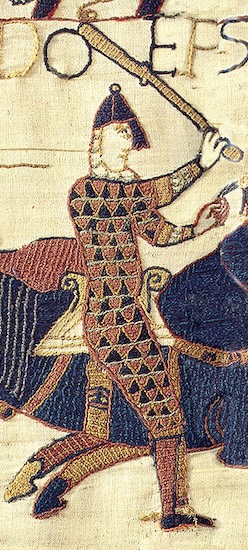
Being made a bishop was often a way for a lord to reward a subject with a respectable title and the revenues from tithes and property values of the diocese, so there is no reason to assume Odo was a priest in anything more than name. His time in the historical record is more about being an advisor to William and a warrior who took part in the Norman Invasion of England and following battles. The illustration from the Bayeux Tapestry shown here has him wielding a club against the Saxons at the Battle of Hastings in 1066.

Why a club? Some say that as a priest he was forbidden the use of a sword, but the club was a cheaper and common weapon, capable of doing great damage to an opponent. William himself is shown with a club later in the tapestry. He also had with him a retinue that would have surrounded him and kept him safer than a typical soldier.

After the Conquest, the time came for rewards. William valued his half-brothers, granting them titles and lands. Odo became Earl of Kent in 1067 and remained a royal advisor, sometimes acting as regent when William was out of the country.

Unfortunately, he got a little too big for his mitre and did something that caused him to lose some lands. After that, he made an even bolder move that led to imprisonment. Tomorrow we'll look at how the mighty can fall.

22 November 2024

Herleva of Falaise

There have been many references in this blog to the children of lords by their mistresses, but we've given very little attention to the women. Let's look at the reason William the Conqueror was called "the Bastard."

Herleva of Falaise was a Norman woman who was the mother of William by his father, Duke of Normandy Robert I. Orderic Vitalis writing a generation or two later said that her father was Fulbert, Robert's chamberlain. William of Malmesbury wrote that Herleva and Robert were later married, but if that had actually happened in William's lifetime then he would have been legitimized and not called Bastard.

Supposedly Robert was high atop one of his towers when he looked down and saw Herleva. She was engaged in the process of dyeing leather by trampling on it barefoot in a tub filled with dye. The story goes that she looked up and saw him watching her, so she lifted her skirts a little more than necessary to show off her legs. Robert ordered that she brought through the back door to meet him, but she refused such a humiliating method, and insisted she would have to enter the castle on horseback through the front gate.

The duke was too anxious to have her join him that he agreed, and a few days later, cleaned up and dressed well, she rode on a white horse through the front gate of the castle. His son William was born in 1027 or 1028.

More realistically, she married Herluin de Conteville in 1031, viscount of Conteville (although that title may have come later, granted him by his step-son, William, after William came to the dukedom). With Herluin she had two sons, Robert of Mortain and Odo, the bishop of Bayeux. They also had two daughters, Emma and another, both of whom made good marriages to nobles.

Robert de Torigni claimed that she was buried at the Abbey of Grestain, a Benedictine monastery founded by Herluin. The statue above of her is in Huy, Belgium, which claims to be her country of origin.

Her other son was Odo, who (like Robert of Mortain) was highly valued by their famous half-brother. Odo became a bishop, and may be the person who instigated the creation of the Bayeux tapestry, which is not a tapestry, but we'll explain that tomorrow when we talk about him.

21 November 2024

Robert of Mortain

When William of Normandy decided to conquer England, he planned carefully. This was going to be a big undertaking, and he needed help and advice. A large amount of that help came from his half-brother, Robert, Count of Mortain (c.1031 - c.1095).

William of Malmesbury (writing decades later, to be fair) described him as crassi et hebetis ingenii, "thick and dull of character." There is also his reputation for having physically abused his wife, mentioned in the biography of Vitalis of Savigny. Vitalis either threatened him with dissolution of the marriage, or left his service which so bothered Robert that he repented of his ways.

Robert and William shared a mother, Herleva of Falaise, who was also the mother of Odo of Bayeux, who became a bishop. As Duke of Normandy, William had jurisdiction over the county of Mortain. A 12th century poet, Benoît de Sainte-Maure, wrote that Duke William exiled a prior Count of Mortain named William Werlenc and replaced him with Robert. When the planning for the Norman Invasion of England began, Count Robert was part of the council and promised 120 ships, a larger number than any other source.

Robert is also included among the definitively known companions of Duke William in the Battle of Hastings. Trying to identify from records those who were present—and those who appear on the Bayeux Tapestry—has been a pastime for historians (fewer than two dozen have been "confirmed"). In the scene above one can see "Rotbert" at William's left side and Odo on his right, showing the importance of his half-brothers to the duke.

For his participation, Robert received from William an enormous amount of land. By the time the Domesday Book recorded all real estate and ownership, Robert held 797 castles, mostly in Cornwall where he held so much that he was functionally "Earl of Cornwall" even though he did not formally hold the title (the first Earl of Cornwall was officially Brian of Brittany, who also was a supporter of Duke William).

In 1069, Robert led a force northward that slaughtered many Danes in Lindsey, after which he drops out of the records except for the mention in Domesday. He was succeeded as count by his only son William, the 2nd Earl of Cornwall, who was offered Mary of Scotland, the daughter of King Malcolm III of Scotland, for his bride, but turned her down. He had three daughters.

Speaking of women and wives, let's turn to Robert's mother, Herleva, for tomorrow's post. See you then.

20 November 2024

Vitalis of Savigny

In the 1170s, a canon of the Church of Saint-Evroult in Mortain (in northwestern France) wrote about a man who had died 50 years prior but whose legend lived on and needed to be recorded. The author was Stephen de Fougères, and the subject was Vitalis of Savigny.

Drawing from details in the mortuary roll (a monastery's record of prominent members who died), we learn little of Vitalis' origin except that he was born c.1060 and had a brother and a sister in a family that was not very prominent. At some point he was ordained and became chaplain to Robert of Mortain.

Robert of Mortain had founded the Church of Saint-Evroult in 1082, and made Vitalis a canon there. After a time, however, Vitalis felt the need for a more purely ascetic life. In 1095 he left Saint-Evroult and began a hermit colony with two others, Bernard of Thiron (who had already been a hermit for a time) and Robert of Arbrissel, the founder of Fontevraud Abbey.

Vitalis became known for his preaching to those who came to hear and/or join the hermitage, and for helping locals. One of his known activities was persuading prostitutes to enter proper marriages. He also traveled, apparently concentrating on Normandy but also visiting England. He tried to reconcile Robert Curthose with his brother, Henry I of England, whom it could be argued "stole" the kingship from the elder Curthose.

One of the incidents that was sufficiently noteworthy to be mentioned in the mortuary roll was his influence on his first patron, Robert of Mortain. The story goes that Robert was physically abusing his wife (probably Matilda, his first wife), and that Vitalis ended that behavior in one of two ways. One version of the incident had Vitalis threatening Robert with dissolving the marriage. A different version says that Vitalis cut ties to Robert and left over his disgust at Robert's behavior. Robert repented, and sent people to bring Vitalis back and begged his forgiveness (and presumably mended his ways).

Between 1105 and 1120, Vitalis founded a nunnery called Abbaye Blanche ("White Abbey"; possibly so-called because they wore habits of undyed wool) at Mortain and set up his sister, Adeline, as abbess. She was later canonized by the Catholic Church.

Between 1112 and 1122 (the year of his death) he founded the Savigny Abbey (see the remains above), a necessity because his life and works as a hermit drew so many people who wished to stay that some organizing principle was needed to manage so many. The Benedictine Rule was initially followed, but by 1150 it became Cistercian.

Vitalis' own sainthood was established in 1738 by the Cistercians, but his canonization by the Catholic Church was never recognized.

His first patron, Robert of Mortain, has a connection that is worth mentioning. Not just some ordinary nobleman, he was half-brother to William the Conqueror, and has some significance in history, which I'll explore further tomorrow. See you then.

19 November 2024

Dalon Abbey

In 1114, the ruler of Salles in France—Gerald de Salles, a French monastic reformer—wanted to found an abbey in the town of Sainte-Trie. He was a friend of the founder of Fontevraud (in French, Fontevrault) Abbey (where nobles like Eleanor of Aquitaine and Richard I would be interred), and wanted a Benedictine monastery there. In fact, he wanted several: he founded many Benedictine houses as well as communities of hermits.

The abbey was initially supported by donations from a couple knights, some other nobles, and the bishop of Limoges. Gerald's successor, a hermit named Roger, expanded into a "chain" of monasteries under the umbrella term "Order of Dalon," named for the Dalon River Valley.

In 1142, several monasteries in France and abroad were reforming themselves by adopting the more strict Cistercian Rule. Dalon Abbey in Saint-Trie and its daughter houses joined the Cistercian Order in 1162 under the command of its third abbot. Dalon opted to be a daughter house of the Cistercian Pontigny Abbey (also founded in 1114 as a Benedictine Abbey by a relative of Bernard of Clairvaux). This brought it to the attention of the Plantagenets, and Henry II, Eleanor of Aquitaine, and Richard I all became patrons and offered it their protection.

The well-known lord of Hautefort and troubadour Bertran de Born retired there as a monk after the death of his second wife. A son from that second wife, also named Bertran, joined him.

Much of the abbey compound has fallen into ruin. It is now private property, and the surviving structure has been adapted into a private dwelling (see above).

I mentioned that Gerald de Salles set up "communities" of hermits, which seems like a contradiction. Gerald was a follower of Vitalis de Savigny, whose simple lifestyle was an inspiration. Vitalis is venerated in the Catholic Church as a saint, who is not listed as a patron saint of anything in particular, but if he were, it would be of preventing wife abuse. I'll explain tomorrow.

18 November 2024

Baron Bertran de Born

When Henry the Young King attacked his brother Richard in 1183, he had the support of a lord of Hautefort. Hautefort was surrounded by provinces in the hands of Henry II of England or his sons, and so was affected by their politics.

In 1183, the lord of Hautefort was Baron Bertran de Born, son of Baron Bertran de Born. Bertran junior had two brothers with whom he co-ruled the area, but like the sons of Henry II, the brothers did not necessarily get along. While Bertran supported Henry junior against Richard, Bertran's brother Constantine sided with Richard. For this reason, Bertran drove Constantine out of the castle they shared.

After young Henry's death in June 1183, Richard sought retribution against those who sided with Henry. With the help of Alfonso II of Aragon, Richard returned Hautefort to Constantine. Henry Ii stepped in, however, and gave the castle back to Bertran.

Why would Henry II have a side in this fight? Perhaps because Bertran was also a troubadour. He wrote love songs and political songs. He wrote songs criticizing Richard I and Philip Augustus of France when they delayed setting out for the Third Crusade.

Bertran loved fighting s much as the two Henrys. One of his poems, translated by Ezra Pound, reads

I tell you that I find no such savor in eating butter and sleeping, as when I hear cried "On them!" and from both sides hear horses neighing through their head-guards, and hear shouted "To aid! To aid!" and see the dead with lance truncheons, the pennants still on them, piercing their sides.

As a friend and supporter of Young King Henry—they probably spent time together on the "tournament circuit" (that's Bertran jousting in the illustration from a 13th century manuscript)—Bertran wrote a lament for him that was very moving. It is possibly this that made Henry II choose to return Hautefort to him, since Henry really wanted his son to thrive and succeed him, despite the rebellions.

Bertran (born in the 1140s) married twice, with children from each marriage; when his second wife died in 1196, he retired to a Cistercian abbey. One son, Constantine, joined him there. Another son, Bertran, also became a troubadour.

His legacy is three dozen manuscripts that are certainly his and a handful of others that might be attributable to him. In later years, a rumor started that he egged Young Henry on to rebel, and so his name became connected with creating discord. Dante even puts him in Hell, beheaded.

The abbey he joined, Dalon, had a history of change, and was special to the Plantagenets. I'll tell you about it next time.

17 November 2024

Young King Henry, Part 3

When Henry II of England crowned his son, Young King Henry, as a co-ruler, he could not have predicted that the son would attempt to overthrow him rather than wait until the father died on his own. The younger had been given little authority of his own originally, but after the rebellion he was given more autonomy. This gave him the funds he wanted to travel about with William Marshal, attending tournaments and making a name for himself.

For some reason, however, Henry had a falling out with William in 1182. A contemporary historian who knew William wrote a biography of him, in which he suggested that the problem was William having an affair with young Henry's queen, Marguerite of France. Henry's sending his wife back to France in 1183 might support this notion, but a modern historian thinks he did this just to keep her safe because he was starting another family war.

Young Henry demanded the Duchy of Normandy be handed into his care. This would give him a strong revenue stream. His father kept Normandy, but agreed to increase his son's household budget. Frustrated, young Henry demanded his brothers Richard and Geoffrey pay homage to him for their lands (Aquitaine and Brittany, respectively), since he would be their king some day. Richard refused, but Henry made alliances with some of the barons in Aquitaine who did not like Richard. War broke out, with Henry senior joining Richard to defend Aquitaine.

While young Henry was pillaging monasteries for funds to pay mercenaries in June 1183, he came down with dysentery. Seeing that he was dying, he received last rites on 7 June. On his deathbed, he sent word to his father that he wished to be reconciled. Henry senior would not come to see him personally—an overabundance of caution told him it might be a trap—but he sent a ring in token of his forgiveness. Young Henry died on 11 June, clutching the ring.

His body was carried to be entombed at Rouen Cathedral (see illustration). He had run out of money, and his funeral procession had to rely on charity as they traveled. His mother, Eleanor of Aquitaine, lobbied with others to have him declared a saint. The Archdeacon of Wells even wrote a sermon stating that there were miraculous happenings around the funeral escort as it traveled. Nothing came of this.

Despite his patricidal leanings, he was considered a good and charismatic figure. Gerald of Wales called him "admirable for gentleness and liberality... had a commendable suavity... commended for his easy temper... remarkable for his clemency." The Occitan troubadour Bertran de Born called him "the best king who ever took up a shield." Bertran even joined Henry in the war against Richard. What could a troubadour bring to the fray? Well, he was also a baron, and we will learn more about him next time.

16 November 2024

Young King Henry, Part 2

King Henry II of England followed the one-time Capetian practice of having your son and heir crowned king in your lifetime to prepare for the succession. I suppose this created an expectation in the heir that might have made him eager to take over sooner rather than later. In the case of Henry, the Young King, this is how it played out.

Young Henry was born in 1155, crowned in 1170 (aged 15), and married to the daughter of the king of France in 1172 (aged 17; making him potentially king of both countries), rebelled against his father in 1173 (aged 18).

Contemporary chroniclers pointed out that he had been given to lands of his own to rule. (His older brother, Henry's first-born William who died at the age of 2, had been named Count of Poitiers at birth; no such designation came to Henry junior.) Also, lack of funds for his lifestyle was given as a reason.

Henry senior had determined in 1169 how he would leave his kingdom to his sons. Young Henry would receive England and Normandy (Richard would get Aquitaine and Geoffrey would get Brittany). He had his sons' pledge fealty to Louis for their future continental lands. Louis probably took this opportunity to poison the sons' minds against their father. Henry's rule was strict, and one could not predict how long he would live. Inheritance looked a long way off (born in 1133, Henry senior was only 36 at this point).

Then Henry senior decided to be kind to his youngsters son, John, in a move that might have triggered young Henry's rebellion. John had nothing; their father even called him "Lackland." But Henry decided he would give John three castles as part of what he would bring to a marriage with Alice of Maurienne. The castles were in young Henry's territory.

Henry junior was not the only one interested in taking control from Henry senior. Richard and Geoffrey were eager to get complete control of their promised lands. Eleanor of Aquitaine had been treated poorly by her husband and joined her sons' rebellion. William Marshal, a rich and powerful lord who was young Henry's companion, supported the rebellion, as did Louis VII and the counts of Brittany, Flanders, and Boulogne. Some earls of England—Robert de Beaumont of Leicester and Hugh Bigod of Norfolk—also felt it was time to depose Henry II.

They all failed; some of them were killed in battle, like Matthew of Alsace, Count of Boulogne, who failed to recover from a crossbow bolt wound. Hugh Bigod had all his lands confiscated and his Thetford Castle destroyed.

William the Lion of Scotland took the strife in England as an opportunity to attack the north in spring of 1174. Henry II was fighting in Normandy, and arrived back in England on 8 July. He had to stop in Canterbury and do penance for the murder of Thomas Becket. Before Henry could head north, however, his right-hand man in the north, Ranulph Glanvill, captured William at Alnwick. Henry was free to g back to the continent to defend Normandy against his sons.

The rebellion was put down, the sons all pledged loyalty to their father again, they were forgiven for being led astray by older lords and advisors, and all was right with the world.

For a time. We will wrap up the (short) life of Henry the Young King tomorrow.

15 November 2024

Young King Henry, Part 1

Henry II of England and Eleanor of Aquitaine were married in 1152 and had a son in 1153, but William died in 1156 at the age of two. On 28 February 1155, their second child, Henry, was born.

Henry doesn't have any history recorded about his childhood, but in 1170 when he was 15 he was crowned king. (The illustration shows the coronation, with Henry II serving his son at the banquet.) This was a custom of the Capetian dynasty: to ensure and publicly proclaim the succession. Normal practice would have been to allow the son to assume some of the roles of government in preparation for assuming the throne, but Henry II retained control of his government. This not only made junior less capable when the time would come, but also annoyed him to the point where he thought he could take matters into his own hands.

He was given over to William Marshall in 1170 to be trained in the knightly arts. Marshall managed young Henry's "tournament team" (until 1182) and made sure he did not get severely hurt. Going to tournaments and jousts across northern and central France brought young Henry an admirable reputation. A contemporary Occitan troubadour, Bertran de Born, called him:

...the best king who ever took up a shield, the most daring and best of all tourneyers. From the time when Roland was alive, and even before, never was seen a knight so skilled, so warlike, whose fame resounded so around the world – even if Roland did come back, or if the world were searched as far as the River Nile and the setting sun.

This may have been true, or it may have been an attempt to curry favor with the man who would become a powerful ruler in both England and on the continent. To be fair, after his death, Gervase of Tilbury (who acted as Henry's chaplain) said 

Assuredly, as he was a solace to the world while he lived, so it was a blow to all chivalry when he died in the very glow of youth.

During this time, he had funds allocated to him by his father. For a tournament in 1179 held at Lagny-sur-Marne by King Louis VII to commemorate the coronation of his son, Philip II, young Henry brought 200 knights at the cost of 20 shillings per knight per day. Henry led the English team against a Flemish team led by his and Marshal's friend Baldwin of Béthune, whose later life was in the service of English kings, not French.

This extravagance was not to last, however. Lack of funds as well as lack of his own lands to rule would be part of his reason for rebelling against his father. But more on that tomorrow.

14 November 2024

Marriage Alliances

It was expected that kings and other nobles would try to gain alliances (and therefore security) by marrying their sons and daughters to important people in other realms, and King Henry II of England was no exception. He had gained Aquitaine and Poitou on the continent by marriage to Eleanor, and was already Duke of Normandy.

Not all marriage plans come to fruition, however, for one reason or another.

Henry's first plan was to marry his eldest legitimate son, Henry the Young King, to Marguerite the daughter of Louis VII of France. Ideally, their offspring would rule both France and England. They were married in 1172, when Henry was only 17 and Marguerite 14 (it had been negotiated when he was only five). Young Henry died in 1183 from dysentery while rebelling against his father. His one child, a son named William, did not survive. The attempt to bring several territories together failed.

Another son, Richard "Lionheart," was betrothed to another daughter of Louis, Alys, in 1169. But the rumor became that Alys, being fostered in the care of Henry II, became his mistress. As the sister of the new king of France, Philip II, Richard was reluctant to renounce the betrothal. When Henry died in 1189 and Richard was crowned, he broke off the intended marriage in 1190 while speaking with Philip on the Third Crusade. A year later Richard married Berengaria of Navarre.

Alys was offered by Philip to Prince John, but Eleanor stopped it. Alys went on to marry William IV Talvas, Count of Ponthieu, in 1195; she was 35, he was 16.

Another son, Geoffrey, was married to Constance of Brittany, daughter of Conan IV, Duke of Brittany, in order to quell problems of rebellion there.

While Henry II was figuring out how his kingdom would be divided among his sons, he had nothing left for the youngest son, John. John's nickname of "Lackland" reflects this. Looking far afield for some way to use his youngest, he made an arrangement to marry John to Alice, the daughter of Humbert III of Savoy. John was promised to inherit from hi father-in-law Savoy, Piedmont, Maurienne, and other possessions in northern Italy. Alice of Maurienne traveled to England to become a ward of Henry II, but she died before the wedding could take place. John later married twice, both women named Isabella; "local" women whose fathers were important and wanted their grandchildren to rule England.

Political marriages don't always work out as planned.

I've used Henry the Young King mostly as a footnote, but he was much written about while he lived, and accomplished more than being crowned prematurely and dying while rebelling unsuccessfully against his father. I want to dive into his life and motives a little more...next time.

13 November 2024

Eleanor Later

In the later years of their marriage, Eleanor of Aquitaine spent long stretches of time apart from King Henry II. From 1168 until 1173, for instance, she held court in Poitiers. She wasn't idle: she had responsibilities to Poitou and Aquitaine—territories that came to her from her father—and Henry was apparently content to have her stay there and manage them as his regent in the area. Moreover, the weather and lifestyle of the continent might have suited her more than life in England.

Her grandfather, William the Troubadour, had added to the Palace of Poitiers, where she lived, and Eleanor would also add to the original Merovingian structure, with a dining hall so vast that it was called the Salle des Pas Perdus, the "hall of lost footsteps," because the sound of footsteps got lost in the 50 by 17 meter expanse (see illustration).

Henry traveled to meet King Louis VII in January 1169. The purpose was to create alliances by betrothing his son Richard to Louis' daughter Alys. Henry's son Henry was already betrothed to Louis' daughter Marguerite. There is no evidence that Henry visited Eleanor while on the continent. They were together for Christmas 1170 near Bayeaux, and again in 1172 at Chinon.

The couple were together for a week in February 1173 at Montferrand for the betrothal of Prince John to Alice of Maurienne. At this time, the young Henry, who had already been crowned in order to establish the succession, became openly rebellious against his father. Henry II took him to Chinon, but the morning after they arrived found young Henry gone. He had fled to Paris and Louis VII, who supported him as the new king of England.

This started a revolt of his sons (but not John, who was only seven and by his father's side) against Henry II. Later writers found reason to blame Eleanor. William of Newburgh wrote that young Henry went to his mother, where his brothers Richard and Geoffrey were staying, to convince them to join him in overthrowing their father. Newburgh claims Henry had help from Eleanor to convince the two. Roger of Hoveden is more explicit, stating Eleanor deliberately sent the other sons to join their brother.

Whatever the case, it seemed Eleanor did put the resources of Aquitaine behind the rebellion. Going to join her sons in Paris in April, Eleanor was captured by Henry II's men and confined in Rouen. In 1174, Henry II took Eleanor and other nobles back to England to prepare for invasion from France. Eleanor was confined to an unknown location.

Henry senior beat the rebellion, and the sons had freedom afterward, but Eleanor was never allowed to be totally free. Her wealth and reputation were too risky to be allowed to interfere in royal policy. He tried having the marriage annulled on the grounds of consanguinity—which is how she became free to marry him in the first place—but a papal legate advised against it. He then tried to convince Eleanor to become a nun, but she requested the Archbishop of Rouen to persuade Henry to stop. Henry turned again to the pope, but was denied. The only recourse was to keep her under "house arrest" while he lived.

Her life after Henry's death was long and eventful, but would take months to discuss in 300-word snippets, so we will say that she died on the night of 31 March 1204 at the age of 80 and entombed between Henry II and Richard I.

History knows that Prince John was a pretty ineffective king, and of his role in Magna Carta and the trouble with Barons, but what happened to that marriage plan with Alice of Maurienne, and what or where was Maurienne, and was it a good match? I'll go into that tomorrow.

12 November 2024

Eleanor in England

On 19 December 1154, Archbishop Theobald of Canterbury crowned Henry Curtmantle as King Henry II of England. His wife, the former queen of France, Eleanor of Aquitaine, was present. It is not recorded if she were also crowned, but it is undeniable that she was now Queen of England, and one of the most wealthy and powerful women of the Middle Ages.

Her wealth grew, as Henry granted her possessions and a generous financial gifts. She used her money to become a patron of the arts, supporting troubadours and authors of stories of courtly love. Many writers Wace was one) dedicated their works to her.

Henry traveled away from home frequently, putting down rebellions or establishing closer ties to his people. Eleanor sometimes traveled with him, and sometimes traveled around separately with their children. When he was gone and she at home, she acted as regent, sometimes with the help of the justiciar. Although contemporary historians did not write much about her life, we can see how busy she was from all the writs and court documents she signed as regent, signing herself Alienor Dei Gracia Regine Anglorum "(Eleanor by the Grace of God Queen of England").

Their first child, William, was born prior to their coronation in England. He was named William IX, Count of Poitiers. Their second child, Henry (later named "The Young King") was born 28 February 1155. She was pregnant again when Henry left England for a long absence on 10 January 1156. Not long after, the eldest son died, not yet three years old. Eleanor's pregnancy resulted in their third child and first daughter, Matilda. She took the children to France to be with their father, but they all came back to England which resulted in their fourth child, Richard (later "Lionheart") born on 8 September 1157.

Eleanor's first husband, Louis VII, had re-married and produced a daughter, Marguerite. His apparent inability to produce a male heir gave Henry the idea of joining their two kingdoms with an eye eventually to ruling both. He went to France to negotiate with Louis and to take Marguerite to foster until she was old enough to marry. Meanwhile, Eleanor had another son, Geoffrey.

When in England, Eleanor mad decisions for the court. In May 1165 she acted as his regent for Anjou and Maine while Henry as negotiating marriages with hi daughters to cement his relations with Frederick Barbarossa. Not long after, she became less involved in the affairs of state.

All their time apart from each other inspired stories of Henry's affairs. He had illegitimate children, whom he acknowledged. His eldest out of wedlock, Geoffrey of York, for instance, ultimately became an archbishop and joined the court of one of his half-brothers. Henry's best-known lover was Rosamund Clifford, the relationship with whom he acknowledged in 1174.

Although some romantic spark might have faded between the king and queen, she remained important for decades, even after moving from England and spending years apart. I'll explain tomorrow.

11 November 2024

Attacking Henry and Eleanor

When Eleanor of Aquitaine married Henry Curtmantle (the future King Henry II of England), the move felt threatening to many people on the continent. Marrying her provinces of Aquitaine and Poitou to his control of Normandy and Anjou covered a lot of area in Western Europe.

King Louis VII, who had just had his marriage to Eleanor annulled, was threatened by Henry's presence against his borders. He might also have been upset that he just lost Aquitaine and that his ex-wife so quickly married a man who was set to become a rival king with possessions near France.

There were others who were not happy with the Henry-Eleanor alliance. Henry's brother Geoffrey, Count of Nantes, had tried to abduct Eleanor immediately after the annulment, in order to forcibly marry her and obtain title to Aquitaine himself. Geoffrey allied himself with Louis, and three others: Count Robert I of Dreux (Louis' brother), Count Henry I of Champagne, and Theobald V of Blois. They all joined Louis in his attack on Henry Curtmantle's Normandy in 1152, hoping to divide up Henry's and Eleanor's lands among themselves.

They were foiled, however. Normandy beat them back in six weeks from Normandy. Theobald V in late 1153 or early 1154 invaded Touraine, east of Henry's Anjou and considered by Henry to be under his protection. By that time, Geoffrey had reconciled with his brother; Theobald took him captive. His "ransom" was to destroy the castle of Chaumont-sur-Loire (a 10th century castle that was an important site for many royal visits; rebuilt, it exists today). In December 1154, Stephen of Blois died, and Geoffrey accompanied Henry and Eleanor to England for the coronation.

The brotherly love was not to last, however. Geoffrey making trouble for Henry, thinking he was safe on the continent while Henry was in England being king, but Henry laid siege to some of Geoffrey's castles: Chinon, Mirebeau, Loudun, and Montsoreau. Geoffrey lost them to his brother.

There were always conflicts between nobles to be dealt with, and Henry was often away from home with his army, dealing with them. He had, however, a capable queen he could leave as regent in his absence. Next time we will look at the early years of her queenship of England.

10 November 2024

Eleanor on the Run

With the annulment on 21 March 1152 from King Louis VII of France, Eleanor of Aquitaine was now a target for any unscrupulous noble who thought they could possess the province of Aquitaine by marrying her—whether she wanted to or not. She was at Beaugency with Louis during the council that decided on the annulment due to consanguinity (they were third cousins), and left directly from there to head south toward Poitiers (capital city of Poitou) where she would be safe.

There were two times on the journey where she had to evade capture. On the night of the 21st while she passed through Blois, the Count of Blois and Chartres, Theobald V, tried to surround her small retinue. She got on a boat at the Loire and floated down to Tours.

At the border of Poitou, she narrowly avoided Geoffrey, Count of Nantes (son of the Geoffrey, Count of Anjou who was part of the Anarchy, and brother of Henry Curtmantle, who had recently become Duke of Normandy on the death of their father). He was waiting for her at the Port des Piles, but she had been forewarned. After this, Eleanor continued to use rivers and avoided roads.

Once she reached Poitiers and safety, she immediately sent secret envoys to England to speak to Henry, Duke of Normandy. They had met when Henry came to Paris to pledge loyalty to Louis as a vassal of his, since Normandy was part of France. Eleanor must have been impressed by this man 11 years her junior. She wanted him to travel as soon as possible to Poitiers to marry her. Besides being Duke of Normandy, Henry was also Count of Anjou, on the northern border of Aquitaine. An alliance with Anjou would give Aquitaine protection from the north.

Henry received the envoys on 6 April. Six weeks later (eight after the annulment) the two were married on 18 May 1152 in a small ceremony at Poitiers Cathedral without any fanfare. As for consanguinity, Eleanor and Henry were more closely related than she was to Louis, but they did not let that stop them. They kept things quiet to avoid interference from Louis, who would have reason to try to prevent the alliance of all these territories on the continent that would create a force that could challenge his rule, especially since Henry was in line to become King of England. (You might get some idea of just how much of the continent would be out of Louis' hands in the illustration above.)

Louis refused to give up the title Duke of Aquitaine; if Eleanor had a male heir, that heir would come the next Duke, and Louis wanted to keep it for his daughters by Eleanor, Marie and Alice. He made preparations for war. And he wasn't alone: he had allies who were all too willing to join him, in the hopes that they would benefit from victory by dividing up Aquitaine and Poitou.

We will see how that turned out for them tomorrow.

09 November 2024

Louis, Eleanor, Annulment

King Louis VII of France had a problem. His clever and wealthy wife, Eleanor of Aquitaine, was really getting on his nerves. On the Second Crusade, she contributed to a blunder that cost thousands of French lives, and they argued over whether to stay ion Antioch and help her uncle, Raymond of Poitiers, or go to Jerusalem. Louis also (according to Odo of Deuil, eyewitness to the Crusade) suspected her of an improper relationship with her uncle, although that may simply have been because the Aquitainian culture was far more emotional and expressive than the Capetians.

She had also not been able to deliver a son and heir, although after 13 years they had two daughters. With their relationship severely strained after the Crusade, Louis sought a way out of the marriage. For that, Louis turned to Beaugency, an important town at a crossing of the Loire.

Beaugency, coincidentally, had been the site where another royal marriage was a topic: in 1104, Philip was excommunicated by the first Council of Beaugency because he had put away his first wife, claiming se was too fat, so he could abduct and marry another man's wife. The Second Council of Beaugency was called in 1152 to find a way to get Louis out of his marriage to Eleanor. Abbot Suger had been an advocate of the marriage, but after his death in 1151, Bernard of Clairvaux's view that the two were too closely related became an issue.

Also in 1151, Henry, Count of Anjou, became the new Duke of Normandy and went to Paris to pay his respects to his liege lord, Louis. Historians such as Walter Map, Gerald of Wales, and William of Newburgh all suspected that something, some spark happened between the 18-year-old Henry (future king Henry II of England) and the 30-year-old Eleanor that also might have contributed to Eleanor wanting to be released from the marriage.

The archbishops of Reims, Bordeaux, and Rouen attended the Council, presided over by Archbishop Hugues of Orléans. Archbishop Samson of Reims represented Eleanor (who was there, as was Louis).
They settled on annulment on the grounds of consanguinity. Sure, they had a common ancestor, Robert II of France (c.972 - 1031), but that was a long way back and didn't prevent the marriage in the first place. But here they were, looking for a reason, and being third cousins once removed, however distant it seemed, was sufficient. The marriage was declared null and void. Eleanor did not object. Their two daughters were declared legitimate, since the couple had married in good faith. Louis gained custody of the daughters. Aquitaine would remain Eleanor's possession.

One would think that the attractive and wealthy Eleanor would be glad to be free from the stiff and monk-like Louis. She was, however, an attractive and wealthy woman, which in 1151 did not allow her independence and agency. Believe it or not, her life was in peril. I'll explain tomorrow.