“You swear that the books received by you shall be safely kept, exhibited and sold in good faith. You swear that you will not deny them nor conceal them, but that you will expose them at proper time and place. You swear that if you are consulted on the selling price of one or more books, you will give in good faith, reserving your proper commission, an estimation, i. e. , such a sum as you would voluntarily give on occasion. You swear that the price of the copy, and the name of the vendor (the person sworn), if required, shall be placed in some part of the book exposed for sale.”[link]
08 April 2023
Medieval Bookshops
07 April 2023
John de Garlandia
Specifically, it describes a practice already in use, known as modal rhythm, which used the rhythmic modes. In this system, notes on the page are assigned to groups of long and short values based on their context. De mensurabili musica describes six rhythmic modes, corresponding to poetic feet: long-short (trochee), short-long (iamb), long-short-short (dactyl), short-short-long (anapest), long-long (spondee), and short-short (pyrrhic). Notation had not yet evolved to the point where the appearance of each note gave its duration; that had still to be understood from the position of a note in a phrase, which of the six rhythmic modes was being employed, and a number of other factors.Modal rhythm is the defining rhythmic characteristic of the music of the Notre Dame school, giving it an utterly distinct sound, one which was to prevail throughout the thirteenth century.[New World Encyclopedia]
Did a bookshop opener write this work? Evidence suggests that it was written in 1240, before John was born (he lived until 1320, so writing in 1240 was not possible), but his name is attached to it, leading to the assumption that he edited the work, or at least wrote later chapters of it. Some of the records of the time refer to John as magister, however, suggesting that he was a teacher at the University of Paris and not just a seller of books. How much he had to do with this work is unknown, but the connection made to it historically is accepted in the absence of other evidence.
For more on the history of musical notation, see here and here.
For information on bookshops in the Middle Ages, well, you'll just have to come back tomorrow.
06 April 2023
John of Garland
He left Toulouse around 1232 when the Cathars re-asserted themselves and university professors stopped being paid. He fled to the University of Paris, where Roger Bacon heard him lecture. It was this time in Paris that gave him his surname: he explains it is from the Rue Garlande in the neighborhood of the University.
There are over two dozen of his writings known (there are a few titles we know of, but have no extant copies). One was his Dictionarius (shown here), which was not a dictionary as we know it, but a textbook that attempted to teach Latin to French students at the University of Paris. Some credit Garland for the origin of the modern word "dictionary."
Besides works of instruction, he wrote poetry such as the Epithalamium beatae Mariae Virginis (“Bridal Song of the Blessed Virgin Mary”) and his account of the crusade against the Cathars, De triumphis ecclesiae (“On the Triumphs of the Church”). His hostility toward heresy was extended to Jews. To quote an author who wrote about this topic:
Although he never denied the possibility that conversion to Christianity could redeem the Jews, he thought it unlikely they would come over to the Catholic faith or remain steadfast in the religion. His invective was extreme by the standards of the time but was influential in that it appeared in many of his pedagogical works for adolescents and young men at the universities. [Journal of Medieval History, Vol.48, Issue 4]
Despite his time in France, his numerous writings were very popular in England, and were printed and re-printed in the 14th and 15th centuries.
Curiously, there was a second John of Garland who lived and wrote about the same time; this one was a music theorist, and will be our next topic.
05 April 2023
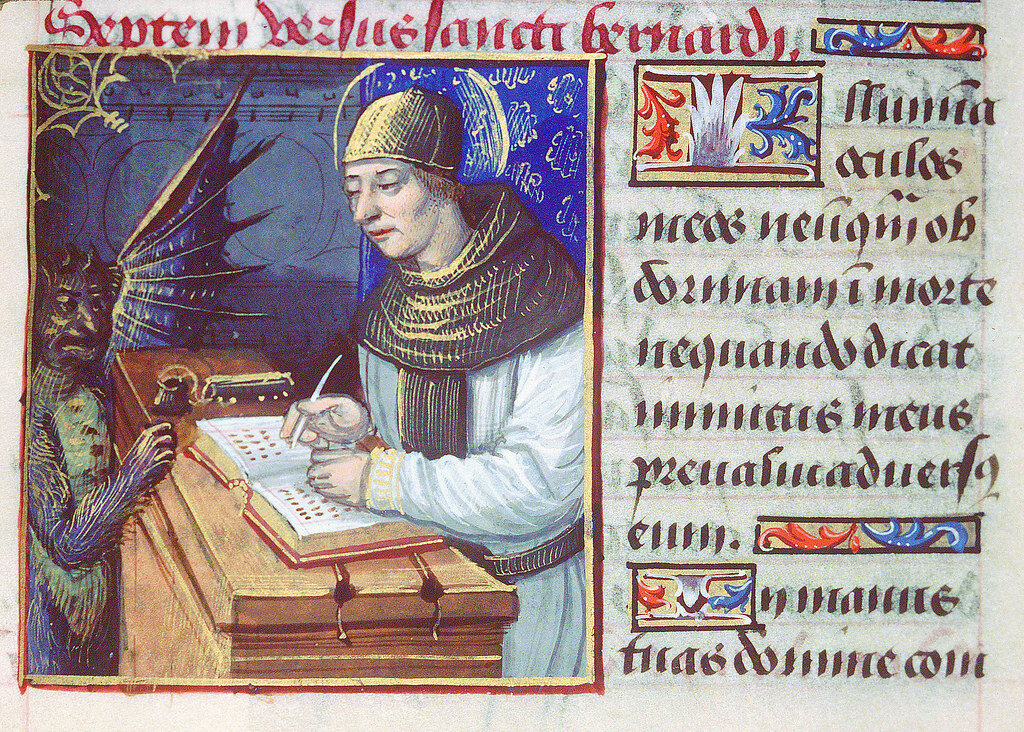
The Recording Demon
The notion of a "recording demon" was popular in the Middle Ages, and went from sermons to physical representations quickly. Here we see two men gossiping (from St. James' Church, Cristow, Devon), and no matter how close and secretive they are trying to be, right above their heads you can see the recording demon taking notes on what they are saying, to be used against them on Judgment Day.
The idea of a recording demon was known in Egyptian monasteries of the 4th century, and was said to visit churches and monasteries and write down the sins that he observed. This demon was ultimately given a name, Titivillus, and he became responsible to some for causing scribal errors. He was used in sermons about acedia, "spiritual sloth": churchgoers who engaged in idle chatter during the service, and priests who mumbled swiftly through the words of the service in order to get done faster.
Another representation of a demon collecting people's words is the "sack-filling demon" or simply "sack demon." Caesarius of Heisterbach mentions this one: a devil in a high place catching the words of people and putting them in a sack. Jacques de Vitry in his sermons mentions the sack demon with an over-filled sack, difficult to handle with the enormous number of inappropriate things said by folk.
The story of the deacon laughing in church was repeated and embellished over time. One version has the deacon criticized by the priest, who does not believe his story. Later, while asleep, he is exonerated when the Virgin Mary places the scroll of the demon's writings on his chest. The scroll proves to the priest that the deacon was telling the truth.
This is told in a poem by John of Garland, of whom I will say more tomorrow.
04 April 2023
The Demon Titivillus
At a time when fear of demons was common, they were "seen" everywhere: causing children to be ill, folk to go mad, cows to dry up, crops to fail, wells to go bad, etc.—they were constantly interfering with human life. One of them was considered the "patron demon of scribes" because he was blamed for errors in manuscripts. His name was Titivillus, sometimes Tutivillus, but in some of the earliest manuscript mentions, their middle letter is unclear and could be n or u/v, so it is written sometimes as Titinillus.
Despite the connection to Caesarius, and a reference in the writings of John of Wales, who died c.1285, as a demon who existed to introduce errors into scribal work, the Oxford English Dictionary's entry attributes the first reference to Peter Paludanus (c.1275 - 1342), who became Latin Patriarch of Jerusalem. The OED suggests the name of the demon might come from Latin titivillitium, a "mere trifle." Titivillus must have been looking over James Murray's shoulder, because Titivillus is clearly found in John of Wales' work long before Peter Paludanus would have been writing. In the Tractatus de Penitentia ("Tract on Sin"), we find
Fragmina verborum titivillus colligit horum
Quibus die mille vicibus se sarcinat ille.
Titivillus gathers up the fragments of these words
with which he fills his sack a thousand times a day.
He gets mentioned in a lot of medieval sermons as a reminder to be ever on guard against error and sloth. Titivillus became a character in medieval Mystery Plays. In the 15th century morality play Mankind, Titivillus is summoned by Mischief and other distractions to make Mankind's life difficult, but only after the audience is asked to pay extra money to make him appear (presumably his costume was suitably fabulous to charge extra). Titivillus' standing as a literary figure fades after that, and Shakespeare uses "Tilly-vally" a couple times when a character brushes off a complaint worthy of Titivillus' sack.
Concerning the phrase "fills his sack." This is not about inducing errors into manuscripts, but something else. Titivillus' career gets conflated with that of other popular medieval figures to watch out for: a "recording demon" and a "sack demon." That's an entirely different post.
Titivillus' presence can still be detected, such as in the fact that the OED (and I cannot believe I have never mentioned it and its mentor James Murray before) misses the earliest reference (but then, I am reading from the first edition; it has been updated). He influences my own work: although I proofread my post hours after writing it and being away, I still miss errors, which are found and shared by a very good friend; I know he is a good friend because he reads daily! (Come to think of it, that friend's name is Nick, and isn't "Old Nick" a name for the devil? Maybe he's trying to undo Titivillus' history of work?)
Well, more demons tomorrow.
03 April 2023
The Prolific Caesarius
Caesarius was the prior (an administrator of an abbey, but not the abbot) of the Cistercian Heisterbach Abbey in western Germany. He wrote Dialogus miraculorum ("dialogue of miracles"), in which a monk tells tales of 746 miracles by saints to a young novice. About 60 versions still exist that were made by hand, suggesting that it was almost as popular as Jacobus de Voragine's Golden Legend.
He also produced sermons, which he claimed he had to make public because monks asked for more detail on his statements. One of his books deals specifically with his interpretation of the phrase Ave praeclara maris stella ("Hail bright star of the sea"), a nickname for the Virgin Mary and a 9th century hymn found in old manuscripts in the Abbey of St. Gall and elsewhere.
In one of his works he wrote about the fairly recent sack of the town of Béziers during the Albigensian Crusade led by fellow Cistercian Arnaud Amalric. Supposedly, when Arnaud was asked how to distinguish between Cathars and Catholics in the town, he said Caedite eos. Novit enim Dominus qui sunt eius ("Slay them all, the Lord will know his own"). This is apocryphal, but is considered the origin of the oft-used phrase "Kill them all and let God sort them out." He also is known for a paradoxical maxim about monasteries: that discipline causes prosperity and then prosperity undermines discipline.
Caesarius complained that his writings were taken and distributed before they were finished and proofread. Perhaps it was in this context that he blamed a demon for errors in his works. That demon was Titivillus, and he will be the subject of my next post.
02 April 2023
The First Mass Murderer
Arnaud was a Cistercian (a branch of Benedictines), who became abbot of Cîteaux from 1202 to 1212. In 1204 he was sent by Pope Innocent III to attempt the conversion of the Albigensians who followed Catharism. His attempts to convert them to mainstream Catholicism did not work, and so his preaching turned to speaking out against them to those who would listen. This was followed by leading a Crusade against Catharism, the first major military operation of which was a 22 July 1209 attack on the town of Béziers in southern France.
In a letter to Innocent in August 1209, he describes the attack:
...while discussions were still going on with the barons about the release of those in the city who were deemed to be Catholics, the servants and other persons of low rank and unarmed attacked the city without waiting for orders from their leaders. To our amazement, crying "to arms, to arms!", within the space of two or three hours they crossed the ditches and the walls and Béziers was taken. Our men spared no one, irrespective of rank, sex or age, and put to the sword almost 20,000 people. After this great slaughter the whole city was despoiled and burnt...
The number 20,000 is clearly an exaggeration, but his description of the wholesale slaughter "irrespective of rank, sex or age" is likely to be more or less accurate. Because the sack of Bèziers apparently did not distinguish between Cathars and Catholics, Arnaud is reported to have said at the time "Kill them. For the Lord knows who are His."
This is considered the origin of an oft-repeated line: "Kill them all and let God sort them out." Arnaud's line was recorded 13 years later by Caesarius of Heisterbach, prior of a Cistercian abbey. Caesarius was not an eyewitness, never met Arnaud, and we have no proof that Arnaud actually said this, but some use the incident to refer to Arnaud Amalric as the first proponent of mass murder.
Arnaud was named archbishop of Narbonne in 1212, after which we hear little about him. He died on 29 September 1225.
As for his imaginative chronicler, Caesarius of Heisterbach, I'll tell you a little more tomorrow, as well as his identification of a particularly unhelpful demon.
01 April 2023
Michaelmas
It was a Holy Day of Obligation until the 18th century, but it is still noted and celebrated. Because it comes shortly after the autumn equinox it is associated with the start of fall. It became the day when a reeve was chosen on a manor to oversee the peasants. In Ireland it was the day rent was due.
Certain foods became associated with Michaelmas, especially because of a legend of St. Patrick. Supposedly, Patrick brought back to life the son of an Irish king who had choked on a goose bone during dinner. The king ordered that a goose be cooked annually in honor of the saint's feat. Starting in the time of Edward IV (1442 - 1483), geese were presented to the landlord by his tenants. Michaelmas was also a day for sheep to be slaughtered and "St. Michael's portion" given to the poor.
Traditionally, Michaelmas was the last day to pick blackberries, after which they were inedible. The legend behind this was that Lucifer, when cast down by Michael, landed in a blackberry bush whose prickles hurt him, so he cursed it to be inedible. Blackberries picked prior to 29 September are fine.
In this post I referred to the date of Michaelmas being different. Because of the correction in the Julian to the Gregorian Calendar. "Old Michaelmas Day" falls on 10 October.
For my next post: you may have heard some version of the phrase "Kill them all and let God sort it out." The man first credited with expressing that idea died on Michaelmas Day in 1225. I'll tell you about an early proponent of mass murder tomorrow.
31 March 2023
To Kidnap a King
He had made many enemies in Europe. The Byzantine Emperor Isaac II Angelos was one, because Richard annexed the island of Cyprus (a Byzantine possession). Holy Roman Emperor Henry VI was angered because Richard supported King Tancred of Sicily, who had usurped the position from its proper heiress, Henry's wife Constance. Leopold of Austria blamed Richard for the murder of Leopold's cousin, Conrad of Montferrat.
So when Richard's ship was wrecked near Aquileia and Richard had to travel over land to get back home, he passed through Vienna, enabling Leopold to capture him around Christmas 1192. Interfering with a Crusader was against papal decree, but Richard had also personally offended Leopold by getting rid of Leopold's banner on the walls of Acre, even though Leopold had been with him at the Siege of Acre. When word got out, Pope Celestine III excommunicated Leopold.
Word got back to England of Richard's captivity, but no one knew where he was being held. He was given over to Henry VI's care on 28 March 1193, who imprisoned him at Trifels Castle. Not only was Henry angered at Richard's previous actions, he also had a goal: conquering all of southern Italy. This required military might, and that required money. Holding a king for ransom was one sure way of acquiring funds.
Henry's status as Holy Roman Emperor made Celestine reluctant to excommunicate him. Richard's treatment was initially respectful, but Richard treated Henry with disdain. Henry convened a council to condemn Richard for the capture of Cyprus, the insult to Leopold, the death of Conrad, and making a truce with Saladin. Richard defended his actions, and explained his lack of respect for Henry's imperial title by saying "I am born in a rank which recognizes no superior but God."
Afterward, Richard was kept in chains "so heavy that a horse or ass would have struggled to move under them." Henry demanded a ransom of 150,000 marks (100,000 pounds of silver). Richard's mother, Eleanor of Aquitaine, now in her early 70s, took action, riding the country to raise funds and writing the pope about the horrible situation. A tax of 25% of the value of property was decreed against layman and all churches. Meanwhile, Richard's brother John and King Philip of France offered Henry 80,000 marks to keep Richard at least until Michaelmas 1194 (29 September in Europe).
Henry did something honorable and refused their offer. The ransom from England came through, and Richard was freed on 4 February 1194. (The illustration shows Richard kissing the feet of the emperor.) Upon his return to England he forgave John's actions and named John his heir (instead of their nephew Arthur, son of their brother Geoffrey).
And now for something completely different: Michaelmas. What was it about, and why did I have to specify "in Europe" above? I'll explain next time.
30 March 2023
Henry VI of Germany
He was born in November 1165, and named King of Germany by his father in 1169. His father made him King of Italy in 1186, the same year that Henry married Constance of Sicily. Constance was the sole heiress of Sicily, but was challenged by her illegitimate nephew, Tancred. Tancred controlled Sicily (with some difficulty) until after 1191.
In 1191, Henry and Constance were proclaimed Holy Roman Emperor and Empress, and they turned their attention to Sicily. Their attempts to take over in Sicily were hampered by the locals' fear of retribution from Tancred if they aided Henry. Even after Tancred's death in February 1194, Sicily remained in his family's control, but in November Henry prevailed. He was named King of Sicily on Christmas Day.
Henry was considered well-educated, learning Latin as well as Roman and canon law. He wrote poetry and was a patron of poets. A German songbook from the 14th century, the Codex Manesse, has three poems attributed to Henry and has a portrait of him, shown above.
He interfered with English politics somewhat. Richard I of England had made an arrangement with Tancred, and so Henry tried to isolate England: he negotiated with Richard's mother, Eleanor of Aquitaine, to break off the engagement of Richard with Alys, daughter of Louis VII of France.
Henry had an even more significant encounter with Richard in 1193, when Richard became Henry's prisoner. More on that tomorrow.
29 March 2023
The Meeting at Erfurt
Louis (1151 - 1190), a nephew of Barbarossa, liked to feud with his neighbors, the nobles of Thuringia in Germany (that's his seal in the illustration). One of them was Conrad of Wittelsbach, the Archbishop of Mainz (c.1120 - 1200).
Conrad was problematic, and very much attached to temporal power. Appointed Archbishop of Mainz by Frederick I, known as Barbarossa, he refused to recognize the antipope Paschal III, put up in opposition to Pope Alexander III. This caused a falling out with Barbarossa, so he fled to Rome, after which Mainz was given to Christian von Buch. Pope Alexander gave Conrad other titles, but Conrad was still considered Archbishop of Mainz. Unfortunately for Conrad, Alexander was forced to accept Christian as Archbishop of Mainz after the Treaty of Venice in 1177, a peace treaty between the papacy and Barbarossa. When Christian died in 1183, Conrad returned to Mainz and resumed his former status, but remembered all the people who had not supported him and instead accepted Christian.
Conrad made enemies along the course of his life, and his falling out with Barbarossa made Barbarossa's nephew Louis opposed to him. While King Henry VI of Germany was traveling through the area on his way to fight Poland, he decided to convene all the region's nobles to insist that they cease the endless territorial disputes. Conrad was not present, but of course Louis was. One record of the latrine disaster claims that Henry and Louis had stepped away to an alcove to discuss matters privately, and were therefore not in the main area that collapsed. Another claims they had to cling to the iron railings of a window frame to save themselves (that would have been very quick thinking).
Either way, they were saved from the terrible outcome. Louis died in 1190 on the Third Crusade. Conrad lived until 1200. King Henry's survival at Erfurt meant he was alive to be made Holy Roman Emperor. We'll talk more about him next.
28 March 2023
The Erfurt Latrine Disaster
In 1184, King Henry VI of Germany held an informal assembly in the Petersberg Citadel. Petersberg is one of the largest and best-preserved fortresses in Germany. This particular citadel included St. Peter's Church (colored green in the illustration), which had been rebuilt between 1103 and 1147 after a fire burned it down in 1080.
During the rebuilding, they updated the plumbing for dealing with toilets. Rather than divert human waste to the streets or a river (the River Gera was on the outskirts, not near the citadel), they dug a sufficiently large cesspit below the foundation, suitable for holding all the waste necessary.
Nobles across all of Thuringia were invited to the meeting with Henry, held on the second floor of the deanery on 26 July. Just as the meeting began, the wooden floor collapsed from the weight, plummeting the participants not only to the ground floor but through it into the cesspit beneath. King Henry at the end of the room sat in an alcove with a stone support, so was safe. (Some reports say he clung to the iron railing of a window until he could be rescued.)
The cesspit was deep and full. Ladders were brought to help people out; however, at least 60 German nobles drowned in urine and excrement, although there are estimates that say it was closer to 100 participants. German sources refer to this as the Erfurter Latrinensturz ("Erfurt latrine fall" but usually called the "Erfurt latrine disaster").
From poop to politics: what was the reason Henry gathered them all together? It was a dispute between secular and religious authorities, which I'll explain tomorrow.
27 March 2023
Medieval Toilets
Much of human history was not so fortunate.
Lacking indoor plumbing, the "privy" or "garderobe" was no more than a cramped alcove with a hole for straddling that dropped waste either to a deep pit or outside. Many castles built their garderobes to jut out from the exterior walls so that waste dropped into a ditch or moat. King Edward I made garderobes a requirement in his extensive Welsh castle-building program.
This design element for castles had one potential problem: the privy that extended out from the walls so the waste could simply fall outside the castle was a potential access point for invaders. An exposed waste shaft at Chateau Gaillard overlooking the Seine in Normandy (owned by King John of England) was low enough to the ground that it allowed forces of Philip II of France to sneak inside. A stone wall was built around the base to prevent further intrusions.
When Mayor Dick Whittington took office, he constructed a 128-seat public toilet facility called "Whittington's Longhouse" that dumped into the Thames so that high tide would flush the waste away. Many municipalities had public toilets, since health and hygiene were important for everyone's safety. They were often placed on bridges over rivers, as in York over the Ouse.
Whatever innovations were designed to drop waste away or flush it away with rivers or tides, there were still unsavory issues to deal with. The smell was always a problem. Also, in situations where refuse was not dropped into rivers but lay where it fell, paid positions were available for people to remove the waste and clean and fix the latrines. Maintenance was important, because unlike the stone example illustrated above, public latrines were built of wood, and wood needed to be replaced occasionally.
Tomorrow I'll share an incident in which architecture failed regarding a latrine. Prepare yourselves.
26 March 2023
What About Soap?
Soap-like materials were being made in Babylon around 2800 BCE, in clay cylinders inscribed with the phrase “fats boiled with ashes.” Egyptians in 1500 BCE were combining animal and vegetable oils with alkaline salts for cleansing. A Roman legend claims that rainwater running down the slopes of Mount Sapo mixed animal fat and ashes, not only producing soap but giving the substance its name.
Pliny described soap as an invention of the Gauls, made from tallow and ashes. Latin sapo ("soap") may be cognate with Latin sebum ("tallow"). The physician Galen recommends soap for cleaning clothes as well as the body.
By the 7th century CE, Mediterranean countries were making soap using oil from the abundant olive trees. Naples even had a guild for soap-makers in the late 6th century. Records for Charlemagne's court list soap as a product the stewards had to account for.
Soap-making in England didn't seem to happen until the 12th century, possibly motivated by the introduction of soaps brought back by Crusaders from the Middle East. Syria, for instance, produced Aleppo soap, a green bar infused with laurel oil. This popular soap was milder and more pleasant smelling than other soaps, and inspired soap-makers to add aromatics to the mix.
Soaps are used for cleaning different things. The soaps used in the household for hand washing, etc., are called in the industry "toilet soaps." That term, as you can imagine, makes me think about medieval toilets, a topic I have never tackled (and only mentioned once) in almost 1200 posts. I think it's time to correct that omission. Stay tuned.
25 March 2023
Medieval Hygiene
For example, the Goodman of Paris, a text written in the early 1390s about managing a household (and mentioned in my post on the hourglass), offers this about hand washing:
To make Water for washing hands at table: Boil sage, then strain the water and cool until it is a little more than lukewarm. Or use chamomile, marjoram or rosemary boiled with orange peel. Bay leaves are also good.
A bowl with water was available for washing your hands and face when you awoke, before meals, when arriving home after a long day's work or a long journey (washing the "dust of the road" from you sounds like a quaint saying today, but centuries ago you arrived home likely covered in dust).
Besides the Goodman, another popular text in Western Europe was the Tacuinum sanitatis ("Maintenance of Health"), a Latin work translated from an 11th century Arabic medical treatise. Numerous versions were produced in the 14th and 15th centuries. It discussed the virtues of bathing with Water of A Pleasurable Warmth:
Nature: Warm and humid in the second degree.
Optimum: The kind that opens the pores with moderate heat or with a fever.
Usefulness: For bodies with open pores; furthermore, it lowers the temperature.
There are also many depictions of people in bathing tubs, such as the one above. Of course, not everyone could afford a tub, or to heat water. Lower classes took advantage of streams and ponds or lakes. No one wanted a build-up of grime on their hands or bodies.
Our old friend Hildegard of Bingen offered a recipe for washing:
...one whose face has hard and rough skin, made harsh from the wind, should cook barley in water and, having strained that water through a cloth, should bathe his face gently with the moderately warm water. The skin will become soft and smooth, and will have a beautiful color.
This is a face conditioner; did they have a face cleanser? Grime could be more easily removed if you had soap. Did they have soap? Let's figure that out tomorrow.