15 January 2024

The Marriage of Poland and Lithuania

In 1385, Lithuania was a very large territory on Poland's eastern border. Poland's throne was held by the pre-teen Jadwiga, who was supposed to marry William of Austria, then Siemovit of Poland, and finally the 30-year-old Jogaila, Grand Duke of Lithuania. An arrangement like this takes a lot of planning and legal wrangling. In the case of Jadwiga and Jogaila, that legal wrangling was embodied in the Union of Krewo, whose document is seen here.

The prenuptial arrangements in the Union of Krewo (called so because it was signed at Krevo Castle) included a certain sine qua non: Jogaila had to convert to Christianity. Poland was a Christian country; Lithuania was exposed to Eastern Orthodoxy on its eastern border with Russian people, but still embraced polytheism. Jogaila was defending Lithuania from Teutonic Knights, who kept attacking under the pretense of a Crusade. He understood that becoming Christian would create an alliance with other countries and pull the rug out from under the Teutonic Order.

The other promises of the document:

  • Conversion of Jogaila, Lithuanian nobles and all pagan Lithuanians to Roman Catholicism
  • Paying 200,000 florins to William of Austria for terminating his engagement with Jadwiga
  • Returning all lands lost in previous Lithuanian-Polish wars
  • Release of all war prisoners of Poland (c.45,000) held by the Lithuanians
  • Attaching Lithuanian lands to the Crown of Poland

In light of these promises, Poland agreed that Jogaila could be their king. In February 1386 Jogaila was baptized by Archbishop Bodzanta. As his baptismal name, he chose Wladislaus in honor of Jadwiga's great-grandfather king Władysław I the Elbow-high.

There was a problem with William of Austria, to whom Jadwiga had been promised nearly since birth. William claimed she was officially married to him, and the marriage to Jogaila made her a bigamist. His protests carried weight with Pope Urban VI, who would not confirm the marriage of Jadwiga and Jogaila. It took a few years until Pope Boniface IX (1389-1404) confirmed their marriage. (Boniface had also similarly supported a certain English arrangement that had raised eyebrows.)

Although this union was the start of four centuries of Lithuania-Poland shared history, Lithuania did not appreciate increasing Polish influence, and Jogaila's brother Skirgaila, who had been left behind to rule Lithuania, was unpopular. This gave Jogaila's cousin Vytautas the opportunity to try to gain more power, leading to a Lithuanian Civil War (1389-92), but that was resolved by making Vytautas Grand Duke while leaving Jogaila as his overlord.

Another complication came from an unexpected source: Jadwiga's sister, Mary, whose husband had become King of Hungary and had his own ideas of what should happen to Poland. I'll go into that next time.

14 January 2024

Jadwiga of Poland

Jadwiga of Poland (c.1373 - 17 July 1399) was the youngest of three daughters of Louis I, King of Hungary and Poland, and Elizabeth of Bosnia. She was named for her ancestor, St. Hedwig.

Her father wanted the inheritor of his throne to be among his immediate family, so he made it clear to the nobles that one of his daughters would be crowned after him. This made his daughters extremely attractive to neighboring royal bachelors, who would gain a throne along with a bride. The Duke of Austria even proposed marriage between his son William and Jadwiga when she was not even a year old. Louis agreed to the Duke's offer, affirmed on 15 June 1378; the marriage would take place when they both came of age. As part of the arrangement, Jadwiga moved to Austria to learn their language and customs.

Jadwiga's oldest sister, Catherine, died in 1378, and Louis had his nobles swear an oath of loyalty to the middle child, Mary. The plan was for Mary to be the heir to Poland and Jadwiga (with William of Austria) the heir to Hungary.

Louis died on 10 September 1382, leaving a widow and two young daughters. Mary was crowned King of Hungary five days later, but her mother arranged that she would run the country on behalf of the 12-year-old king instead of Mary's intended husband, Sigismund of Luxembourg (then only 14).

The nobles of Poland decided they did not like the idea of outsiders ruling Poland, but they could not easily overturn the marriage promise between Mary and Sigismund (who was likely to be the next Holy Roman Emperor, after his father). The queen mother, Elizabeth, released the nobles from the oath of loyalty to Mary (and Sigismund). Elizabeth offered to have Jadwiga named the next heir to the throne of Poland. The assembled nobles liked this plan, and they wanted her to marry a Polish prince, Siemovit IV, Duke of Masovia.

This looked like a good plan, but in the background another plan was forming. The House of Tęczyński was an influential Polish family, and for reasons of their own started negotiations with Jogaila, the Grand Duke of Lithuania. When this became known, Siemovit responded militarily, laying siege to some Polish towns. Delegates from several towns and cities were ready to name him king in order to prevent an outsider from becoming king, unless Jadwiga returned to Poland as soon as possible.

Once Jadwiga was back in Poland and a coronation of a Polish ruler could take place, things calmed down. She was crowned King of Poland on 16 October 1384. Archbishop Bodzanta, who had supported Siemovit originally, threw his support behind the marriage of Jadwiga and Jogaila. It was Bodzanta who baptized Jogaila, presided over their marriage, and crowned Jogaila. (The illustration shows Jadwiga's royal oath being presented by Bodzanta).

King or Queen—what was her title, really? Consensus is that she was crowned king, and her husband would only take that title if she consented. Some scholars think that was only to distinguish her as an actual reigning queen, rather than just a queen consort who had no authority of her own. But contemporary sources refer to her as "king."

How did the marriage go, and their reign afterward? Let's look at the continuing story tomorrow.

13 January 2024

Christian At Last

The conversion of Mindaugas, Grand Duke of Lithuania (ruled 1253-1263), was largely a political move to gain allies, and did not extend to the rest of Lithuania with a mass forced conversion. Some of the population of the territory was Eastern Orthodox, however, because of exposure to the Kievan Rus and other neighbors. This did not bother their rulers, who were usually followers of Lithuanian polytheism.

The Teutonic Order continued to attack the region, claiming they were on Crusade (but also probably just looking to expand territory). Mindaugas' nephew (and later Duke) Treniota convinced Mindaugas in 1260 to ignore his Christian conversion and fight back against the Teutonic Knights. The attempt was ineffective, and Treniota allied with Daumantas, a duke of a northern province of Lithuania, to assassinate Mindaugas. (Daumantas is accused of the assassination of Mindaugas and two of his sons, but since Treniota succeeded Mindaugas as Grand Duke, it is pretty likely that he orchestrated the succession.)

Treniota was a staunch pagan and declared that Christianity was not officially part of Lithuanian culture. Unfortunately, a remaining son of Mindaugas, Vaišvilkas, killed him within a year and made himself Grand Duke. Vaišvilkas actually was baptized in a Greek Orthodox rite, and became so drawn into his new religion that he gave up the throne and founded a monastery, which he entered as a monk.

The ensuing decades include very few records, and we are uncertain of even the names of some of the Grand Dukes. Attacks by the Teutonic Knights continued, however, because Lithuania's rulers were not interested in Christianity.

Politically motivated marriages led to some Lithuanian rulers marrying Eastern Orthodox brides, but these made no lasting influence until Jogaila (c.1352 - 1434). Jogaila's mother wanted him to marry Sofia, the daughter of Prince Dimitri of Moscow. Jogaila would have to become Eastern Orthodox, and Lithuania would become a fief of the Grand Duchy of Moscow. A better option would shortly appear, however.

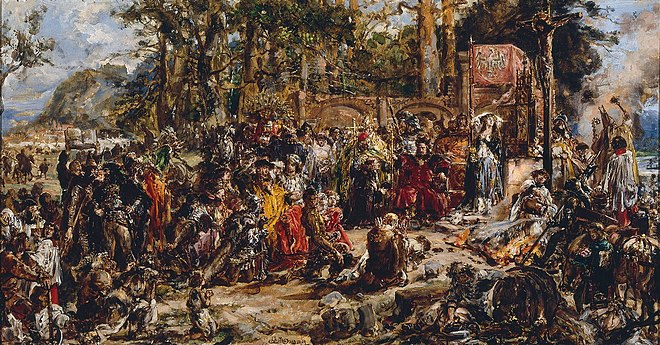
On 15 February 1386, Jogaila married Jadwiga (aka Hedwig), the "King" (Queen) of Poland. This created the opportunity for him to be crowned King of Poland as well as Grand Duke of Lithuania, a prospect that was so tempting that converting to his bride's Christian faith was no problem for him. He took the Christian name Władysław II Jagiełło. The baptism of his court and family followed, and Jogaila/Władysław sent to Pope Urban VI with a request to create an episcopal see at Vilnius, the capital. Vilnius got its cathedral in 1387.

Urban recognized Lithuania officially as a Roman Catholic state on 19 April 1389, although parts of Lithuania held out into the 15th century. (The illustration is called "The Baptism of Lithuania" by 19th century Polish painter Jan Matejko.)

So about Jadwiga: who was she, and was she King of Poland or Queen? That's a good story...for next time.

12 January 2024

The Last Holdout

As the western world was turned to Christianity from paganism, there was one area that did not rush to baptism.

In 1009CE, there is a reference to Lietuva Land in the Annals of Quedlinburg. Lietuva Land was the first reference to what we know as Lithuania. They had exposure to Eastern Orthodox Christianity because of contact with the Kievan Rus. In the 11th and 12th centuries, more personal names crop up that are East Slavic language versions of Christian names, showing that there was more contact and influence from Christian nations around them.

There was actually a Lithuanian Crusade attempted by the Teutonic Order against polytheistic pagan Lithuania from 1238 to 1422. Their plan was to incorporate Lithuania into a Teutonic State along the southeastern shore of the Baltic Sea; they had done this with Prussia. (The religious motivation may have been a cover for simply wanting to expand their state.) Lithuanian rulers were opposed to the concept of Christian baptism and fought back.

Well, not all Lithuanian rulers. Mindaugas (c.1203 - 1263) founded Lithuania as a duchy and was its first duke. He had opposition to his power, most notably his nephew Tautvilas, who in 1250 accepted Christian baptism from the Archbishop of Riga, which made neighboring Christian forces into willing allies against Mindaugas.

The politically savvy Mindaugas knew exactly how to counter this ploy, however, and himself accepted baptism (the illustration is a 17th century portrayal of this event) in exchange for Pope Innocent IV acknowledging Mindaugas as King of Lithuania. Innocent signed two papal bulls related to this. One directed the Bishop of Chełmno (Poland) to crown Mindaugas King of Lithuania, appoint a bishop for Lithuania, and build a cathedral. The second declared that the new bishopric would be accountable to the pope, not the Archbishop of Riga.

Mindaugas successors did not necessarily follow in his footsteps and accept Christianity, however. I'll go into that more tomorrow.

11 January 2024

Paganism and Christianity, Part 4


Although Christianity was replacing paganism all over Europe, pagan cultural influences inevitably lingered, and we can see this everywhere. The days of the week, and even the idea of a seven-day week, did not originate with Christians or the Bible. Pagan Romans had a seven-day week, and the modern English names come from Anglo-Saxon pagans and their Norse deities:

    • Sunday = Sun-day
    • Monday = Moon day
    • Tuesday = Tyr's day (god of war)
    • Wednesday = Woden's day (Odin, father of gods)
    • Thursday = Thor's day (thunder god)
    • Friday = Frigge's day (goddess of love)
Many pagan figures were turned into Christian saints because their stories were compelling. The saints Barlaam and Josaphat were decreed to be early saints, although they are from a much older Buddhist story. Some scholars doubt the historicity of St. Brigid of Kildare, suggesting that she was a re-purposing of the Celtic goddess Brigid, a member of the Tuatha.

Although the Bible does not mention the word or idea of a halo, Christian art puts it on the heads of religious figures as a standard indication of divinity. It is a much earlier image, however, appearing with Buddha, with Krishna, and the Egyptian sun-god, Ra.

The image of the Good Shepherd seems to come from the Bible, and was painted on Christian and Jewish tombs in the Roman catacombs, but it was previously used for pagan tombs as well. Jesus may be depicted as an adult with a beard, but the earliest Good Shepherd motif is of a beardless youth wearing Roman clothing from before the Common Era.

Other images in Jewish and Christian art that are predated by pagan use are found in the catacombs: woman praying with upright hands (so-called Orant figures), Winged Victories and cupids are seen throughout the catacombs, figures eating grapes, seven steps leading to a tomb, pairs of peacocks, scrolls—are all parts of pagan art that were adapted to Christian symbolism.

C.S.Lewis, after converting to Roman Catholicism, was happy to explain these borrowings as important parallels:

preparatio evangelica, a divine hinting in poetic and ritual form at the same central truth which was later focused on and (so to speak) historicized in the Incarnation... [from the essay "Myth Became Fact and Religion without Dogma"]

Of course the more deliberate adaptation of pagan-to-Christian culture is when Pope Gregory sent Augustine to convert Britain, telling him to appropriate their holy places and customs, or when St. Boniface cut down a sacred oak and used the timber to build a church. Gregory's re-defining certain words tells a similar story.

The Christianization of Europe kept advancing, but like the Renaissance it did not happen all at once. There was a country on the Baltic Sea that is considered the last country to become officially Christian. Curiously, its capital city of Vilnius had such a large and thriving Jewish population that it was called Yerushalayim D'Lita (the "Jerusalem of Lithuania"). Tomorrow we talk about (not for the first time) Lithuania.

10 January 2024

Paganism and Christianity, Part 3

When Alaric and the Goths sacked Rome in the first years of the 5th century, the empire was shocked out of complacency. St. Jerome said “the city which had taken the whole world was itself taken.”

Support from emperors such as Theodosius had made Rome the center of Christian hopes for a bright future. Abandonment of the Greco-Roman pantheon and the growing Christian presence made many blame Christianity for Rome's apparent weakness. Augustine of Hippo penned a response to the criticism, creating the first work of cultural criticism, De civitate Dei contra paganos, "On the City of God Against the Pagans." It is seen as a contrast between two societies: the corrupt and worldly City of Man and the higher-minded City of God. There was more to it than that, however.

He points out that Rome had plenty of troubles (like the sack of Rome in 387 by the Gauls) that were not prevented by the previous gods, and that good and bad things happen to everyone. He sympathizes with the women who were raped during the Goths' attack. He also points out that Roman citizens—pagan and Christian alike—took refuge in Christian churches. (They were safe there: Goths were Christians, though Arian Christian.) He argued that eternal life was not available through the Roman gods, and that only Jesus could provide safety from demons. He points out that even a prolific pagan Roman philosopher, Varro, appreciated some of the tenets of Judaism over Roman paganism.

The two cities were "created" when the good and bad angels were separated. He traces the histories of the two cities from Noah to Abraham to Samuel and David. He also addressed the topic of the Jews, saying that they are scattered throughout the world to provide testimony of the Old Testament (which, of course, foreshadows Jesus).

Next time we'll look at Christian art and how paganism contributed to it.

09 January 2024

Paganism and Christianity, Part 2

The Emperor Theodosius I (347 - 395) embraced Christianity, so much so that he was ruled by Bishop Ambrose over the Massacre at Thessalonica (the illustration shows Ambrose preventing Theodosius from entering church to receive the Eucharist), and his Edict of Thessalonica tried to establish consistency of Christian beliefs in the Byzantine Empire, specifically by settling on the form of the Nicene Creed.

Along with this push for consistency from Theodosius (called "the Great") came a shift away from tolerating all religions. Anti-pagan laws existed (that is, those religions that did not follow the Greco-Roman gods), but there is no record of them actually being enforced. Theodosius declared Nicene Christianity the official religion of the empire, but this was mostly an attempt to stamp out the "heresy" of Arianism.

Animal sacrifice was a chief target of Christians' demand for legal changes. Altars for blood sacrifice—a central practice of pagan ritual since pre-history—were routinely smashed. Eliminating it was a primary goal of Christians who were gaining political influence. This change had started prior to Theodosius: the Emperor Julian (reigned 360-363) was pagan, but when he restored pagan altars in Antioch, Christians destroyed them again. Christians were still a minority, but they were making themselves known.

Theodosius did not want open rebellion against his decisions, so pagan temples were allowed to remain open, and worship could take place. Pagan holidays could be celebrated, but they were no longer days off from work. Animal sacrifice and divination were banned. Theodosius' praetorian prefect, Maternus Cynegius, took it upon himself to vandalize pagan shrines in the eastern provinces. When he died, however, Theodosius replaced him with a moderate pagan who offered more protection to pagan temples. The emperor also named pagans in the senate to important administrative posts.

Not all temples were destroyed; it is likely that some were converted to churches. Modern archaeology has found evidence of 120 churches that started as pagan temples. Of course, 120 out of the thousands that would have existed in the empire is not a significant percentage.

The sack of Rome by Visigoths in 410 was a shocking moment for the empire, and pagans blamed the shift to Christianity as the source of a weakened empire. This prompted Augustine of Hippo to write the work we know as The City of God, except that was not what he called it. Augustine called it De civitate Dei contra paganos, "On the City of God Against the Pagans," which would set the tone of anti-pagan thought for centuries. What he meant by that will be tomorrow's post.

08 January 2024

Paganism and Christianity, Part 1

Paganism is a catch-all term to refer to countless religions that existed during the Classical Era and the Middle Ages (and experiencing a revival in the Modern Era). A lot of people are familiar with the story of Emperor Constantine "making Rome Christian." What he really did was simply enforce tolerance of Christians who wished to practice their faith openly in the Roman Empire. The illustration shows Constantine defeating his rival, Maxentius, at the Battle of Milvian Bridge in 312.

Shifting a culture from paganism to Christianity was not a one-step, black-and-white process. The Christianization of Europe involved wars and mass baptisms, surely, but followed by natural (and slow) evolution away from older habits.

The clash of Christianity with paganism is seen as early as the 1st century: in Acts 19 in the New Testament, silversmiths in Ephesus who crafted images of Artemis rioted against Paul's proselytizing, because his success meant the loss of their livelihood.

The persecution of Christians in early Rome was not unique to Christians. Roman officials in 186CE persecuted followers of Dionysius and the practice of Bacchanalia, which took place at night. Gatherings taking place "under cover of darkness" were suspicious, because that is how anyone plotting against the emperor would act. Bacchic groups were disbanded and their leaders arrested. Other groups who were deemed suspicious by Roman imperial authorities and outlawed were druids, Jews, astrologers, the cult of Isis, some philosophers, as well as Christians.

Christians, originally seen as a sect of Judaism, was by the 2nd century seen as its own group, but just one of the many religious groups that Rome needed to keep an eye on. As early as 64, however, with the fire that destroyed much of Rome during Nero's reign, Nero chose to blame the Christians, whom Suetonius (writing later) described as men following a "new superstition."

Although mocked and abused in the Roman Empire, Christian persecution was not a state practice until Decius (emperor from 249-251). Decius decreed public sacrifices with mandatory participation; those who refused were arrested, imprisoned, tortured, and sometimes executed. Emperors Diocletian (284-305) and Galerius (305-311) continued the persecutions, until Galerius relented with the Edict of Milan, promoting tolerance. Constantine who followed Galerius legalized Christianity in 313.

Constantine did not, however, "turn the Roman Empire Christian." Paganism was still practiced and tolerated...for a time. We will continue this discussion tomorrow.

07 January 2024

Eastern Orthodox Paganism

When Vladimir the Great converted from Slavic paganism to Christianity, he used the occasion to try to unify a wide heterogeneous culture. The Russian Primary Chronicle for 980 discusses the Slavic gods prior to conversion:

And Vladimir began to reign alone in Kiev. And he placed idols on the hill outside the palace: a Perun in wood with a silver head and a gold moustache, and Khors Dazhdbog and Stribog and Simargl and Mokosh.

Vladimir was willing to incorporate Christianity and paganism, so although he had the temple mentioned in the Primary Chronicle torn down and the idols thrown into the Dniester, the growing Church linked the Slavic deities with Christian saints. Perun, god of thunder and lightning, was equated with Elijah the prophet, known for bringing fire down from the sky. Veles of the underworld was linked to Saint Blaise. Yarilo, god of spring and agriculture, was linked to St. George. The dates of pagan festivals found themselves celebrating Christian festivals, so Christmas–Easter–Whitsunday were used for the indigenous festivals Koliada (Winter Solstice), Yarilo (Spring), Kupala (Summer Solstice). The Virgin Mary was iconized as "Fiery Mary" ("Ognyena Maria"; see illustration), and turned into a sister of Perun.

Supposedly, Vladimir turned all his territory Christian in eight years, but in truth pagan beliefs and practices lingered for centuries. Vladimir's baptism ritual was not repeated for his followers, and in fact not routinely used until the 20th century; the "Christianization" was essentially a nation-wide declaration.

Even today, there are "Old Believers" or "Old Ritualists" in Eastern Orthodox Christianity who still want to follow rituals that were considered inappropriate by the Orthodox Church, who tried to stamp them out in the Stoglav Synod of 1551. The text of the synod was turned into 100 chapters, which in Russian is sto glav. Each chapter is worded as answers to 100 questions by Tsar Ivan IV of Russia (sometimes called Ivan the Terrible).

The shift from Paganism to Christianity was sometimes evolutionary, sometimes revolutionary. Tomorrow we'll take a closer look at how some rulers chose to either tolerate or mandate religious practices.

06 January 2024

Slavic Paganism

This blog has mentioned paganism before, usually in the context of converting whole nations to Christianity, but what did it look like in Eastern Europe prior to the Christianization that got started around the 8th-9th centuries? 

The Byzantine historian Procopius is our source for information about the Vandals and other topics. He tells us about their human sacrifices to their thunder god:

They believe that one of the gods, the creator of lightning, is the lord over all, and bulls are sacrificed to him and other sacred rites are performed. They do not know fate and generally do not recognize that it has any power in relation to people, and when they are about to face death, whether they are seized by illness or in a dangerous situation in the war, they promise, if they are saved, to immediately sacrifice to God for their soul; having escaped death, they sacrifice what they promised, and they think that their salvation has been bought at the price of this sacrifice. They worship rivers, and nymphs, and all sorts of other deities, offer sacrifices to all of them and with the help of these sacrifices they also produce divination. [Book VII of War with the Goths]

Other Western Europe authors refer to the Slavic cult of Radegast, god of the Polabian Slavs, and the sun-god Svarozhich. We might question the accuracy of the interpretation by these "outsiders," but we do have some reports from the "inside." The Russian Primary Chronicle for 980 discusses the Slavic gods prior to conversion:

And Vladimir began to reign alone in Kiev. And he placed idols on the hill outside the palace: a Perun in wood with a silver head and a gold moustache, and Khors Dazhdbog and Stribog and Simargl and Mokosh. And they offered sacrifices and called them gods, and they took their sons and daughters to them and sacrificed them to the devils.

Helmold of Bosau (c.1120 - 1177) wrote his Chronica Slavorum ("History of the Slavs"), covering c.800 - 1171. His report says the Slavs believed in a single heavenly deity who created all the minor spirits that managed elements of nature. These lesser spirits:

...obeying the duties assigned to them, [the deities] have sprung from his [the supreme God's] blood and enjoy distinction in proportion to their nearness to the god of the gods.

According to Helmold, wheel symbols, and symbols showing multiple arms (see illustration), represented the numerous minor spirits in their relationship to the main deity.

From folklore that has survived, we can gather that there were several supernatural figures that functioned as deities. Outside of the supreme god, Perun was a thunder/sky god (sometimes treated as the supreme god). Veles was his opposite, a god of the underworld. Svarog was the god of the sun/fire and of blacksmiths. Dazhbog (sometimes considered Svarog's son) was the god of domestic fire, the hearth. In other tales, he is the god of rain.

Marzanna was the goddess of winter, and so her presence was dreaded and her departure celebrated, when she withdrew from the world and was replaced by Yarilo, god of spring and agriculture. Vesna was also a goddess of spring, and her name was popularly given to girls.

Mokosh was the goddess of weaving and a protector of women, and Devana the goddess of hunting and the wilderness. Lada was the goddess of love and beauty. She mirrors Persephone, in that she spends part of the year in the Underworld.

There were other minor deities and creatures such as Baba Yaga and Vampir, whose name indicates exactly what you're thinking: he attacks people in the night and sucks blood. Fortunately, being killed by Vampir does not make one a vampire; one becomes a Vampir by being a bad person.

Slavic paganism survived in Russia into the 15th century, and some pagan elements were incorporated into the Russian Orthodox Church. Let's look at the "survival" of paganism in Russia tomorrow.

05 January 2024

Boris and Gleb

Vladimir the Great (c.958 - 1015) was Prince of Novgorod and Grand Prince of Kyiv. Although originally a pagan, he converted himself, and then the whole of the Kievan Rus, to Christianity. The Eastern Orthodox Church made him a saint. Among his children were two sons, Boris and Gleb. When Vladimir converted the country to Christianity, the sons were baptized and given new names. Boris became Roman, and Gleb was baptized as David. When later canonized, however, their birth names were used.

According to a monk named Nestor, who wrote Account about the Life and Martyrdom of the Blessed Passion Bearers Boris and Gleb, they were their father's favorites. Boris ruled the town of Rostov, and Gleb ruled Murom. Boris was said to have been Vladimir's heir apparent, although not his eldest. When Vladimir died, the real trouble started.

The eldest son, Sviatapolk, declared himself Grand Prince of Kyiv. Boris had been on campaign with the army, and his friends tried to get him to go to Kyiv to challenge Sviatapolk, but Boris said “I will not raise my hand against my brother, who is even older than I, and whom I should respect as my father!” Sviatapolk was not so interested in avoiding civil or familial strife, however, and had Boris assassinated while sleeping. Well, almost: he was stabbed, but while the body was being transported to Kyiv in a bodybag, those escorting it realized he was still breathing inside, and they thrust a sword into it.

Word had not yet reached Gleb that their father was dead. Sviatapolk sent a message that Vladimir was on his deathbed, causing Gleb to rush to his side, suspecting no treachery. Another brother, Yaroslav, learned about Sviatapolk and told Gleb that Boris is dead and to not meet with Sviatapolk, but the warning didn't help: while praying for Boris, Gleb's own cook slits his throat with a kitchen knife.

Because the two were faced with potential violence and did not meet it with violence, they were declared martyrs for the Faith. They were canonized by the Eastern Orthodox Church in 1071. They were interred at the Vyshhorod Cathedral. The Roman Catholic Church canonized them in 1724. Many Russian and Ukrainian churches were named for them.

Their Christianity, so soon after their father converted the nation, was surprisingly steadfast. If Vladimir had not done that, how would they have been raised differently, one wonders. What was Slavic paganism like? Let's talk about that tomorrow.

04 January 2024

Nestor the Chronicler

In 1073CE, a young man entered the Monastery of the Caves in Kyiv. The Monastery was only about 20 years old at the time—founded by Theodosius of Kyiv—and so was Nestor. One of his experiences in the monastery was joining with other monks to exorcise a devil from Nikḗtas the Hermit.

Nestor was made the chronicler for the monastery, a task he took very seriously. It was in that service he produced a Life of the Venerable Theodosius of the Kiev Caves, and also the Account about the Life and Martyrdom of the Blessed Passion Bearers Boris and Gleb.

In 1091 he was given the important task of disinterring the body of Saint Theodosius so the relics could be transferred to the Church.

Nestor appreciated books and learning:

Great is the benefit of book learning, for books point out and teach us the way to repentance, since from the words of books we discover wisdom and temperance. This is the stream, watering the universe, from which springs wisdom. In books is a boundless depth, by them we are comforted in sorrows, and they are a bridle for moderation. If you enter diligently into the books of wisdom, then you shall discover great benefit for your soul. Therefore, the one who reads books converses with God or the saints.

Some—maybe most—accounts of his life claim he wrote the Russian Primary Chronicle, mostly because of his previous writing credits and the fact the Chronicle was produced during his lifetime. There is no direct evidence, however, that the Chronicle came from his pen. In fact, his own writing includes details that contradict details in the Chronicle. The argument has been made that he should be called "Nestor the Hagiographer," since the only authentic writing of his is saints' lives.

He died about 1114 and was buried near the Caves Monastery. The Eastern Orthodox Church made him a saint, and his feast day is 27 October.

There's an interesting story to be told about Boris and Gleb, however, and I'll tell you about it next time.


03 January 2024

The Russian Primary Chronicle

The largest ethnic and linguistic group of peoples in Europe in the first millennium CE was the Slavs of the Kievan Rus. Although they chiefly occupied eastern and southeastern Europe, they extended also across northern Asia all the way to the Pacific Ocean. Our chief source of their early history is the Russian Primary Chronicle, covering the years 850 to 1110.

In its native language its title translates to the "Tale of Bygone Years," derived from the opening lines of one of the extant early manuscripts: "These are the narratives of bygone years regarding the origin of the land of Rus', the first princes of Kiev, and from what source the land of Rus' had its beginning."

Traditionally, it was also referred to as the "Nestor Chronicle" because it was believed to have been written by a monk called Nestor, but later scholarship has suggested that it is a compilation and not the work of a single author. Also, the chief evidence for Nestor's authorship seems to be the name Nestor (нестера) inserted into a later edition. A likelier author is Sylvester of Kiev (c.1055 - 1123), an assistant abbot of the Vydubetsky Monastery in Kiev.

There are five (maybe six: one from 1450 was destroyed in a fire in 1812 and "reconstructed" from memory; it is considered unreliable) early manuscripts used to study the Primary Chronicle, the earliest of which is more than two centuries newer than the original, so we have no idea what exactly the original would have looked like, or what changes were made by well-meaning copyists and editors. The Laurentian Codex (shown above; you can read the whole thing and scholarship about it here) is the oldest version we have, from 1377. It continues the history through 1305, but some years (898–922, 1263–83 and 1288–94) have been inexplicably left out.

The Primary Chronicle includes many anecdotes, including the founding of Kyiv and the manner that St. Olga got revenge on the Drevlians after they murdered her husband. Some of the history, however, contradicts other chronicles, including some writings by the aforementioned Nestor the monk. Nestor was real, and the temptation to link him to the Primary Chronicle is understandable, since he wrote many things around the time of the original. In fact, we should talk about Nestor tomorrow.

02 January 2024

The Moses Coin

Many Viking coin hoards included coins from far afield, especially Islamic dirhams, such as in the Spillings Hoard. The Spillings Hoard also contained, among about 14,000 dirhams, a coin that is practically unique in the history of numismatics: a Moses coin (pictured here).

As of 2006, only five Moses coins have been found, and they are all unusual in more ways than one. They are called "Moses" coins because, although similar to Islamic dirhams which have the phrase "Muhammad is the messenger of God" (or a similar phrase), they are inscribed with "Moses is the messenger of God" in Arabic. Who made these? It turns out that they were made by the Khazars.

The Khazars were a nomadic people who ranged in the area between and north of the Black and Caspian Seas starting in the late 6th century. Geographically, they were a buffer between the Byzantine Empire and the Umayyad Caliphate. In the second half of the 10th century, they were conquered by the Kievan Rus ruler Sviatoslav I. The Khazars were not a homogeneous culture: among their tribes one could find three languages and several religions. Judaism is considered one of the Khazar religions, and the Moses coin is the only evidence found to support that claim.

According to The Jews of Khazaria, by Kevin Alan Brook, the Khazar government minted four series of dirhams in 837-838, all from the same mint. One series included the phrase (in Arabic) Ard al-Khazar ("Land of the Khazars"), with the date 3 December 837 to 22 November 838.

This Khazar mint was also the source of the Moses coins, but the five found so far all have fake mint dates and locations. The one from the Spillings Hoard is inscribed with Madinat as-Salaam (Baghdad) and the date 766-767. The other four Moses coins (found in hoards from Russia, Estonia, and Finland) include Madinat as-Salaam with the dates 803-804. Why the Moses coins exist and why they have inauthentic dates and mint marks is a mystery.

Above I said the coins were similar to Islamic dirhams. Brook's book says the Khazars minted "additional varieties of imitation dirhams after the year 838." The actual name of the Khazar silver coin was the sheleg, a name we get from the Russian Primary Chronicle, in which the sheleg is mentioned as tribute. What was the Russian Primary Chronicle, you may ask? It was briefly mentioned here, but maybe it deserves a closer look...next time.

01 January 2024

The Islamic dirham

We have previously mentioned the dinar here and here. Usually of gold, it was used alongside the dirham, usually of silver and of a lesser value.

Also spelled dirhem or drahm, the name comes from the Greek drachma, because it was originally a silver coin circulated in the pre-Islamic Mid-East out of Byzantium. Persia adopted the word drahm to refer to it, and near the end of the 7th century the Islamic world started minting its own version. Originally the dirham bore the head of the caliph, but that was considered idolatry, so the caliph's image was replaced with verses from the Koran. They were also commonly imprinted with the phrase "Muhammad is the messenger of God" and a statement of the year and location of their minting.

Used widely around the Mediterranean coasts (North Africa, Egypt, the Eastern coast, Moorish Spain), through trade and plunder it wound up in places as far-off as Britain and Sweden. It was so ubiquitous that Jewish Orthodox law even used the dirham as a unit of weight to indicate requirements in religious functions, such as the "dough portion" the proportion of your bread dough that should be offered to the kohen, the Jewish priest. Maimonides (1138 - 1204), an extremely influential philosopher and scholar of the Torah, calculated the dough portion at "520 dirhams of wheat flour." He was referring specifically to dirhams minted in Egypt, which were 3.333 grams each (3.8 pounds is a lot of bread dough!). Other locations minted dirhams that may have been consistently different by fractions of a gram.

The dirham is still used as a unit of currency in several countries as a division of the dinar.

There is an interesting variation of the dirham called the "Moses coin" from the Khazar region. A handful exist (one was found in the Spillings Hoard), and the inscription on them—specifically the mint location and date—raises more questions than answers. I'll tell you about them tomorrow, and why what appeared to be an Islamic coin is called a "Moses coin."