02 March 2024

Fergus versus Scotland

(The illustration is a sketch of Cruggleton Castle, an important Galloway fortress which now is more accurately called a pile of rock than even an "historical ruin.")

The Lords of Galloway in southwestern Scotland seem to have looked more toward the Isles of the west and north coasts as friends and allies more than the inland kingdoms. Such seems to have been the case with Fergus of Galloway, who married his daughter Affraic to Óláfr Guðrøðarson, King of the Isles. Óláfr had seen a vicious power struggle among his brothers when their father died, and (like David I of Scotland) was taken in by Henry I of England. Sometime between 1112 and 1115, Henry established Óláfr on the throne of the Isles  (which encompassed the Isle of Mann, the Inner Hebrides, the Outer Hebrides, the Orkneys, and the Shetlands).

Óláfr was assassinated by three nephews, and his and Affraic's son, Guðrøðr Óláfsson, might have expected help from Guðrøðr's grandfather Fergus, but before Fergus could send any help, Galloway was attacked. Fergus had a good relationship with David I, supporting him in the (disastrous for them) Battle of the Standard, but David's grandson, Malcolm IV (David's son and Malcolm's father, Henry Earl of Huntingdon had died from illness), did not feel the same. Malcolm was born in 1141, and so was only 19 when he launched three campaigns against Galloway. Had Fergus been encroaching on Scottish territory, or did Malcolm simply want to expand? We'll never know.

Fergus was forced to retire to Holyrood Abbey in Edinburgh, founded in 1128 by David I and the recipient of largesse from Fergus himself in happier days. Fergus died 12 May 1161, and was interred at Holyrood. His lordship was divided between his sons, Uhtred and Gille Brigte (after they fought each other, as often happens among royal siblings).

As I mentioned yesterday, Fergus "lived on" in a different way. His name seems to have become unexpectedly attached to the Arthurian Cycle. Even more unexpectedly, a bad translation of it is considered a Dutch classic. Tomorrow we take a literary trip into the Roman de Fergus.

01 March 2024

Fergus of Galloway

In yesterday's post about St. Ninian, I suggested that the biography of him written 700 years later by Aelred of Rievaulx may have had a political origin. To explain that, we have to talk about Fergus of Galloway.

An 1136 charter by King David I of Scotland includes as a witness Fergus of Galloway. This is our first reference to him. In the early Middle Ages, Galloway would have been a "sub-kingdom" in southwest Scotland, and a king of Scotland like David would have been seen as a "first among equals" like the high-king in Ireland. Over time, these sub-kings were designated as hereditary lords. The dynasty of Fergus lasted from his time until 1234.

Digging into contemporary documents, it appears that he may have been married to an illegitimate daughter of King Henry I of England, Elizabeth Fitzroy. (By some counts, Henry had two dozen illegitimate children.) Fergus had three children: Uhtred, Gilla Brigte, and a daughter Affraic. The chronicler Roger de Hoveden refers to Uhtred as a cousin of Henry's son Henry II. Fergus' second son, Gilla Brigte, had a son who was referred to as a kinsman of Henry II and his son, King John. In other marriage news, Fergus married Affraic to with Óláfr Guðrøðarson, King of the Isles (the Isle of Mann, the Inner Hebrides, the Outer Hebrides, the Orkneys and the Shetlands). Their son, Guðrøðr Óláfsson, became King of Dublin and the Isles. A 12th-century monk and chronicler, Robert de Torigni, claimed that Guðrøðr was related to Henry II.

The Fergus dynasty was very supportive of Augustinians, Benedictines, Cistercians, and Premonstratensians (a strict order founded by a friend of Bernard of Clairvaux, Norbert of Xanten). In one case, records state that Fergus founded a Premonstratensian house at Whithorn. Supposedly, St. Ninian had started the diocese of Whithorn, but it had lapsed, to be revived in 1128. Other records suggest that Fergus founded an Augustinian house that was later converted to Premonstratensian by Christian, the second bishop of the revived Whithorn diocese.

Fergus' extensive support of monasteries and orders has caused some head-scratching to determine the cause. Did he simply want to mirror what other, more-powerful lords did in their realms? Or was there some other underlying purpose. As it turns out, the greatest atrocities during the Battle of the Standard in 1138 were (according to chroniclers) committed by Gallovidian soldiers supporting King David's attempt to capture more territory. It seems likely that Fergus's religious generosity may have had a penitential flavor. Is it possible that the Life of Saint Ninian by Aelred of Rievaulx was a royal request in exchange for a gift to Rievaulx Abbey? Royal patronage is not an unlikely answer. The fact that a biography of a saint who originally founded Whithorn and performed miracles would bring attention and fame to a location within the bounds of Fergus' realm was simply a happy bonus.

For all his publicly expressed piety, however Fergus did not have a happy end. I'll tell you about that tomorrow. The next time after that, however, we will see how the facts of your life don't matter if someone decides afterward that you'd make a good story. See you soon.

29 February 2024

St. Ninian, Apostle to the Southern Picts

Aelred of Rievaulx (c.1110-1167) wrote several works, including biographies, one of which was about a saint from several centuries earlier, Ninian. The Vita Sancti Niniani ("Life of Saint Ninian") exists in two early manuscripts.

Our first reference in history to Ninian (c.360 - c.432), is from the 8th century when Bede mentions him as the first Christian missionary among the Picts in Scotland. Supposedly he was a son of a Briton chieftain who made a pilgrimage to Rome, was made a bishop, and then headed home through Gaul where he met Martin of Tours. Modern scholarship supports the idea that in 397 he built a whitewashed stone church at what is now called Whithorn ("White House"; in Latin it was called Candida Casa) in Caledonia, which became a leading Anglo-Saxon monastic center.

He was considered a miracle worker. In one instance, sitting to dine with the monks, he remarked that there were no vegetables on the table and called the monk in charge of the gardens, who informed Ninian that he had just planted the garden that morning and nothing had yet grown. Ninian sent him to the garden, whereupon the monk found that there were plenty of full-grown leeks and other herbs. In another anecdote, the traveling Ninian blesses a herd of cows and draws a circle in the field with his staff to keep them contained and safe for the night. Thieves who attempt to steal the herd find their leader gored to death by the bull and the rest made mad. Ninian in the morning prays to God to restore the dead man and restore the others. Ninian's prayer is successful.

St. Patrick, whose missionary work followed Ninian's by a few decades, refers to the Picts in his "Letter to Coroticus" as "apostates" (people who revert from their faith), suggesting that Ninian's seeds did not take permanent root:

Soldiers whom I no longer call my fellow citizens, or citizens of the Roman saints, but fellow citizens of the devils, in consequence of their evil deeds; who live in death, after the hostile rite of the barbarians; associates of the Scots and Apostate Picts; desirous of glutting themselves with the blood of innocent Christians, multitudes of whom I have begotten in God and confirmed in Christ.

The northern Picts were converted by St. Columba, and Christianity was still strong there. The "apostate" label would have to apply to the southern Picts, so Patrick clearly was aware that there had been missionary attempts there before him. 

He may have got the name wrong, however. Archeology and anthropology suggest that the story of Ninian by Bede and others may actually be the story of Finnian of Clonard, or Finbarr of Cork, or Finnian of Movilla. The fact that Ninian is referred to as Ringan in Scotland and Trynnian in Northern England also suggests that exact identification of a bishop who built the first stone church at Whithorn has its difficulties. Aelred's source for the name "Ninian" is actually a scribal error from "Ninia," which (according to one modern scholar) was itself a scribal error from early records of St. Finnian (of Movilla) spelled Uinniau.

You can read Aelred's Life of Ninian in English here. Ninian's image appears in stained glass in a church in Galloway (see illustration).

But why was Aelred so interested in this obscure saint from seven centuries earlier? During Aelred's life, Whithorn was revived as a bishopric. Did he have a reason to draw attention to the newly resurrected bishopric? It may have been a political favor. I'll explain that tomorrow.

28 February 2024

Aelred's Later Life

Aelred of Rievaulx took a successful abbey and made it even more grand (although the illustration will show that its fortunes have fallen somewhat, thanks of course to Henry VIII).

Rievaulx was intended at its founding by Bernard of Clairvaux to spread Cistercian reform ideas across the north. By the time Aelred became abbot (1147), the abbey was only about 15 years old, but already had five daughter houses in England and Scotland. Residents had to accept a life of physical deprivation in exchange for spiritual rewards. Aelred wrote a guide for novices called Speculum caritatis ("The Mirror of Charity"), warning them:

Our food is scanty, our garments rough; our drink is from the stream and our sleep upon our book. Under our tired limbs there is a hard mat; when sleep is sweetest we must rise at a bell’s bidding … self-will has no scope; there is no moment for idleness or dissipation … Everywhere peace, everywhere serenity, and a marvellous freedom from the tumult of the world.

Despite these conditions, by the end of Aelred's term as abbot, the abbey had doubled to 140 monks and 500 lay brothers.

He wrote extensively. He wrote biographies of King David I of Scotland, Saint Ninian (mentioned here), and Edward the Confessor. He also produced treatises on the life of Jesus at the age of 12, anchoresses, spiritual friendship, and other topics. There are several sermons that have survived, and histories of Genealogia regum Anglorum ("Genealogy of the Kings of the English"), Relatio de Standardo ("On the Account of the Standard"), and De bello standardii ("On the Battle of the Standard"), about the Battle of the Standard, and a couple on miracles, specially those connected to the Church of Hexham where Aelred was born. His treatise De spirituali amicitiâ ("Spiritual Friendship"), has prompted modern scholars to suggest that he was homosexual.

His job as abbot was to travel to the daughter houses regularly, and visit the general chapter of the Cistercians at Cîteaux in France once each year. This was difficult for him as he got older, especially since it appears he suffered from arthritis and kidney stones. His biographer, the Rievaulx monk Walter Daniel, reports that in 1157 he got permission to sleep in the infirmary rather than his own cell. He died in the winter of 1166-67, aged about 57. He is venerated as a saint by both the Catholic Church and the Anglican Communion. He is considered the patron saint of bladder problems; more recently LGBTQ Christians have embraced him as well.

Was there something particular about St. Ninian that made Aelred feel motivated to write his biography? And was Ninian even his name? Let's figure that out next time.

27 February 2024

Aelred of Rievaulx

In 1134, a man in his 20s entered Rievaulx, a Cistercian abbey in North Yorkshire. A sentence like this has been written many times in this blog, but it usually refers to a younger son of a family who had no prospects in life other than the church. In this case, however, the young man had already had a significant career that could have lasted his whole lifetime, and he gave it all up. A monk at Rievaulx who knew Aelred, Walter Daniel, wrote a biography of Aelred, giving us more biographical detail than we usually have on anyone from this time period.

Aelred of Rievaulx was born c.1110 in Hexham in Northumberland, one of three sons of a priest named Eilaf. (Archbishop Anselm of Canterbury's prohibition against clerical marriage was very recent.) Although priests still had sons, a 1095 order from the Council of Claremont forbade the sons of priests to become priests (the idea was to prevent inheritance of benefices, since a bishop or higher-ranking prelate should decide where a benefice goes when a priest dies).

He would have been educated at the cathedral school at Durham. We know he spent several years at the court of King David I of Scotland, and was there long enough to rise to the title echonomus, a word related to "economy" and indicating that he was a steward or seneschal, possible the steward of the king's household, managing all of the "below stairs" members of staff. While in this role, Walter Daniel tells us of an incident where a knight harassed him and used a degrading sexual slur. Daniel uses this anecdote as an example of Aelred's capacity for forgiveness, but the incident seems to have made Aelred depressed and disillusioned with court life.

On a mission for David to Thurstan, Archbishop of York, Aelred learned of Rievaulx Abbey, founded only two years earlier by monks from Clairvaux Abbey in northeastern France. Aelred realized that a religious life was his true calling, and joined Rievaulx. A few years later he was part of a delegation to Rome to see Pope Innocent II. The purpose was to present northern England delegates who opposed the election of Henry de Sully as Archbishop of York; although de Sully was an abbot, his main qualification was that he was a nephew of Stephen of Blois, whose seizing of the throne of England caused The Anarchy. Their delegation was successful.

After Rome, Aelred in 1143 was made abbot of Revesby Abbey in Lincolnshire, founded that year as a daughter house of Rievaulx. Not long after, in 1147, he was made abbot of Rievaulx itself. According to his biographer, Aelred "doubled everything" at Rievaulx. The buildings, the members, the resources—all increased under Aelred at what was an already flourishing complex.

Tomorrow, we'll talk more about Aelred's leadership and authorship. See you then.

26 February 2024

David and Scotland

King David's rule over Scotland was entwined with his relationship with England. When England experienced the constitutional crisis and civil war called The Anarchy (see Parts 1, 2, and 3), David got involved. One reason was that he wanted to support the chosen heir of his friend and brother-in-law, King Henry I. Henry wanted his daughter Matilda to rule after him, but a cousin, Stephen of Blois, was able to take the throne because Matilda was on the continent. (Coincidentally, Henry had done something similar.)

Another "benefit" of supporting Matilda over Stephen was that it gave David an excuse to invade England, incidentally capturing territory along the way and expanding Scotland's borders. David brought an army into England in December 1135, right after Stephen was crowned. David quickly occupied the castles of Carlisle, Wark, Alnwick, Norham, and Newcastle. Stephen responded, but wanted to avoid a battle (possibly because he knew he would need his army to deal with the part of the country that supported Matilda), and a truce was made that left David with Carlisle and gave his son Henry the title Earl of Huntingdon and the promise of Earl of Northumberland (if that earldom was ever re-created).

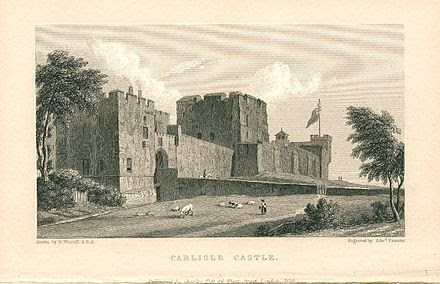
David attacked again in the spring of 1137, but again a truce was made that lasted the year. In January 1138, David again invaded, demanding that his son receive Northumberland, and in July he was defeated at the Battle of the Standard. Negotiations later that year resulted in affirming David's son as Earl of Huntingdon and Northumberland, and David being allowed to keep Carlisle (seen here in an 1829 engraving) and Cumberland. This was considered a success for Scotland. Cumberland gave him access to silver mines in Alston, resulting in Scotland's first silver coinage.

He also had success with the Scottish Church. The 12th century monk Aelred of Rievaulx wrote:

...he found three or four bishops in the whole Scottish kingdom, and the others wavering without a pastor to the loss of both morals and property; when he died, he left nine, both of ancient bishoprics which he himself restored, and new ones which he erected.

Although modern scholars say there is no evidence of David increasing the church as reported, perhaps his contemporary chronicler was a little more in tune with the events. David is also given credit for establishing parties, we do know that parishes existed long before he came to power.

And, of course, he had the problem seen in recent posts of the debate between archbishops and secular lords. David did not want his bishops professing obedience to the Archbishop of York, Thurstan in this case, and that created problems. The popes supported the archbishop.

Then the worst came: his son and heir Henry died, and David was old and did not have long to live. He named as his heir Henry's son, Malcolm IV. David died 24 May 1153, aged about 70.

I want to turn now to one of the sources of Scottish history, the aforementioned Aelred of Rievaulx, an Englishman who spent significant time at David's court before becoming a Cistercian. See you next time.

25 February 2024

David versus Máel Coluim

King David I (pictured here) was one of many sons of Malcolm III of Scotland, several of whom had their chance on the throne after it had been usurped by their uncle, Donald. David was about 40 years old when his turn came, and he took the throne with the support of his brother-in-law, King Henry I of England. There was a problem, however: his nephew, Máel Coluim.

Máel Coluim ("Malcolm") mac Alexander was the illegitimate son of David's older brother, Alexander I. According to historian Orderic Vitalis, Malcolm "affected to snatch the kingdom from [David], and fought against him two sufficiently fierce battles; but David, who was loftier in understanding and in power and wealth, conquered him and his followers."

Malcolm escaped into more obscure parts of Scotland, surviving and gaining allies over a six-year span, after which he attempted to attack David for the throne again. One reason for his motivation might have been that David spent time in England, seeming to prefer visiting Henry's court over being among his own people.

Malcolm, with the support of Óengus of Moray (mentioned here), marched against David's army. The Annals of Ulster report that 4000 of Óengus' army and Óengus himself died, while only 1000 of the men loyal to David died that day. David's force, led by a constable, marched into the now undefended Moray and captured it. Malcolm himself escaped, and spent the next four years battling David's forces.

David was aided with a large force, including ships, from Henry. Malcolm was captured in 1134 at Roxburgh Castle, and history has no more to say about him. Moray was given to David's nephew, only son of David's oldest brother Duncan, who had held the kingship for less than six months in 1094.

David was called by William of Newburgh a "King not barbarous of a barbarous nation." He attempted to make some reforms that he felt Scotland and its church needed. I'll explain some of those tomorrow.

24 February 2024

King David I of Scotland

King Henry I of England changed a lot of the political atmosphere that had been damaged by his brother, William Rufus. One of his changes was forging a good relation with King David of Scotland, starting when David was very young.

Although he had an illustrious Scots heritage through his father, Malcolm III, and grandfather, Duncan I (the basis for the character of that name in Shakespeare's MacBeth), David's English mother, Margaret of Wessex, gave him a strong connection to England.

David was probably born c.1084. His father was killed while invading Northumberland in 1093, and his mother died shortly after. The throne of Scotland was seized by his uncle, Donald III, and David and his brothers were exiled. It is believed that the boys were brought safely to England by their maternal uncle, Edgar the Ætheling. This was the time of King William, who sent David's older brother Duncan into Scotland with an army to depose Donald. They were unsuccessful, and Duncan was killed. William sent David's other brother, Edgar, in 1097; this time they were successful, and Edgar became king.

When William Rufus died and Henry seized the throne, he married David's sister, Matilda, who had been kept out of the political intrigues because she was a nun—but not really (check the link at her name). David was now the brother-in-law of the king of England, and so had a privileged position at the English court, becoming Anglicized—or, more accurately, Anglo-Normanized—as he matured. King Edgar of Scotland bequeathed lands south of the River Forth to his younger brother, making David a landowner in his own right as Prince of the Cumbrians.

David married Matilda of Huntingdon, daughter of the Earl of Northumberland, a match arranged by King Henry. They had two sons; one died young, but a second named for King Henry survived.

The death of King Edgar in 1107 gave the throne of Scotland to yet another brother, Alexander I. Alexander I died in 1124, and David was the remaining brother among Malcolm III's offspring. Alexander had a son with other plans, however. That was Máel Coluim mac Alexander, who decided the throne should be his, despite his illegitimacy. He chose war as his strategy to assume the kingship of Scotland. It did not go well for him.

But that's a story for tomorrow.

23 February 2024

Battle of the Standard

Also called the Battle of Northallerton (because it took place near Northallerton in Yorkshire), the Battle of the Standard was between a small English force against an invading force from Scotland. King David of Scotland was trying to enlarge his kingdom and support the claim of Empress Matilda to the throne of England. (See here to understand Matilda's situation.) Matilda was King David's niece.

King Stephen of England was fighting in the south, but upon hearing of David's progress through Northumberland he sent a force of mostly mercenaries to meet the Scots. On 22 August 1138, the two armies met near York.

It is called the Battle of the Standard because the Archbishop of York, Thurstan of Bayeaux, created the standard that was carried in battle. Thurstan supported King Stephen over Matilda, and he gathered a fighting force from the north to join with Stephen's mercenaries. Mounting a ship's mast on a cart, Thurstan attached to it the banners of Saint Peter of York, Saint John of Beverley, and Saint Wilfrid of Ripon. The cart also carried a pyx, a container containing a consecrated Host to provide spiritual support. (In the above illustration, by John Gilbert, you see Thurstan standing on the cart with the standard, blessing the troops.)

Divine support was hardly needed, as the unarmed Scots were up against an armed (and often mounted) opponent who also had archers. The attacking Scots failed to make any progress and within three hours had descended into chaos except for small groups still protecting David and his son. The English force did not bother to pursue the retreating enemy, certain that they would go back to their borders. But David's army regrouped in Carlisle.

Thurstan negotiated a truce, which left David at Carlisle so long as he did not expand his aggression. He was allowed to retain some of the territory he had conquered. Later, however, once Henry II came to power, Henry re-took all the territory that had been granted to David from David's successor, Malcolm IV.

Was King David an enemy of England? Not really. He was quite loyal to Henry I and owed Henry for helping him achieve the throne, and even wanted to model Scotland's government after what he saw in England. I'll talk more about David I next time.

22 February 2024

Thurstan of Bayeaux

Thurstan (or Turstin) of Bayeaux (c.1070 - 1140) was the son of a priest (this was before Anselm disallowed priests in England to marry). Born at Bayeaux, his father became a canon at St. Paul's in London by 1104.

Thurstan was a clerk under Kings William Rufus and Henry I. For a time he was Henry's almoner, responsible for distributing alms to the poor.* Henry selected Thurstan as the next Archbishop of York after the death of Thomas II of York. Thomas had refused to recognize Archbishop Anselm of Canterbury as his superior, and got his pallium from a papal legate and not bestowed on him by Canterbury. This was part of the Canterbury-York dispute.

In Thurstan's case, Anselm had been succeeded by Ralph d'Escures, who likewise would not support Thurstan's elevation to archbishop unless Thurstan professed obedience to Canterbury. This Thurstan would not do.

To be clear, he did not need to. Henry decided to quash the Canterbury-York controversy at the 1116 Council of Salisbury by ordering Thurstan to submit to d'Escures. Thurstan resigned the archbishopric instead of submitting. Meanwhile, however, Pope Paschal had sent him and the king letters that supported Thurstan against Canterbury. Thurstan's resignation was ignored. The next two popes repeated Paschal's orders, and in October 1119 Thurstan was in Reims being consecrated by Pope Calixtus II, even though Calixtus had earlier told King Henry that he would not consecrate Thurstan until the king gave his consent.

Henry was outraged, and vowed that Archbishop Thurstan would not set foot in England. Thurstan stayed on the continent with Calixtus. He also visited Henry's favorite sibling, his sister Adela of Normandy. Adela helped convince Henry to reconcile with Thurstan. Calixtus had also threatened interdict on England (no sacraments could be administered to the faithful) if Henry did not comply. When Adela retired from active life and entered the monastery of Marcigny at Easter 1120, Thurstan escorted her. A year later he ws recalled to England. (I can't help thinking Adela had a large hand in changing her brother's mind.)

One of Thurstan's more controversial moves was to make a bishop out of a man who was obscure of birth, boastful of his (fictitious) parentage, haughty and materialistic. Thurstan wanted to create more bishops to oversee more dioceses in northern England. One of these was Wimund, who was made Bishop of the Isles, including the Hebrides and the Isle of Mann. When Thurstan created a bishop for galloway, Wimund objected because he felt he had jurisdiction over Galloway. Wimund did more than object: he decided to compensate for the loss of revenue by losing Galloway that he became essentially a pirate, a story I told here.

Thurstan eventually resigned his position on 21 January 1140 in order to fulfill a lifelong goal of becoming a Cluniac monk at Pontefract. He died there on 6 February, after a two-week retirement.

Two years earlier, he had been essential in raising an army against the Scots. For the story of the Battle of the Standard, you'll have to come back tomorrow.

*The United Kingdom still has a Lord High Almoner.

21 February 2024

Ralph d'Escures

While Anselm was still abbot of Bec and avoiding the journey to England to become Archbishop of Canterbury because of William II's authoritarian attitude, he attended the installation of his friend Ralph d'Escures as abbot of St. Martin at Séez (northwestern France). d'Escures had been at Bec with Anselm.

Orderic Vitalis, a contemporary chronicler, said he was well-educated and loved by all. The critical-of-clergy William of Malmesbury even said good things about him, although William says that d'Escures occasionally lapsed into inappropriate behavior.

Not long after becoming abbot of St. Martin, d'Escures was in England, visiting St. Martin's daughter house, Shrewsbury Abbey.* Henry I was having trouble with Robert, Earl of Shrewsbury, and some chroniclers say it was Ralph who mediated in Robert's surrender. Robert demanded homage from d'Escures, because Shrewsbury Abbey was in Robert's domain, but d'Escures refused. Pope Urban II had declared that clergy should not owe homage to secular lords, and d'Escures was willing to fight that fight.

d'Escures remained in England, and was one of the clergy who examined the body of St. Cuthbert when it was disinterred for travel, declaring it to be uncorrupted. In August 1108, he was made Bishop of Rochester at the death of Gundulf, and less than a year later attended Anselm's deathbed. He was chosen to succeed Anselm, but not appointed until April 1114. Henry I tried to appoint Faricius, the Abbot of Abingdon. The bishops and secular nobles objected, however, because Faricius was Italian and they wanted a Norman for the position.

It was now up to Pope Paschal II to grant the pallium, without which an archbishop could not be properly consecrated. Paschal was reluctant, however: just as Anselm had fought for the autonomy of the English Church from secular authority, the pope noticed an alarming amount of independence of the English Church from papal authority. England was naming bishops to dioceses without consulting with or getting approval from the pope.

d'Escures also refused to confirm a new Archbishop of York, because the candidate, Thurstan, would not profess obedience to Canterbury. Paschal supported Thurstan, but d'Escures still refused. After Paschal's death, d'Escures held out on Thurstan through two other popes, Gelasius II and Calixtus II (who finally settled the Investiture Controversy).

In July 1119, as he finished Mass and was removing his vestments, he suffered a stroke, becoming unable to speak clearly and partially paralyzed. He insisted on still being involved in important affairs, however. When King Henry I married Adeliza of Louvain (his first wife, Matilda of Scotland, had died a year earlier), d'Escures wanted to officiate. Unable to perform himself, however, he stubbornly forced his own choice of officiant on the ceremony rather than the king's choice.

Ralph d'Escures died on 20 October 1122, and was buried in the nave of Canterbury Cathedral three days later.

Thurstan was still not installed as Archbishop of York, so with Ralph gone, one would expect that the York-Canterbury controversy would end. Not quite. Tomorrow I'll tell you about the ups and downs of Thurstan's journey to York, and how he inadvertently created a pirate.

*Inciodentally, the site of the Brother Cadfael mysteries.

20 February 2024

Anselm's Legacy

One of Anselm's last challenges was dealing with a challenge to his authority, but this time not from a secular source. England had two archbishops, Canterbury and York (seen here in 2023). Traditionally, the Archbishop of Canterbury was the primate of England with authority over the English Church. The Archbishop of York was secondary, but this was not acceptable to many of the men who sat in that seat.

In 1108, the Archbishop of York was Thomas II of York. Thomas refused to profess obedience to the Archbishop of Canterbury. The cathedral chapters of each place supported their archbishops. The lay investiture debate—whether secular lords like the king could determine religious titles—was raging, and it would have been against the church's best interests to appeal to the king for help in resolving their primacy issue.

The question had already been resolved in 1071 when Anselm's predecessor, Lanfranc, and the Archbishop of York, Thomas of Bayeaux, appealed to Pope Alexander II, who sided with Canterbury (although he refused to resolve a different dispute between the two, leaving it to the king's council).

Thomas of York's point was that he had received his pallium directly from Pope Paschal II (he had sent the dean of York Cathedral to Rome to fetch it). He therefore felt he did not owe anything to Canterbury.

An old and ill Anselm, from his sickbed, declared anathema any who failed to recognize the superiority of Canterbury. This was a sign that excommunication was on the table, and Henry stepped in, ordering Thomas to profess obedience to Canterbury. Anselm, hearing this, declared himself content. He died 21 April 1109, and was interred near Lanfranc at Canterbury Cathedral in what is now St. Thomas's Chapel. His current remains are unknown, having been relocated after a fire in the 1170s.

Anselm left a body of writing that is considered some of the sharpest intellectual discussions of Christianity in the Middle Ages. They were copied and spread far and wide, and influenced many including Bonaventure, Thomas Aquinas, Duns Scotus, and William of Ockham. He also spoke out strongly against slavery, although his declarations did not bring about any changes.

His lifelong battle to separate church authority from lay investiture had an unintended consequence, that put Pope Paschal at odds with Anselm's successor. I'll explain the Pope's problem with England and the next Archbishop of Canterbury tomorrow.

19 February 2024

Adela of Normandy

Recent posts have mentioned three of William of Normandy's sons who had claims (some of them realized) to the throne of England. The Conqueror had several children with his wife, Matilda of Flanders. One of his daughters was known as Adela of Normandy, named for her maternal grandfather.

She has been called Henry I's favorite sister. She was born c.1067, a year before Henry, and so was close to him growing up, receiving a similar education. She was probably educated at the Abbey of Sainte-Trinité, a Benedictine nunnery in Caen founded by her father. (Her mother would be buried there after her death in 1083.) Although she would not be in a position to inherit anything from her father, her parentage made her a valuable political asset as a bride.

About her 15th birthday, therefore, she was married at Chartres Cathedral to the son and heir to Count Theobald III of Blois, Stephen-Henry. Stephen-Henry was well into his 30s at the time. The marriage linked two powerful families of northern France. They had several children, a few of whom (William, Theobald, and Philip) are seen in the above illustration with their mother.

Stephen became Count of Blois at his father's death in 1089. When the First Crusade was announced, Stephen became one of tis leaders, using money from Adela. He was present at the Siege of Nicaea, writing letters to Adela about the events. His later actions were less than noble, a fact that disturbed his wife deeply and caused her to mock him.

Adela was regent whenever he was away, showing his trust in her and her administrative ability. She made grants to build new churches, and worked with St. Ivo, Bishop of Chartres, concerning misbehavior of nuns. She made sure her children were educated, since they were likely to have illustrious political careers—except, of course, for the ones she wanted to see enter Holy Orders, like her youngest, Henry, whom she dedicated to a religious life.

She became ill in 1105, and was visited by Anselm, the Archbishop of Canterbury, currently exiled to the continent because of disputes with Adela's brother, Henry. In their conversations, Anselm made clear that excommunication of Henry was a possible next step to force Henry to comply with Anselm's demands for church autonomy. It is believed that she had a large part in convincing Henry to work with Anselm instead of against him.

She retired in 1120 to a prestigious convent at Marcigny near Cluny Abbey, where her son Henry was living. She died in 1137. Her financial support of churches and her devotion caused her to be named a saint.

Her persuasion of her brother to work with Anselm was a continuation of her support for the Church. Let us return to Anselm's story tomorrow.

18 February 2024

Anselm and Henry Working Together

As mentioned here, the relationship between Archbishop of Canterbury Anselm and King Henry I of England was not completely adversarial. Henry wanted desperately to rule England, even if his elder brother Robert Curthose had a valid claim, and Henry wanted allies. He even apologized in a letter to Anselm (who was on the continent, having been exiled by Henry's other brother, King William II) for being crowned by Bishop Maurice of London, rather than waiting for the archbishop, as was traditional.

Anselm also approved the marriage of Henry to Matilda of Scotland, after convening a council to decide if Matilda, although she had been living in a convent as a nun for many years, had actually become a nun. Anselm helped Henry deal with some of his enemies: he supported Henry deposing Ranulph Flambard, the Bishop of Durham who had been loyal to William II but not to Henry; Anselm also threatened Robert Curthose with excommunication, when Robert (then as Duke of Normandy) wanted to invade England and take the throne from Henry. Anselm was involved in persuading Robert to accept the Treaty of Alton.

There was one crucial item where Anselm and Henry did not see eye-to-eye, and that was the question of authority between church and king. Henry still wanted approval of clerical positions (lay investiture), including that of archbishop. Anselm had to pull out his "big gun" if he was to resolve this: he made clear that Henry was facing excommunication, also sending the message obliquely through Henry's sister, Adela. For Henry, not being seen as a faithful member of the Catholic Church would undermine his attempt to be seen as a "good king" after the corruption of his predecessor.

Henry had to compromise. Henry was willing to leave investing of bishops and priests to the Church, but if those positions held lands, they needed to acknowledge that the lands were held in trust from the king and do him homage as landowners. (Anselm and Pope Paschal both agreed to this, but still hoped to eliminate this homage in the future.) Henry also asked that the excommunication of his advisors (see the first link above) be lifted. This Anselm did himself (though later Paschal criticized him for "overturning" the pope's decision without consulting him.)

Anselm was not satisfied, however, and would not return to Canterbury until the king met with him. Henry traveled to Bec in August 1106. Anselm demanded the return of all lands once belonging to Canterbury that William had confiscated. Henry had taxed married clergy, but after Anselm had forbidden clerical marriage, Henry made up for the loss of revenue by taxing all clergy. Anselm forced Henry to make clergy exempt for three years from tax. These changes were enough to satisfy Anselm, who returned. He lived two more years, attending to the duties of Archbishop of Canterbury.

Before concluding Anselm's life, we are going on a side quest. I (and far more consequential historians) have written much about William the Conqueror's sons Robert, William, and Henry. He had other children, and they also had influence. I want to introduce you Henry's older sister, Adela, who was very likely instrumental in convincing him to accept Anselm's demands. See you tomorrow.

17 February 2024

Anselm and Henry I

I have written before of how William II of England died unexpectedly, and how his younger brother Henry quickly assumed control of England in spite of the elder brother Robert's claim (sibling rivalry among princes is especially consequential, but Robert was far away on the First Crusade), and how Henry was accepted by the nobles probably because he offered to undo the corrupt practices of William in his Charter of Liberties.

One of the other benefits of Henry being a very different person from William is that Anselm of Bec was able to resume his position at Canterbury as archbishop. Unfortunately, although Henry asked Anselm back and was going to give him all the states connected to Canterbury, he did ask Anselm to do him homage, and wanted to invest him (again) with the ring and crozier of his station. This would have meant that the king had authority to invest an archbishop, to which Anselm immediately refused. Henry even asked permission for this from Pope Paschal II, but Paschal would not grant it for the same reason that Anselm refused it.

Not everything between Anselm and Henry was hostile. Anselm supported Henry against his brother, Robert Curthose, who asserted a claim to England. Anselm also supported Henry's deposing of the Bishop of Durham, Ranulph (Ralph) Flambard, who was responsible for some of the corruption of William's administration. (Flambard was the first person to be imprisoned in the Tower of London, as well as the first person ever to escape. I told that story here.)

Anselm also supported Henry in his desire to marry Matilda of Scotland (illustration), despite Matilda's status as a nun(!). At a different council, however, Anselm established the Gregorian reforms, prohibiting marriage, concubinage, and drunkenness among clerics. He also regulated clerical dress and condemned the British slave trade. Henry supported Anselm's reforms, but still asserted that he had authority over Anselm himself. Henry dispatched three bishops to Rome to get the pope's approval for his authority, and upon their return claimed that the pope had given it. Anselm decided to travel to Rome himself to verify this, along with William Warelwast whom he had sent to Rome earlier. Upon learning of the king's deception, Pope Paschal excommunicated the three bishops who had lied for Henry.

When word of the pope's actions reached Henry, he sent a message to Anselm, telling him not to return to England. In this second exile, Anselm decided it was time to go on the offensive. He made Henry an offer he dare not refuse. I'll explain tomorrow.