11 February 2022

Orleans University

The city of Orleans is in north-central France, in the Loire Valley. In the very early Middle Ages it had been the capital of the Kingdom of Orleans, but under the Capetians (who ruled France from 987CE to 1328), it became merely part of a county. It regained a little prominence when King Louis IV held his coronation in Orleans Cathedral instead of in Reims. In the later Middle Ages, Orleans was one of France's three richest cities, along with Paris and Rouen.

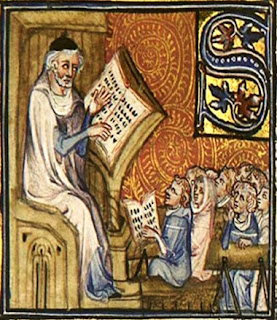
The University of Orleans started in 1230, when several; teachers and students fled the turmoil taking place at the University of Paris. Pope Clement V (1264-1314) studied there, and as pope published a papal bull in 1306, endowing the scholarly pursuits there with the status of university. In all, twelve popes granted it privileges.

In the 1300s it had as many as 5000 students from France, Germany, and even Scotland. Eustache Deschamps was one. St. Ivo of Kemartin, the patron saint of lawyers, was another. Later notables were John Calvin, Pierre de Fermat (of Fermat's Last Theorem fame), and Molière.

The current University of Orleans was founded in 1960. The original had been merged with the University of Paris in 1808.

Speaking of the University of Paris, what was the turmoil that caused teachers and students to flee to Orleans and start teaching there? We'll get into that next time.

10 February 2022

Eustache Deschamps

Somehow, in 770 posts on this blog, I never talked about Eustache Deschamps before. He was an extremely prolific poet who lived from 1346 until 1406/7. Born in northeast France, he studied under Guillaume de Machaut (about whom I have posted). Then, after studying law at Orleans University, he became a diplomatic messenger for King Charles V. He was granted other significant titles and duties during his life, including governor of the the commune Fisme.

Fisme suffered during the Hundred Years War between the English and French, and for this and other reasons Deschamps hated the English, using his poetry to express his feelings.

Deschamps wrote over 1100 ballades. To be fair, ballades were fairly short. The medieval ballade consisted of three eight-line stanzas with a repeating refrain. Most of them are satirical attacks on the English. He had praise for one Englishman though: he wrote one ballade praising Geoffrey Chaucer as a philosopher and poet. Chaucer, in turn, was inspired by Deschamp's one long poem, over 12,000 lines o the subject of women.

He also wrote a treatise on French poetry, in which he outlined the "rules" for different kinds of verse. He also shares his theory about music versus poetry. Music he considers "artificial" because anyone can learn it (it was a major course of study in universities), whereas poetry was "natural" because without being born with the talent for poetry, you would not be any good at it.

At least one line of his you might have heard. He wrote "Friends are relatives you make for yourself."

Next, I want to tell you a little about his university.

09 February 2022

The Gittern


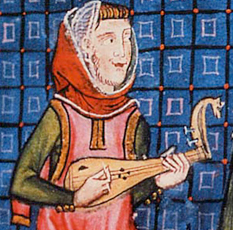
The 14th century French poet Eustache Deschamps said “at royal courts everyone wants to play the trumpet, gittern, and rebebe.” You know what a trumpet is. The rebebe was a bowed instrument. The gittern has been called:

"one of the most important plucked fingerboard instruments of the late medieval period. Loved by all levels of society, it was played by royal appointment, in religious service, in taverns, for singing, for dancing, and in duets with the lute." [link]

The naming of medieval musical instruments was very confusing, with different names for the same instrument and multiple instruments being called by the same name. It didn't help that the same instrument could be of varied construction.

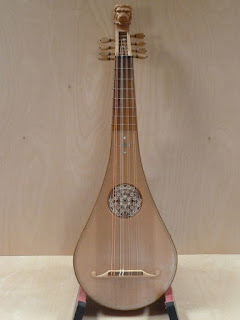
The gittern could have anywhere from two to five gut strings, played with a plectrum made from a quill. It was shaped like a smaller lute with a pear-shaped body. The body and the neck were a single piece of wood, unlike many other stringed instruments.

The popularity of the gittern may have led to its scarcity now. When something is extremely common, it is not always valued properly. In consequence, despite its popularity, we have very few extant gitterns today. You can see one in the Metropolitan Museum of Art, there's one in the Wartburg Castle Museum in Eisenach, Germany. These were the only two known, until one was recognized in a medieval outhouse in Poland.

The image above is of a modern recreation from a maker of musical instruments. If you would like to hear a gittern being played, click here.

But who was Eustache Deschamps, who made such a bold statement about the gittern? I'll gladly talk about him tomorrow.

08 February 2022

A Musician Beheaded

The Peasants Revolt of 1381 was an uprising against...let's say "government overreach." It was not a simple protest, however. The rebel crowds over the course of months murdered officials and damaged buildings, even burning some down, including the most magnificent house in London, the Savoy Palace, residence of the king's uncle, John of Gaunt.

Of course, there would be repercussions. Hundreds and hundreds were involved, but they could not all be identified and incarcerated. Principle actors, however, paid a heavy price. The chief name linked to the Revolt was that of Wat Tyler, who was struck down early on by the Mayor of London, Simon of Sudbury.

One of the few names on a list of those whose involvement was so egregious that they were to be beheaded was John Stakpull, or Stakepoll. Other than this, we really have no clues to the identity of this man; rather, we have some circumstantial clues.

An escheator record (an escheator is in charge of confiscating property on behalf of the Crown) lists the possessions of Stakpull that had been taken after his beheading. Here's the list, and the value of the items in shillings and pence:

1 red gown (3s.6d.)
1 cloak of red and green cloth (8s.)
3 hoods, 1 pair worn-out stockings (2s.6d.)
1 pair worn-out thigh-high boots (8d.)
1 overslop (covering for a chainmail headpiece) (18d.)
1 worn-out earthenware pot (6d.)
1 harp, 1 gittern (12d.)

The overslop is interesting, because it suggests that he had been a soldier. But then, lots of people had been soldiers. No, the curious items are the harp and gittern. These musical instruments, along with the very colorful garments, suggest that he was a minstrel. Could he have been the first protest singer, playing music to rally the rebels? We'll never know.

But let's go in a different direction. You might be assuming that the "gittern" is an old word for a guitar. Not quite. Let us talk about the gittern when next we meet.

07 February 2022

The Peasants Are Revolting!

The Peasant's Revolt of 1381 was the result of several factors , first enumerated and named in A Short History of the English People (John Richard Green, 1874), and analyzed endlessly since. (You can find several posts I've made on this here.) Distrust of government, belief in corruption of royal officials, anxiety over the French raiding southern England, and a poll tax of 12 pence per adult—the third in four years—made the average rural citizen say "Enough!"

The first signs of rebellion came when collectors of the poll tax were attacked in spring. This was followed by more resistance by attacking justices in Essex in May, and then a June uprising in Essex promised to rebel against all the king's laws. People started burning property, and an escheator (official in charge of claiming property for the Crown when, for instance, the previous owner died intestate) was beheaded and his records burned. Elsewhere, houses of officials and official records were being destroyed.

A leader appeared in the records, one Wat Tyler, who led the rioters into Canterbury, executing officials and freeing prisoners, after which they approached London. The group was joined by a radical priest, John Ball, southeast of London. Meanwhile London was experiencing a sympathetic uprising of citizens who burned the grandest house in London, the Savoy Palace, and the main building of the Hospitallers.

The rebels outside London entered, invading the Tower of London. They captured and beheaded the Archbishop of Canterbury, Simon Sudbury, and others.

See my other posts for more detail, but let me say that most of the rebels were given pardons once the destruction stopped, except for the individuals who were responsible for more grievous destruction and murder. A list of "principle leaders and traitors" includes Walter Tyler (who had been killed earlier by the Mayor of London), Alan Threader, William Hawk, and John Stakpull. We know very little about John, but what we know leads to an interesting conjecture. I'll tell you about that next time.

06 February 2022

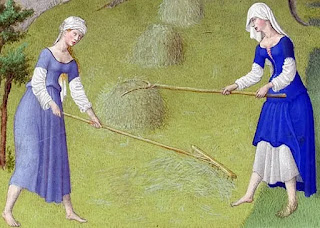
Free vs. Unfree Peasants

A medieval peasant—for this term, we mean an agricultural laborer—could be free or unfree. Although serf would seem to be a useful term (deriving from Latin servus, "slave"), it doesn't appear in written records until the late 15th century. For the difference between free and unfree, I will use the terms freeman and villein.

A freeman was just that: a tenant who was free from owing service to the lord of the manor. He paid rent for the house and land. The percentage of freemen was small, maybe 10% in England.

The greater number of peasants on a manor were villeins, who also rented land and homes, but were obligated to spend time working the lord's fields as well. They were allowed to farm their own land as much or as little as they liked: they would at least try to be self-sufficient, but if they sold goods and made a profit, so much the better. The lord's permission was needed to leave the land and to marry.

Could a freeman become a villein? Imagine a drought or some other natural disaster that caused crop failure, or some destruction by criminals. The freeman could fall on hard times and be unable to pay rent, at which point he could make an arrangement to the lord of the manor, essentially indenturing himself for a period of time. During that time, defaulting on that deal by moving to another manor would be a bad idea.

Could a villein become a freeman? Well, he could run away; if he made his way to a city and survived for a year without being sought and caught, he was automatically free. That was a risky way. He could purchase his way out of bondage, by earning enough from his industry to pay off the lord. Here's the thing, though: when villeins made sufficient money to purchase their freedom, they didn't. The likeliest reason is that their unfree status entitled them to protections that. freeman did not have (see the above paragraph). Being unfree may seem like a burden, but it afforded security in ways that being a freeman did not.

This is not to say that peasants were content to "stay in their lane." In 1381, there was a significant revolt, which we'll talk about tomorrow.

05 February 2022

Feudal Hierarchy

The phrases "feudal system" and "feudalism" were not used in the Middle Ages. They were coined in the 1700s by scholars describing economic systems. The Medieval Latin feodum (whose precise origin is unknown), it was used to refer to a grant of land one xchange for a service. Documents originally used the Latin beneficium, but for some reason that term started being replaced with feodum by the year 1000.

As societies grew more populated and government became less centralized, the feudal system enabled better management of land by "outsourcing" to trusted people. The trustee, or vassal, would pledge to fight for the lord who granted the land, using revenue from the land to furnish military equipment. Feudal customs varied from country to country, but the pledge of military support was common.

The primary vassal didn't work the land himself. A hierarchy evolved over time. Here are several positions of the economic/social strata that existed in English feudalism.

Lord Paramount, or Territorial Lord: the highest role in feudalism; the person who had no loyalty to anyone higher. In England, the king.

Tenant-in-chief: the person who holds his land from the king.

Mesne lord: a person who had vassals under him, but was in turn a vassal of a higher lord but not of the king.

Landed gentry/Gentleman: someone whose grant of land was sufficient to support him in comfort; this person might use the term esquire, but that was a courtesy title and conferred no special status.

Franklins & Yeomen: free men (not tied to the land by contract); they might be thought of as a middle class. Yeomen often were guards for the mesne lord or tenant-in-chief.

Free tenant/Husbandman: peasant farmers who worked the land and paid rent (and a percentage of goods) to the landholder.

Serf/Villein: peasant farmers who were essentially indentured to the landowner and legally forbidden to seek employment elsewhere.

So, if you had a choice to be a free tenant or an unfree serf, which do you think you would choose? There are some records from medieval England that may just shed some light on that topic, which I'll share with you tomorrow.
04 February 2022

Legal Terms

I'll admit: I'm not a lawyer; I don't understand current legal terms (most of which are Latin holdovers from the Middle Ages). I'm fascinated, however, by the legal terms that were used centuries ago. Here's a list, some of which are still used (if not commonly known), that are dealt with in the Treatise of Glanvill.

Curia Regis: the King's court, including administrators and advisers for the king, replaced later when Parliament evolved.

eyre or iter or general eyre: the clue is in the Latin iter, in that this was an itinerary taken by a traveling judge who made a regular circuit to hear cases in different areas. We still use "circuit court."

essoin: an excuse for not appearing in court; the person who takes your excuse to the court on your behalf was the essoineur.

purpresture: we might call this "public nuisance" these days; you could be prosecuted for blocking a thoroughfare or encroaching on someone else's (especially the king's) property.

dower: not "dowry" which was a pre-marriage provision; dower was a provision made by a husband or family for a wife, giving her financial support should she be widowed. In the popular show Downton Abbey, Maggie Smith plays the "Dowager Duchess"; that is, she is a widow who is financially independent because her husband provided for her in the event of his death.

villeinage: the Treatise has an entire section on the rights and treatment of villeins, who were serfs tied to the land they worked; that is, unlike a freeman, they could not pick up and move to another estate to seek work.

In fact, villeinage is a good stopping point here, and a good jumping on point for tomorrow, where I'll give an overview of the strata in the feudal system.

03 February 2022

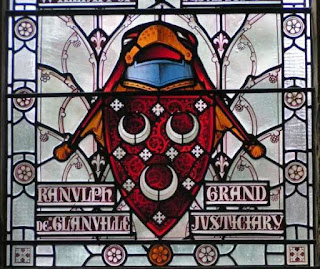
Ranulph Glanvill

Ranulph de Glanvill is the reason I started dailymedieval.com, to pay some attention to the countless people, places, and paraphernalia of the Middle Ages that would never get any attention in the Modern Era, but were of course significant in their time. 

We don't know much now about his early life, except that he was born about 1112 at Stratford St. Andrew in Suffolk. His public activity is first noted as Sheriff of Yorkshire, Warwickshire and Leicestershire until he was removed from office in 1170 along with several other sheriffs for corruption.

Whatever his offense, it did not prevent his re-appointment as Sheriff of Lancashire by 1173, then Sheriff of Westmoreland in 1174. During the Battle of Alnwick in 1174, when William I of Scotland invaded Northumbria, Ranulph was the leader of an English force that met and captured William. King Henry II appreciated this, and later appointed Ranulph Chief Justiciar of England. This sounds like he was made "Chief Justice," but that is not the case. The Chief Justiciar had authority comparable to the modern Prime Minister, as the monarch's chief minister.

As Henry's right-hand man, he was effectively the regent when Henry was absent from the kingdom. He was also entrusted to custody of Eleanor of Aquitaine, when Henry saw fit to confine his queen to Winchester Castle. (There were good reasons for this, which we will someday get to.)

After Henry's death, Richard I imprisoned him until he paid a ransom. Why? A possible reason is that Richard just wanted to raise money to continue his favorite pastimes: fighting and Crusading. Ranulph went on Crusade and died in 1190 at the Siege of Acre. Considering his age, I would not be surprised if Richard coerced Ranulph into "taking the cross."

During his lifetime, he founded two abbeys and a leper hospital. Of course, he also produced the Treatise of Glanvill, discussed in the previous post. Next time, we'll look at some of the medieval legal terms addressed and codified on the Treatise.

02 February 2022

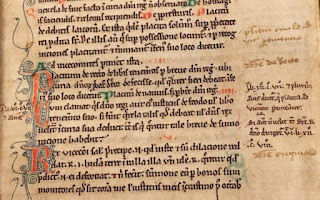
Treatise of Glanvill

The Treatise of Glanvill was the earliest comprehensive treatise on English Law. It's full name is Tractatus de legibus et consuetudinibus regni Angliae ("Treatise on the Laws and Customs of the Kingdom of England"), produced in .

Prior to this, England was managed by a blend of Anglo-Saxon laws and Norman laws. The Treatise codified the laws that were considered most useful, and introduced the innovation of writs.

Writs had existed in Anglo-Saxon law as a brief administrative order—usually a land grant or instructions to a local court—attested to by a seal. After the Norman Invasion, William had writs produced in Latin (rather than Anglo-Saxon), and increased their use to cover more parts of the increasingly complex administrative purview. Henry expanded the use of writs to cover instances of individuals seeking justice. He would hear grievances as his court traveled around the country and have his decisions codified in writs.

One result of this use of writs was limiting the jurisdiction of local courts: a writ from the king superseded all others, except for ecclesiastical courts. Ecclesiastical courts managed decisions regarding marriage, legitimacy, wills, and ecclesiastical issues. Henry seemed to be more focused on any decisions relating to property ownership.

So why was it colloquially called the Treaty of Glanvill? Henry liked to pick capable men to implement his ideas, and Ranulph Glanvill was one of those. I'll tell you about his career tomorrow.

01 February 2022

Regarding Henry

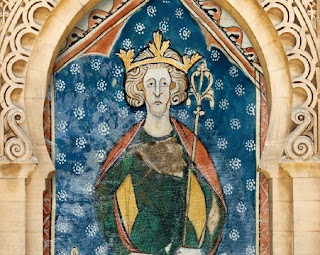
Henry II was king of England from 1154 (when he was 21) until his death in 1189. His mother, Matilda, fought to get the throne of England away from Stephen of Blois, a grandson of William the Conqueror, and arranged what was essentially a military coup that was resolved with a peace treaty in 1153 that agreed to let Henry inherit when Stephen died—which Stephen obligingly did a year later.

Henry was a king of England who did not speak English: he spoke only Latin and French. During his reign, Henry ruled much of England, gained control over Wales, and held substantial land on the continent. He had been named Duke of Normandy (in northwest France) in 1150, and became Duke of Aquitaine (in southwest France) in 1152 upon his marriage to Eleanor of Aquitaine. He also had occasional control over Scotland and Brittany.

He was described as a short, stocky, good-looking redhead, bow-legged from all the horseback riding. He was reported to have great energy, which he applied to (among other things) reforming/standardizing royal law, where previously there had been several variations due to local tradition. His reign resulted in the first comprehensive treatise on English law, the Treatise of Glanvill, which is worth taking a look at...next time.

31 January 2022

Arthur's Grave

In 1184, Glastonbury Abbey was devastated by a fire in the monastic buildings. A new Lady Chapel was consecrated in 1186, after which progress slowed down. Pilgrimages—and the donations they bring—had fallen off.

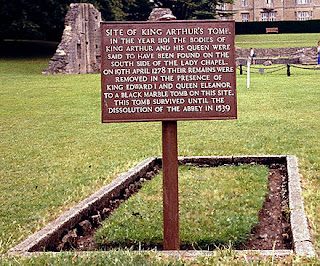
In 1191, however, an excavation on the grounds was undertaken, inspired by (we are told) information passed onto King Henry II from "an aged British bard." The excavation turned up a large flat stone. On the underside of the stone a leaden cross was attached. When the cross was detached, on the side facing the stone they found letters proclaiming Hic jacet sepultus inclitus Rex Arturius in insula Avallonia ["Here lies buried famous King Arthur on the Isle of Avalon"]. Several feet below this was found a large coffin made from oak containing a very large set of bones, along with a smaller set. These were understood to be Arthur and Guinevere.

Well, pilgrimages soared, of course. The relics and lead cross were put in the church; a few eyewitnesses mention them, but they are long vanished now. So...what was it about? Does anyone today really believe that King Arthur's bones were found under Glastonbury? If the king were involved, what was his return on the investment?

Arthur was considered a national hero, and legend said he would return in time of the nation's need. Henry wasn't British: he was the current monarch resulting from the Norman Conquest of Britain. He didn't even speak English. Some have suggested that his involvement was to discourage Welsh nationalism by showing that their legendary king was truly dead and would never return. I believed this for awhile, until I noticed the dates involved.

That idea doesn't quite fit history. The story that Henry had the clue to finding the body comes from Gerald of Wales, a historian writing a few years after the discovery. Interestingly, Henry had died two years prior to the excavation, so Gerald's suggestion that Henry got his information from that anonymous British bard seems spurious to me. It is more likely that the Abbey itself arranged this to increase attention and income.

Henry was a fascinating character in his own right, however, and worth looking at next time.

30 January 2022

Glastonbury Abbey


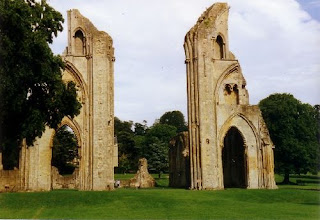
Glastonbury Abbey in Somerset may be the best-known of English abbeys. Originally founded in 712 with the construction of a stone church, it has been rebuilt and expanded many times. One of the expansions was under Dunstan (mentioned here) when he reformed it, expelled all the monks he considered unfit, and instituted the Rule of St. Benedict. It became an important site: King Edmund I was buried there, and an important charter of King Cnut's was disseminated from there.

Legend claims that an abbey was founded there in the 1st centuryCE by Joseph of Arimathea, the New Testament figure who provided the tomb for Jesus. This legend was described by Robert de Boron, a French poet of the late 12th century. His claim was that Joseph brought to Glastonbury 12 disciples as well as the Holy Grail containing drops of Jesus' blood, collected as he suffered on the cross.

For these and other reasons, Glastonbury became prominent as a pilgrimage site and a political power. A fire in 1184 destroyed the monastic buildings. Not wanting for money, reconstruction began right away, but the building of a large church and many buildings takes time. Pilgrimages—and the donations they bring—declined. In 1191, however, a discovery took place during excavation that would bring attention to Glastonbury once again, and shed light on an age-old legend.

But that's a story for tomorrow.

29 January 2022

Elf Shot

Speaking of ailments caused by elves and other supernatural beings, "elf shot" was a concern in the Middle Ages, caused by invisible arrows shot by invisible elves causing sudden shooting pains. I am old enough to have experienced sudden sharp pains in limbs or my side, and I always assume it is simply the ravages of aging, or one of Hamlet's "thousand natural ills that flesh is heir to."

The Middle Ages understood enough about cause and effect to want to ascribe these pains to an external cause, and capricious and malicious elves was the best option. The Old English word aelfsogoða was used to describe internal pain from jaundice, and meant hiccups, also thought to be caused by elves.

The notion of "shot" was supported by archeological evidence; that is, folk in the Middle Ages occasionally found flint arrowheads left over from their neolithic ancestors. These were "evidence" of elf arrows. Dolled up and turned into amulets (see photo), they were worn as charms against witchcraft.

The cure was the concoction described in yesterday's post: feverfew, red nettles, way bread (European plantain); their vaguely spear-shaped leaves would make them suitable to counter an arrow wound.

Concerns about elf shot persisted. A report in 1884 from Orkney attributes the death of a cow from "her heart was riddled with fairy shot."

Going back a couple days...I mentioned St. Æthelwold's time spent at Glastonbury Abbey. It's a fascinating place, and will be the next topic.

28 January 2022

Against a Sudden Stabbing Pain

I want to talk about Wið færstice, an Old English medical text whose title is pronounced (roughly) "with fair-stitch-uh" and means "against a sudden/violent stabbing pain." It is a charm meant to be recited along with the use of a potion to cure a certain kind of pain. The potion was made of feverfew, red nettle, and waybread (plantain). Boil them together, and then boil the result in butter. A knife was dipped into the potion and then applied to the pain.

The 'stice' part of the name of the charm is related to modern "stitch" when we refer to a sudden sharp pain in the side. Scholars do not know if there was a particular cause for the pain; rheumatism or lumbago have been suggested, but in my opinion it was more likely to be what it was called: a sudden sharp pain, the kind that seems to have no particular trigger.

The creators of the text guessed at the source of the pain, and claimed their remedy would help in several cases, according to these lines from the charm.

This for you as a remedy for the shot/pain of ēse;
this for you as a remedy for the shot/pain of ælfe,
this for you as a remedy for the shot/pain of hægtessan; I will help you.

ēse refers to the Æsir, the Norse gods; ælfe refers to elves; hægtessan refers to witches. The Wið færstice was supposedly good for pain caused by any of these supernatural sources. Whether it worked for anyone, we'll never know.

Another term for a sudden stabbing pain with no visible source was "elf shot," which I'll talk more about tomorrow.