26 February 2022

A Book of Fables

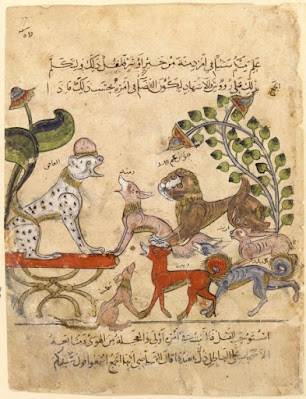
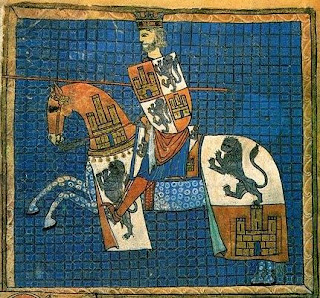
King Alfonso X's son, Fernando de la Cerda, requested that the Toledo School of Translators produce a Castilian version of a Book of Fables, Kalīla wa-Dimna. The book is a series of stories with animals as the main characters; each story has a lesson to be learned, similar to the fables of Aesop.

The title refers to two of its characters who are jackals, the steady Kalīla and the ambitious Dimna. They are door wardens for the king, who is a lion. Oddly enough, Kalīla and Dimna only appear in the first of the 15 stories contained in the collection.

Several of the stories include a king, and their subject matter is usually about the relationship and duty of a king toward his subjects. The introduction to the book claims that it was written for the king of India. It was then called the Panchatantra. When the king of Persia, Khosrow I, heard of the book, he sent his physician to India to make a copy in Pahlavi (Middle Persian).

Copying was not allowed by the king of India, but the physician, Borzuya, was allowed to read it. He read a story each day, and then at night wrote in a journal what he remembered. In this way he brought the fables westward. The Arabic author and translator Ibn al-Muqaffa (died c.756) translated it into Arabic as Kalīla wa-Dimna. It became the first Arabic literary classic. Its popularity led to the publication of a German version by Gutenberg. Today copies can be found in over 100 languages.

The frequent theme of a king's relationship with his subjects places this collection not only into the genre of fables but also into the genre of "Mirrors for Princes," guides to teach proper conduct when one has authority and responsibility.

One more foray into the realm of cultural and linguistic melting pots: next time, we look at Mozarabic culture.

25 February 2022

Toledo School and Language

The previous post refers to John of Seville being the chief translator from Arabic into Castilian; this is an important linguistic distinction.

The Iberian Peninsula at the time contained several different kingdoms. The Toledo School of Translators was in the southern part of Castile. Navarre and Aragon were eastward, and the Catalan Counties further east. Galicia and Leon were westward, and also Portugal (much smaller than it is today). Southward was all Muslim-held. All these territories had their own dialects; not only was there no "Spain," there was no "Spanish." Into this situation stepped King Alfonso X of Castile.

Alfonso (1221-1284CE) was King of Castile, León, and Galicia. His court was a melting pot of Jews, Muslims, and Christians, and he encouraged the translation of scholarly works from Arabic, Hebrew, and Latin into the Castilian vernacular. He wanted more works put into a language that was llanos de entender ("easy to understand") and would therefore reach a wider audience, not just the highly educated. They used a revised version of Castilian that would become the foundation of Spanish.

The method of translation changed as well as the target language. In the first phase of the school, a native speaker would read aloud the work to a translator who would dictate Latin to a scribe. Under Alfonso, a multi-lingual translator would translate from the original language to Castilian, which he would dictate to a scribe. The resulting text would be checked by editors for accuracy. Sometimes, Alfonso himself would proofread the text.

Alfonso of course dealt with other affairs besides scholarship. He had a civil war, for instance, but it's nice to focus on something other than politics in a king's reign. For instance, he organized about 3000 sheep holders into the Mesta to ensure a coordinated supply of wool. Someday I may return to Alfonso, the Mesta, and why it and his other policies were economically disastrous for him. For tomorrow I want to look at the very first translation in Castilian to come out of Alfonso's revised school, a book of fables.


24 February 2022

The Toledo School of Translators

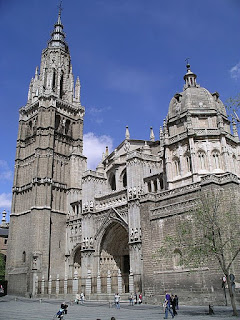
In the beginning of the 12th century, European science lagged behind Arabic scholarship, in many ways because early Greek texts had not made the transition to Western Europe, but were accessible by Arabic scholars in the Eastern Mediterranean, particularly their association with the Byzantine Empire. In the mid 12th century, the Archbishop of Toledo, a French Benedictine named Francis Raymond de Sauvetât (fl.1125-52), established the Toledo School of Translators at the Cathedral of Toledo to correct this lack.

The archbishop assembled a team that included Jewish scholars, Madrasah teachers, Cluniac monks, and Mozarabic Toledans.

The goal was not just to make Arabic learning available to the Latin-speaking west. Arabic texts were translated also into Hebrew and Ladino (Judaeo-Spanish). Examples are works by Maimonides, Ibn Khaldun (considered the originator of studies that would evolve into sociology and economics), and the physician Constantine the African.

The school was well-organized, and as a result we are aware of many of the translators who worked there. Gerard of Cremona was not the only noteworthy translator. John of Seville (fl.1133-53) was one of the chief translators into Castilian, working closely with Dominicus Gundissalinus, the first appointed director of the school.

The importance of Toledo for Western European scholarship cannot be underestimated. The University of Paris was the seat of the Condemnations of Paris: between 1210 and 1277, they were enacted to restrict teaching that were considered heretical. Without Toledo, who knows how long it might have taken for Europe to gain access to so much knowledge?

The school had two chief periods of activity. Tomorrow I'll talk about the second, and the importance of Castilian.

23 February 2022

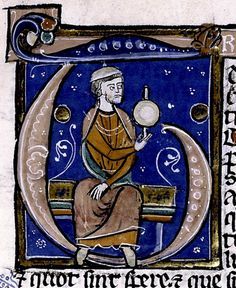
Gerard of Cremona x 2

Gerard of Cremona (1114-1187CE) was an important translator of Arabic texts into Latin. Born in Cremona in northern Italy, he went to Toledo in the Kingdom of Castile because he desired to learn more about Ptolemy. Why did an Italian travel to Spain to learn about a Greek? Because Ptolemy's writings, although the man and his importance were known to Europe, were not available except in Arabic translations from the Greek.

Why Toledo? We'll delve into that more deeply tomorrow. For now, know that Gerard learned Arabic sufficiently that he not only translated Ptolemy's Almagest, the definitive work on astronomy until it was replace by Copernicus, but also he is credited with translating a total of 87 Arabic works.

Many of them were Arabic translations of Greek originals. Gerard's work made available to Latin readers works by Archimedes, Aristotle, Euclid's Elements of Geometry, and Arabic works on algebra and astronomy. He also edited the Tables of Toledo, a compilation of astronomical data.

There was a second Gerard of Cremona, however, and some of the 87 works attributed to Gerard might have been translated by Gerard, if you follow. This second Gerard was working in the 13th century, and seems to be the translator of medical works, whereas the first concentrated on astronomy and science. Roger Bacon's access to Al-Kindi's work, which would have been after 1240, is likely to be due to the second Gerard. Modern scholarship on the work of Gerard points out that many of the words he uses in his Latin translations are still used today; diaphragm, orbit and sagittal are examples. (To be fair, some of the modern scholarship also suggests that his translations look like the work of a hurried graduate student.)

But back to Toledo. In the 12th and 13th centuries, there was a robust Toledo School of Translators. I'll tell you about it tomorrow.

22 February 2022

De Gradibus

De Gradibus (Latin: Concerning degrees) was written by the Father of Arab Philosophy, Al-Kindi (801-873CE). In it, he applies mathematics to medicine, demonstrating a method he invented to determine the proper strength of a drug for a patient. Also, he discusses the degrees of the phases of the moon and how they help a physician to determine the most crucial days of a patient's illness.

When it was translated into Latin, the complex mathematical reasoning made it difficult for Western Europeans to grasp. Roger Bacon appreciated his approach, and endorsed it thusly:

The degree can only be determined by the method taught by Al-Kindi’s De gradibus, one extremely difficult and almost entirely unknown among Latin physicians of these days, as everyone is aware. Whoever wants to become perfect in this philosopher’s art must know the fundamentals of mathematics, because the species of greater and lesser inequality, the species of ratios, and the very difficult rules of fractions are all used by this author.

Plinio Prioreschi, a 20th century expert on the history of medicine, credits Al-Kindi with the earliest attempt to quantify medicine.

Al-Kindi was heavily influenced by noted Greek physician Galen (129-216CE). The stereotype of a Muslim rejecting any non-Muslim source of knowledge is tossed out by Al-Kindi's approach to knowledge. He wrote:

We must not hesitate to recognize the truth and to accept it no matter what is its origin, no matter if it comes to us from the ancients or from foreign people. My purpose is first to write down all that the ancients have left us on a given topic and then, using the Arabic tongue and taking into account the customs of our time and our capacities, to complete what they have not fully expressed.

How did Arabic works come to be available to European scholars. Was it haphazard, or was there a deliberate move to share knowledge. Tomorrow we will learn about Gerard of Cremona, and for a double treat, we will also talk about Gerard of Cremona. (Not a typo.)

21 February 2022

Al-Kindi

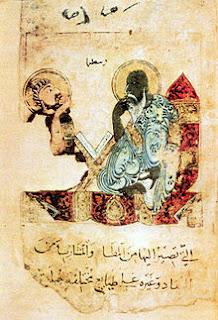
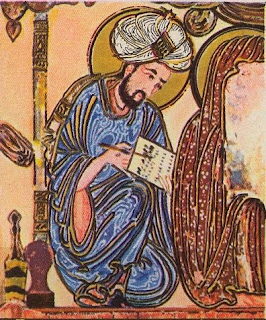
Abu Yūsuf Yaʻqūb ibn ʼIsḥāq aṣ-Ṣabbāḥ al-Kindī (801-873CE) is called the Father of Arab philosophy. Born in Kufa and educated in Baghdad, he was instrumental in the translation of many Greek scholarly texts into Arabic. (Remember that a lot of classical scholarly knowledge came to Western Europe via Arabic translations.) He is also credited with introducing Indian numerals (what we mistakenly think of as Arabic numerals) into the Arab and western world.

He was a polymath who contributed to many fields, although he did not always find the scientific truth.

In astronomy he followed Ptolemy's geocentric theory of the solar system, and he was certain the planets followed circular orbits in obedience to God.

He was a chemist who debunked the idea of alchemy turning base metals into gold or silver. He was the first to distill pure ethanol, with which he created several perfumes. He also created cosmetics and pharmaceuticals, and wrote a book on the chemistry of perfume.

A recently discovered book of his in Istanbul, entitled (in English) A Manuscript on Deciphering Cryptographic Messages shows that he was a pioneer in cryptography with the first known explanation of how to decipher encrypted messages by analyzing the frequency of letters.

He wrote on pollution, environmentalism, and meteorology, and explained tides as a result of heating and cooling.

He published 15 treatise on music theory—five of which have survived—including the first known written use of the term "music" (musiqia); he urged the use of music in therapy.

In optics, he explained that both the eye and the object seen must be linked by a transparent medium (air) filled with light. He criticizes Anthemius of Trailes for reporting that sunlight could be focused in war to cause opposing warships to burst into flame. Anthemius did not witness it himself. Al-Kindi performed experiments to be certain this would actually work.

His theory that time, space, motion, and bodies were not absolutes but relative to other objects and the observer puts him closer to Einstein than to Galileo and Newton.

Although his belief that philosophy could support theology was contested by many Arabic scholars who followed him, his writings laid the groundwork much of Arabic philosophy to come.

He also applied mathematics to pharmacology, which I'll talk about tomorrow.

20 February 2022

Roger Bacon's "Opus Majus"

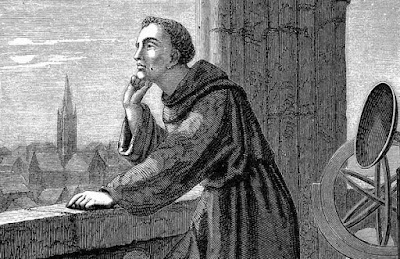
Roger Bacon was born about 1219 into a wealthy family in England. He attended classes at Oxford University, where he learned a love of science from masters such as Robert Grosseteste and Adam Marsh. About 1240 he joined the Franciscans, which might have stifled his interests. There was a prohibition on the order against publishing without special permission from the superiors. This was in place because of a work published previously that was considered heretical.

Bacon looked for support and patronage from the papal legate to England, telling him that educational reform was needed. This was one Gui Foucois, although in England he was known as Cardinal Guy de Foulques. The cardinal was not interested in providing financial aid, but was interested in his work and ideas. Unfortunately, without money, Bacon could not afford the writing materials and scientific equipment to produce what he wanted to send.

Then, in 1265, the situation changed. Guy de Foulques was elected Pope Clement IV. Another request to the new pope returned the same result: Clement wanted the information, but would not send money. Bacon could only assemble a shorter work than he wanted to. The result was the Opus Majus or Opus Maius (Latin: "Greater Work"). Its seven sections (which included some of his earlier writings along with new materials) are:

•The Four General Causes of Human Ignorance (believing in an unreliable source,  sticking to custom, ignorance shared by others, pretending to knowledge)
•The Affinity of Philosophy with Theology (concludes that Holy Scripture is the foundation of all sciences)
•On the Usefulness of Grammar (a study of Latin, Greek, Hebrew, Arabic)
•The Usefulness of Mathematics in Physics (in this section he proposes changes to fix the Julian calendar)
•On the Science of Perspective (the anatomy of the eye and brain; light, vision, reflection and refraction, etc.)
•On Experimental Knowledge (a review of alchemy, gunpowder, and hypothesizes microscopes, telescopes, eyeglasses, machines that fly, and ships driven be steam)
•A Philosophy of Morality (philosophy and ethics)

It was sent to Clement in late 1267 or early 1268; however, Clement died in 1268. We do not know if he even had opportunity to read what he had requested.

"The Science of Perspective" was about optics. In that section, he discussed the anatomy of the eye, and how light is affected by distance, reflection and refraction. He also goes into mirrors and lenses. Most of this knowledge of optics came from Alhazen's Book of Optics, previously discussed here, and Robert Grosseteste's work on optics based on Al-Kindi, of whom I have never written before; I think there's my next topic.

For more on Bacon, use the search feature in the blog.

19 February 2022

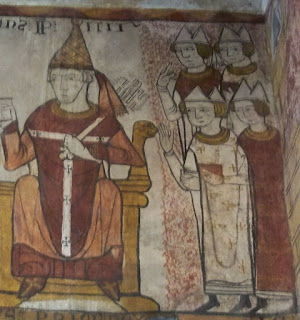
Pope Clement IV

Gui Foucois was born November 1190 in the Languedoc region of France to a lawyer. He became a soldier at the age of 19 to fight the Moors in Spain. Afterward, he studied law in France, and became a secretary to King Louis IX. He married and had two daughters, both of whom became nuns. After his wife's death, he joined the church.

Possibly through the influence of the king—which is not to say he wasn't deserving of promotion—he rose rapidly in the ranks, becoming a pastor in 1255, Bishop of Le Puy in 1257, Archbishop of Narbonne in 1259, and a cardinal in December 1261. He was the papal legate to England 1262-64.

I've said enough about the Disputation of Barcelona in recent posts that there is no need to repeat myself. Among his other actions, he invited the Dominican Thomas Aquinas to Rome in his capacity as a theologian, who founded what in modern times is called the Pontifical University of Saint Thomas Aquinas, whose focus is the philosophy of Aquinas.

In 1267, Clement started corresponding with Abaqa Khan, whose father was a grandson of Genghis Khan. Abaqa was suggesting a Franco-Mongol alliance in order to deal with a common enemy. The Mongol Empire faced conflict with Muslims; Western Europe wanted Christian control of the Holy Land. The alliance made sense, and embassies went back and forth, but there was never any coordination of forces to deal with their mutual Muslim concerns.

Also, Clement died in November 1268. The Throne of St. Peter was empty for the next three years. The College of Cardinals had some argumentative and stubborn men, but rather than address that...

...Roger Bacon, an eminent English philosopher, addressed his Opus Majus to Clement; why, and what it is, will be next.

18 February 2022

Nachmanides

First, let's talk about the name. He was born Moses ben Nachman. He sometimes called himself Ramban, an acronym for Rabbi Moses ben Nachman. Nachmanides is the Greek form of his name, and how he is recognized in western literature. He lived from 1194 - 1270, and lived most of his life  in Catalonia.

He was a scholar, a physician, a philosopher and poet. He began writing commentary on Jewish law at the age of 16. He believed that the rabbis of the Talmud and Mishnah were not to be criticized. He criticized his scholarly predecessor, Maimonides, however. Where Maimonides described any story in the Old Testament where angels appear as a prophetic vision rather than a true angelic visitation on Earth, and tried to explain some of the events in the Bible as naturally occurring, Nachmanides asserted that

no man can share in the Torah of our teacher Moses unless he believes that all our affairs, whether they concern masses or individuals, are miraculously controlled, and that nothing can be attributed to nature or the order of the world.

Previous posts discuss his participation in the Disputation of Barcelona and its outcome. He wrote an account of the debate afterward. Pablo Christiani, his chief opponent in the debate, seized on this account as further proof of blasphemy: he found objectionable passages and went to the head of the Dominicans, Raymond de Penyafort. A charge was brought against Nachmanides, and the complaint was brought before King James. Nachmanides pointed out that his account contained nothing that he had not already said in the presence of the king during the disputation, where the king himself had allowed him to speak freely. His innocence was clear, but the Dominicans wanted results, so Nachmanides was exiled for two years.

An appeal to Pope Clement IV made the exile permanent. Nachmanides, at the age of 70, had to leave his lifelong home. He eventually made his way to Jerusalem, where he reestablished the Jewish community that had been disrupted by the efforts of the First Crusade. He also established a synagogue that is to this day known as the Ramban Synagogue. He died at the age of 76; his burial place is unknown.

This blog has previously discussed Popes Clement I, II, III, V, VI, but never IV, the man who made Ramban's exile permanent. I think I have my topic for tomorrow.

17 February 2022

James I of Aragon

James I of Aragon (2 February 1208 - 27 July 1276) reigned longer than any Iberian monarch. The Iberian Peninsula contained several different political entities; besides being King of Aragon, Count of Barcelona, and Lord of Montpelier, James was eventually also King of Majorca, and even later King of Valencia.

He agreed with Louis of France to not try to reclaim the Catalan lands to the north that France had taken from James' father, Peter II of Aragon; in return, he prevented France from trying to push south into the County of Barcelona.

A great patron of the arts and learning, he wrote (actually, he dictated) the first autobiography of a Christian king, Libre dels fets (Catalan: "Book of Deeds").

In 1263, he presided over the Disputation of Barcelona, a debate on the identity of the Christian Messiah between a converted Jew, Pablo Christiani, and a Jewish rabbi, Nachmanides. On the question "Is the Messiah a divine or human being?" Nachmanides said:

"[... it seems most strange that... ] the Creator of Heaven and Earth resorted to the womb of a certain Jewish lady, grew there for nine months and was born as an infant, and afterwards grew up and was betrayed into the hands of his enemies who sentenced him to death and executed him, and that afterwards... he came to life and returned to his original place. The mind of a Jew, or any other person, simply cannot tolerate these assertions. If you have listened all your life to the priests who have filled your brain and the marrow of your bones with this doctrine, and it has settled into you because of that accustomed habit. [I would argue that if you were hearing these ideas for the first time, now, as a grown adult], you would never have accepted them." [The Disputation at Barcelona. p. 19. ISBN 0-88328-025-6]

Even though Christiani and the Dominicans claimed the victory, James was so impressed with Nachmanides' answers that he gave him 300 gold coins, telling him he had never heard "an unjust cause so nobly defended." James even attended the synagogue in Barcelona on the Sabbath after the Disputation, addressing the congregants, an event likely unique in Medieval Europe.

Rather than have the Talmud destroyed, James ordered the removal of passages that seemed offensive to Christians, creating a commission of the bishop of Barcelona and some Dominicans to oversee the censorship. One of the Dominicans, Ramón Martí (Raymond Martini), did not want the Talmud destroyed, because he claimed many passages in it confirmed the truth of Christianity. But don't think Martini was sympathetic to Judaism: he wrote two anti-Jewish books.

After the Disputation, Nachmanides wrote an account (see the passage above), but this account got him in further trouble. I'll finish talk of disputes and the Talmud with a brief bio of Nachmanides tomorrow.

16 February 2022

Book Burning

The rounding up and burning of the Talmud and other important Jewish works, and the Disputation of Paris, in France in the early 1240s were not the only events of their kind. Western civilization had a tradition of harassing Jews by denying them their sacred and important texts.

Emperor Justinian in 553 forbade Jews to use the Secunda Editio (Latin: "Second Edition"), apparently referring to the Midrashic commentaries on Scripture. Centuries later, Crusaders marching through Germany decided to defend Christianity long before reaching the Holy Land by confiscating Jewish works as they passed through cities, leaving behind them piles of ash.

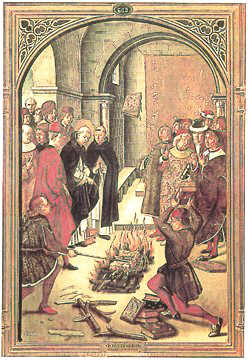
A decade before the Disputation of Paris, a public burning of Maimonidean writings took place in Montpellier France. Like the Disputation, this was started by an "internal" dispute. Solomon ben Abraham of Montpellier was extremely orthodox and was opposed to Moses ben Maimon's philosophy, so he invited Dominican and Franciscan inquisitors to look at the writings of one whom Solomon considered a heretic. The burning took place in December 1233. The inquisitors did not stop there. About a month after the Montpellier event, the Talmud became a target; copies of it and others—an estimated 12,000 volumes—were burning publicly in Paris.

The burning of the Talmud became a common event. Louis IX ordered more confiscations in 1247 and 1248; he produced an ordinance about this in 1254, which was upheld by Philip III in 1284 and Philip IV in 1290 and 1299.

In July 1263, the Disputation of Barcelona took place at the court of King James I of Aragon between another convert from Judaism to Christianity, the Dominican Friar Pablo Christiani, and the leading Jewish scholar Moshe ben Nachman, called Nachmanides. The debate was chiefly on the question "Was Jesus the Messiah?" The Disputation is a play by Hyam Maccoby, based on the Disputation; it was made into a film in 1986 starring Christopher Lee. You can watch it on YouTube.

The Christians claimed victory, but King James gave Nachmanides 300 gold coins, and to explain that, I should next tell you about James of Aragon.

15 February 2022

The Disputation of Paris, Part Two

The Disputation of Paris, a debate between four rabbis and a Jew-turned-Franciscan, began on 12 June 1240. There were 35 charges against the Talmud that the Franciscan, Nicholas Donin, had brought before Pope Gregory IX. Among blasphemous statements about Jesus and Mary, there were passages that supposedly allowed Jews to kill non-Jews, to lie to Christians, and to violate promises without guilt. In France, all copies of the Talmud were confiscated and prepared for burning pending the outcome of the Disputation: if the charges against the Talmud were proven, then the copies were to be destroyed. 

Rabbi Yechiel of Paris headed the defense. In many cases, the charges that Jesus was blasphemed against came from folklore about people named "Jesus" (Yeshu) which was not a unique name. One tale was about a Jesus who was boiled in excrement for all eternity in Hell. Another was of a Yeshu who was executed for sorcery. Yechiel pointed out that these were not the Jesus of the New Testament, and that not everyone named "Louis" was King Louis. Another Jewish folktale suggested that Adam, prior to being given Eve, tried copulating with the animals in Eden.

Although some witnesses believed that the rabbis were successful in their defense, there was little doubt that the Disputation was a formality encouraged by Blanche of Castile, the mother of King Louis IX of France. The Talmud was condemned.

On 17 June 1242, 24 wagon loads containing thousands of volumes of the Talmud and other Jewish works were burned. Since the printing press (as we know it) did not exist, these documents represented countless hours of work to create. The loss was incalculable, and replacement unimaginable.

This was not the last event of its kind. There was another one a generation later that was even turned into a movie with Christopher Lee. I'll talk about that next, and a little more on the history of Christianity's attitude toward Jewish written works.

14 February 2022

The Disputation of Paris, Part One

This blog made a reference to the Disputation of Paris years ago, but never got around to any details. The Disputation was a debate between rabbis in France and a Franciscan friar, Nicholas Donin. How did it come about?

Donin had not always been a Franciscan, or even a Christian. He was a Jew who was excommunicated by Rabbi Yechiel of Paris. Why was he excommunicated? Donin followed Karaite Judaism, which taught that the only true commandments from God were the Torah, and that any additional oral law codified in the Talmud or Midrash was not authoritative. Rabbi Yechiel was a follower of Rabbinic Judaism, who studied and taught and enforced the Talmud.

After living ten years as an excommunicate, Nicholas Donin converted to Christianity and joined the Franciscan Order. Possibly to ingratiate himself to his new community, possibly to strike back at Rabbinic Judaism, he went through the Talmud and found 35 instances that were damaging to the reputations of Jesus and Mary and Christianity. Donin presented these to Pope Gregory IX in 1238. Gregory ordered that all copies of the Talmud were to be seized and examined by the authorities of the Church; if the allegations were found to be true, the Talmuds were to be burned.

Only France cared about the order. Louis IX ordered the four most prominent rabbis in France to dispute Donin's charges in public: Moses of Coucy, Judah of Melon, Samuel ben Solomon of Chateau-Thierry, ... and Rabbi Yechiel of Paris.

This is where Blanche of Castile (from yesterday's post) comes in. She guaranteed the safety of the rabbis, although there were limitations put on what they were allowed to say. The outcome was probably a foregone conclusion, with the copies of the Talmud at stake. I'll tell you what happened tomorrow.

13 February 2022

Blanche of Castile

Blanche of Castile was born on 4 March, 1188, in Palencia in north-central Castile (Spain). Her father was King Alfonso VIII; her mother was Eleanor of England, a daughter of King Henry II. In her lifetime, an attempt to end the endless fighting between England and France over the Duchy of Normandy took place between John of England and Philip II of France. This was the Treaty of le Goulet, and it was sealed with a marriage between Blanche's sister, Urraca, and Philip's son Louis.

Eleanor of Aquitaine, however, decided that Blanche would be more suitable for the marriage. When Blanche was 12 years old, Eleanor took Blanche to France to make the marriage happen. Louis was only 13, and so the marriage would not be consummated until a few years later. Blanche bore her first child in 1205.

Because Blanche had English ancestry through her mother (more specifically, through her grandfather Henry II), her role in the alliance marriage was accepted, and Louis of France was agreed to as the future king of England. King John died in October 1216, however, whereupon his son, nine-year-old Henry, was supported by the barons, who then rejected the idea of Louis inheriting the throne.

Louis' father Philip Augustus refused to support him in another war with England. Blanche decided to raise money for a fleet to send against England to put Louis on the throne. She organized two fleets; neither succeeded, being soundly defeated by English forces.

She only enjoyed three years as Queen of France before Louis died in 1226, leaving Blanche regent for his  12-year-old son, Louis IX. Several French barons did not support the young king, but Blanche appealed to the townspeople of Paris to protect him, which they did. She was instrumental in creating the Treaty of Paris which recognized Louis as king.

She was a highly important figure during her life, never backing down from fighting for what was right (for her).

One event she created which was not for her direct benefit was deciding to treat Jews fairly. She arranged the Disputation of Paris, a debate between Christianity and Judaism, which I will look at tomorrow.

12 February 2022

University of Paris - The Strike

I mentioned yesterday that Orleans University had its start in 1230 with teachers and students who fled from turmoil at the University of Paris. Time to explain the turmoil.

In March 1229, University of Paris students—normally boisterous and given to drinking heavily—were enjoying the pre-Lenten Mardi Gras-like atmosphere (it was Shrove Tuesday and the beginning of Lent). An argument broke out between a band of students and a tavern proprietor over the bill; a fight ensued, resulting in the students being beaten by the townspeople and tossed out.

The students returned the next day, Ash Wednesday, with friends and clubs. They trashed the tavern and beat the taverner. A riot started that damaged nearby shops. The students thought themselves free from punishment, because university students had benefit of clergy. The King's courts couldn't touch them, and the ecclesiastical courts tended to be protective of university students, who were all potential clergy.

The King of France at the time, Louis IX, was only 15 years old. The regent in charge of royal affairs decided the students' crime could not be allowed to go unpunished. The Paris city guard, not known to be gentle toward university students anyway, were given permission to mete out punishment. They found a group of students and killed several. There is no proof that the guardsmen had attacked the actual instigators of the original trouble.

The university went on strike. Teaching ceased. Students left, taking their spending money with them. The economy of Paris suffered. Students and teachers wound up in Reims, Oxford, Toulouse, and some went to Orleans and started teaching there.

In 1231, Pope Gregory IX (an alumnus!) issued a decree that the University of Paris was under papal patronage, making it independent of any local authority. Masters were allowed to cancel classes for almost any provocation; the threat of economic losses kept the city in line.

If the regent had not stepped in, who knows what would have happened? More rioting? Or just moving beyond the incident. No dispersal of university staff and students might have meant no university at Orleans or elsewhere? We will never know. But we do know who the regent was who caused that turning point: Blanche of Castile. I'll tell you about her tomorrow.