12 April 2022

The Dream of a United Italy

Italy was not unified as a country until 1861; before then, the separate regions/cities saw themselves as unique sovereign entities. This led frequently to rivalries that could become wars, but many often looked back to the glory of Rome, when such wars did not happen.

Gian Galeazzo Visconti (16 October 1351 - 3 September 1402) was the first Duke of Milan. He himself made Milan into a duchy in 1395, after being granted the title of duke from Wenceslaus IV of Bohemia (after paying Wenceslaus 100,000 florins).

He was lord of Milan earlier, a position he gained by overthrowing his uncle Bernabò. He did this by faking a religious conversion, inviting Bernabò to a celebratory ceremony, and capturing him; Bernabò was imprisoned, but not for long: his death came in short order, supposedly from poison.

He brought the same ruthless efficiency to conquering Verona, Vicenza, and Padua (he spent 300,000 florins to divert the course of the River Brenta that supplied Padua with water and transportation). He wanted to unite all of northern Italy, re-creating the old Lombardy. Of course, he wanted to unite it under himself, which did not sit well with some city-states such as Bologna and Florence. Still, the hope of a powerful empire on/of Italy inspired poets and politicians. One modern website reports:

Poets talked again of “un solo re,” the King above race and party, who would bring back the Roman peace and turn the cities from their path of fratricidal war; patriots feared the engulfing of those cities within the belly of the Viper.

The hopes and fears were centred upon one man, Giangaleazzo Visconti, Count of Virtue and first Duke of Milan, the greatest of a family that had been climbing to the position of supreme power in Lombardy for over a hundred years. It was said that the Duke had taken the Iron Crown from its safe-keeping and was preparing his coronation robes. [link]

Italy might have done worse. Visconti was more than just a power-mad potentate. He built monasteries and continued the work on the cathedral of Milan. At Visconti Castle he expanded the library's scientific papers and illuminated manuscripts. He may have created the "first modern bureaucracy" in that he established a department for the purpose of improving public health.

Health was to be his undoing. Shortly after subjugating Bologna, and with Florence failing against his attack because of problems with famine and disease, he fell ill to a fever. He died on 3 September 1402. An extraordinary statesman who might have, given another several years, made the peninsula a force to be reckoned with instead of a series of separate states.

But what about the hapless Bernabò? It's easy to see him as just a stepping stone to power for Gian Galeazzo, but there must be more to his story...and there is, including a link to my favorite English poet. This next one may have lots of links to previous posts.

11 April 2022

Kyiv

Kyiv is one of the oldest cities in eastern Europe. Humans lived there since the Stone Age, and from the Iron Age there is evidence of animal husbandry and trading with inhabitants of the Black Sea coast. Roman coins found dating to the 2nd through 4th centuries CE are evidence of wider trading.

The Primary Chronicle, that tells the history of the Kievan Rus peoples from about 850 to 1110, tells the story of four siblings: the brothers Kyiv, Shchek, Khoryv, and their sister Lybid. They founded the city around 485, and named it after Kyi. The family was part of the Khazar Empire, a semi-nomadic Turkic group that was covered parts of Russia, Ukraine including Crimea, and Kazakhstan. The Primary Chronicle has residents of Kyiv saying "there were three brothers Kyi, Shchek, and Khoriv. They founded this town and died, and now we are staying and paying taxes to their relatives the Khazars."

Another tale is that Saint Andrew passed through the area and set up a cross to mark where a church would be built. St. Andrew did not leave a lasting mark, though, since in the Middle Ages St. Michael's image became linked with the city.

There is another saint linked to Kyiv, about whom I wrote years ago. You really need to click this link.

Kyiv was on the trade route between Greece and the Varangians to the north, which helped its prosperity. By the year 1000CE its population was about 45,000, rising to about 100,000 by the beginning of the 12th century. Prosperity made it a target, however. It was attacked in 968 by the nomadic Pechenegs. In 1169, Grand Prince Andrey Bogolyubsky sacked the city and destroyed the royal palace. In 1203 Prince Rurik Rostislavich burned the city. In 1240, the Mongol invasion again destroyed the city. In the 1320s, Grand Duke Gediminas and a Lithuanian army conquered Kyiv. In 1482, Crimean Tatars sacked and burned it again. And then, of course, World Wars I and II took their toll. Through all this, it has survived.

Slava Ukraini.

Tomorrow, as promised, back to Gian Galeazzo Visconti.

10 April 2022

The Ostrogoths, Finally

To be fair, I have mentioned one Ostrogoth before: King Theodoric was talked about here and here. The larger culture of the Goths has been mentioned many times in this blog, but this particular group has been wanting attention. The "Ostrogoths" part of the name comes from Germanic auster meaning "eastern." Before descending on Italy, these "Eastern Goths" built an empire in the 3rd century stretching east to what is now Belarus and Ukraine; "many Ostrogothic graves have been excavated south and southeast of Kiev" [Britannica] It is believed that the difference between Ostrogoths and Visigoths is based on geography, with "Visi-" being tacked on by the Roman scholar/statesman Cassiodorus (mentioned in the first Theodoric link above).

Little is known of the Ostrogoths and Visigoths except through records from the cultures with whom they came in contact, mostly Roman. They left us no literature of their own, although we know they had their own spoken language: a Goth Christian Bishop named Wulfila (or a team working under him) designed a Goth alphabet based on Greek and used it to translate the Bible; I showed their alphabet here. A few additional Goth religious fragments exist. Other Gothic documents such as statements from Theodoric are in Latin.

Isidore of Seville wrote a history of the Goths, in which he tells us that, when they asked the Roman Emperor Valens to send them teachers to instruct them in the Christian faith, Valens (because he had strayed from the truth) sent them heretical priests who instructed them in the Arian heresy. Salvian of Marseilles, a 5th century writer in Gaul concerned with the decline of the Roman Empire, writes in his De gubernatione Dei ("On the government of God") about the vices of the Romans versus the virtues of the "barbarian" Goths. The Arian Goths are praised for the chastity, tolerance toward Catholics.

Sometimes a charismatic ruler is necessary to hold a nation together. When Attila the Hun died and his empire began to fall apart, the Ostrogoths grew in strength, especially under Theodoric, and expanded, eventually into Italy. But after Theodoric died in 526, the Ostrogoth control of Italy started to disintegrate, and the Emperor Justinian in the Eastern Empire saw his chance. He declared war on the Ostrogoths in 535. In the following two decades, much of Italy was damaged in the battles between the two armies. What is certain is that, after 554CE, no more Gothic texts are produced in Italy; the Ostrogoths seem to have lost their national identity.

Although I said I would touch on the Ostrogoths only before taking on the first Duke of Milan, I can hardly pass up the opportunity at this point in modern history to seize the opportunity given me by the Ostrogothic link to Kyiv.

09 April 2022

Mediolanum

In 286CE, the Emperor Diocletian decided that the capital of the Western Roman Empire should be Mediolanum (Milan) instead of Rome, leaving Maximian to rule there while he ruled the Eastern half from Nicomedia. The origin of the name "Mediolanum" is in doubt: a case could be made that it is Latin for the "middle of a plain," but it originally was a Celtic settlement, and so it could come from a Celtic root llan meaning "church."

Whatever the case, the area was rich for farming, vineyards, and raising wool-bearing sheep, so it could support a capital's population and preference for opulence. That environment—as well as its position in the north, just below the Alps—meant it was the best point of attack for invading groups from Europe. Also, Maximian made it a more desirable prize by expanding: monuments, hot baths, palaces and official buildings; he surrounded it with a 4.5 kilometer stone wall.

The Visigoths attacked in 402, prompting then-Emperor Honorius to move official functions south to Ravenna. Half a century later, Attila the Hun overran the city. In 539 the Ostrogoths destroyed Milan during their war with the Empire. A mere 30 years later, the Lombards descended from the origins near the Elbe in Germany, conquered Milan, and settled in, giving their name to the Lombardy region. They surrendered the city to Charlemagne in 774.

There were more ups and downs for Milan in the turbulent centuries that followed, but the 14th century saw relative peace. Near the end of that century, Milan became a dukedom, a center of fashion, and one of the largest cities in Europe. Before I get to the first Duke of Milan, Gian Galeazzo Visconti, and his extraordinary dream of a united Italy, however, I want to talk about a group that was mentioned in the above paragraph for the very first time: the Ostrogoths.

08 April 2022

The Massacre of Thessalonica

The following tale, like much of early history, cannot be confirmed, but it has come down to us as an actual event with actual consequences. During the reign of the Emperor Theodosius (reigned 19 January 379 - 17 January 395), a charioteer tried to rape...someone. It may have been a servant of Butheric, a Roman general. Butheric arrested the charioteer. The general populace demanded the charioteer's release, but Butheric was having none of it. They rose up and lynched Butheric.

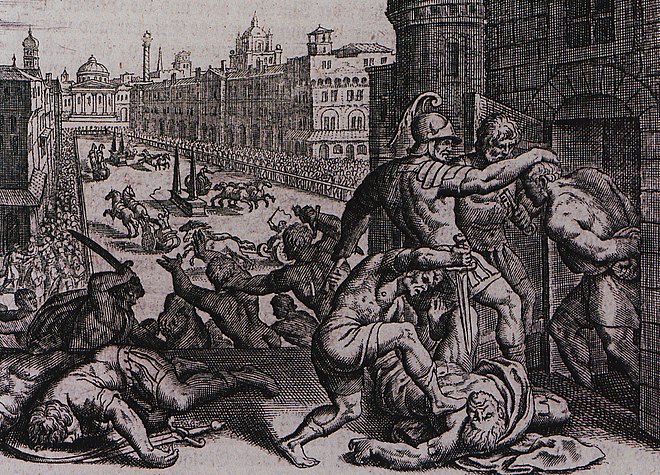
Theodosius decided a lesson had to be learned. When a large number was gathered in the hippodrome in Thessalonica (southeastern part of Illyricum, or northeast part of Greece, if you prefer), Theodosius (or a local officer) set his troops upon them, killing 7000. (See the 16th century engraving of the massacre above.)

Whomever ordered the massacre, Theodosius accepted responsibility for it. Ambrose, the bishop of Milan, was appalled and outraged. He wrote to Theodosius to tell him he would not be able to receive the Eucharist until he repented. Theodosius accepted this, but only after eight months of being stubborn. That is the inspiration for the painting by Rubens of Ambrose denying Theodosius entrance to the church in Milan, displayed in the previous post. (The story was sufficiently popular that van Dyke later painted the same moment in an almost identical manner to Rubens' design.)

There was an earlier clash between Ambrose and Theodosius worth noting. Theodosius' court was not in Rome, but in Milan in northern Italy (hence the Edict of Milan, not Rome). In the 380s, according to one historian [Peter Brown], the need of this northern court for food motivated landowners to oppress and misuse their tenants to produce it. Ambrose opposed what he saw as abuse of the lower classes, speaking out about the need of the rich to care for the poor as was appropriate in a Christian nation. Christianity would not, however, affect politics as much as the Edict of Thessalonica would suggest. According to Brown, "modern scholars link the decline of the Roman empire to the avarice of the rich of this era."

But let's turn from people and politics for a bit and consider a place. A (brief) history of Milan is next.

07 April 2022

Edict of Thessalonica

Although Constantine had called the 1st Council of Nicaea to make sure there was an established orthodoxy for Christianity throughout the empire, the resulting Nicene Creed did not accurately express the beliefs of all Christians. There were still many Arians who viewed Christ's nature as subordinate to God the Father. Constantine's son in the east, Constantius, was an Arian, and even exiled some Nicene bishops. His successor, Julian, rejected Christianity personally, and supported all religions. Julian's successor, the Christian Jovian, reigned for eight months before being succeeded by another Arian, Valens. By 379, when Valens was succeeded by Theodosius I, Arianism was the dominant form of Christianity in the Eastern Empire, while Nicene Christianity was dominant in the West.

Like Constantine, Theodosius wanted to establish a single Christian orthodoxy for the empire, and he issued an edict:

It is our desire that all the various nations which are subject to our Clemency and Moderation, should continue to profess that religion which was delivered to the Romans by the divine Apostle Peter, as it has been preserved by faithful tradition, and which is now professed by the Pontiff Damasus and by Peter, Bishop of Alexandria, a man of apostolic holiness. According to the apostolic teaching and the doctrine of the Gospel, let us believe in the one deity of the Father and of the Son and of the Holy Spirit, in equal majesty and in a holy Trinity. We order the followers of this law to embrace the name of Catholic Christians; but as for the others, since, in our judgment they are foolish madmen, we decree that they shall be branded with the ignominious name of heretics, and shall not presume to give to their conventicles the name of churches. They will suffer in the first place the chastisement of the divine condemnation and in the second the punishment of our authority which in accordance with the will of Heaven we shall decide to inflict.

Note the term "Catholic Christians." "Catholic" means "universal," and was an attempt to stress that everyone should have the exact same beliefs. (Of course, threatening heretics was also supposed to be a powerful motivator.) This edict was released on 27 February 380, and was followed in 381 by the first Council of Constantinople, which slightly revised the Nicene Creed.

Of course, enforcement of the edict was going to be necessary. In 381 there was an edict that forbade heretics from settling in cities, followed in 392 and 394 by laws forbidding heretics from living in Constantinople. In 383, Theodosius ordered all non-Nicene sects to submit written creeds to him for review. He declared them all invalid (Arian, Macedonian, Anomoean), except for the Novatian Creed (their big difference was that they claimed no lapsed Christian who had performed a pagan sacrifice should be allowed back into Christianity; what distinguished them from the Donatists was that Novatians did not submit to Rome, whereas Donatists followed Rome, but felt that some of their fellow clergy were traditors. Also, Donatists were willing to welcome traditors back into the fold with a baptism, whereas Novatians did not believe in second chances. Novatians were declared schismatics, and eventually also labeled heretics and persecuted. They survived until the 8th century.

The illustration on the pages is a painting by Rubens of Theodosius being refused entry to the church in Milan by St. Ambrose. Why this was the case, why Milan was important, and what this has to do with the decline of the Empire, will be next.

06 April 2022

Edict of Milan

The winds of change blew quickly for christians in the Mediterranean in the early 4th century. Emperor Diocletian had persecuted christians pretty successfully—those who gave in and turned over their copies of Scripture were labeled traditors, and opposition to them became the Donates movement—until he retired in 305CE. After 305, the emperor was Gaius Galerius Valerius Maximianus, who continued the Diocletian persecutions until 30 April 311, when he issued the Edict of Toleration, which declared Christianity as a religio licita ("approved religion")

I should mention that, at this time, the Roman Empire was split in half, with an Eastern and a Western Empire. Though they had distinct cultural differences, they endeavored to stay united as an empire. Therefore, it came as no surprise when Licinius, ruler of the Eastern Empire, came to Milan to Constantia, the younger half-sister of Emperor Constantine of the Western Empire. This happy occasion, in February of 313, was ideal for the two imperial personages to spend time together and discuss business along with pleasure.

Constantine had some business to discuss. Several months earlier, on 28 October 312, he had defeated a rival for the throne at the Battle of Milvian Bridge. According to one chronicler, Eusebius of Caesarea (mentioned most recently here), Constantine saw a cross of light above the sun and the Greek words Ἐν Τούτῳ Νίκα ("in this (sign), conquer"; usually given as the Latin in hoc signo vinces, "in this sign you will conquer."

They painted the chi rho, the first two letters of Christ's name, on their shields. Constantine's forces won, and he declared he would convert to Christianity. Full disclosure: he did not convert until he was on his deathbed, according to Eusebius, who cannot always be trusted; he died 22 May 337.

But back to the Edict: Constantine and Licinius issued a joint statement that according to some reports (an actual document does not exist) says:

When we, Constantine Augustus and Licinius Augustus, met so happily at Milan, and considered together all that concerned the interest and security of the State, we decided ... to grant to Christians and to everybody the free power to follow the religion of their choice, in order that all that is divine in the heavens may be favorable and propitious towards all who are placed under our authority.

Emperor Constantine is often described as having made Christianity the official religion of the Roman Empire. This document does not do that. He did try to make sure Christianity was uniform and understandable, so in 325CE he called the first Council of Nicaea which established the Nicene Creed as opposed to Arianism. Also, his mother did all she could to promote Christianity. It would be another 43 years before Christianity pushed out the Roman religion, but that's a story for tomorrow.

05 April 2022

The Council of Arles

No religious group has ever stayed uniform in its beliefs and practices, and in the first few centuries of the Common Era, the burgeoning Christian religion was no different. Every couple of generations there were synods (Greek sunodos; "meeting"), gathering to determine and approve proper practices and policies.

The first Council of Arles was convened in 314CE. I mentioned this recently regarding Donatism, but there was more to discuss than that.

Besides declaring Donatism heresy and excommunicating Donatus Magnus, they determined that those who truly were traditors by turning their holy books over to persecutors would be deposed, but their official acts would not be declared invalid.

The Council also determined:

The date of Easter should be held on the same day throughout the Christian world, not on a day set by each individual church.

Ordaining a priest required the approval and cooperation of at least three bishops. Clergy must live in the parish they were supposed to manage.

Actors, and those who participated in gladiatorial combat and races in the arena, should be excommunicated

This was all started right after the Edict of Milan, when everything changed for the early Christian Church. We'll get to that tomorrow.

04 April 2022

Donatism Aftermath

Although Donatus Magnus' appeal at the Council of Arles failed, and he was exiled to Gaul until his death, Donatism did not die out. After all, it had become the dominant church in parts of North Africa. Rome and a succession of popes would have liked to bring the Donarists of North Africa back "into the fold," but there was opposition.

Donatism also had its own internal problems, some of which came from the Circumcellions. The name was derived from Latin circum cellas euntes ("those going around larders") The larder in this case referred to a cool place for food storage, from which we get the word "cellar." The meaning behind the label was because the Circumcellions lived off of food from others whom they tried to convert to their cause. The called themselves Agonistici ("fighters" [for Christ]). They first appeared in 317 from the lower strata of society, fiercely anti-Roman and desiring social reform.

A bishop in Numidia, Optatus, remembered for his writing against Donatism, said that in 340 they started attacking officials such as creditors and landlords. Those killed during the violence were considered martyrs. In fact, martyrdom became the primary Christian virtue, as opposed to chastity, charity, humility, etc. In fact, they would sometimes attack Roman legionnaires with wooden clubs, knowing they were outmatched, so that they could be martyred. 

Augustine of Hippo (pictured here) spoke out against them, writing:
And those men also belong to this same heresy [i.e.of the Donatists] in Africa who are called circumcelliones, a rough and primitive type of men most notorious for their outrages—not just for the savage crimes that they perpetrate against others, but also because in their insane fury they do not spare even themselves. For they are accustomed to killing themselves by various kinds of deaths, but especially by throwing themselves off heights, by drowning, or byself-immolation. And they seduce others whom they can, of either sex, to join them in this same mad behavior.
They would also disrupt courts of law to produce the same outcome. The punishment for contempt of court was, in fact, execution. The Donatists did not necessarily want the alliance mentioned by Augustine.

Right up through the 15th and 16th centuries, attempts at church reform that declared priests in the wrong were slammed with accusation of the heresy of Donatism, including John Wycliffe and Jan Hus.

I want to get back to the Council of Arles in which Donatism was rejected a second time. It was the first of many at Arles, and dealt with much more than Donatism. Stay tuned.

03 April 2022

The Donatists

In Northern Africa, specifically the area we now call Algeria, a Berber Christian bishop created one of the first schisms in the Catholic Church. I'm talking about Donatus Magnus, who died around 355CE.

Christians in the Roman Empire were persecuted prior to Emperor Constantine (274-337CE). Many church leaders turned over their scriptures and paraphernalia instead of defying imperial writ. These traitors to the faith were labeled traditors (literally "surrenderers").

Donatus was adamant that services or sacraments performed by traditors were invalid, and that they needed to be re-baptized into the faith if they intended to act like clergy again. If they were not re-baptized, then those they baptized would not truly be members of the Church.

(A lot of names coming at you:) The real trouble began when Bishop Felix of Aptungi consecrated Caecilian as Bishop of Carthage and Primate of North Africa. There was a rumor that Felix had become a traditor, though the people of Carthage knew he was not. The Primate of Numidia, however, held a council that declared Caecilian to be invalid. That council then consecrated Majorinus as bishop. Majorinus died soon after, and Donatus Magnus in 313 was consecrated Bishop of Carthage and Primate of North Africa.

Now there were two Bishops of Carthage and Primates of North Africa. Each of them went on to consecrate bishops, ordain priests, baptize people and deliver sacraments, and soon there were cities with two bishops, one under Caecilian, and one in communion with Donatus. The Donatist group appealed to the Emperor, who wanted nothing to do with it and passed it to Pope Miltiades, who was of Berber descent and therefore linked to the people of North Africa.

Miltiades summoned each to a council in October 313. The Donatist arguments against Caecilian were brushed off, so the Donatists stormed out. Miltiades then affirmed Caecilian. The Donatists appealed to the Emperor again, but the Council of Arles in 314 again ruled against them. This started a trend of Donatist-leaning clergy to declare anyone they did not like a traditor and therefore invalid as priests.

Donatus continued to preach his cause and fight against Rome, with no major success, but it didn't die out easily. Tomorrow we'll look at how it survived for more than a millennium.

02 April 2022

The Berbers

They call themselves the Amazigh, but history knows them as Berbers, who inhabited northwestern Africa since at least 10,000BCE. The etymological origin of "Berber" is problematic. The obvious guess is that it comes from the Greek βάρβαρος ("barbaros"), used by the Greeks to refer to any non-Greek speaking people. One scholar thinks instead it's from the Bavares, a tribe known to exist in Mauretania from the 3rd to 5th century CE.

The historian Ibn Khaldun shared two popular theories of the origin of the Berbers. One was that they were descended from Canaan, son of Ham, son of Noah. Either that or they were descended from another son of Ham, Keloudjm.

As Muslims moved westward across northern Africa, Arabization had a profound effect on Berber culture: tribal practices were replaced with Islam. During the 12th century, Christian and Jewish communities became marginalized, although Jews continued to exist as dhimmis, protected peoples. 

Prior to the influence of Islam, however, most Berber groups were either Christian or Jewish or Animist. One of the most famous of early Christian fathers, St. Augustine of Hippo, was from a Berber family. On the other hand, so possibly was Arius, an early heretic. Another Berber who created an approach to Christianity that did not suit the mainstream was the heretic Donatus Magnus. Let's dabble in heresy next time.

01 April 2022

The Laffer Curve


That is an odd headline (and topic) for a blog on the Middle Ages, but let's push on and see where we wind up. The Laffer Curve (named for Arthur Laffer, illustrates a "a supposed relationship between economic activity and the rate of taxation which suggests that there is an optimum tax rate which maximizes tax revenue." [New Oxford American Dictionary] Arthur Laffer acknowledged that Ibn Khaldun essentially defined what we now call the Laffer Curve in his best-known book, Al-Muqaddimah ("Introduction").

We know quite a bit about Ibn Khaldun (27 May 1332 - 17 March 1406) because he wrote an autobiography. Born to a wealthy Arabic family, he was able to trace his ancestry back to the time of Mohammed. He had a classical Islamic education, memorized the Koran, and studied law and Arab linguistics. He also learned mathematics, logic, and philosophy. While in his teenage years, both parents died in the first big wave of the Black Death.

He started his political career at the age of 20 in Tunisia, producing fine calligraphy on official documents, but shortly after moved to Fez as a writer of royal proclamations. There he fell out with the sultan while scheming to advance himself and went to jail for 22 months. After getting out, he was not getting the attention he felt he deserved in terms of jobs, and decided to move to Granada. The Sultan of Granada gave him a diplomatic mission to King Pedro the Cruel of Castile, which Ibn Khaldun carried out successfully. Eventually getting involved in too much political intrigue, he left for Ifriqiya, where the current sultan had been Khaldun's cellmate! The sultan made Khaldun his prime minister. In 1366, that sultan died, and Khaldun allied himself with a different sultan, who was defeated a few years later, upon which Khaldun decided a monastic life was best. He continued to get involved in politics, however, always finding ways to anger someone.

Regarding his works, Al-Muqaddimah was the first part of a seven-volume work that included a world history up to his time. The socio-economic-geographical approach to describing empires is considered by 19th and 20th century scholars as the first ever writing in the social sciences. Khaldun explains that there is a group solidarity that enables small groups to grow in power, and yet become their own worst enemy and eventually fall from power and be overcome by another tightly knit group. He had similarly ahead-of-his-time ideas about economics.

I will leave the discussion of Ibn Khaldun (for now at least) with one more thing: his apt description of government as "an institution which prevents injustice other than such as it commits itself."

A large part of his historical work involves the Berbers, and I will talk about them in the next post.

31 March 2022

Ifriqiya

Along the Mediterranean coast of Northern Africa was an area controlled by the Roman Empire called the Africa Proconsularis. When the Empire broke up, the Byzantine Eastern Empire still controlled the territory until the Muslim Empire started its westward move, ultimately reaching the Iberian Peninsula.

To be clear, Islam existed in the area already, but Muslims did not have political control until the Umayyads took over in 703CE. Ifriqiya included modern Tunisia, eastern Algeria, and western Libya (shown here in red).

Control shifted from dynasty to dynasty: from Umayyads to the Aghlabids (who were regents for the Abbasids) to the Fatimids in 909, to their own regents, the Zirids, who slowly grew in power, then to the Almohads and finally the Hafsids. The capital city was Kairouan, or al-Qayrawān, founded in 670 by the Umayyads. It became an intellectual and cultural center for Sunni Islamic scholarship. Charlemagne sent envoys to Kairouan; they returned with reports of the amazing palaces and gardens, not to mention reports of the heavy taxation of the population that paid for the excesses of the ruling class.

Several mosques in Africa are the result of Muslim influence spreading out and southward from Ifriqiya. Swahili absorbs vocabulary from many languages, most recently English, but 16-20% of its vocabulary still is from Arabic, especially administrative terms.

Notable individuals from Ifriqiya include Constantine the African (mentioned in a recent post), and the historian Ibn Khaldun, who would be worth taking a closer look at in the next post.

30 March 2022

The Book of Pee

One of the medical texts composed by Isaac Israeli ben Solomon was translated from Arabic to Latin and called De Urinis ("Concerning Urine"). One manuscript copy (Ms. 690) in the University of Utrecht Library shows signs of frequent use, and yet has survived for 800 years with its original binding, showing extreme care being taken by any of its owners.

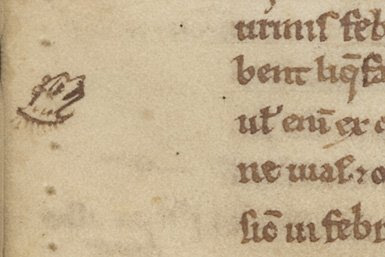
De Urinis was not one of the books translated at Toledo; the Latin version that was used in the Middle Ages was translated by Constantine the African, a Benedictine monk and physician who spent the first part of his life in Ifriqiya, then brought Isaac's work and others from Tunisia to his retirement at the Benedictine Abbey of Monte Casino. Unfortunately, Constantine often did not include in his translation the name of the original author, leading many to think that he himself wrote the medical texts. It took other references to these works to be able to affix the proper author's name. (The illustration here shows a dog's head added to the margin by a bored copyist.)

There are ten sections to De Urinis, as follows:

  1. The science of uroscopy, placing it in context of the four temperaments*, particularly in relation to the blood;
  2. The importance of nocturnal urine;
  3. Types of urine in relation to pathology;
  4. Urine as humor-discharging fluid;
  5. Types of urine by colour;
  6. The state of the body judging by its colour;
  7. Types of urine based on clarity and viscosity;
  8. Sediment in relation to pathology;
  9. Types of urine in coherence with sediment;
  10. Different types of urine and sediments and their meaning.
According to the Utrecht summary of the manuscript:

This text influenced islamic medicine to a great extent (where uroscopy was of great importance) and contributed to the rise of uroscopy as one of the most important branches of medicine in the Middle Ages (Prioreschi 2001). Ms. 690 is a remarkably early witness of this.

If you would like to see the manuscript in digital form, click here.

This is the second post in a row that mentions Ifriqiya, which sounds like "Africa" and should be addressed. I shall do so next.

*Referring to the four humors whose proportions determined a human being's temperament and health: yellow bile, black bile, phlegm, and blood.

29 March 2022

Isaac Israeli ben Solomon

Some of the works translated at Toledo by our old friend Gerard of Cremona were the Book of Definitions and the Book of Elements into Latin from Arabic. Written by Isaac Israeli ben Solomon (alias Isaac Israeli the Elder, alias Isaac Judaeus), sometimes known as Isaac the Jew, they and his other works became standard works in medicine at Salerno.

Isaac Israeli ben Solomon was born in Egypt around 832CE. Growing up in Cairo, he became known as a skilled oculist (illustration is from an Arabic manuscript on oculism, showing the parts of the eye). About 904CE he was made court physician to Emir Ziyadat Allah III of Ifriqya (and I really should talk about him and there in the near future). A few years later he traveled to Kairouan, Tunisia and studied under a famous Arab physician, then became the doctor to 'Ubaid Allah al-Mahdi, who founded the Fatimid dynasty. al-Mahdi found Israel charming and witty.

In Kairouan he started writing his treatises, which were considered "more valuable than gems," and giving popular lectures on medicine and other topics in science. All his treatises were written in Arabic. Besides the ones mentioned above, they also include The Book on Fevers, a work on food and remedies called Universal Diet, and more. He also wrote books on philosophy, metaphysics, logic, a commentary on Genesis, and a treatise on the difference between the spirit and the soul. The Latin translations of many of these were quoted by Albertus Magnus, Aquinas, Roger Bacon, Nicholas of Cusa, and others.

Next I want to delve into one of his works specifically. I don't think I've ever indulged in what they call "dad jokes," but let me just say "urine for a treat."